






Anthropic và OpenAI tự tay cắt đứt logic của cổ phiếu và tiền mã hóa trước khi niêm yết


- Quan điểm cốt lõi: Anthropic và OpenAI lần lượt tuyên bố không công nhận các giao dịch chuyển nhượng cổ phiếu chưa được Hội đồng quản trị phê duyệt (bao gồm cả việc nắm giữ gián tiếp thông qua SPV), khiến thị trường token cổ phiếu trước khi niêm yết sụt giảm mạnh, phơi bày rủi ro pháp lý của các loại token này, và có thể dẫn đến làn sóng "xóa bỏ bong bóng" trong ngành.
- Các yếu tố then chốt:
- Cả Anthropic và OpenAI đều tuyên bố, việc chuyển nhượng cổ phiếu khi chưa có sự đồng ý của Hội đồng quản trị là vô hiệu, không công nhận quyền cổ đông của bên mua, và nghiêm cấm rõ ràng việc SPV (Công ty có mục đích đặc biệt) mua lại cổ phần của họ.
- Các token cổ phiếu trước niêm yết hiện có trên thị trường (như ANTHROPIC, OPENAI trên Prestock) phần lớn dựa trên cấu trúc SPV, giá trị của chúng phụ thuộc vào tính hiệu lực của cổ phiếu gốc do SPV nắm giữ; việc công ty không công nhận có thể khiến giá trị token về không.
- Cấu trúc "búp bê Nga" của SPV làm tăng rủi ro: Tính minh bạch pháp lý của các lớp lồng ghép thấp, phí quản lý ăn mòn lợi nhuận qua từng lớp, và bất kỳ lớp cổ phần nào bị tuyên bố vô hiệu cũng sẽ phá vỡ toàn bộ chuỗi giá trị.
- Phản ứng thị trường dữ dội: Token ANTHROPIC giảm 20,62% trong một ngày xuống còn 1082 USD, token OPENAI giảm mạnh 26,82% xuống còn 1440 USD, các nhà đầu tư hoảng loạn vì rủi ro xác nhận quyền sở hữu.
- Các sản phẩm hợp đồng trước niêm yết (không nắm giữ cổ phiếu thật, chỉ đặt cược vào giá IPO) ít bị ảnh hưởng hơn vì chúng dựa vào sự biến động giá chứ không phải sự hỗ trợ từ cổ phiếu.
- Quan điểm trong ngành phân hóa: Một bên cho rằng việc các công ty hàng đầu chặn SPV sẽ chấm dứt logic của các token trước niêm yết; bên kia cho rằng các nhà đầu tư đáng lẽ phải chịu rủi ro giao dịch từ các kênh không chính thức.
- Sự kiện này được xem như một bài học rủi ro cho các nhà đầu cơ, giúp vạch ra ranh giới và "xóa bỏ bong bóng" cho thị trường token cổ phiếu trước niêm yết vốn đang phát triển mất kiểm soát.
Original: Odaily Planet Daily (@OdailyChina)
Author: Azuma (@azuma_eth)

The pre-IPO stock token market has just experienced a violent shock. The epicenter of this earthquake came from statements by two AI giants, Anthropic and OpenAI.
Anthropic and OpenAI Both "Refuse to Acknowledge" Unauthorized Transfers
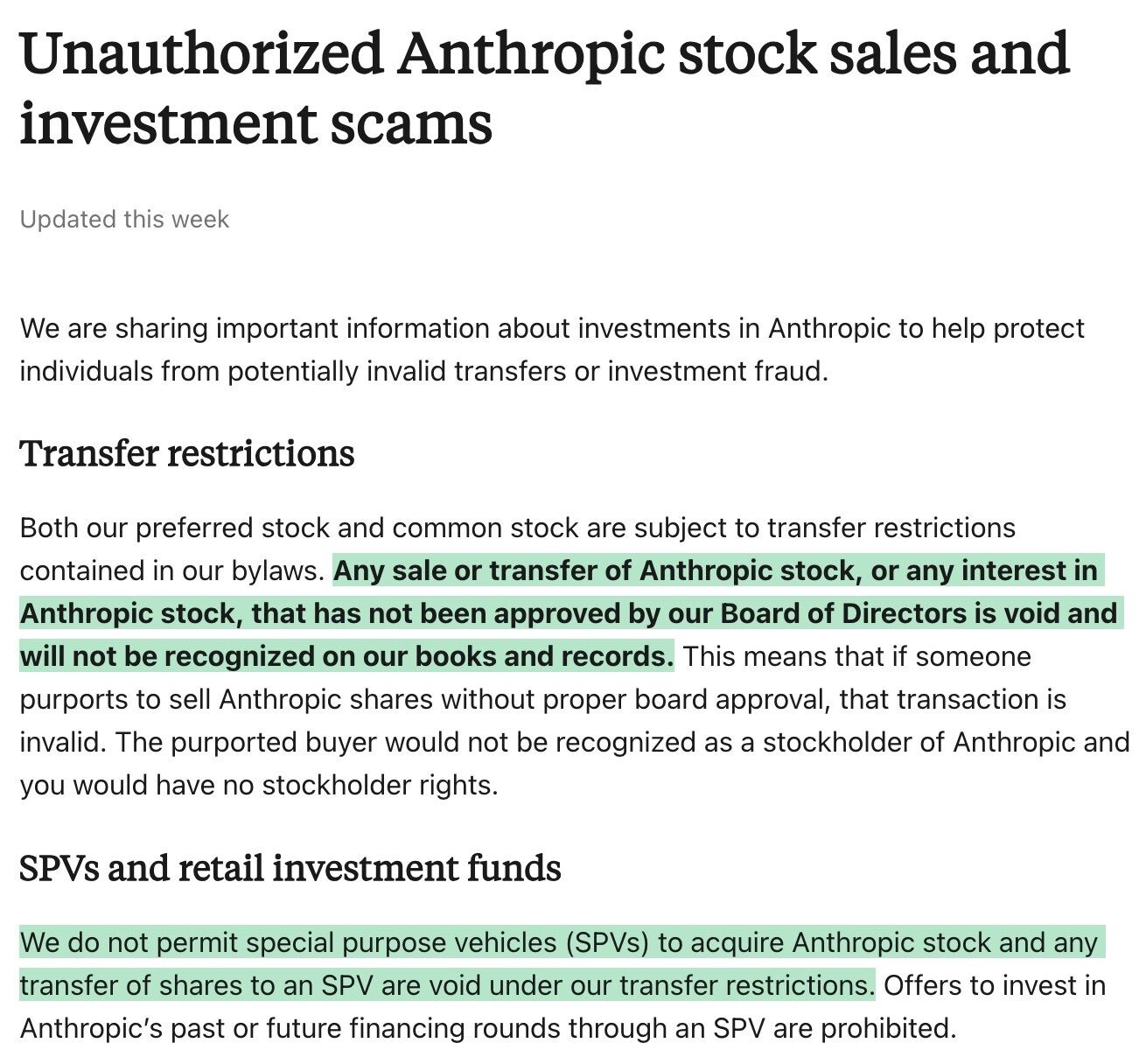
Today, Anthropic updated an official statement from February titled "Unauthorized Anthropic Stock Sales and Investment Scams".
In the article, Anthropic explicitly states: "Any sale or transfer of Anthropic stock, or disposition of any interest in Anthropic stock, that is not approved by our board of directors is void (note the use of the word 'void'), and will not be recognized on the company's books and records. This means that if someone sells Anthropic stock without prior board approval, the transaction will be deemed invalid. The so-called buyer will not be recognized as a shareholder of Anthropic and will not have any shareholder rights."
Shortly after Anthropic's updated statement, OpenAI also released a notice stating: "All equity is subject to transfer restrictions. No shares may be transferred, directly or indirectly, without the company's written consent. Any sale made without such consent is not only unauthorized but also void."
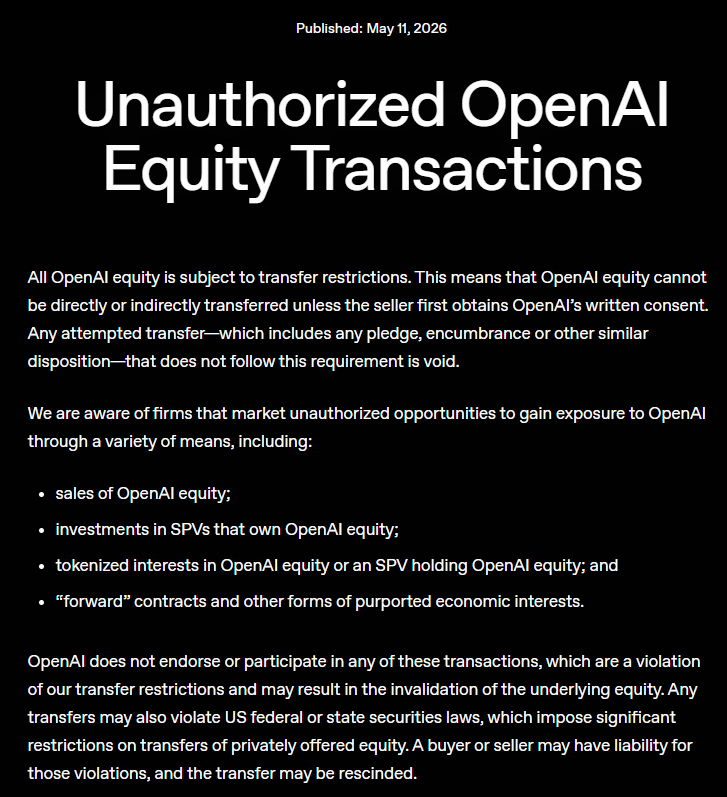
In their announcements, both Anthropic and OpenAI explained that the company's preferred and common stock are subject to transfer restrictions stipulated in the articles of incorporation, thus all stock transfers require board approval.
Anthropic further emphasized that the company also does not permit "Special Purpose Vehicles" (SPVs) to acquire Anthropic shares, and any transfer of shares to an SPV violates the company's transfer restrictions... Some investment funds may claim to offer indirect access to invest in Anthropic stock, but these funds are likely attempting to circumvent the transfer restrictions. Therefore, any third party claiming to offer Anthropic stock to the public – whether through direct sales, forward contracts, stock tokens, or other mechanisms – may be engaging in fraud, or may be offering worthless investments due to Anthropic's transfer restrictions.
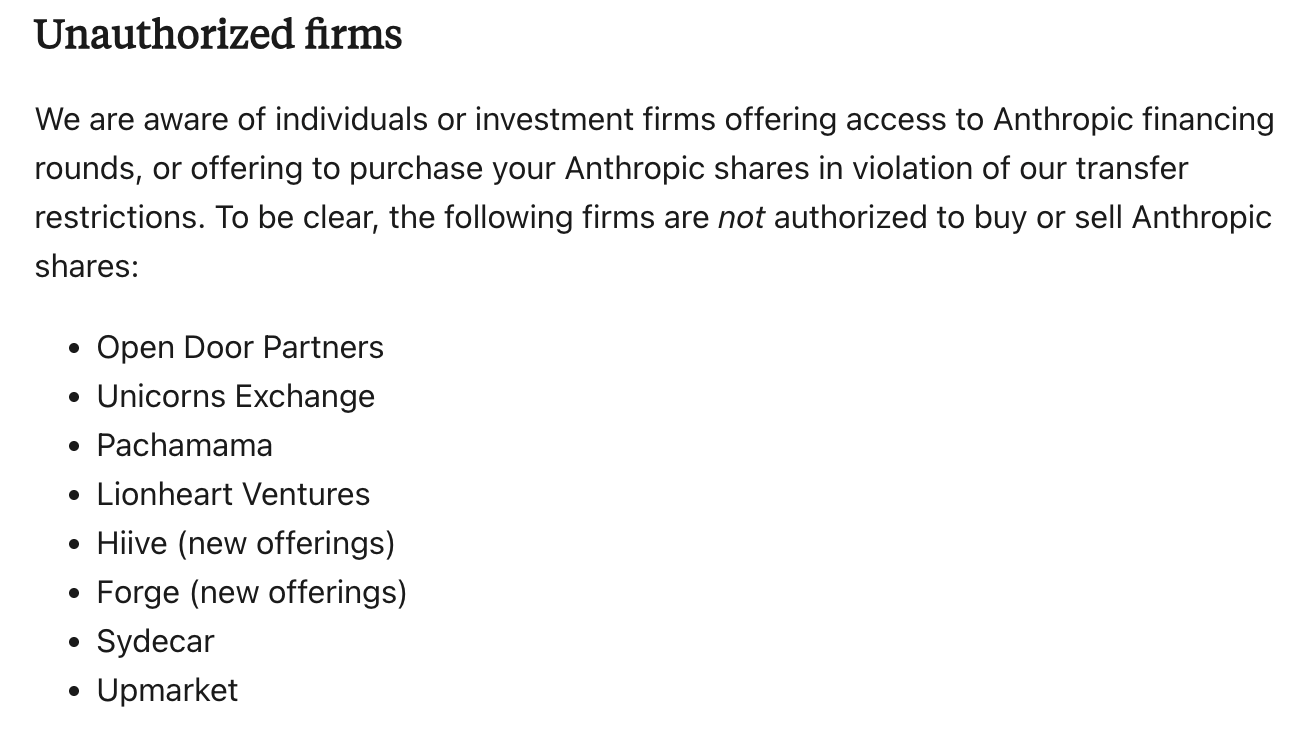
- Note: The image shows unauthorized equity transfer platforms named by Anthropic.
What is an SPV?
To understand why this update had such a massive impact on the pre-IPO stock token market, one must first understand what an SPV is.
In traditional pre-IPO stock trading, directly transferring original shares is extremely difficult, limited not only by company charters but also involving complex legal procedures. Against this backdrop, SPVs emerged.
An SPV is a separate legal entity created for a specific transaction or investment purpose. It can be understood as a "shell company specifically used to hold an asset" – Multiple investors can contribute capital to the same SPV, indirectly holding shares of a company or a class of assets, thereby achieving centralized holdings, lowering entry barriers, and optimizing legal and tax structures. SPVs are particularly common in popular pre-IPO stock trading. Since many prominent companies are often unwilling to directly bring in a large number of small shareholders, institutions typically first establish an SPV, which then uniformly invests in the target company.
For example, what the market calls "early participation in Anthropic or OpenAI share subscription" essentially involves investors first contributing capital to an SPV, which then uniformly acquires the unlisted equity of Anthropic.
Currently, most pre-IPO stock token platforms on the market (like Prestock) use the SPV structure.
- The platform or its partners register an SPV in a certain jurisdiction. The sole task of this SPV is to buy Anthropic's original shares on the secondary market (usually from employees or early investors);
- The platform then issues derivative tokens on-chain (e.g., ANTHROPIC or OPENAI). These tokens are legally defined as "claims on the economic benefits of this SPV";
- Theoretically, these tokens are pegged 1:1 to the original shares. For every 1 token issued, the off-chain SPV should hold the corresponding share of stock.
However, the problem now is that Anthropic and OpenAI have clearly stated they "do not recognize unauthorized stock transfers." This means that if a certain SPV transfers stock without board approval (which is almost impossible to obtain), the stock held by that SPV could be considered void in the eyes of Anthropic and OpenAI – if the stock held by the SPV is invalid, then the "economic benefits" targeted by the on-chain tokens become worthless.
The "Matryoshka" Risk of SPVs
The main reason Anthropic and OpenAI are so resistant to SPVs is that as their companies' pre-IPO stock tokens are continuously hyped (Anthropic's pre-IPO valuation once soared to $1.4 trillion, far exceeding its last funding round valuation), the risks of SPVs being over-financialized have begun to emerge.
Among these, the most noteworthy issue is the "Matryoshka doll" problem of SPVs – Many investors buying pre-IPO stock tokens think they are buying company shares, but in reality, they only hold a claim on the economic benefits of a certain SPV. More alarmingly, many SPVs do not directly hold Anthropic's original shares but are nested two to three layers deep within other SPVs.
This "nested doll" structure is actually very dangerous.
- Legal Transparency Issues: With each additional layer, the authenticity of the underlying asset becomes more unclear. It is very difficult for investors to confirm whether the bottom-layer SPV actually obtained the company board's transfer approval.
- Management Fee Exploitation: Each layer of SPV charges management fees, performance fees, and dividends. After peeling away these layers, the investor's actual returns are severely diluted.
- Risk of Going to Zero: If the equity transfer at any single layer is deemed "void" by Anthropic, the entire value chain can collapse instantly.
For reasons of reputation and investor protection, Anthropic and OpenAI clearly do not want to see this situation.
Pre-IPO Stock Tokens Plummet, Contracts Remain Relatively Stable
Once the announcements from Anthropic and OpenAI gained traction, the market reacted immediately.
On PreStocks, ANTHROPIC experienced a sharp drop, briefly falling below $1000 before settling at $1082 as of 12:00, a single-day drop of 20.62%; OPENAI was trading at $1440, a single-day drop of 26.82%.
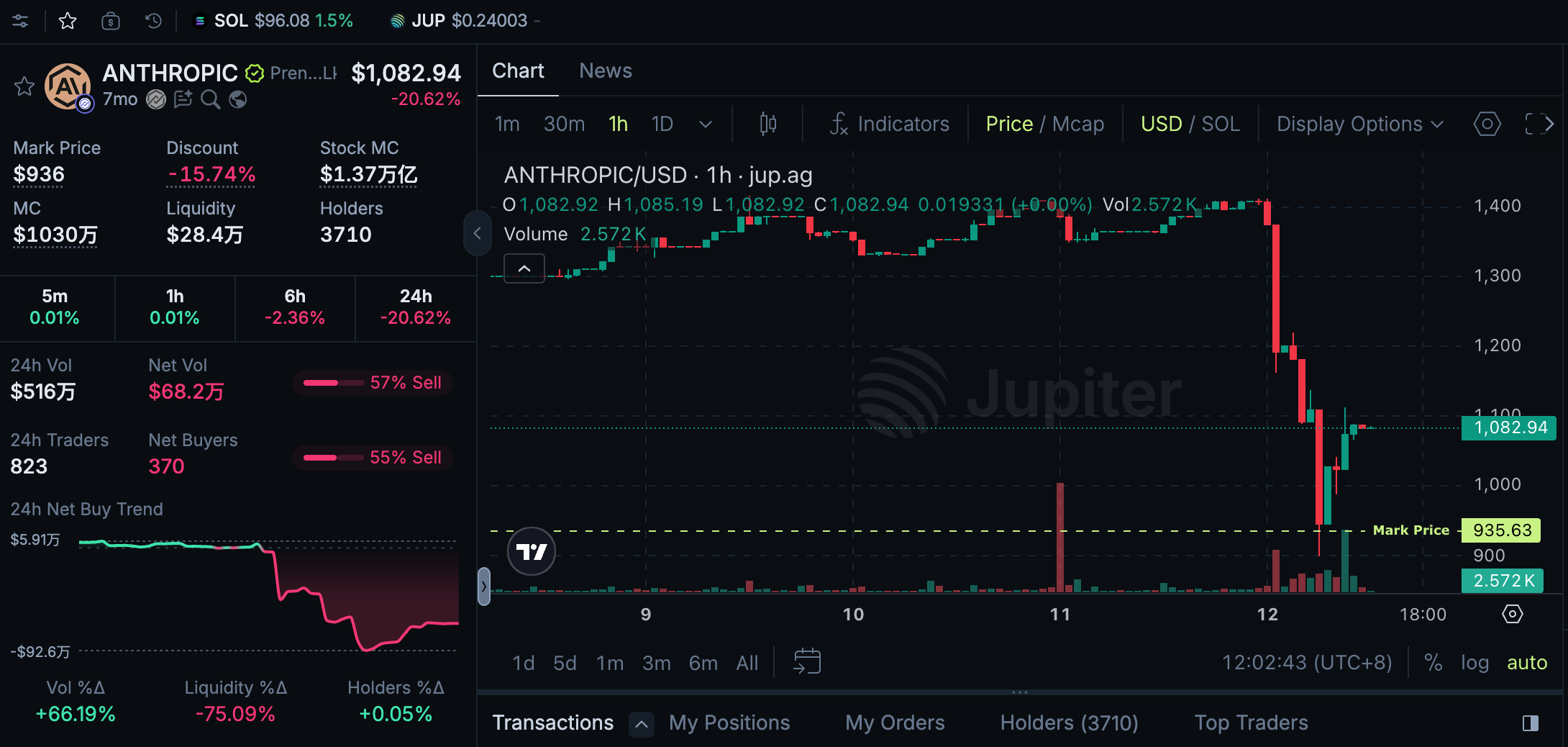
Investor panic is easy to understand. Since Anthropic and OpenAI explicitly stated they do not recognize unauthorized shareholdings, the "equity" behind these tokens has a probability of becoming "worthless paper," and holders may face huge confirmation risks and legal litigation costs.
Interestingly, while pre-IPO stock tokens came under pressure, another type of pre-IPO stock trading product performed relatively stably – pre-IPO contracts that rely entirely on bilateral market speculation. The reason for this is that such products essentially do not hold any real stock. The restrictions imposed by Anthropic and OpenAI have no impact on them; they are merely "two-sided bets" on the future IPO price, relying on price negotiation between buyers and sellers.
Future Trend Predictions
In response to the "non-recognition" stance of Anthropic and OpenAI, two distinct voices have emerged within the industry.
Some believe the logic of pre-IPO stock token trading is dead. If top-tier giants like Anthropic and OpenAI take the lead in cracking down on SPVs, other major companies may follow suit. With the backing of equity being shaken, it is doubtful whether so-called pre-IPO stock tokens still hold value.
However, others, including Rivet founder Nick Abouzeid, argue that this is not a big deal, and trading pre-IPO stock tokens through unofficial channels has always been a gamble; buyers should have had the awareness from day one that "the company might not recognize it." – You lack a direct investment opportunity, and obtaining that opportunity through other means always entails a certain degree of risk.
In summary, as the premium on pre-IPO stock tokens continues to expand and market sentiment grows increasingly fervent, the statements from Anthropic and OpenAI have undoubtedly poured cold water on the entire track.
In the past few months, more and more investors have begun to view pre-IPO stock tokens as a "low-barrier channel to participate in the growth of top AI companies." The valuations of some AI-concept pre-IPO stock tokens have clearly detached from reality, even leading to frenzied speculation far exceeding the valuation of their last funding rounds. Against this backdrop, Anthropic and OpenAI's public "crackdown" is, to some extent, redefining the boundaries of this wild, burgeoning market.
For speculators, this is a lesson in risk; but for the long-term development of the industry, the market perhaps also needed such a moment of "de-bubbling."


