Năng lượng khủng hoảng đang đến gần, Mỹ đang thua trong cuộc chiến Iran


- Quan điểm cốt lõi: Bài viết dẫn lời tuyên bố đầu hàng của Robert Kagan trên tờ The Atlantic, chỉ ra rằng thất bại chiến lược của Mỹ tại Iran không phải là một thất bại cục bộ trên chiến trường, mà là sự mất mát căn bản về an ninh năng lượng toàn cầu và quyền kiểm soát trật tự Vịnh Ba Tư. Việc đóng cửa eo biển Hormuz đánh dấu sự thay thế của hệ thống "tự do hàng hải" bằng "chế độ cấp phép", Mỹ bất lực trong việc mở lại eo biển, gây ra cuộc khủng hoảng năng lượng toàn cầu và sự tái cấu trúc trật tự.
- Các yếu tố then chốt:
- Xác nhận thất bại chiến lược: Robert Kagan, người từ lâu đã bảo vệ các can thiệp quân sự của Mỹ, thừa nhận Mỹ đã phải chịu một thất bại mang tính quyết định "không thể bù đắp cũng không thể phớt lờ" tại Iran, về bản chất hoàn toàn khác với các cuộc chiến tranh Việt Nam và Afghanistan.
- Eo biển Hormuz bị kiểm soát: Iran đóng cửa eo biển và thiết lập chế độ cấp phép đi lại, khoảng 20% lượng dầu vận chuyển bằng đường biển toàn cầu bị chặn lại. "Dự án Tự do" của Hải quân Mỹ chỉ hộ tống hai tàu thương mại mỗi tuần, thấp hơn nhiều so với mức trung bình 130 tàu mỗi ngày trước chiến tranh.
- Khủng hoảng năng lượng toàn cầu lan rộng: Sri Lanka áp dụng chế độ phân phối nhiên liệu, Pakistan thực hiện chế độ làm việc bốn ngày một tuần, Ấn Độ chỉ còn dự trữ đủ 6-10 ngày, Nhật Bản lần thứ hai giải phóng kho dự trữ chiến lược, nhiều quốc gia áp dụng các biện pháp như giảm thuế, hạn chế đi lại, trợ cấp.
- Khả năng quân sự và kho dự trữ cạn kiệt: Sau chỉ vài tuần giao tranh với Iran, một "cường quốc hạng hai", kho vũ khí của Mỹ đã xuống mức nguy hiểm, không thể mở lại eo biển một cách hiệu quả, các đồng minh từ chối tiếp nhận nhiệm vụ.
- Cấu trúc an ninh Vịnh Ba Tư sụp đổ: Các quốc gia vùng Vịnh như Ả Rập Xê Út, UAE đã chứng kiến tận mắt sự bất lực của Mỹ trong việc bảo vệ các tuyến đường hàng hải, đang chuyển hướng thỏa hiệp với Iran. Cam kết an ninh của Mỹ bị chứng minh là sai lầm, và thế giới bắt đầu tái cấu trúc dựa trên thực tế này.
- Lừa dối chính sách và hậu quả: Cuộc chiến được ngụy trang thành một "chiến thắng chớp nhoáng", nhưng những người ra quyết định đã phớt lờ các cảnh báo của quân đội (bao gồm dự đoán của Hội đồng Tham mưu trưởng Liên quân về việc đóng cửa eo biển). Người phải trả giá là những người dân thường phụ thuộc vào chuỗi cung ứng, như chủ xe chạy xăng, chủ doanh nghiệp nhỏ và người tiêu dùng lương thực.
Original title: Trump Has Officially Lost The War In Iran And The Great Energy Collapse Of 2026 Is Coming.
Original author: Dean Blundell
Translation by: Peggy
Editor's note: When a military operation originally packaged as a "quick victory" evolves into a prolonged blockade of the Strait of Hormuz, rising global energy prices, and countries initiating fuel rationing and strategic reserve releases, the consequences of war no longer remain on the battlefield but penetrate the underlying system of the global economy.
Using Robert Kagan's article in The Atlantic as a starting point, this piece points to a symbolic turning point: a man who has long provided strategic justification for U.S. military intervention now has to admit that America's confrontation with Iran is not a local setback but a deeper strategic defeat. What the author truly wants to discuss is not simply whether the U.S. won a war, but whether it still has the capacity to underwrite global energy security, Gulf order, and its alliance system.
What deserves more attention is not whether the Strait of Hormuz will reopen in the short term, but that the global trust structure built around this strait has been rewritten. In the past, the U.S. maintained "freedom of navigation" through naval power and security commitments; now, the author argues, this mechanism is being replaced by a new "licensing system," with the licensing authority shifting to Tehran. Gulf states are re-evaluating their relationships with Iran, allies are questioning the effectiveness of U.S. promises, and energy-importing nations are responding to the new reality through rationing, reserves, alternative imports, and price controls.
The sharpness of the article lies in connecting military defeat, the energy crisis, and domestic political deception on a single chain of understanding: war is not an isolated event but the accumulated result of years of strategic arrogance, policy misjudgment, and political theater. When decision-makers treat war as a victory narrative on television screens, those who truly bear the cost are the people lining up at gas stations, small businesses dependent on diesel transport, food systems pressured by rising fertilizer prices, and ordinary people relying on global supply chains to live.
When the U.S. cannot reopen an energy lifeline it has long promised to protect, the global order begins to reprice itself around this fact. The cost of war will gradually shift from sentences in strategic reports to numbers on everyone's bills.
Below is the original text:
On Saturday, Robert Kagan published an article in The Atlantic titled "Checkmate in Iran."
Yes, the same co-founder of the Project for the New American Century, the husband of Victoria Nuland, the brother of Frederick Kagan, and the "court philosopher" for every U.S. war over the past thirty years.
In the article, he wrote that the U.S. experienced "a complete defeat in a conflict, a defeat so decisive that this strategic loss can neither be remedied nor ignored."
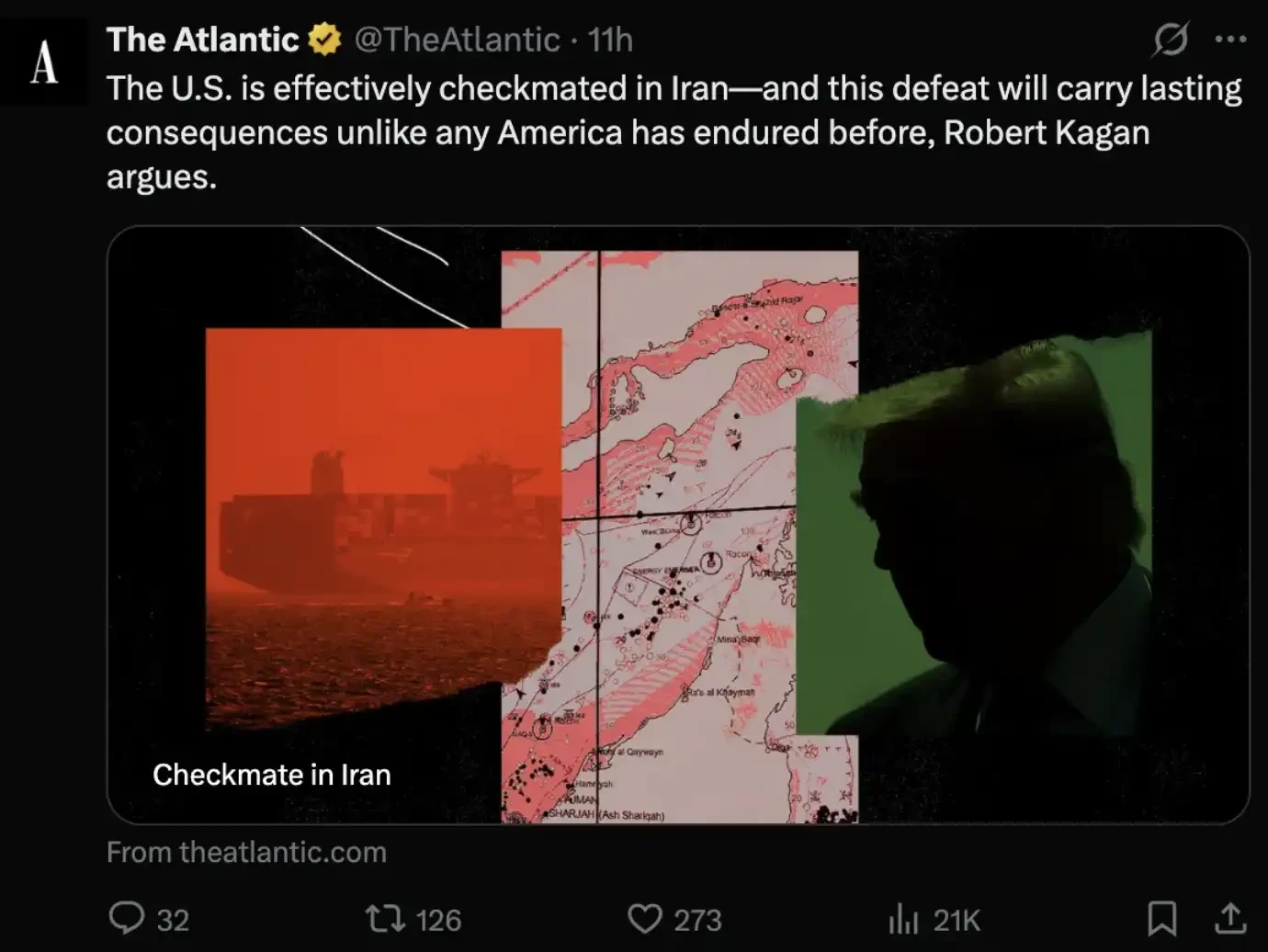
This is not an ordinary critic, but a man who has long provided strategic arguments for hardliners like Dick Cheney; this is not an ordinary media outlet, but a magazine that has nearly packaged every U.S. military intervention as a "strategic necessity."
But now, it is they who are telling readers, in a language they would have once dismissed as "defeatist" or even "unpatriotic," that the U.S. has just lost. Not a battle, not a military operation, but its position in the global order.
If Ronald McDonald starts saying hamburgers are bad, the problem is truly serious.
What should make every American stop and think is this: while Kagan is writing his post-mortem on the editorial page of The Atlantic, the real world—the world of gas stations, supermarkets, refineries, and shipping costs—is already suffering the consequences.
Sri Lanka has begun rationing fuel via QR codes; Pakistan has implemented a four-day workweek; India's strategic petroleum reserve is down to just 6 to 10 days; South Korea has implemented odd-even driving restrictions; Japan is conducting its second emergency reserve release this year. And in the U.S., a country whose Defense Secretary publicly declared in February that Iran would "surrender or be destroyed," gasoline prices are rising, and the Strategic Petroleum Reserve is being included in the largest coordinated release action in IEA history.
This is the reality of a "war of choice": the choice is made by a group of people willing to burn their own country to manipulate markets and satisfy fragile egos.
Let's break this down step by step.
I. Trump told you this war would be over in a weekend
Go back in time—not too far, as it was only 70 days ago—to February 28, 2026.
That night, the Trump administration, in coordination with Israel, launched "Operation Epic Fury." It was a combined air and sea strike. Within 72 hours, Iran's Supreme Leader was killed, its navy was destroyed, its defense industrial base was largely paralyzed, and an entire generation of its military leadership was decimated.
Before the smoke had cleared, Trump announced "Peace Through Strength" on Truth Social. Then Pete Hegseth—the man who now insists on calling himself "Secretary of War" and seems unable to resist role-playing at press conferences—took the Pentagon podium and, with his characteristic bluster and near-total lack of analytical depth, declared that Iran had "no defense industry and no replenishment capability."
But he missed a key detail. What Iran needed to do next didn't require a defense industry. It just needed a map.
On March 4th, six days after Hegseth declared the war won, the Islamic Revolutionary Guard Corps announced the closure of the Strait of Hormuz. Not "impeded traffic," not "restricted waterways," but closed. According to Iran, "not one liter of oil" would pass without permission from Tehran. Any vessel attempting to pass that was "linked to the U.S., Israel, or their allies" would be considered a "legitimate target."
Within 48 hours, war risk insurance premiums quintupled. Within 72 hours, the AIS transponders of numerous large oil tankers around the world were turned off. The Strait, which normally handles about 20% of the world's seaborne oil and a significant portion of its LNG, fell into effective silence.
To be fair, the Joint Chiefs of Staff had warned Trump. According to multiple reports, during the pre-Operation Epic Fury briefing, the military explicitly cautioned that Iran's most likely countermeasure was closing the Strait of Hormuz.
Trump's response, in essence, was that Iran would "surrender"; if they didn't, "we'll just open the Strait again."
But reality is, the U.S. didn't reopen it. The U.S. cannot reopen it.
That sentence is the core of the entire story.
II. What Kagan really admitted, and what he still can't say
The most noteworthy aspect of Kagan's article is not what it predicts, but what it admits.
If you strip away the usual jargon of strategic circles and the rhetorical packaging typical of The Atlantic, what remains is a confession. More bluntly, he admits the following:
First, this is not Vietnam, nor Afghanistan. According to Kagan, those wars "did not cause lasting damage to America's overall position in the world." But this time, he states unequivocally that its nature is "completely different," and its consequences are "neither repairable nor ignorable."
Second, Iran will not give back the Strait of Hormuz. Not "not this year," not "not unless negotiations fail," but simply no. As Kagan says, Iran can now "not only demand tolls but also restrict passage for countries not on good terms with it."
In other words, the "freedom of navigation" regime that has underpinned the global oil order since the Carter Doctrine—the core premise justifying the U.S. military presence in the Persian Gulf for 40 years—is over. What emerges is a new licensing system, with the licensing authority now in Tehran's hands.
Third, the Gulf monarchies must compromise with Iran. Kagan writes: "The U.S. will prove itself to be nothing but a paper tiger, forcing Gulf and other Arab states to make concessions to Iran."
Translated more directly: every Saudi and Emirati royal who has seen with their own eyes that the U.S. cannot protect refineries and shipping lanes is now on the phone with Tehran, negotiating new arrangements. In other words, the security architecture the U.S. spent half a century building in the Gulf is collapsing in real-time.
Fourth, the U.S. Navy cannot reopen the Strait. This point deserves careful attention, as it is the most explosive admission in the entire article. Kagan writes: "If the U.S., with its powerful navy, cannot or will not open the Strait, then no coalition with a fraction of its capability can possibly do so."
German Defense Minister Boris Pistorius said almost the same thing in a blunter way: what exactly does Trump expect a few European frigates to do that the mighty U.S. Navy cannot?
This sentence can almost be read as an obituary. The U.S. asks its allies to clean up its mess, and the allies ask back: with what?
Fifth, U.S. weapons stockpiles are nearly depleted. Kagan writes: "Just a few weeks of war with a second-rate power"—note, the term "second-rate power" comes from a man who has long supported regime change narratives—"has depleted U.S. weapons stockpiles to dangerously low levels, with no quick remedy in sight."
If you are sitting in Taipei, Seoul, or Warsaw reading this passage from The Atlantic, you will not feel safer; you will only feel significantly less safe.
Sixth, allied trust is damaged, U.S. security guarantees are falsified, and the assessments of China and Russia are vindicated. Kagan barely says this directly—he can't, at least not so bluntly in The Atlantic—but this conclusion is hidden behind every sentence he writes, like a body under the floorboards.
Of course, what he truly can't say is: how did the U.S. get to this point?
Because he himself is one of the people who brought the U.S. here. He, his wife, his brother, every signatory to every Project for the New American Century open letter since 1997, every think tank researcher who has spent the last 25 years continually framing Iran as America's indispensable enemy—all are part of this process.
In his article, there is not a trace of self-reflection. Not a single moment acknowledging that perhaps 30 years of maximum pressure forged the very opponent now capable of backing the U.S. into a corner.
The smoke is everywhere, and the arsonist is still wondering why the air smells like burning.
So, what is his proposed solution?
You'll want to laugh first, but then you won't be able to.
The answer: a larger war. Specifically, he advocates for "launching a full-scale ground and naval war to overthrow the current Iranian regime and occupy Iran."
A man who just wrote 4,000 words explaining that the U.S. Navy cannot reopen a 21-mile-wide waterway against an opponent he calls a "second-rate power" concludes by recommending invading and occupying a country of 90 million people, sitting on some of the most defensible mountainous terrain in West Asia.
The arsonist's solution to putting out a fire is to start a bigger one.
III. Meanwhile, in the real world: the global oil crisis unfolds country by country
Strategic analysis is one thing. Strategists can finish writing their articles, walk to a café on a Washington street corner, order a flat white, and not have to think about where the diesel came from for the truck that delivered the milk.
But the rest of the people on Earth are now calculating the costs. And the calculation doesn't look good.
As of this morning, the global situation is this:
· Sri Lanka has entered a nationwide fuel rationing state. Each vehicle receives an allocation via QR code, and schools and universities have also implemented energy-saving measures. This is not a prediction; it is an already realized reality.
· Pakistan has implemented a four-day workweek in both the public and private sectors. Markets close early, and remote work is being widely promoted to reduce commuting needs.
· India's strategic petroleum reserve is down to about 6 to 10 days. While total system stocks are around 60 days, panic buying is rapidly increasing, and the government is scrambling for emergency import sources. More and more crude oil is coming from Russia, which is obviously happy to supply it.
· South Korea has implemented mandatory odd-even driving restrictions for the public sector, voluntary measures for others with price cap incentives. It has also imposed a five-month export ban on naphtha.
· Japan is conducting its second large-scale emergency strategic reserve release this year. The first was in March. Now, Japan has started tapping into its 230-day buffer reserve previously declared to the IEA.
· The UK is in price shock mode. The government has introduced targeted aid for households using heating oil, windfall tax legislation is back on the agenda, and anti-price gouging enforcement has been launched.
· Germany has extended gasoline and diesel tax cuts and introduced employer-provided fuel subsidies.
· France has introduced targeted fuel discounts and accelerated the distribution of energy vouchers to high-mileage drivers, transport workers, fishermen, and agricultural sectors.
· South Africa has significantly cut fuel taxes, but queues at gas stations continue.
· Türkiye has reduced its special consumption tax on fuel.
· Brazil has abolished diesel taxes and provides direct subsidies to producers and importers.
· Australia has halved the fuel excise tax, launched a nationwide "Every Little Bit Helps" energy-saving campaign, and offered business support loans to industries hit by fuel price shocks.
· The U.S. is participating in the largest coordinated strategic reserve release in IEA history, totaling 400 million barrels. Meanwhile, several states have implemented gasoline tax cuts, and the federal government is publicly considering a nationwide policy.
· China, the world's largest crude oil importer, is responding in its classic crisis mode: pull up the drawbridge. Massive domestic reserves are being preserved, refined product exports are banned, and domestic price controls are tightening further. At the same time, it is quietly buying up every discounted spot cargo of Russian and Venezuelan crude it can find. Because of course it is.
And all this is happening even as the IEA has already activated a historically large coordinated release.
Please read the next part carefully, because from here on, it's no longer just numbers on a chart; it enters daily life.
Eric Nuttall, an energy analyst at Ninepoint Partners, recently told Bloomberg—based on the transcript I saw—that his core judgment is: "We're not talking about months or quarters from now. Within weeks, you will have to curb demand by a magnitude greater than during COVID."
According to his description—not my summary—this could be "the largest energy crisis in modern history." And rationing, especially demand-side rationing of a kind the U.S. has barely seen since 1973, may be "only weeks away."
Weeks. Not months, not an abstract medium-term, but weeks.
You should now look at the car in your driveway with completely different eyes.
IV. Why this won't "solve itself"
I want to pause here because American readers might easily interpret this as a temporary disruption.
They will instinctively think that some combination of events will end things within the next news cycle: Iran "blinks" and surrenders; Trump finds a face-saving off-ramp; Saudi Arabia opens its taps; or the U.S. Navy finally "takes action."
But this won't happen, for the following reasons.
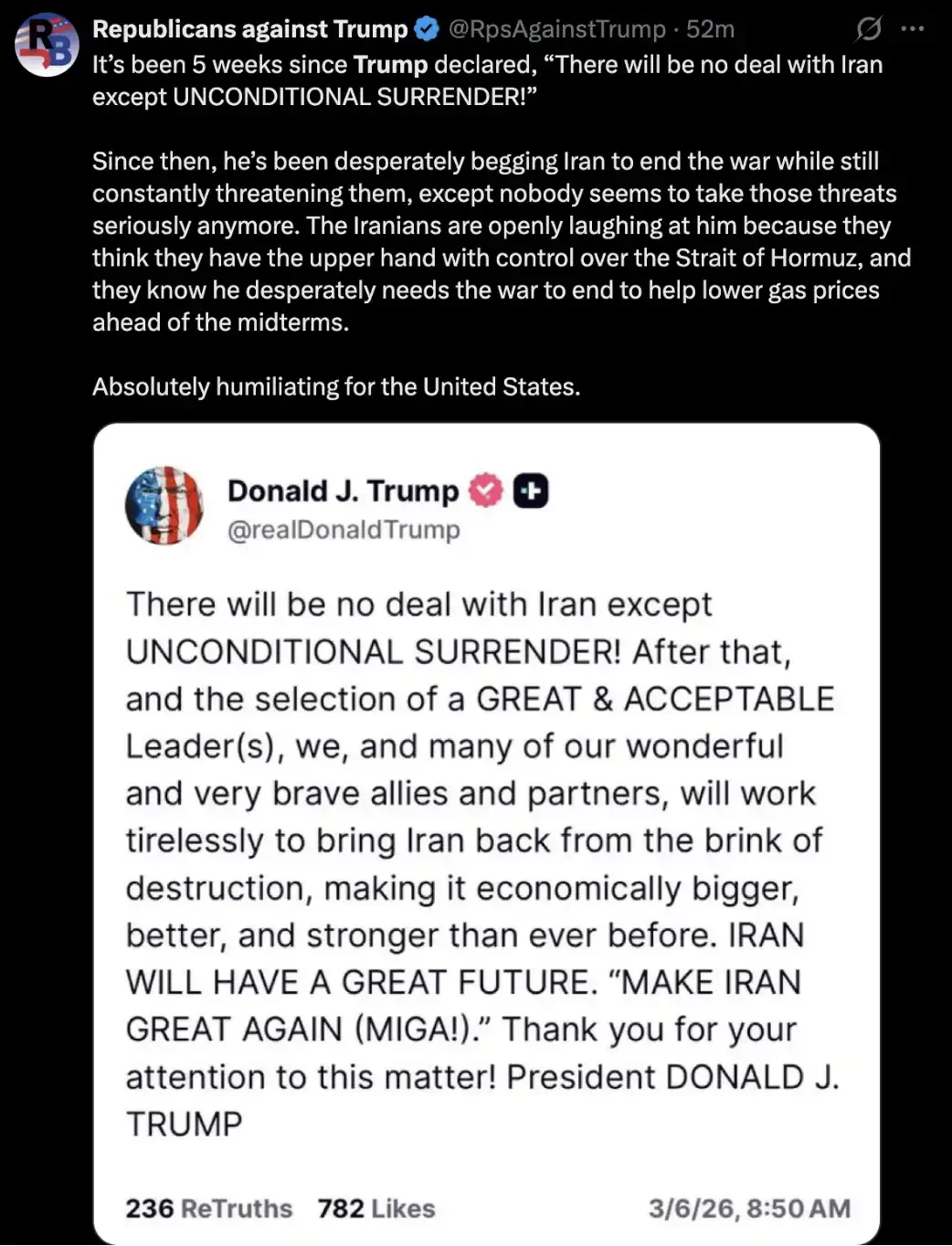
Iran has zero incentive to give up the Strait of Hormuz.
None. Zero.
Today, the Strait has become Iran's most valuable strategic asset—more valuable than the nuclear program it ostensibly started the war over, more valuable than the network of proxies it previously used as bargaining chips. Iranian Parliament Speaker Mohammad Bagher Ghalibaf has already stated publicly that "the situation in the Strait of Hormuz will not return to pre-war conditions."
This is not bluster; it is a policy declaration.
For 40 years, Iran was told it had no leverage. Now, it holds the single most important card in the global economy. The next Iranian regime—and there will be a next regime because airstrikes have killed enough of the old leadership that a power transition is almost inevitable—will inherit and use this card.
To believe Iran will easily give it back is to lack a basic understanding of what just happened.
The Gulf monarchies can no longer openly confront Iran either. Saudi Arabia's refinery network, the UAE's ports, Qatar's LNG terminals—all these facilities are within range of Iranian missiles, drones, and proxy forces. And these countries just witnessed the U.S. fail to defend Israel's most strategic targets, fail to protect U.S. bases in the UAE and Bahrain, and fail to reopen the Strait that sustains their economic lifeline.
The security promise has been falsified by reality.
Riyadh and Abu Dhabi will not bet their national survival on a guarantor who just proved incapable of providing guarantees. They will seek deals. In fact, they are already seeking deals.
The U.S. military also cannot realistically reopen the Strait. This fact alone should be a cause for outrage.
In absolute terms, the U.S.