






ETH กลับมาสู่เส้นทองคำอีกครั้ง รอบการดีดตัวนี้แตกต่างอย่างไร?


- มุมมองหลัก: ราคา Ethereum กลับมายืนเหนือระดับ 2300 ดอลลาร์อีกครั้งหลังจากผ่านไปกว่าสามเดือน รอบการดีดตัวนี้ขับเคลื่อนโดยการปรับปรุงของสภาพแวดล้อมมหภาค กระแสเงินทุนที่ไหลเข้าอย่างต่อเนื่องของ Spot ETF และการเพิ่มขึ้นของขนาดการstaking ทำให้ตลาดมีความคาดหวังเชิงบวกต่อแนวโน้มระยะกลางและระยะยาวมากขึ้น
- ปัจจัยสำคัญ:
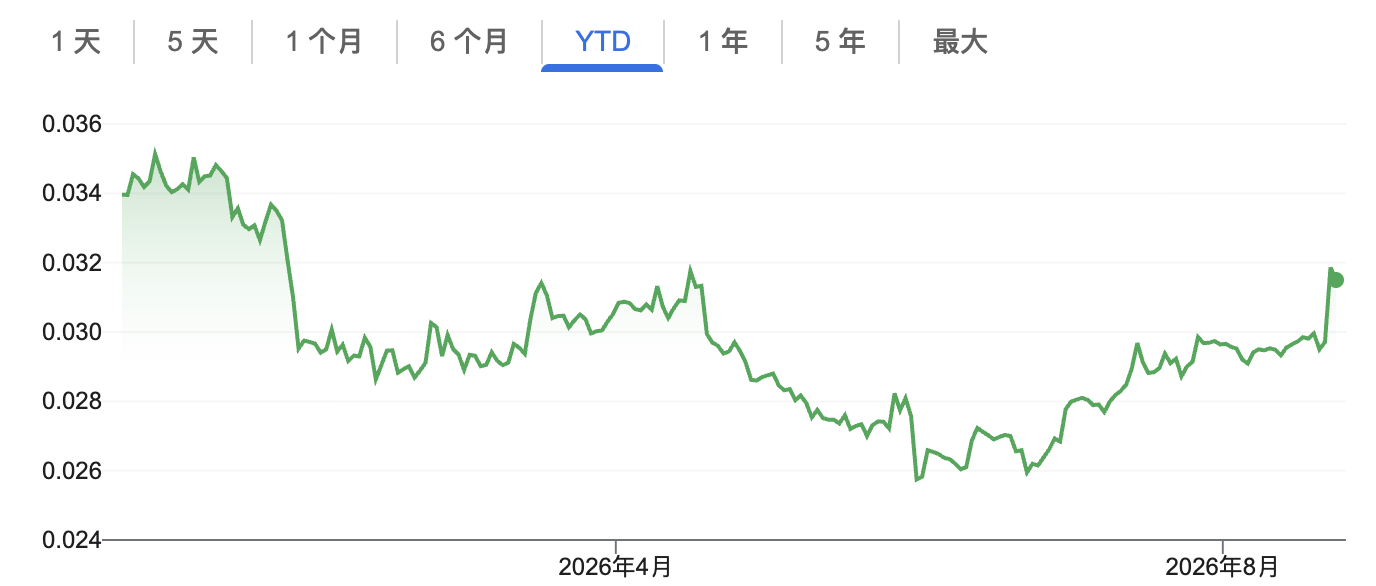
- ราคา ETH เพิ่มขึ้นประมาณ 25% ภายในหนึ่งสัปดาห์ มูลค่าตลาดกลับมาอยู่ที่ 284.3 พันล้านดอลลาร์ แซงหน้า Dell ขึ้นเป็นอันดับที่ 72 ของสินทรัพย์ทั่วโลก และอัตรา ETH/BTC กลับมาใกล้ระดับ 0.031 อีกครั้ง
- การบีบสถานะshortขยายการพุ่งขึ้น ตั้งแต่ 19 สิงหาคมเป็นต้นมา ยอด liquidation สะสมของสัญญา Ethereum เกิน 1.33 พันล้านดอลลาร์ โดยสถานะshortคิดเป็น 88.4% ของยอด liquidation ทั้งหมด เกิดภาวะ逼空อย่างชัดเจน
- Spot ETF ของ Ethereum มีกระแสเงินไหลเข้าสุทธิติดต่อกัน 4 วัน เกิน 510 ล้านดอลลาร์ โดยในวันที่ 20 สิงหาคมมีกระแสเงินไหลเข้าสุทธิ 220 ล้านดอลลาร์ในวันเดียว ซึ่งสูงสุดนับตั้งแต่เดือนตุลาคมปีที่แล้ว และประสิทธิภาพของเงินทุนดีกว่า Bitcoin ETF อย่างชัดเจน
- การจัดสรรของสถาบันเร่งตัวขึ้น Morgan Stanley เพิ่มสถานะ ETH ในไตรมาสที่สอง 18.6% เมื่อเทียบรายไตรมาส Bank of America ขยายการถือครอง ETHA ไปประมาณ 29 เท่า และ Santander Bank ของสเปนเปิดเผยการถือครอง ETF ที่เกี่ยวข้องเป็นครั้งแรก
- ขนาดการstakingทำสถิติ新高 มี ETH มากกว่า 41.1 ล้านเหรียญ (คิดเป็น 33.7% ของอุปทานทั้งหมด) อยู่ในสถานะstaking คิวการออกของ validator ใกล้เป็นศูนย์ และมี ETH อีก 2.21 ล้านเหรียญรอเข้าสู่ระบบ
- อัตราผลตอบแทนจากการstakingลดลงจากจุดสูงสุดที่ 2.86% มาอยู่ที่ 2.59% และข้อเสนอใหม่ EIP-8363 เตรียมลดรางวัลของ validator เมื่ออัตราการstakingถึง 50% ทำให้ตลาดกังวลเกี่ยวกับความน่าสนใจของผลตอบแทน
Original Author: Nancy, PANews
After more than three months, the price of Ethereum has finally reclaimed the $2,300 mark.
From an external perspective, the recovery in macro risk appetite, improved regulatory expectations, and a short squeeze have provided direct momentum for ETH's rise. Internally, continued inflows into spot ETFs, accelerating institutional allocation, and the steadily increasing scale of ETH staking are also continuously improving the market's medium-to-long-term outlook for Ethereum.
Ethereum Stages a Strong Comeback, Reclaiming the "Golden Line" for the First Time This Bear Market
Ethereum supporters, the wait is finally over for ETH's strong rebound.
CoinGecko data shows that as of August 21, the price of ETH had risen to around $2,354, returning to levels seen in early May this year.
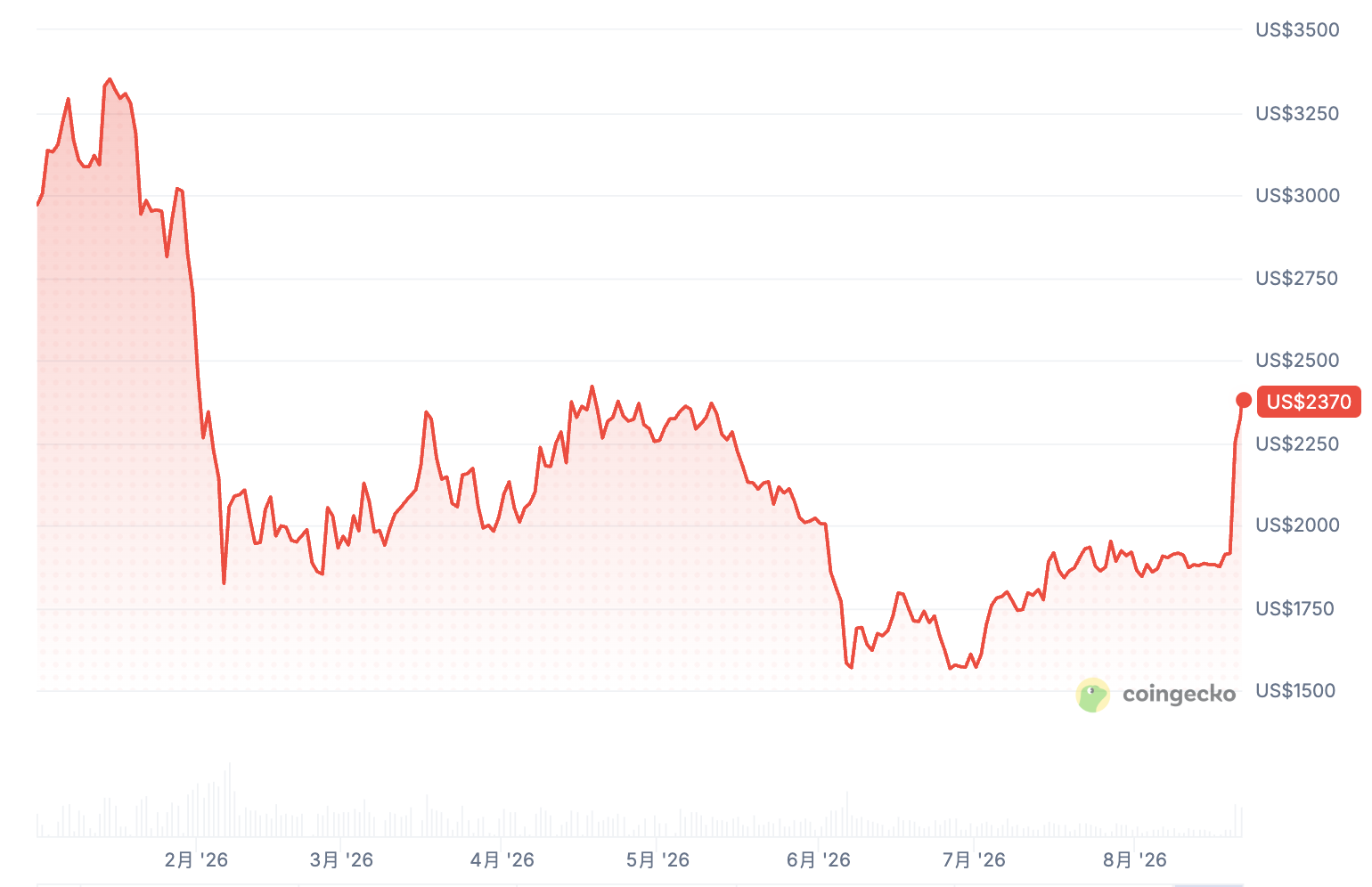
Within just one week, ETH surged approximately 25%, ranking among the top ten gainers among the top 100 crypto assets by market cap, significantly outperforming Bitcoin over the same period. The ETH/BTC ratio has also been breaking its long-term downtrend, currently recovering to around 0.031, returning to levels from April this year.
With the strong rebound in Ethereum's price, its market capitalization has also re-entered the upper echelons of global mainstream assets. Data from 8 Market shows that Ethereum's total market cap has now risen to approximately $284.3 billion, surpassing Dell and ranking 72nd among global assets by market cap. Just a few months ago, due to sustained price declines, Ethereum's market cap had temporarily fallen out of the global top 100 assets.
During this rapid rebound, short sellers were forced to bear the brunt of the losses. CoinGlass data shows that since August 19, cumulative liquidations in ETH futures contracts have exceeded $1.33 billion, with short liquidations accounting for as much as 88.4% of the total. Of course, this wave of large-scale short covering has further amplified ETH's upward momentum, resulting in a pronounced short squeeze.
Renowned trader Doctor Profit noted that Ethereum has now decisively broken through the key resistance zone of the bear market phase and, for the first time since the bear market began, has reclaimed the "Golden Line" (Weekly EMA50) he tracks. In his view, this breakout is a significant technical signal for ETH, leading him to advise "buckle up" while warning that short sellers may face further pressure.
BitMine Chairman Tom Lee, meanwhile, pointed out that the rising ETH/BTC ratio indicates the market has begun to focus on the real-world implementation of tokenization and AI agent applications, which will benefit Ethereum. Historically, the ETH/BTC ratio tends to rise during crypto bull markets alongside increases in Ethereum's usage relative to Bitcoin. Previous drivers included the ICO wave of 2017-2018, the NFT wave of 2020-2021, and the stablecoin wave of 2025. The driver for this cycle will be Wall Street's on-chain tokenization business and the large-scale adoption of blockchain by AI agents. Easing financial conditions will also provide a tailwind for the crypto market.
As a major ETH bull, BitMine is also experiencing a long-awaited "recovery moment." As of August 16, BitMine, the largest institutional holder of Ethereum, held 5,815,164 ETH at an average cost of $3,366. With Ethereum's rebound, BitMine's unrealized loss has narrowed from over $8.5 billion to $5.8 billion.
Ethereum ETF Fund Flows Outperform Bitcoin, Multiple Institutions Add Positions Against the Trend
On the capital front, Ethereum spot ETFs continue to emit positive signals.
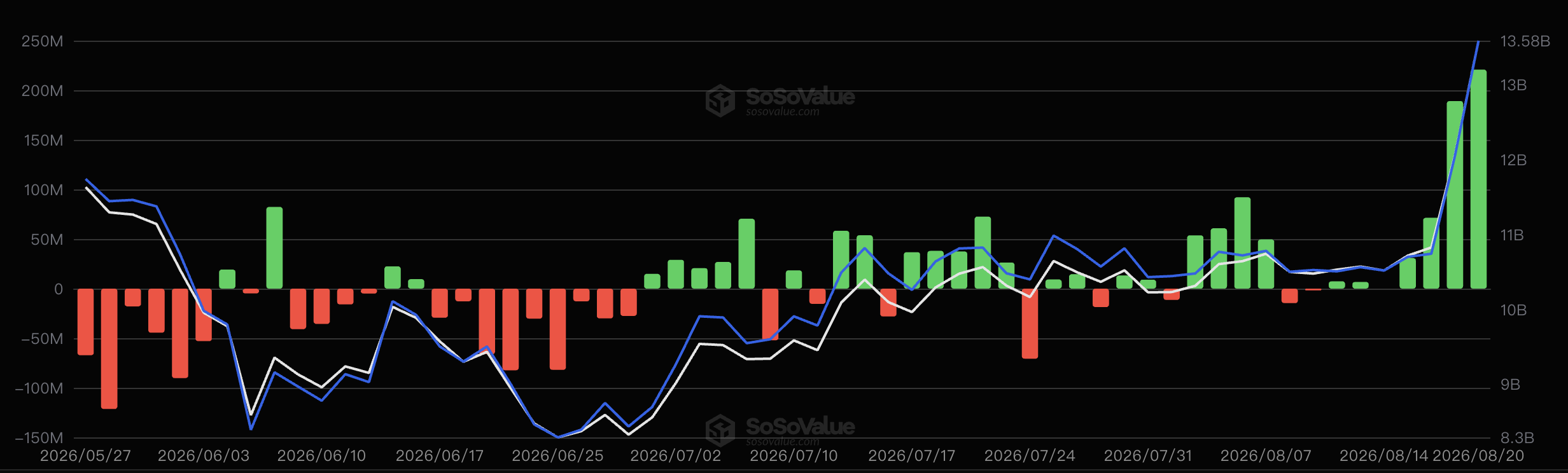
Sosovalue data shows that Ethereum spot ETFs have recorded net inflows for four consecutive trading days, with cumulative net inflows exceeding $510 million this week. On August 20 alone, net inflows surpassed $220 million, marking the highest single-day level since last October. BlackRock's ETHA remains the primary source of inflows, with the latest single-day net inflow reaching $173 million.
In recent times, the capital performance of Ethereum spot ETFs has also begun to clearly outperform Bitcoin spot ETFs. A recent report from DWF Labs shows that in June, ETH ETF net outflows accounted for 4.65% of fund assets, significantly lower than BTC ETF's 8.09%. By July, ETH ETFs had turned to net inflows, accounting for 3.19% of fund assets, while BTC ETFs saw only 0.34% — the former being approximately 9.4 times that of the latter.
Institutional allocation is also changing. DWF Labs noted that Wall Street banks significantly increased their exposure to ETH in Q2, at a growth rate notably higher than that for BTC. For example, Morgan Stanley's BTC exposure grew 3.7% quarter-over-quarter, while its ETH exposure grew 18.6%. JPMorgan's BTC exposure grew 12.2%, while its ETH exposure grew 67.3%.
Additionally, several institutions have also been adding to their Ethereum ETF positions against the trend. According to 13F filings, Bank of America's holdings of ETHA increased from approximately 67,500 shares to roughly 1.98 million shares, expanding its position to about 29 times its previous size, with a reported value of approximately $23.6 million at the end of Q2. Italy's largest bank significantly reduced its holdings in BlackRock's Bitcoin ETF (IBIT) while roughly doubling its position in BlackRock's Ethereum staking trust. Spain's Santander Bank also disclosed for the first time in Q2 that it holds BlackRock's Bitcoin and Ethereum ETFs.
Compared to the short-term rebound in price, this shift in capital structure may be more noteworthy.
Recently, several ETF issuers have also been continuously enhancing their product appeal. For instance, BlackRock's Ethereum ETF (ETHA) is planning a 1-for-3 reverse stock split on October 6, while Fidelity has applied to add a staking feature to its Ethereum ETF (FETH).
Over One-Third of ETH Staked, Falling Yields May Weaken Appeal
Unlike the recent prolonged slump in Ethereum's price, its staking scale has maintained a growth trend.
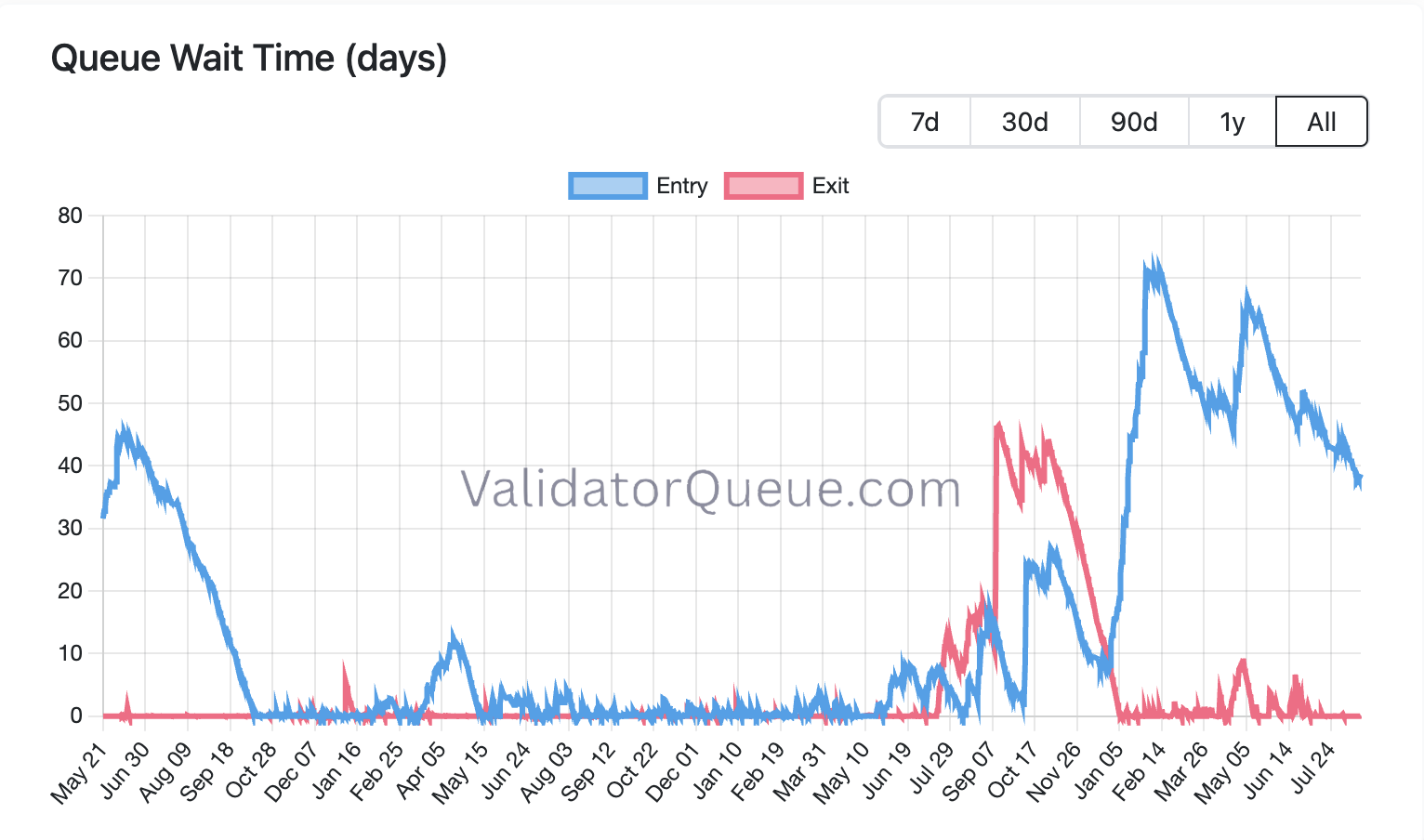
ValidatorQueue data shows that Ethereum's current staking ratio has risen to an all-time high, with over 41.1 million ETH staked, accounting for nearly 33.7% of the total supply. At the same time, the validator exit queue has dropped to nearly zero, while the entry queue still has approximately 2.21 million ETH waiting, with an estimated wait time exceeding 38 days.
On-chain data also confirms the market's long-term holding intentions. Santiment data shows that between May 20 and August 20, large wallets holding more than 1,000 ETH collectively reduced their holdings by approximately 1.7 million ETH, accounting for 2.9% of that tier's holdings. During the same period, the share held by small wallets holding 1 to 10 ETH rose from 4.38% to 4.52%, with 65 days of increases versus only 27 days of decreases.
However, the decline in large holder positions does not entirely mean ETH is being sold. Santiment noted that only about 300,000 ETH of this outflow can be traced to smaller wallets; the rest has likely entered staking or contract addresses. Meanwhile, the ETH balance on exchanges also fell from approximately 7.07 million to 6.54 million during the period.
The continued rise in staking scale has also raised market concerns. Recently, Ethereum researchers Justin Drake and Jerome de Tychey proposed a new EIP (EIP-8363), suggesting that when Ethereum's staking rate reaches 50% of total supply, the new issuance rewards for consensus layer validators would be progressively reduced to zero through a gradual burning mechanism. However, the proposal has faced community opposition.
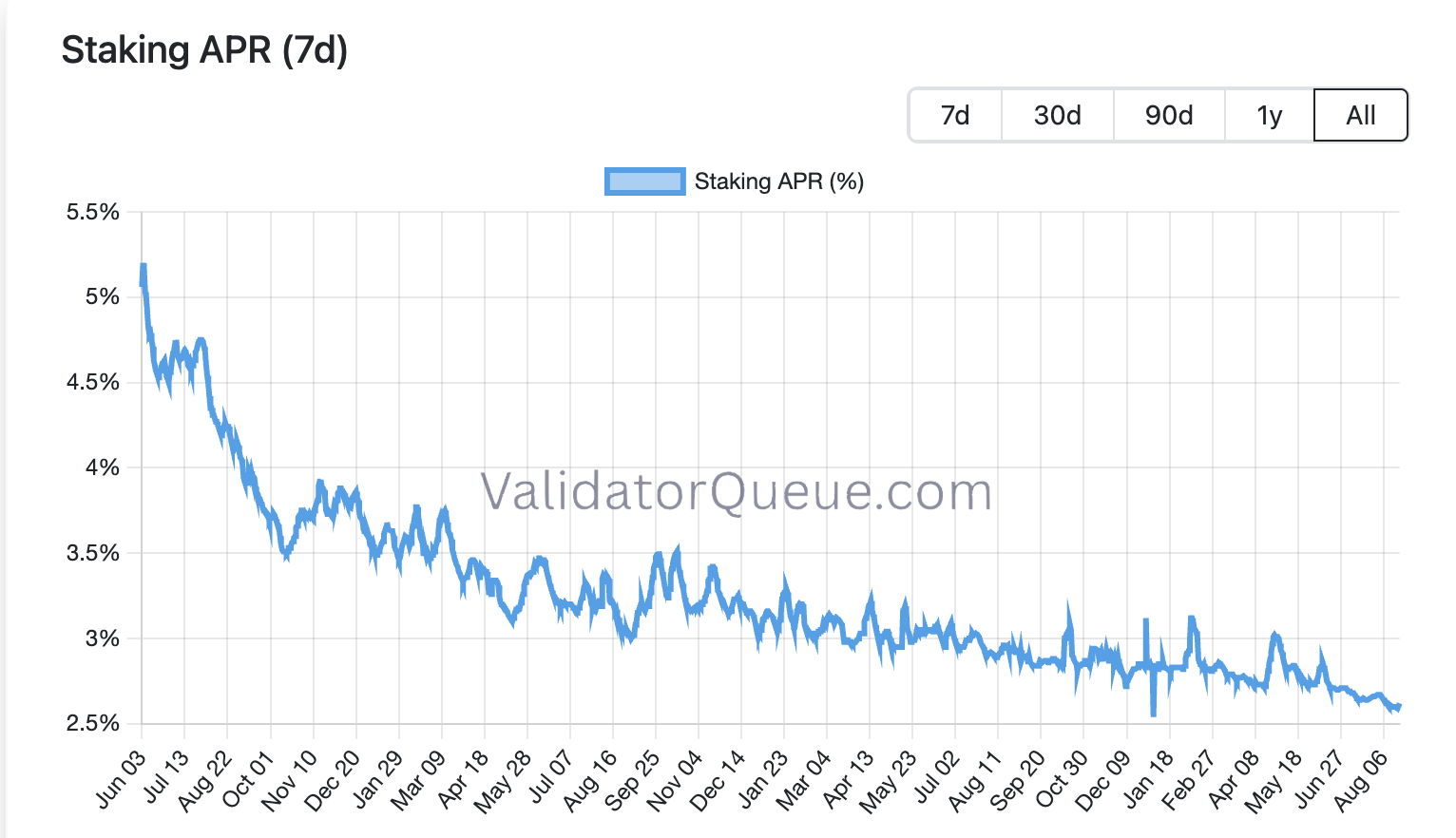
Meanwhile, as the number of staked ETH and validators continues to increase, staking yields have begun to decline. Data shows that over the past three months, the ETH staking yield has fallen from a high of 2.86% to 2.59%, significantly lower than the peak of around 5.2% seen three years ago. If staking yields decline further, their appeal to new capital could be somewhat diminished.
It is worth noting that Ethereum's next major upgrade, Glamsterdam, is scheduled for Q4 2026, with EIP-8061 being considered for inclusion. This proposal aims to remove the validator exit cap and increase exit processing speed to approximately four times its current rate, thereby improving the efficiency and flexibility of ETH staking exits. If the relevant proposal is ultimately implemented, stakers would be able to manage their capital liquidity more flexibly while still earning yields. For institutional investors, higher exit efficiency implies lower liquidity risk and could further increase their willingness to participate in staking.
Overall, this rebound in Ethereum has received multiple supports from sentiment, capital, and fundamentals, but whether it can truly sustain its recovery will require time and more fundamental evidence to provide the answer.


