






AI Computing Power Assetization Wave: Axe Compute Could Be the Most Underestimated GPU Compute Entry in US Stocks


- Core Thesis: Axe Compute (AGPU), by transforming from a biotechnology company into an AI computing power service provider, leveraging its hybrid “Instant Access” and “Cluster Building” business model and “Compute + Treasury” dual-engine strategy, has signed over $1.6 billion in orders. Its market value is severely underestimated, with a potential 6–11x upside for its stock price.
- Key Elements:
- Beginning in December 2025, Axe Compute strategically transformed from a biotech company (POAI) into an AI computing company (AGPU). In April 2026, it completed the commercial integration of Aethir's distributed GPU network, covering over 400,000 GPUs across 93 countries.
- The company's business is divided into the asset-light “Instant Access Program” (Access) and the asset-heavy “Cluster Building Program” (Build). In July 2026, the Build business line added a new $1.3 billion, five-year AI infrastructure contract, bringing the total order backlog to over $1.6 billion.
- Based on signed definitive contracts, the conservative estimate for FY2026 confirmed revenue is $125 million. Compared to industry leader CoreWeave's forward price-to-sales ratio of approximately 3.88x, AGPU's long-term reasonable market cap is roughly $485 million, corresponding to a target price of $42.6, representing approximately a 6.2x upside from the current price of $6.85.
- The company holds a large number of ATH tokens as a strategic reserve. By running the Access business on the Aethir network, it creates a positive “Compute + Treasury” flywheel effect where “orders drive ATH demand, and ATH appreciation feeds back into the business,” forming a unique AI x Crypto capital model.
- Key risks include: execution and delivery delays for large-scale orders, the risk of revenue conversion and financial verification falling short of expectations, and potential valuation downgrades due to macroeconomic and market adjustments. The current narrative is ahead of financial realization.
From the end of 2025 to the first half of 2026, as other tracks (some high-valuation growth, cyclical, and pure narrative themes) fade, and AI Capex continues to exceed expectations, while semiconductor and data center-related stocks significantly outperform, a true market consensus forms: "AI is no longer just one of many themes, but has become the absolute mainline of the global capital market." Through research on undervalued US-listed AI companies, Axe Compute has become our key focus this year. The recent announcement on July 22 of a $1.3 billion AI computing contract greatly strengthens our confidence in investing in Axe. If the contracts can be implemented orderly and the data can be genuinely reflected in financial reports in the future, we believe that "Axe Compute, a company currently with a market cap of less than $100 million, could become the most undervalued GPU Compute entry point in the US stock market."
1. A Remarkable Transformation from Pharmaceuticals to AI Computing
Before its name change in December 2025, Axe Compute was formerly known as Predictive Oncology Inc. (NASDAQ: POAI), a typical US-listed micro-cap biopharmaceutical company. As a classic "small-cap biotech stock," POAI had mediocre performance in the pharmaceutical sector: revenue lingered in the hundreds of thousands of dollars for a long time, it was continuously loss-making, its market cap hovered in the tens of millions for years, and it received very little attention from the capital market.
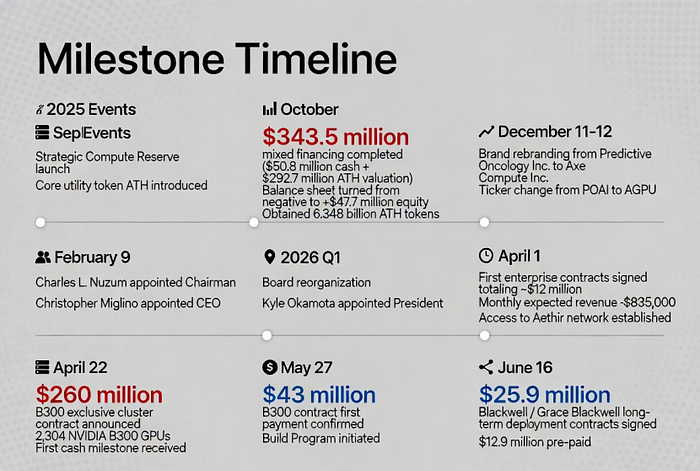
In September 2025, the company suddenly launched the Strategic Compute Reserve, explicitly using Aethir's native utility token (ATH) as its core, continuing the Crypto Treasury strategy narrative, hinting that the company would pivot towards the AI narrative and computing business.
In October 2025, it completed two simultaneous PIPE financings totaling $343.5 million in cash, a hybrid financing method comprising $50.8 million in cash and $292.7 million in nominal value of ATH. Through this financing, the company's balance sheet shifted from negative equity to a positive $47.7 million gain, acquiring 6.348 billion ATH, officially forming a deep bond between the company and the Aethir network. This created a capital operation model combining the AI computing narrative and a treasury company, bringing the entity into the observation scope.
On December 11–12, 2025, the company underwent a brand rebranding, changing its name from Predictive Oncology Inc. → Axe Compute Inc., and its ticker from POAI → AGPU, continuing to trade on Nasdaq.
By the end of the first quarter of 2026, Axe Compute officially began operating as a new cloud service provider. Related parties from the crypto project Aethir are expected to become its largest shareholders, signaling a comprehensive transformation to the financial markets:
On February 9, Charles L. Nuzum became Chairman, Christopher Miglino (previously involved in designing the ATH transaction structure) officially assumed the role of CEO, and the board was restructured in March, with Kyle Okamoto (formerly CTO/GM of Aethir) becoming President.
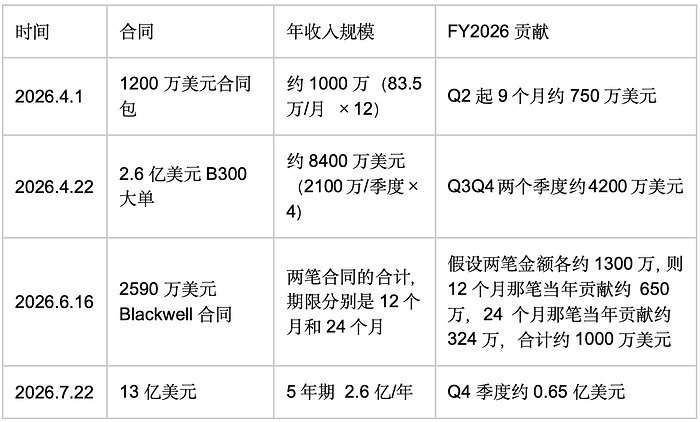
On April 1, the company completed the enterprise-level commercial integration of the Aethir distributed GPU network (400,000+ GPU containers, 200+ locations, 93 countries), signing its first batch of enterprise contracts worth approximately $12 million. The contracts are mainly for the Immediate Access Program, contributing an expected monthly revenue of about $835,000. Payment terms are prepaid + monthly advance payments, and it has begun contributing a small amount of computing revenue (approximately $7,000 actually recognized in Q1).
On April 22, 2026, it disclosed a $260 million exclusive cluster contract for B300 (the first order under the Build Program). Key contract terms: A 36-month take-or-pay agreement, delivering 2,304 NVIDIA B300 GPUs + AI high-speed storage (US Tier-3 data center, 4.8 MW dedicated power). Structured deposit + prepayment + monthly advance payments. After going live in Q3 2026, quarterly revenue is expected to be approximately $21 million.
On May 27, 2026: Confirmed receipt of a $43 million down payment for the B300 contract. This is the first true contract cash milestone, confirming that the Build model has been initiated as planned, with hardware procurement and deployment progressing.
On June 16, 2026: Secured a $25.9 million long-term deployment contract for Blackwell / Grace Blackwell (12 months + 24 months, renewable), of which $12.9 million has been prepaid.
On July 22, 2026: Announced new AI infrastructure customer contracts totaling $1.3 billion. These agreements are based on five-year terms with optional renewals, requiring significant upfront prepayments, and include clauses for continuous GPU upgrades as new generations come to market. Revenue is expected to begin generating by the end of the fourth quarter of 2026, with prepayments made in the third quarter of 2026. At that point, Annual Recurring Revenue (ARR) is projected to exceed $384 million. This massive $1.3 billion order should be the starting point for the entire market to truly re-evaluate Axe.
2. Multi-AI Computing Solutions, the High-Flexibility "CoreWeave": Deconstructing Axe's Business Model
Axe Compute Inc. is a technology company primarily focused on providing high-performance computing infrastructure for artificial intelligence (AI) workloads. It secures large-scale GPU capacity from hardware manufacturers and infrastructure providers, then deploys it to enterprise clients through long-term service agreements. Its services encompass hardware procurement, colocation, networking, storage, and financing. Axe also retains its oncology drug discovery solutions business, but it is not currently the company's main focus.
1. Axe's Business is Divided into Two Product Lines
(1) Immediate Access Program
Targets customers needing rapid deployment and elastic scaling. Leveraging existing GPU inventory from Aethir's distributed network, deployment can be completed in as fast as 48 hours, covering over 200 global nodes. Suitable for scenarios like inference, fine-tuning, and small to medium-scale training. Billed monthly based on reserved capacity.
(2) Build Program / AI Factory
Targets ultra-large-scale, long-cycle dedicated computing needs. Axe handles overall architecture design, data center site selection and power negotiation, hardware financing arrangements, and eventual enterprise-grade SLA (Service Level Agreement) operations – a "design-deploy-own-operate" model.
The $260 million, three-year contract signed in April 2026 is a landmark case for this model. The company plans to procure a dedicated cluster of 2,304 NVIDIA B300 GPUs and dedicated AI high-speed storage infrastructure from a US Tier-3 data center facility, supported by 4.8 MW of dedicated redundant power. The client specifies the deployment location and service standards. Deployment is scheduled for completion in Q3 2026. It utilizes a structured payment plan, with an initial $43 million already received. Over the 36-month service period, the company will recognize approximately $21 million in revenue per quarter.
In June 2026, the company secured another $25.9 million long-term deployment contract for Blackwell and Grace Blackwell, covering both inference infrastructure and simulation platform scenarios. $12.9 million has already been received as an upfront payment.
In July 2026, the Build business line secured additional long-term AI infrastructure contracts in the US and Europe totaling over $1.3 billion over five years, significantly exceeding its full-year target of $1 billion for new signings. Project prepayments will be received in Q3 2026, with sustained revenue recognition officially starting from the end of Q4 2026. Once all clusters are fully operational, the corresponding Annual Recurring Revenue (ARR) will exceed $384 million. Company management indicates strong current market demand, and related revenue will contribute to the 2027 ARR, continuously opening up medium to long-term growth potential.
2. Re-understanding Axe's Build Computing Business
The best comparison is CoreWeave – one is the leader in centralized training, the other is a new force in global hybrid computing:
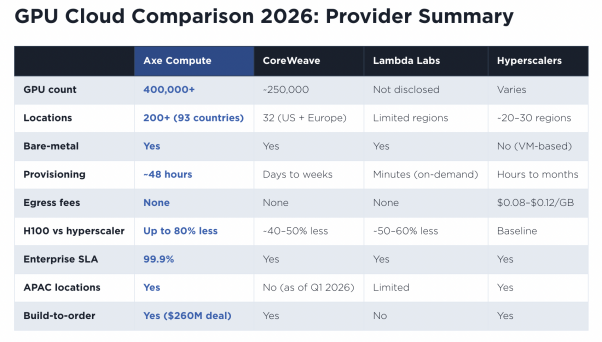
CoreWeave follows an asset-heavy, centralized, training-focused approach. It operates 49 large-scale AI data centers across North America and Europe, possesses approximately 250,000 high-end GPUs, and builds single-cluster, exa-scale training clusters using InfiniBand high-speed interconnect networks and native Kubernetes orchestration. Its extreme performance for ultra-large-scale distributed training suits the trillion-parameter training needs of top AI labs like OpenAI, Meta, and Microsoft. Listed on Nasdaq in March 2025, it received an additional $2 billion strategic investment from NVIDIA in January 2026, becoming the benchmark enterprise in the dedicated AI cloud (Neo-Cloud) space. However, with all data centers concentrated in North America and Europe, the 80-150ms network latency from transcontinental transmission, coupled with various countries' data residency compliance requirements, keeps CoreWeave out of many regional markets like Asia-Pacific, the Middle East, and Latin America.
Axe Compute follows a hybrid, distributed, globally covered model. On one hand, it leverages the Aethir distributed computing network to integrate global third-party data center resources, deploying over 200 computing nodes across 93 countries, providing access to a total of over 435,000 GPUs. On the other hand, it is aggressively expanding its asset-centric new cloud business valued at $1 billion+. This allows it to penetrate the large-scale customized computing market, serving all types of GPU buyers and AI companies.
3. Financial Analysis
Axe Compute's Financial Results for the First Quarter Ended March 31, 2026
Press enter or click to view image in full size
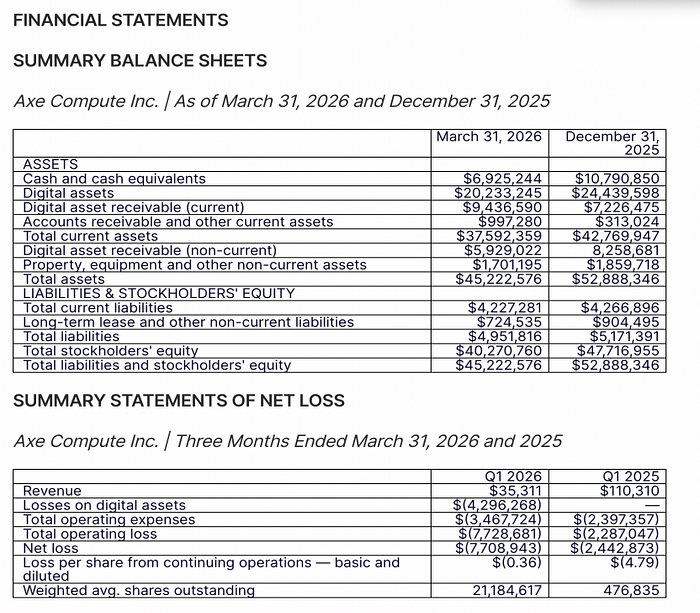
As of March 31, 2026, the company held $6.9 million in cash and cash equivalents, $20.2 million in ATH digital asset holdings (approximately 2.83 billion tokens), and $9.4 million in current digital asset receivables, totaling a liquidity pool of about $36.5 million. Management believes this is sufficient to support the company's operations through fiscal year 2026 and beyond.
Revenue for the first quarter of 2026 was $35,000, compared to $110,000 in the first quarter of 2025. Sales in Q1 2026 primarily came from the legacy drug discovery services segment, with the compute services segment contributing only $7,000. According to company disclosures, the $43 million down payment for the major B300 contract was received in May, and an additional $25.9 million long-term Blackwell series contract was signed in June, but neither has yet been converted into profit and loss statement revenue.
Once the $260 million dedicated cluster goes live in Q3, the company can recognize approximately $21 million in compute revenue in a single quarter – 600 times the total Q1 revenue. Assuming the $1.3 billion order goes live in Q4, quarterly revenue could further increase by $65 million to $86 million, representing over 400% quarter-over-quarter growth. The company stands at the explosive inflection point of transitioning from tens of thousands in quarterly revenue to hundreds of millions in quarterly revenue. Current market pricing has not yet fully priced in the certainty of this step-change revenue surge.
Net loss for the first quarter of 2026 was $7.7 million. The net loss includes a non-cash mark-to-market loss of $4.3 million on the company's ATH digital asset holdings. As of March 31, 2026, accounts receivable were $659,000, up from $32,000 on December 31, 2025. Both accounts receivable and contract liabilities increased significantly in the quarter, reflecting monthly prepayments due from Compute Services customers following the launch of projects at the end of Q1.
Axe Compute CEO Christopher Miglino stated: "Our goal this year was to sign $1 billion worth of contracts. Securing the July contracts has far exceeded that target... We believe signing another $2 billion in contracts this year is not out of reach, which would help boost next year's Annual Recurring Revenue (ARR)." Combined with public statements from the first half of the year, Axe Compute currently has a potential business order pipeline exceeding $4 billion, has signed $1+ billion in contracts, and aims to sign a total of $3 billion in contracts this year.
4. Valuation Analysis
- Model 1: FY2026E Forward P/S
Annual Revenue Estimate
Based on officially announced confirmed orders, the determined revenue for FY2026 can be calculated at approximately $125 million.
Three Wall Street analysts forecast AGPU's 2026 revenue to average $163,935,524, with a low estimate of $157,505,455 and a high estimate of $168,752,872. For 2027, this figure reaches $254,372,663, with a low estimate of $244,405,017 and a high estimate of $261,853,600. Our conservative estimate based on confirmed revenue is approximately $125 million.
CoreWeave's Forward P/S is about 3.88x. Axe Compute's confirmed 2026 revenue is approximately $125 million. Total shares outstanding are 11.385 million, current price $6.85.
Axe Market Cap = $125 million × 3.88 = $485 million
Corresponding Stock Price: $485 million ÷ 11.385 million shares ≈ $42.60/share
Upside from Current Price: $42.60 ÷ $6.85 ≈ 6.21x
- Model 2: P/ARR (Forward Scenario Calculation)
P/ARR (Price to Annual Recurring Revenue) is a common steady-state valuation metric in the computing infrastructure industry, suitable for business models centered on multi-year locked-in computing contracts. It better reflects the intrinsic value of a company's long-term stable cash flows. This analysis uses the industry leader CoreWeave's P/ARR valuation midpoint of approximately 2.4x as of July 2026 as a fair pricing benchmark for mature computing service providers.
To date, the company's total in-hand Build business long-term orders represent a forward steady-state annualized recurring revenue (ARR) of $384 million.
Axe's Forward Reasonable Total Market Cap = $384 million × 2.4 = $921.6 million
Corresponding Target Stock Price = $921.6 million ÷ 11.385 million shares ≈ $80.94/share
Upside from Current Price: $80.94 ÷ $6.85 ≈ 11.8x
Combined calculations suggest Axe's stock price has an upside potential of 6-11 times. The current market value significantly underestimates the company. These calculations do not apply valuation discounts for differences in business scale and development maturity between the two companies; the actual reasonable valuation midpoint may have room for downward adjustment.
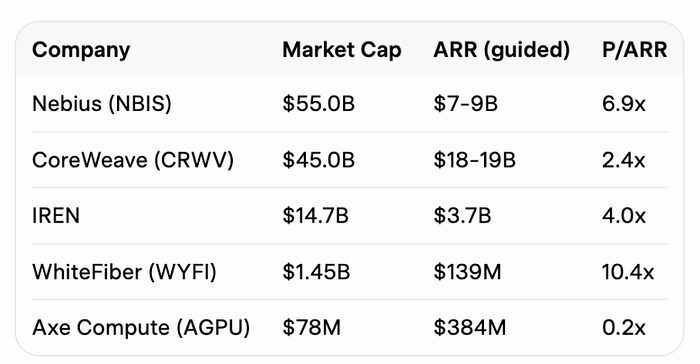
Looking at industry peers horizontally, AGPU's current market pricing shows a significant disparity with its business scale and growth potential. As of now, the company's market cap is only about $80 million, while its guided ARR, based on signed long-term contracts, has reached $384 million, corresponding to a P/ARR of just 0.2x. In comparison, peers Nebius, CoreWeave, IREN, and WhiteFiber have P/S on ARR of 6.9x, 2.4x, 4.0x, and 10.4x, respectively. Even considering that AGPU is in its early commercialization stage with revenue recognition not yet fully unleashed, its valuation level remains far below the industry average. As the B300 dedicated cluster and subsequent contracts exceeding $1 billion begin contributing revenue in the second half of 2026, the company's ARR is expected to materialize quickly next year. The current extremely low valuation multiple provides investors with significant margin of safety and upside potential.
3. Capital Model Design for AI x Crypto: The "Compute + Treasury" Dual-Engine Flywheel
Beyond the surprisingly strong Compute business, AGPU possesses a highly imaginative flywheel model: the ATH Treasury strategy. Unlike treasury companies that simply hoard BTC or ETH, ATH is placed within a company generating positive cash flow from a related business. Compute orders directly drive ATH demand and settlement, while Treasury appreciation feeds back into Compute expansion. The two are mutually causal and synergistic, forming a self-reinforcing positive flywheel.
1. What are ATH and Aethir?
The Aethir Network is a decentralized physical infrastructure network developed by the Panama foundation company DCI Foundation (referred to as "DCI"). The Aethir Network aggregates enterprise-grade GPUs contributed by independent data centers, enterprises, and other hardware owners into a global distributed network. The network is designed to provide on-demand GPU computing resources for AI training and inference, cloud gaming, and other virtualized computing workloads, often at lower prices than centralized cloud providers. Within the


