






BitMEX officially confirms shutdown: Why is it shutting down? What should users do next?


- Core Thesis: BitMEX announced it will cease operations on September 23, 2026, marking the exit of a platform that once dominated the crypto derivatives market. Due to loss of market share, increased regulatory burdens, and its product advantages being replicated, it chose to proactively withdraw after a strategic review, highlighting that industry competition has shifted to a comprehensive contest of liquidity, compliance, and capital efficiency.
- Key Elements:
- BitMEX has stopped new user registrations. From August 26, 2026, users can only reduce positions. On September 23, all open positions will be force-liquidated.
- BitMEX once held approximately 57% of the global crypto derivatives market share. It subsequently lost its market dominance due to the rise of USDT-margined contracts, lower fees, and decentralized platforms.
- The platform has long been plagued by regulatory issues. Its founders and corporate entities were penalized in 2022 and 2025, respectively, for violating the Bank Secrecy Act, damaging its brand and market share.
- Users need to actively close positions and withdraw funds before the shutdown. Balances not withdrawn in time will incur a monthly account fee of $50 or an annualized fee of 1%.
- When migrating, users should focus on the asset transparency, actual liquidity, contract terms, and jurisdictional restrictions of alternative platforms, rather than making decisions based solely on historical reputation or fee structures.
Overview
BitMEX has announced it will officially cease exchange operations on September 23, 2026, at 04:00 UTC, marking the end of over 11 years of operation for the platform that once dominated the crypto derivatives market. The market is closely watching the BitMEX Shutdown not only because another established exchange is exiting, but because BitMEX pioneered and popularized perpetual contracts. Its closure reflects profound changes in the competitive landscape, liquidity distribution, and survival thresholds for platforms within the crypto derivatives industry.
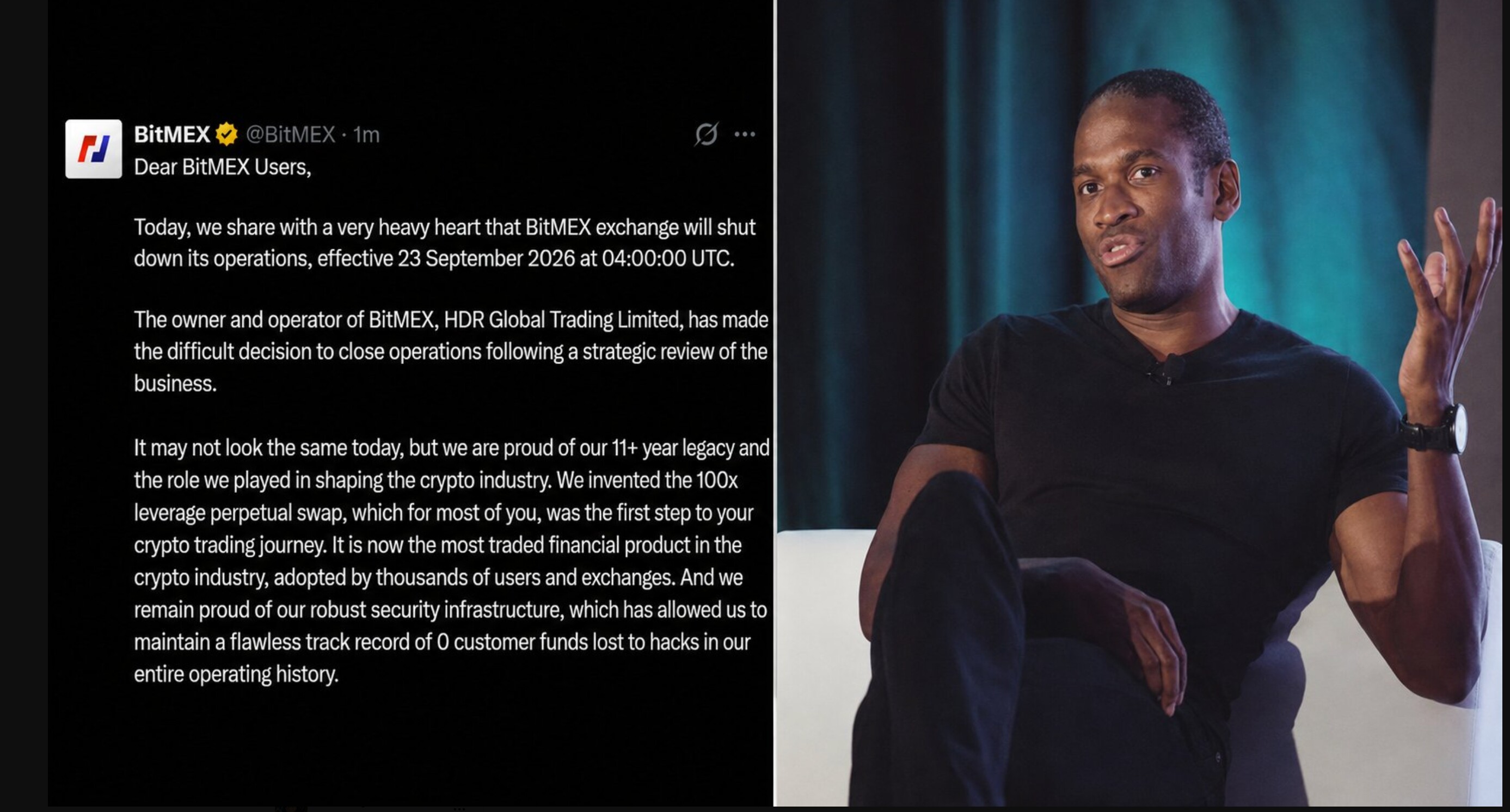
According to the official BitMEX closure announcement, the platform has immediately stopped accepting new user registrations. Existing users can still trade normally for now, but starting August 26, 2026, at 04:00 UTC, users will be unable to open new positions and can only reduce existing ones. After this point, BitMEX will gradually force-close any remaining positions, and all positions still open at the final shutdown time will be automatically liquidated.
Users can still withdraw funds for now, and BitMEX states its reserve assets exceed platform liabilities. However, users should not delay action based on this. Balances not withdrawn before the shutdown time may incur ongoing account fees, and delays can also occur due to withdrawal review processes, blockchain congestion, and network confirmation times.
Key Takeaways
BitMEX will cease exchange operations on September 23, 2026, at 04:00 UTC.
The platform has immediately stopped accepting new user registrations.
Existing trading services will continue to operate during the transition period.
From August 26, 2026, at 04:00 UTC, users can only reduce positions, not open new ones.
BitMEX will gradually force-close open positions before the final shutdown.
After the shutdown, users can still log in to view balances, transaction history, and request withdrawals.
Account balances not withdrawn in time may be subject to monthly fees.
Users should close positions, withdraw funds, save transaction records, and revoke API permissions as soon as possible.
Why Did BitMEX Decide to Cease Operations?
HDR Global Trading Limited, BitMEX's parent company, stated that the decision to close the exchange was made after a strategic review of the company's business and the broader crypto industry. The official announcement did not disclose specific issues regarding revenue, profit, cash flow, or customer assets, nor did it attribute the closure to bankruptcy, hacking, or a funding gap.
This distinction is crucial. The BitMEX Shutdown currently represents a voluntary winding down of business and an orderly exit by the company, rather than a court-led bankruptcy liquidation. The platform is still providing trading and withdrawal services during the transition period and has clearly outlined arrangements for position handling, account access, and fees on remaining funds.
Long-Term Market Share Erosion Weakened Platform Competitiveness
Founded in 2014, BitMEX quickly rose to become the dominant platform in the industry, leveraging high-leverage Bitcoin derivatives and perpetual contracts. As noted in a CoinDesk report on the BitMEX closure, BitMEX commanded roughly 57% of the global crypto derivatives market share around 2019, with an annual trading volume exceeding $1 trillion.
Subsequently, the crypto derivatives market expanded rapidly. More centralized exchanges began offering USDT-margined contracts, a wider variety of altcoin contracts, lower trading fees, and more intuitive margin systems. Concurrently, decentralized perpetual contract platforms started attracting professional traders, market makers, and on-chain capital.
BitMEX once built a competitive moat with its XBTUSD inverse perpetual contract, but the market gradually shifted towards stablecoin margin, unified accounts, multi-asset collateral, and a broader range of trading instruments. Product innovation didn't disappear; the platform that first created these products simply lost its exclusive advantage.
Regulatory History Added Long-Term Operational Burden
BitMEX's operating history has long been impacted by regulatory issues. U.S. Department of Justice and regulatory agencies previously charged BitMEX with failing to establish compliant anti-money laundering (AML) and Know Your Customer (KYC) systems. BitMEX founders Arthur Hayes, Benjamin Delo, and Samuel Reed pleaded guilty in 2022 to violating the U.S. Bank Secrecy Act.
The BitMEX operating entity subsequently pleaded guilty in 2024 and was sentenced in 2025 to a $100 million fine and two years of probation. Reuters documented the relevant case and penalty arrangements in a report on the BitMEX AML penalty.
Although the U.S. President later pardoned the relevant BitMEX founders, former executives, and the corporate entity, years of legal proceedings had already impacted the platform's brand, institutional partnerships, market access, and business expansion. The pardon could eliminate some criminal consequences, but couldn't automatically restore the lost market share and user trust.
Management Changes Preceded an Accelerated Strategic Shift
Three weeks before the official shutdown announcement, BitMEX experienced notable management adjustments. CoinDesk reported that CEO Stephan Lutz, CFO Ina Steiner, and Chief Growth Officer Raphael Polansky left their positions, with General Counsel Peter Wilkinson assuming the role of CEO.
Prior to this, the market had also heard rumors of BitMEX seeking potential buyers. While the concentration of management changes, potential sale, and eventual closure cannot be simply equated, the sequence of events clearly suggests the company reassessed the feasibility of continuing independent exchange operations.
Therefore, the "strategic review" mentioned officially likely encompassed multiple factors including market share, cost structure, regulatory burden, product competitiveness, and potential deal arrangements. This assessment is based on public information analysis; BitMEX has not disclosed the complete contents of its internal review.
Official Timeline for the BitMEX Shutdown
BitMEX opted not to halt all services immediately but set a transition period of approximately two months. For users still holding funds or contract positions, understanding each key date is more important than analyzing the reasons for the closure.
July 23, 2026: New User Registrations Stopped
Effective from the date of the closure announcement, BitMEX has stopped accepting new account registrations. Existing users can still log in and use the functions available during the transition period.
This means new users can no longer move funds to BitMEX, and existing users should not continue to view the platform as a long-term trading venue. Even though trading is temporarily still possible, all actions should be focused on reducing risk, closing exposure, and transferring funds.
August 26, 2026: New Position Creation Restricted
Starting from August 26, 2026, at 04:00 UTC, BitMEX will implement new risk restrictions. Users will no longer be able to increase positions or open new ones; they will only be able to reduce existing holdings.
These restrictions could have additional implications for strategies involving long/short positions, portfolio margin, cross-currency collateral, or automated trading. Certain orders used to hedge existing positions might also be identified by the system as increasing risk exposure. Therefore, users should not wait until the restrictions take effect to begin adjusting their strategies.
August 26 to September 23: Gradual Forced Liquidation
BitMEX states that after the new position restriction takes effect, the platform will begin to forcefully close remaining positions to ensure an orderly market exit.
The platform has not guaranteed that all positions will remain open until September 23. Illiquid contracts may be closed earlier according to existing early settlement procedures, and BitMEX reserves the right to liquidate positions before the final shutdown time.
This means users cannot assume their positions will definitely be held until the planned date. Users, especially those holding futures contracts with expiries after September 23, need to pay close attention to early settlement announcements.
September 23, 2026: Official Cessation of Exchange Services
September 23, 2026, at 04:00 UTC is BitMEX's announced final shutdown time. At that point, all remaining open positions will be immediately and forcefully closed.
After the exchange services stop, users can still log into their accounts, but account functions will be primarily limited to viewing wallet balances, historical transaction data, and withdrawing remaining assets. Normal trading, position creation, and other exchange services will no longer be available.
How Will Customer Funds Be Handled?
BitMEX's closure announcement does not indicate that customer funds are frozen, nor does it declare bankruptcy or insolvency. The platform states that users can continue to withdraw their withdrawable balances and claims its reserve assets exceed customer liabilities.
BitMEX States Assets Exceed Liabilities
In the official announcement, BitMEX referenced its Proof of Reserves (PoR) and Proof of Liabilities (PoL) pages, stating that platform assets are sufficient to cover liabilities. CoinDesk also noted that publicly available reserve data at the time indicated full asset backing for liabilities.
However, a Proof of Reserves is not equivalent to a full audit and cannot replace users holding their own assets. Even if the platform currently has sufficient reserves, the closure period could see increased processing volumes, extended manual review times, and blockchain network congestion.
For users with no further trading needs, leaving funds on the platform offers no clear benefit but adds risks related to operational delays, account fees, and incorrect network selection.
BMEX Staking Has Been Released
BitMEX has released all BMEX Token staking on the platform. The relevant tokens should now be available for use or withdrawal in user accounts.
Holders of BMEX still need to pay attention to the token's liquidity. The exchange's closure may reduce BMEX's use cases, fee discount value, and natural demand. Even if the token can be withdrawn, it does not guarantee its market price or external trading liquidity will remain stable.
Unwithdrawn Funds May Incur Account Fees
Users who have completed KYC and have not withdrawn assets before the final shutdown time will be subject to account fees. The fee will be charged monthly, with the amount being the higher of $50 equivalent or 1% annualized of the remaining account balance.
BitMEX also stated it may increase the fee in the future with prior notice. Users who do not withdraw by the deadline will be deemed to have accepted this fee arrangement.
This rule means small dormant balances could be particularly affected. For users with low balances, the fixed $50 fee could consume a significant proportion of their account assets over a relatively short period.
Can Users Still Withdraw from BitMEX?
As of the closure announcement, users can still request withdrawals. BitMEX also explicitly advises users to close positions and withdraw funds as soon as convenient.
Withdrawal Function Will Remain Available Post-Closure
BitMEX states that even after the exchange services cease on September 23, 2026, users can still log into their accounts to view balances and history, and to withdraw remaining funds.
However, this does not mean users can safely delay indefinitely. Post-closure accounts may continue to incur fees, and the withdrawal process may rely more on manual review and limited operational resources.
From a risk management perspective, the ability to withdraw post-closure is merely a safety net and should not be considered a normal withdrawal plan.
Withdrawals May Be Delayed Due to Review and Network Congestion
BitMEX indicates that to mitigate fraud and theft risks during the closure period, the platform will implement additional reviews on all withdrawal requests. With a large number of users transferring assets simultaneously, processing times may be extended.
Blockchains like Bitcoin can also experience slow confirmations. The platform notes that confirmation intervals for some Bitcoin blocks can approach one hour. Since the exchange processes withdrawals from a fixed address pool, a high volume of requests in a short time could create a queue.
If a withdrawal status shows "Processing," BitMEX says the request is still in the queue and will be submitted to the blockchain once an available address is released.
Verify Network and Address Before Withdrawing
When transferring USDT, USDC, or other multi-chain assets, users should confirm their target wallet supports the selected network. Sending assets via the wrong network can prevent automatic credit on the target platform, potentially leading to permanent loss.
For larger amounts, consider sending a small test transfer first. Users should also check their withdrawal whitelist, two-factor authentication, email access permissions, and anti-phishing codes. Do not log in via links from social media direct messages or search ads.
BitMEX has clearly stated there are no priority or expedited withdrawal services. Any third party claiming to help users skip the queue should be considered high risk.
What Happens to Open Positions?
For users still holding perpetual contracts, futures, or other derivatives positions on BitMEX, the most important principle is to exit proactively rather than waiting for the platform to handle it.
Reducing Positions Only After August 26
Once the new position restrictions take effect, users can only reduce their existing risk exposure. Traders may still be able to submit orders to close positions or reduce position size, but cannot increase net risk.
Users employing trading bots, APIs, or quantitative strategies should disable automated order-opening logic in advance. Otherwise, the system might continuously submit orders that cannot be executed, or generate unexpected strategy behavior following position changes.
Platform May Forcefully Close Positions Early
BitMEX will gradually close open positions between August 26 and September 23. Users cannot decide the specific timing of the platform's forced liquidation, nor can they guarantee the execution price will match their target price.
During periods of high market volatility or low liquidity, forced liquidation may face significant slippage. BitMEX has stated it is not liable for trading losses incurred by users who fail to close positions on time.
Therefore, users should plan their exit strategy based on position size, leverage, market depth, and funding rates, rather than concentrating all actions in the final few trading days.
Low Liquidity Contracts May Settle Early
For contracts with low trading volumes or visibly thinning order books, BitMEX may initiate early settlement procedures. The platform states it will notify affected users in advance following normal procedures.
As the shutdown date approaches, market makers may proactively reduce their orders and capital commitment. This can lead to wider bid-ask spreads, reduced depth, and higher impact costs for larger orders.
Traders should not only focus on the mark price and unrealized P&L, but also observe actual executable prices, order book depth, and the time required to exit positions.
What Should BitMEX Users Do Next?
Users don't need to panic, but should process their accounts in a clear order. The priority is to reduce trading risk, then withdraw assets, and finally save records and revoke external permissions.
Proactively Close Open Positions
Users should check all perpetual contracts, futures contracts, and any small positions that might be easily overlooked, including hedge positions, bot positions, and sub-account positions.
When closing positions, ensure limit orders are actually filled. Merely submitting a closing order does not mean the position is closed. Users should also cancel any unfilled orders to avoid accidentally increasing or altering exposure during price fluctuations.
Withdraw All Available Balances
After positions are closed and settled, users should confirm the withdrawable balance, not just the total account equity. Unrealized P&L, unsettled fees, or margin still occupied by orders may temporarily be unavailable for withdrawal.
After the withdrawal is complete, verify the asset arrival using a blockchain explorer or the target platform's deposit records. Do not rely solely on the withdrawal status displayed on the BitMEX page.
Download Transaction and Account Records
Users should save records of trades, deposits, withdrawals, funding rates, fees, realized P&L, and annual account statements.
This data may be needed for tax filing, accounting, trade analysis, or future dispute resolution. Although the platform allows viewing historical information after closure, the long-term availability of access and data export functions remains uncertain.
Revoke API and Automation Permissions
Users who connected API keys to trading bots, portfolio trackers, tax software, or third-party platforms should revoke those permissions after completing data export.
If the same password, email, or security credentials were reused on other platforms, they should also be changed. News of an exchange shutdown typically triggers a surge in phishing emails, fake customer support accounts, and fraudulent withdrawal page scams.
Which Alternative Platforms Can Users Consider?
BitMEX users may consider migrating to other centralized derivatives exchanges, spot exchanges, regulated platforms, or decentralized perpetual contract protocols. No single platform is a perfect substitute; the choice depends on the user's jurisdiction, desired trading products, capital size, and risk appetite.
Centralized Derivatives Exchanges
Centralized platforms typically offer deep order books, unified accounts, APIs, cross-margin, and a wider range of contract symbols. For traders relying on high-frequency execution, limit order depth, or multi-currency collateral, these


