






旋转门交易曝光:谁在为Tether量身打造美国稳定币法案?


- 核心观点:彭博社调查揭露特朗普政府《GENIUS 稳定币法案》制定过程中,其幕僚Howard Lutnick与Bo Hines为全球最大稳定币发行商Tether量身定制有利条款,弱化监管约束,形成政府政策与个人经济利益深度交织的局面。
- 关键要素:
- 法案关键条款对Tether倾斜:包括允许境外发行人受“对等监管”(如萨尔瓦多)、设置三年合规宽限期、免除发行商对DeFi二级市场责任。
- 关键人物利益冲突:商务部长Lutnick曾任Tether储备托管方掌门人,其公司在2024年以极低价获得Tether 5%股权认购权,其子女亦获Tether贷款。
- Bo Hines的推动:白宫幕僚Hines在法案谈判中明确将保留三年宽限期设为“不可退让的红线”,一个月后被Tether聘为高管。
- USDT仍被广泛用于非法活动,Elliptic数据显示2025年有超40亿美元USDT在诈骗团伙黑市流通。
Original Author: Anthony Cormier, David Kocieniewski, Annie Massa, Bloomberg
Original Translation: Saoirse, Foresight News
This event is regarded as a landmark moment for the crypto industry and marks the first legislative achievement in Trump's agenda to position the US as the "global crypto capital."
One year ago this month, Trump signed the GENIUS Act into law at the White House East Room, witnessed by lawmakers and industry executives. He called the bill a crucial step in integrating digital assets into the US mainstream financial system.
The Act establishes the first federal regulatory framework for stablecoins, aiming to rebuild market confidence in this $300 billion sector. It requires issuers to maintain public accounts and prevent financial fraud. It also plans to bring stablecoin issuers under US regulatory jurisdiction, regardless of their country of incorporation, addressing a long-standing industry pain point: criminals, terrorist groups, and sanctioned entities using stablecoins to move funds.
However, numerous interviews and court documents have revealed the behind-the-scenes negotiations. In the months before and after Trump's inauguration, his advisors Howard Lutnick and Bo Hines worked behind the scenes to weaken regulatory provisions. The final version of the bill tilted favorably toward Tether, the world's largest stablecoin issuer. Multiple sources involved in the negotiations stated that Lutnick and Hines had a decisive influence on the bill's direction among Trump's advisors, with the final text incorporating several provisions benefiting Tether. Dozens of industry executives, lobbyists, and current and former US officials who provided information for this report spoke on condition of anonymity, as they were not authorized to disclose the details of the negotiations.
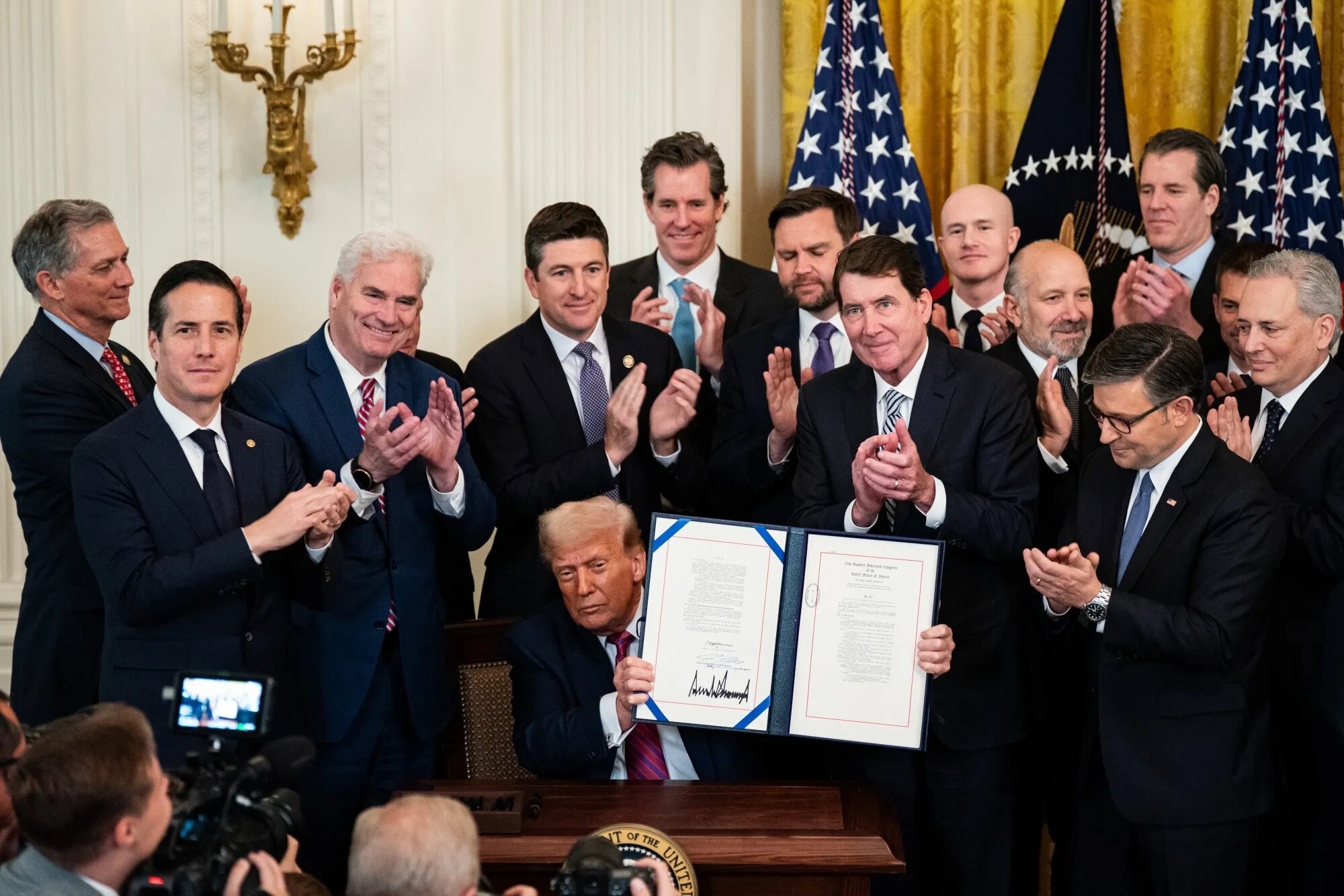
Trump signs the GENIUS Act at the White House on July 18, 2025. He called it a "major step forward" in cementing America's dominance in global finance and crypto technology. Photo: Al Drago/Bloomberg
Before becoming Trump's Secretary of Commerce, Howard Lutnick was Chairman and CEO of Cantor Fitzgerald, the Wall Street investment bank entrusted with managing Tether's reserves. Congressional lobbying records, federal court filings, and a source confirmed that throughout 2024, Lutnick acted as Tether's crisis management liaison, quelling negative publicity and lobbying lawmakers to reject bills Tether opposed.
After Trump took office, Bo Hines was tasked with finalizing the legislative bill. This 29-year-old White House aide, a North Carolina native, entrepreneur, and crypto investor, ran unsuccessfully as a Republican for Congress in 2022 and 2024. He referred to himself as the White House's "tough enforcer" driving the bill. According to three sources, as negotiations neared their end, Hines stated publicly that the provisions Tether was fighting for were non-negotiable "red lines" for the White House.
This report outlines the complete legislative process, revealing previously undisclosed maneuvers: first by Howard Lutnick, then by Bo Hines, which allowed Tether, commanding roughly 60% of the global stablecoin market, to secure favorable rules. The report also clearly demonstrates how this administration's policy-making is deeply intertwined with the personal financial interests of its officials. Both Hines and Lutnick have received substantial returns from Tether.
Over 18 months, starting from 2024 until shortly after the GENIUS Act was passed, Tether executives executed a series of business moves:
- In April 2024, granted Howard Lutnick's financial firm options to acquire company shares worth tens of billions of dollars for a consideration of only $600 million. Tether's chairman reportedly told a partner the price was "laughably low."
- In December 2024, invested $775 million in the consistently loss-making Rumble Inc. This streaming platform partnered with the company operating Trump's Truth Social, and several Trump associates numbered among its investors.
- In August 2025, hired Bo Hines as an executive, just one month after the bill was signed.
- In October 2025, provided a loan to a trust benefiting Howard Lutnick's children, who were in the process of acquiring their father's multi-billion dollar business assets.
In accordance with federal ethics agreements required of cabinet officials, Howard Lutnick had promised to divest his Cantor Fitzgerald holdings and actively recuse himself from all matters involving potential conflicts of interest. A Commerce Department spokesperson did not respond to details in this article, simply stating that Lutnick adhered to ethics agreements, divested all assets including those related to Tether, and "did not participate in any work pertaining to the stablecoin provisions of the GENIUS Act."
Bo Hines did not respond to interview requests, and the White House also declined to comment.
Tether released an official statement, strongly denying any impropriety related to its lobbying activities with policymakers regarding stablecoin legislation. The company stated it has long engaged in legal, transparent communication with regulators, lawmakers, and law enforcement, which is common practice for many market participants. Tether also emphasized that the GENIUS Act does not contain any special preferences for Tether, and the new rules will uniformly apply to all stablecoin issuers wishing to operate under this framework.
The bill prompted intensive lobbying across the financial industry, involving crypto exchanges, credit card companies, and community banks. But Tether's position as the undisputed industry leader, with its largest competitor only half its size, meant it had the highest stakes during the 2025 bill negotiations.
Since the bill's enactment, Tether, registered in El Salvador, has continued to expand. The company has launched a new compliant token for the US market, but its core product remains the world's most widely circulated stablecoin. Multiple industry research firms and government data show that USDT has long been used by terrorists, North Korean hackers, and entities sanctioned in Iran and Russia. Based on the GENIUS Act's text, this core USDT token might permanently remain outside the direct jurisdiction of US regulators.
The final version of the GENIUS Act is notably skewed towards Tether, differing significantly from stablecoin regulatory proposals previously drafted by lawmakers. Stablecoins offer both convenience and pseudonymity: blockchain wallet addresses are permanently public, but the true identity of users cannot be directly traced.
Trump's Key Advisors Shaping Crypto Legislation
Back in 2023-2024, bipartisan lawmakers drafted bills that set strict requirements: foreign stablecoin companies (like Tether) wanting to operate in the US must submit to US regulatory scrutiny and implement full anti-money laundering (AML) compliance.
The GENIUS Act substantially relaxed this constraint. A clause critics call the "regulatory equivalence loophole" states that as long as the US Treasury Secretary deems El Salvador's regulatory standards broadly equivalent to those of the US, Tether's USDT could be regulated by El Salvador, where Tether plans to relocate its headquarters. The specific rules for making this equivalence determination are still being drafted.
Another adjustment narrows stablecoin issuers' liability, known in the industry as the "DeFi loophole": issuers are not required to track the misuse of their tokens in secondary markets within decentralized finance. Users can trade peer-to-peer on the blockchain, bypassing banks and exchanges, without needing to verify identities or explain fund usage.
The Act also includes a three-year compliance grace period: stablecoin issuers entering the US market are not mandatorily required to meet all compliance requirements for three years. During the legislative negotiations, some Democratic lawmakers proposed shortening this grace period to 18 months. Sources said Tether insisted on retaining the three-year period, with Bo Hines forcefully championing it at critical moments.
During negotiations, Bo Hines told various parties that Tether was significant to the White House and that Republicans should hold their ground. Three sources recounted Hines explicitly stating that keeping the three-year transition period was a non-negotiable red line.
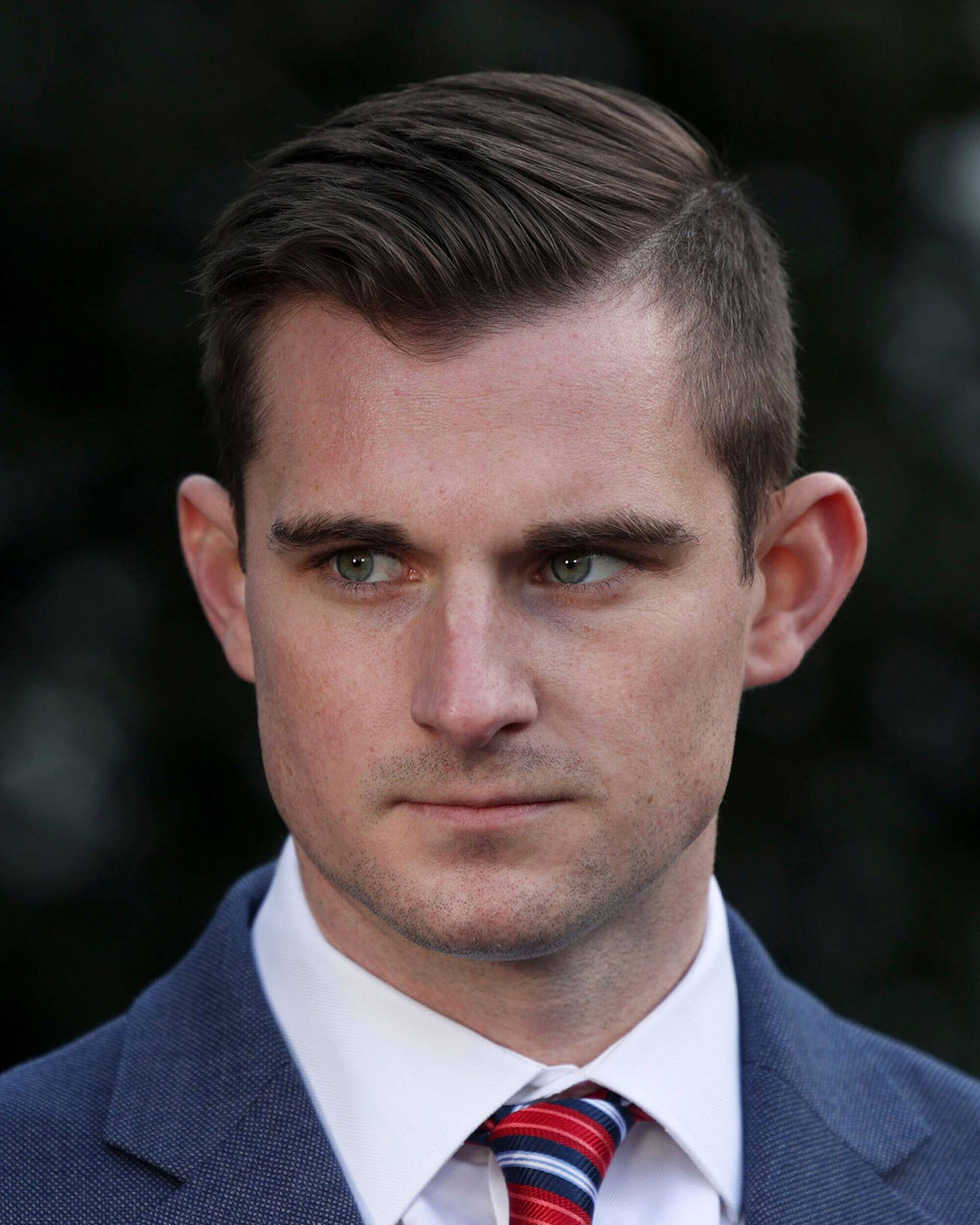
Bo Hines, appointed by Trump as Executive Director of the Presidential Digital Assets Advisory Council, leading the push for the GENIUS Act through Congress. Photo: Tierney L. Cross/Bloomberg
Many financial experts warn that these provisions could weaken the US's ability to combat money laundering by criminals and sanctioned entities, while simultaneously hindering Trump's goal of establishing a global digital currency leader.
Timothy Massad, former Assistant Treasury Secretary under the Obama administration, raised concerns that regulatory loopholes could create an uneven playing field, where US-based crypto firms face high compliance costs while foreign issuers can circumvent stringent AML rules, potentially even harming the US dollar's global reserve currency status. Massad also served as Chairman of the Commodity Futures Trading Commission from 2014-2017.
"If we want the US dollar to remain the world's primary reserve currency, we cannot allow terrorists, sanctioned individuals, and criminals to move dollar funds anonymously," Massad said.
Every currency carries the risk of illicit use. However, since launching USDT in 2014, Tether has faced persistent scrutiny over its insufficient due diligence on users. Tether previously argued that being based overseas protected it from what it termed US "over-regulation." Its stance later shifted: in December 2023, Tether implemented rules to proactively freeze wallet addresses linked to individuals and entities on the US Treasury's sanctions list.
Investigative bodies have continuously gathered evidence showing USDT is used for activities like funding fentanyl trafficking in Mexico and helping Russia evade sanctions. A January 2024 UN report identified USDT as the preferred tool for Southeast Asian crypto money laundering syndicates. Two sources revealed that in 2024, the Biden administration's National Security Council even discussed a potential ban on Tether's token entering the US market entirely.
This proposal was ultimately shelved, with law enforcement citing the ability to trace illicit funds associated with USDT through on-chain transactions. Over time, federal law enforcement also acknowledged Tether's increased willingness to cooperate in freezing assets involved in illegal activities.
A Tether spokesperson responded: "The company has built a law enforcement cooperation mechanism leading the global financial sector in effectiveness." Tether stated its commitment to combating financial crime and that the GENIUS Act would further strengthen these efforts.
Even so, throughout the bill's negotiations and after its enactment, USDT has continued to be frequently chosen by illicit groups.
Data from blockchain analytics firm Elliptic shows that in 2025, the sanctioned Central Bank of Iran purchased $507 million worth of USDT. In July of the same year – the month Trump signed the bill – Elliptic detected nearly $2.5 billion in USDT flowing into wallets of multiple Russia-linked entities, which the US Treasury identified as building cross-border channels to help various parties evade sanctions.
This year alone, over $4 billion worth of USDT circulated in black markets operated by Chinese scam syndicates, used for activities like pig butchering, impersonation scams, and sextortion, according to Elliptic data.
Court records show that since July 2025, federal prosecutors across the US have filed dozens of lawsuits seeking to seize USDT involved in illegal activities, with the total amount in question at least $172 million.
Tether's circulating supply is more than double that of its primary competitor, Circle Internet Group Inc, but it employs less than half the staff, outsourcing much of its suspicious transaction analysis to third parties. Tether declined to disclose the size of its compliance team but stated: "We continuously cooperate with over 67 jurisdictions and more than 340 law enforcement agencies globally to identify, freeze, and assist in recovering assets linked to illegal activities."
A company spokesperson said: "This is not just a paper compliance commitment; it is actionable, quantifiable cooperation that most traditional financial institutions struggle to match."
Howard Lutnick's Lobbying Network
Cantor Fitzgerald began managing Tether's reserves in 2021, around which time the investment bank executive had known Trump for decades. Trump had just finished his first presidential term and was preparing to return to the White House. Tether was highly profitable but faced significant market controversy. In 2024, Howard Lutnick was simultaneously working for Trump's campaign and Tether.
Independent auditing is crucial for convincing investors that a token has adequate reserves, but Tether has never published a full independent audit of its reserves. In 2021, Tether and a related exchange paid a $61 million settlement to resolve charges brought by federal regulators and the state of New York, which alleged Tether misrepresented its reserves and misled investors. Tether did not admit wrongdoing in the settlement. Under the GENIUS Act, stablecoin issuers must produce annual audit reports. Tether announced hiring auditors this year but has not yet disclosed a timeline for releasing a complete audit report.

Howard Lutnick (then Chairman and CEO of Cantor Fitzgerald) at the World Economic Forum in Davos, Switzerland, January 2024. Source: Bloomberg
When the market persistently questioned the authenticity of Tether's reserves, Howard Lutnick publicly stepped forward to vouch for the company. In January 2024, he appeared on Bloomberg TV from Davos, stating: "They have the funds they claim to have."
The following month, Lutnick traveled to El Salvador to meet with Tether Chairman Giancarlo Devasini and the country's crypto-enthusiast president, Nayib Bukele, who calls himself the "world's coolest dictator." Soon after, Tether officially announced plans to relocate its headquarters to the capital, San Salvador.
In April 2024, Cantor Fitzgerald spent $600 million on a convertible bond, securing options for a 5% stake in Tether. This deal was only made public months later, after Trump won the November election. Based on Tether's own financial reports, the discount was enormous: in 2024, Tether's net profit was approximately $13 billion. Applying valuation logic used for public financial institutions, the company's valuation would be at least $130 billion. By this estimate, the paper value of Cantor's investment stake exceeds $6 billion.
Bitcoin entrepreneur Cory Klippsten, who met with Tether executives and Howard Lutnick in 2024, recounted that Tether Chairman Giancarlo Devasini described the deal as "ridiculously cheap."
Cory Klippsten had previously engaged in a business partnership with Tether that ended acrimoniously, leading to litigation. In court documents, Klippsten accused Tether executives of poaching staff, stealing code and trade secrets, and breaking agreements. Tether countersued Klippsten for improperly using Tether's investment as collateral for other trades. During the lawsuit, Klippsten sought to subpoena Howard Lutnick and obtain communications between Cantor Fitzgerald and Tether. Lutnick's lawyers argued in court that the Commerce Secretary was unrelated to the dispute and that the request was merely to "harass and humiliate Lutnick."
In a March court filing, Klippsten stated he had preserved records of his conversation with Giancarlo Devasini, with the complaint excerpting dialogue that included the phrase "ridiculously cheap price." The filing suggests that Cantor's convertible bond was essentially implicit compensation for Howard Lutnick acting as Tether's advocate in Washington D.C. and the media.
The Early Regulatory Bill that Was Abandoned
Lawmakers had long been skeptical of Tether. In late 2023, Wyoming Republican Senator Cynthia Lummis co-signed an open letter urging the Justice Department to investigate whether Tether provided material financial support to Hamas and other terrorist groups during the October 2023 attack on Israel. In April 2024, Lummis teamed up with New York Democratic Senator Kirsten Gillibrand to introduce a bill requiring all stablecoin issuers operating in the US to comply with US AML rules and disclosure obligations.
Lummis made her stance clear: if Tether wanted to access the US market, it would have to follow US laws. "If Tether decides to stay overseas and be regulated by another regulator, that's a business decision," she told CoinDesk after the bill's release. "But if they want to be accepted in the US market, we expect them to be compliant with US rules."
In July of the same year, at the Nashville Bitcoin Conference, Howard Lutnick again publicly supported Tether. Trump also delivered the keynote address at this event. An emotional Lutnick said, "We will never work with any company involved in jihadist terrorism; this issue is deeply personal to me." He reminded the audience that Cantor Fitzgerald lost over 650 employees in the 2001 World Trade Center attacks, including his brother.
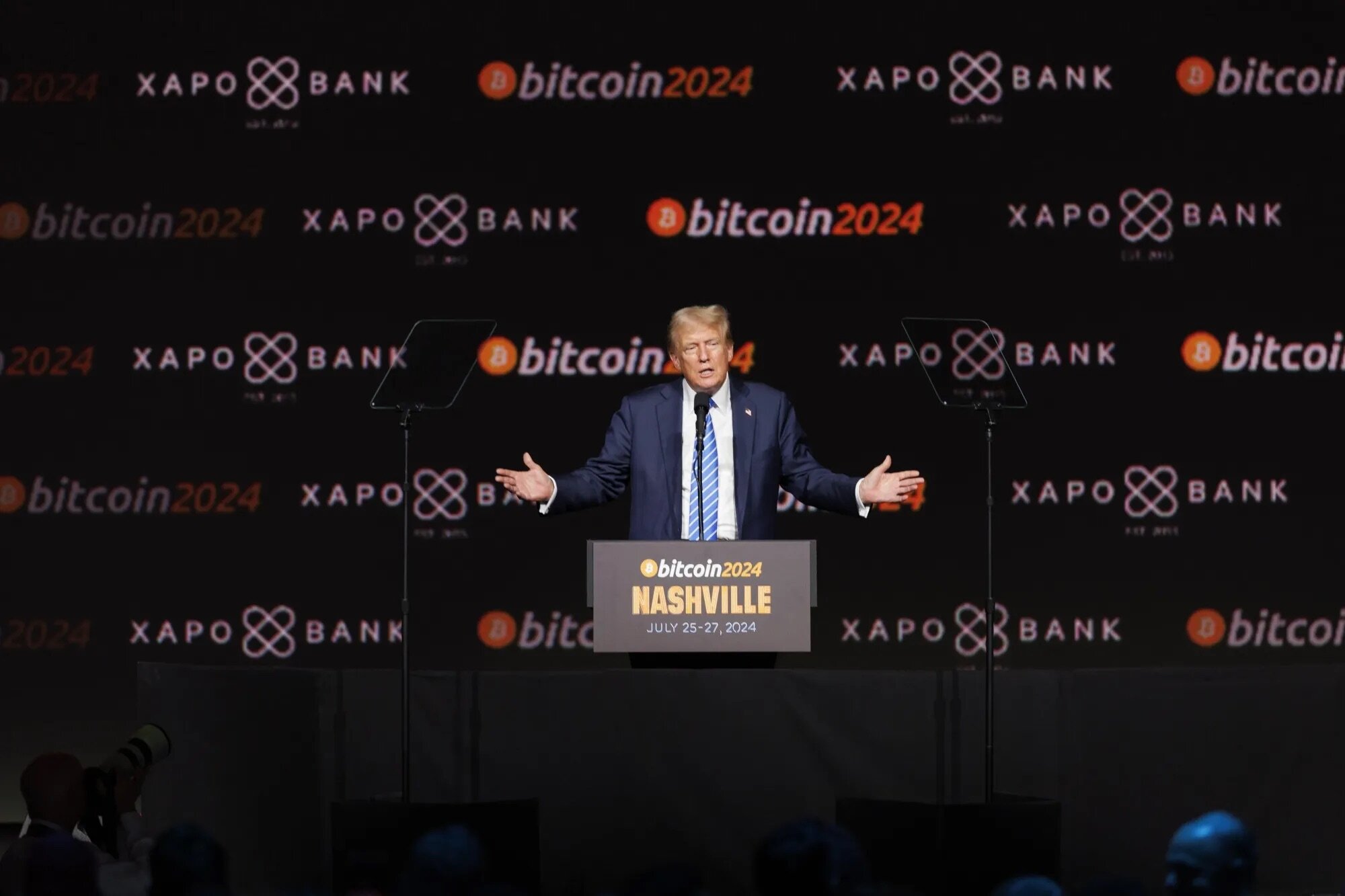
Trump speaks at the Bitcoin 2024 conference in Nashville, Tennessee, July 2024. Photo: Brett Carlsen/Bloomberg
After this speech, Trump, who had shifted from a crypto skeptic to a supporter, invited Lutnick onto his campaign plane and appointed him co-chair of his Presidential Transition Committee. The group flew to Minnesota, where Lutnick delivered a warm-up speech before Ohio Senator JD Vance (a known crypto supporter) spoke.
Cory Klippsten's notes indicated that Trump's rising poll numbers greatly boosted Tether executives' confidence. "They saw a new opportunity to fly to New York, appear on CNBC – that's the platform Trump can provide."
In 2024, Howard Lutnick traveled to Washington D.C. Lobbyists hired by Cantor Fitzgerald continuously communicated with House and Senate lawmakers to advance several pending stablecoin bills. Sources revealed that Lutnick met with then-House Financial Services Committee Chairman Patrick McHenry to discuss how new laws would impact foreign companies like Tether. McHenry did not grant an interview. In September, Lutnick met with Cynthia Lummis. Her spokesperson stated the meeting primarily concerned the formation of the presidential transition team, with only a brief discussion of her concerns about Tether's involvement in financial crime.
The spokesperson emphasized:


