






「小作文」再引恐慌: 谷歌或成首家削减AI支出的巨头?


Original Title: AI Bubble Burst: Alphabet Could Be The First To Cut AI Capex
Original Author: Damir Tokic, Seeking Alpha
Original Translation Compiled by: Surge
Editor's Note: Damir Tokic, a Seeking Alpha columnist, finance professor, and CTA (Commodity Trading Advisor), published a forward-looking analysis of Alphabet's earnings on Monday, sparking widespread discussion among US stock investors. The article suggests that Alphabet, Google's parent company, could become the first major tech firm to cut AI capital expenditures. Notably, Alphabet will hold its Q2 2026 earnings call on July 23 at 4:30 AM Beijing time.
Driven by the spread of this view and market sentiment, discussions around AI capex and the "AI bubble" have heated up again. Several AI semiconductor-related stocks, such as SK Hynix, turned from gains to losses during intraday trading. The following is the original content:
Alphabet Reports Earnings First
Alphabet (GOOG) (GOOGL) will be the first to report earnings, with market focus squarely on AI capex guidance. In April, Alphabet raised its AI guidance for 2026 and signaled a significant increase in AI capex for 2027.
However, there are growing concerns in the market that AI capex is unsustainable on multiple levels, and hyperscalers may have to slow down or even cut AI capex through the rest of 2026 and into 2027. Given that Alphabet will be the first to report Q2 earnings, it could be the first hyperscaler to lower AI capex expectations, with others—Meta (META), Microsoft (MSFT), Amazon (AMZN), and Oracle (ORCL)—likely following suit.
In fact, the recent weak performance of AI capex beneficiary stocks—such as the semiconductor sector (SMH)—reflects the market's anxiety over AI spending.
As detailed below, Alphabet is particularly vulnerable due to its adjusted free cash flow issues and the need to issue debt and new equity to fund AI capex.
Even a mere hint from Alphabet of slowing AI capex guidance could accelerate the bursting of the AI bubble—making this a macro signal as well.
The Big Picture
First, let's look at the big picture. The U.S. economy, particularly the stock market, is heavily reliant on AI capex. Estimates suggest AI capex will be around $700-800 billion in 2026 and well over $1 trillion in 2027, primarily focused on data center infrastructure.
However, multiple constraints make this projected AI capex difficult to realize.
· Tokenomics and Return on Investment (ROI): The most critical constraint is the uncertain ROI of AI capex, which is likely well below the cost of capital—meaning AI spending could be wasteful. Specifically, U.S. data centers are designed for expensive frontier models, while enterprises adopting AI demand cheap open-source models. This creates a mismatch. Due to the substitution effect (from expensive to cheap), token prices are continuously falling, compressing hyperscalers' margins per token and making the entire project financially unsustainable. China's new open-source model, Kimi K3, demonstrates that powerful LLMs can be built at very low cost—raising the question of whether all this AI capex is necessary.
· Energy and Water Constraints: Data centers require vast amounts of electricity and water for cooling. These are tangible physical constraints limiting the further expansion of data center infrastructure.
· Regulation and Local Opposition: New York State pioneered a one-year moratorium on new data center construction, and several other states are considering similar measures. In the U.S., it seems "red states" like Texas permit data center construction, while "blue states" like New York oppose it. Consequently, AI infrastructure has become politicized. Even in Texas, consumer resistance to data centers is growing, potentially becoming a difficult issue for Republicans in the upcoming elections.
Therefore, AI infrastructure faces real financial, physical, and political constraints, making it difficult to see how current AI capex guidance can be sustained.
As mentioned, even signs of slowing AI capex could accelerate the bursting of the AI bubble.
Alphabet's Position
The market narrative surrounding Alphabet has been:
· "The risk of under-investing is greater than the risk of over-investing"—implying Alphabet acknowledges the possibility of over-investment but is willing to continue AI capex for competitive and strategic reasons.
· "Compute demand outstrips supply"—suggesting Alphabet has not seen overcapacity and has explicitly stated that building more capacity would lead to higher revenue.
Thus, there were no signs Alphabet would slow or cut its AI capex guidance.
However, problems are emerging on the financing side of AI capex—these are real funding constraints.
Specifically, Alphabet appears to have a significant free cash flow problem; therefore, it has been forced to sustain AI capex through debt issuance (over $30 billion in bonds issued in Q1) and equity financing (announced over $80 billion in new share issuance)—even halting share buybacks in Q1.
In fact, Alphabet's free cash flow problem may be more severe than reported. The Wall Street Journal, in an article titled "How Big Tech’s Financials Mask the True Cost of AI Buildout," citing "Heard on the Street" columnist Jonathan and Purdue Professor Kevin Koharki, pointed out that after adjusting for economic costs like stock-based compensation, Alphabet's 2025 free cash flow could be 67% lower than reported, and Q1 2026 free cash flow 62% lower. This means the reported $73 billion in 2025 free cash flow would fall to $24 billion, while the reported $10 billion in Q1 2026 free cash flow would drop to around $4 billion.
The key implication is that Alphabet cannot sustain AI capex without borrowing and issuing new shares—increasing debt exposes it to credit risks (especially with low ROI), while new equity dilutes existing shareholders.
Now, as we approach the Q2 earnings report, Alphabet must update its AI capex guidance—creating a tricky situation for investors.
· If Alphabet raises AI capex guidance despite facing financial constraints (tokenomics, ROI), physical constraints (energy, water, opposition), and funding constraints (FCF, debt, equity), investors will question management's motives and prudence—the stock price is likely to fall.
· If Alphabet cuts AI capex guidance, it will be interpreted as a macro signal, likely accelerating the AI bubble burst, particularly hitting AI capex beneficiary stocks like SMH.
· Even if Alphabet merely reiterates its 2026 guidance and offers cautious but slightly bullish commentary on 2027 AI capex, it could be perceived as slowing AI capex growth, producing the same macro effect as an outright cut.
Therefore, this is indeed a dilemma for Alphabet and the broader market. Investors are unlikely to reward increased capex, while a cut would likely penalize AI capex beneficiary sectors.
Judging by the recent performance of the semiconductor sector, investors seem to be already preparing for a slowdown or cut in AI capex.
Alphabet's Financial Situation
Approximately 80% of Alphabet's revenue comes from its Services (ad-driven) business, primarily Google Search, while about 20% comes from Google Cloud.
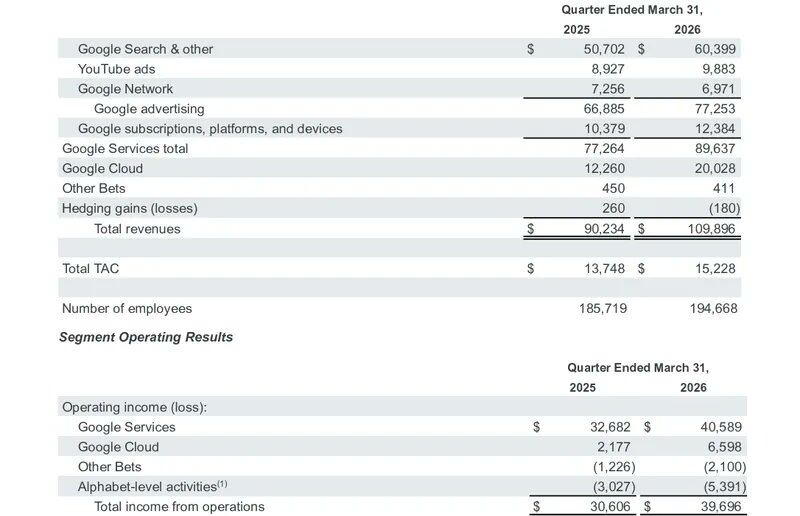
Alphabet Q1 Earnings Report
Alphabet CEO Sundar Pichai stated after the Q1 results:
A strong start to 2026. Our AI investments and full-stack approach are activating every aspect of our business. Search had a strong quarter, with AI experiences driving usage growth, query volume at an all-time high, and revenue up 19%. Google Cloud revenue grew 63%, with backlog nearly doubling sequentially to over $460 billion. Driven by the Gemini app, this was our strongest quarter ever for consumer AI. Total paid subscriptions reached 350 million, driven by YouTube and Google One. Gemini enterprise momentum is strong, with paid monthly active users up 40% sequentially. Finally, I'm thrilled to see Waymo surpassing 500,000 fully autonomous rides per week. These outstanding results are built on our differentiated full-stack approach. Our proprietary models like Gemini now process over 16 billion tokens per minute via direct customer API calls, up 60% sequentially. It's exciting to see our AI investments creating value for users, customers, and the business.
Thus, Google Search grew by about 19%, overall margins improved from 34% to 36%, and AI Overviews have not yet eroded advertising revenue.
Google Cloud grew 63%, with compute demand remaining strong—this is Alphabet's primary growth driver. Additionally, Gemini API usage grew, with token usage up 60%, indicating the model substitution effect has not yet materialized.
These are positive signals, and there are no factors in the financial data pointing to a downgrade—in fact, Alphabet is seen as an AI winner, with even Berkshire Hathaway investing in it.
However, problems are gradually appearing in the cash flow statement, even without adjusting for free cash flow. With FCF declining, Alphabet cannot achieve its guided AI capex without taking on significant credit risk or diluting existing shareholders.

Alphabet Q1 Earnings Report
Implications and Insights
Alphabet reported strong Q1 financials. The only red flag was declining free cash flow—especially the adjusted decline—which is a significant warning justifying a downgrade of GOOG to a "Sell" rating.
Alphabet cannot achieve its AI capex guidance without new debt and equity issuance, which not only increases credit risk and dilutes shareholders but also curtails buybacks. In the context of the big picture outlined above, this is negative.
If Alphabet cuts or slows its AI capex guidance, investors will have to lower growth expectations, implying a contraction in valuation multiples—also negative. Note that GOOG's GAAP P/E ratio is 26x, not particularly expensive. However, given concerns about overall earnings inflation, the actual P/E could be much higher.
Please note, this is also a macro judgment—as the bursting of the AI bubble accelerates, the S&P 500 (SPY) (SP500) and Nasdaq 100 (QQQ) could face a deep correction, with Alphabet potentially being the first hyperscaler to cut AI capex guidance.


