NOXA exits the stage, who will claim the crown of Robinhood Chain's token issuance?


- Core Thesis: NOXA, the hottest token launch platform on Robinhood Chain, suddenly ceased its core issuance business due to ownership disputes and bot attacks. Since then, traffic has been diverted to platforms like Flap and Bankr. However, a new leader has yet to emerge, and the ecosystem still needs a high-market-cap representative Meme coin.
- Key Elements:
- At its peak, NOXA had issued approximately 60,000 tokens cumulatively, accounting for over 75% of all new token issuances on the entire chain. It also produced the Meme coin CASHCAT, which reached a market cap of over $200 million, with cumulative protocol fees once exceeding $14.5 million.
- On July 11, NOXA announced the suspension of new token issuances, citing bot-driven mass token creation and Vamp attacks. After its relaunch, it only retained functions for trading historical tokens and claiming fees, effectively exiting the competition.
- NOXA's lead developer, Amun Phantom, operates anonymously and has been involved in the early stages of other new chain projects like Monad and MegaETH, excelling at capturing initial first-mover traffic but lacking proven long-term operational sustainability.
- After NOXA's halt, Robinhood Chain's token issuance volume hit new highs: on July 14 alone, over 31,000 Meme tokens were created in a single day. Currently, more than 20 launchpads are competing for traffic.
- Flap has emerged as the biggest beneficiary: it saw over 11,000 tokens created in a single day, accounting for more than 35% of daily issuance. However, it has not yet produced a representative token to rival CASHCAT.
- Bankr focuses on AI Agent-centric token issuance, with backing from Coinbase Ventures and a relatively high level of product maturity. Klik attracts traders through fee rebates.
- The current landscape for token launch platforms on Robinhood Chain is highly competitive, but no single platform has proven itself to be the new traffic hub. To become the leader, a platform must first produce a Meme coin with a market cap in the tens of millions or even hundreds of millions of dollars.
Original Article: Odaily 星球日报 (@OdailyChina)
Author: Asher (@Asher_0210)
NOXA, the most popular token launch platform on Robinhood Chain, suddenly announced the suspension of its token issuance business at its traffic peak.
Over the past ten-plus days, NOXA has dominated the meme narrative on Robinhood Chain, having launched approximately 60,000 tokens in total. It once accounted for over 75% of all new token issuances on the network and produced CASHCAT, a meme coin with a market cap peaking above $200 million. Additionally, NOXA’s cumulative protocol fees exceeded $14.5 million, and its consecutive single-day fees even surpassed those of Pump.fun before the crash.
However, this explosive run lasted less than two weeks before NOXA bowed out amid ownership disputes. Who can take over from NOXA to become the next leading token launch platform in the Robinhood Chain ecosystem?
From Temporary Suspension to No Resumption: What Really Happened to NOXA?
On July 11, NOXA officially announced a pause on new token launches, citing a massive influx of bot-generated tokens, replication of popular projects, and Vamp attacks, which severely overloaded the platform with new coins. The market generally viewed this as a temporary adjustment.
Subsequently, the NOXA website experienced a two-day outage. The team explained that traditional domains were affected by Cloudflare and IP issues and that they were testing a new ENS-based entry point. They assured that historical tokens could still be traded on Uniswap and creators could continue to claim fees.
However, the reactivated page last night revealed a situation beyond a simple technical glitch. NOXA only restored static entry points for viewing historical tokens, trading, and claiming creator fees. The new token launch function was not restored. Simultaneously, trading fees for historical tokens were adjusted to 100% allocation to creators. This means that although NOXA hasn't completely shut down, it has ceased its core token issuance business, effectively exiting the race for Robinhood Chain’s launchpad crown.
The community consequently began labeling NOXA a "rug pull." However, as of press time, there is no on-chain evidence indicating that NOXA has withdrawn locked historical LP, transferred user custodial assets, or engaged in clear on-chain theft. More accurately, NOXA resembles a project that abruptly stopped its core business at peak traffic, rather than one that vanished after absconding with assets.
Looking at the team's background, signs of NOXA's sudden halt were perhaps present. Its publicly stated lead developer, Amun Phantom, is anonymous and has previously participated in projects like Monad, Plasma, and MegaETH. He appears more like a serial entrepreneur chasing new chain opportunities: skilled at quickly launching products and capturing first-mover traffic in early ecosystems, but with an unproven track record for sustained operations after the hype fades.
NOXA Falls, But Robinhood Chain’s Token Issuance Hits New Highs
Following NOXA's pause, the frenzy of token issuance on Robinhood Chain has not cooled down.
According to Dune data, the network-wide token creation briefly dipped on July 12 but rebounded sharply just a day later. On July 13, 19,586 meme tokens were created in a single day, second only to Solana. On July 14, this number further exceeded 31,000, setting a new record since Robinhood Chain’s mainnet launch.
The new token issuance demand on Robinhood Chain has been rapidly diverted to other launch platforms. Currently, over 20 launchpads exist on Robinhood Chain. Platforms with single-day issuance exceeding 1,000 tokens include Flap, trench.today, Bankr, and Klik. Meanwhile, products originally active on Base, such as Virtuals, Clanker, and Bankr, have also entered Robinhood Chain via cross-chain deployment or external entry points.
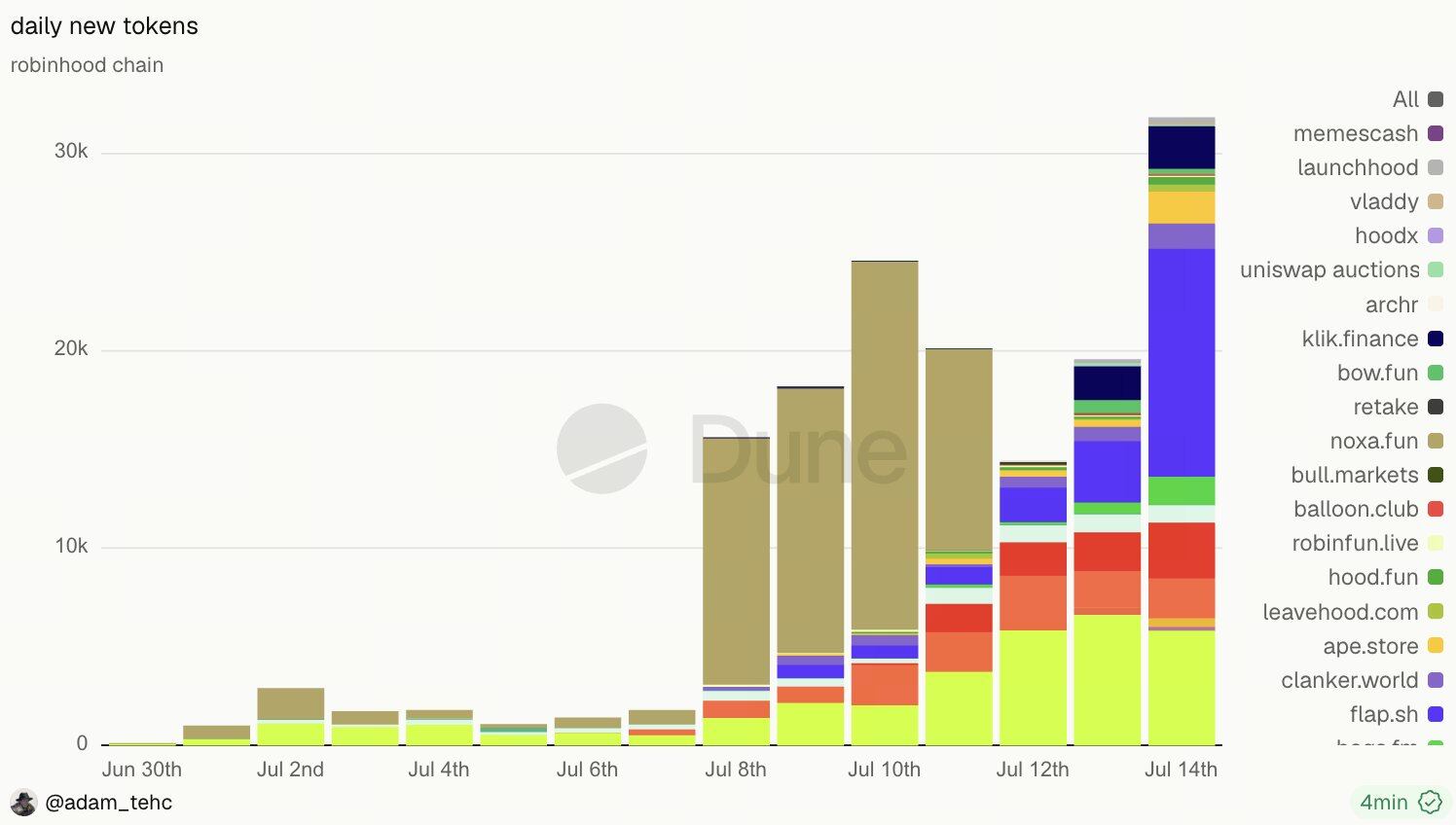
Daily token creation count on Robinhood Chain
Flap Emerges as the Biggest Beneficiary
After NOXA halted operations, Flap was the first to capture this traffic wave. Flap created over 11,000 tokens in a single day, accounting for over 35% of the daily token creation on Robinhood Chain, making it the largest launch platform on the network currently.
Flap is not a newly built platform created after NOXA's crash. Previously, Flap had already deployed token issuance services on EVM networks like BNB Chain and Base, supporting regular tokens, tax tokens, and creator fee distribution models. It was also selected for the third season of YZi Labs’ EASY Residency program.
Although Flap’s prior performance on BNB Chain and Base was not particularly outstanding, its multi-chain experience allowed for rapid deployment once Robinhood Chain gained traction. Compared to native launch platforms starting from scratch, Flap didn’t need to rebuild products and contracts. It simply needed to integrate a trading terminal and open the issuance entrance to quickly absorb the massive demand left by NOXA.
However, currently Flap mainly handles the volume of issuances; it has yet to produce a representative token comparable to CASHCAT.
Bankr: The Newcomer with the Strongest Team Background
Bankr is not a traditional web-based token launch platform; it is an AI Agent-centric entry point for token creation. Users can create tokens via the Bankr Agent, X, Telegram, or Console, with issuance and liquidity deployment handled by Doppler and Uniswap V4. Currently, Robinhood Chain has become a primary issuance network for Bankr alongside Base.
Bankr’s greatest advantage lies in its team and resources. Coinbase Ventures previously supported Bankr through the Base Ecosystem Fund. In contrast to many anonymous teams with newly launched products, Bankr boasts more mature products, stronger financial backing, and more comprehensive external channels.
In terms of token issuance volume, Bankr will find it difficult to compete with Flap, which opens its API to cater to high-volume bot-generated issuances. However, by establishing multiple issuance gates through AI Agents, social platforms, and developer tools, Bankr is better positioned to attract genuine creators and projects. Rather than purely focusing on issuance quantity, Bankr’s potential to leverage its distribution capabilities to produce higher-quality, longer-lasting tokens is more noteworthy.
Klik Competes for Traders with Fee Rebates
Klik is also not a new launch platform on Robinhood Chain. Its documentation indicates support for Ethereum, Base, and Robinhood Chain. Tokens launched on Klik receive direct Uniswap V4 liquidity and operate on a dynamic fee model that decreases as market cap grows.
Upon entering Robinhood Chain, Klik officially announced it would return all platform-generated fees to traders to attract early users and trading volume.
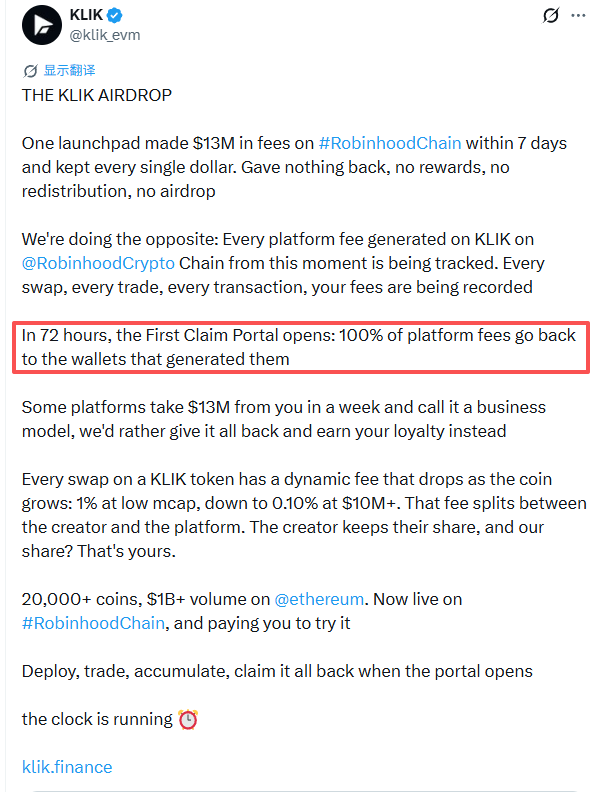
Klik’s fee rebates might attract bots and high-frequency traders in the short term, but whether this subsidized traffic can be converted into long-term users depends on its ability to produce a truly distinctive representative token.
trench.today Joins the Top Tier, but Transparency is Lacking
On July 14, trench.today created 2,830 tokens in a single day, ranking it among the top launch platforms on Robinhood Chain. The platform uses a Bonding Curve model, focusing on creator fee splits. Having previously operated on Ethereum, it quickly extended its launch functionality to Robinhood Chain.
Data suggests trench.today has successfully absorbed the overflow demand after NOXA stopped issuing and now sits in the top tier of issuance volume. However, its shortcomings are equally clear. Currently, verifiable team background, fundraising details, and historical operational data are limited, and the platform has yet to see a sufficiently distinctive representative token.
A Chaotic Battle for Launchpad Supremacy: The Next Leader Remains Undetermined
Robinhood Chain is an open network; any developer can deploy contracts and create tokens. Having "Robin," "Hood," or "Vlad" in the name, being listed on trading terminals, or receiving likes or retweets from Robinhood-related individuals are insufficient to prove official Robinhood vetting, investment, or endorsement.
The rapid rise and fall of NOXA demonstrates that the biggest moat for a token launch platform has never been code. Launch pages can be replicated in a day, issuance contracts can be deployed across chains, and bots can switch entry points at any time. Therefore, creating thousands or even tens of thousands of tokens in a single day only proves a platform is temporarily absorbing issuance demand, not that it has become a new traffic hub.
What truly propelled NOXA to the top spot on Robinhood Chain wasn't just its issuance volume, but the fact that it produced CASHCAT. A meme coin once valued at over $200 million brought sustained trading volume, user attention, and wealth effects to NOXA, attracting more token creators and traders to the platform.
Therefore, to become Robinhood Chain’s next leading token launch platform, one must first produce a representative meme with a market cap of tens or even hundreds of millions of dollars. Until then, Robinhood Chain remains a battleground with many entrances but no clear leader.