






OpenAI与Anthropic的IPO对决:万亿估值、价格战与中国开源转向


Compiled & Translated by: Shenchao TechFlow
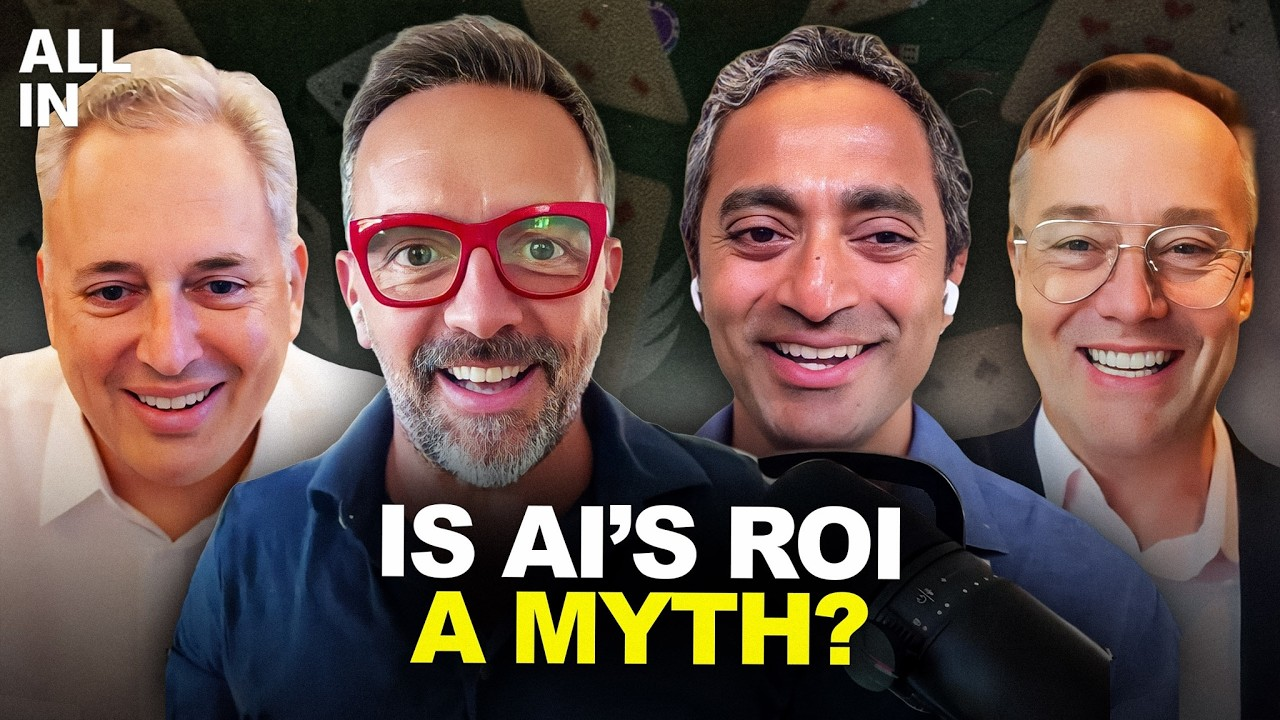
Guests: Chamath Palihapitiya (Founder of Social Capital), Brad Gerstner (Founder & CEO of Altimeter Capital), David Sacks (Partner at Craft Ventures)
Host: Jason Calacanis, All-In Podcast
Podcast Source: All-In Podcast
Original Title: OpenAI vs Anthropic IPOs, Anthropic $3T, Zuck's Price War, China Ends Open Source?, Trump Accounts
Air Date: July 11, 2026
Key Takeaways
In this episode, All-In #280, Friedberg is on vacation, and Brad Gerstner fills in. The show kicks off with a trillion-dollar IPO race: SpaceX has already gone public successfully at a $1.75 trillion valuation. Anthropic confidentially filed on June 1st, with OpenAI close behind. Gavin Baker predicts Anthropic's annual revenue could surpass $100 billion this year, with an IPO valuation potentially reaching $3 trillion. Brad doesn't hesitate to say Altimeter would heavily buy into both companies' IPOs.
But Chamath pours cold water on the optimism. He finds that his company's token costs are doubling every 45 days, while downstream productivity gains are at most 5%. He asked Claude 5 a question: How much EPS growth has AI contributed to the S&P 500? The answer was 50%. However, stripping out the revenue from Nvidia selling chips to Amazon, the actual EPS growth for the S&P 493 is only 9%, mostly driven by pricing power above inflation and buybacks, with the true AI ROI falling between 0% and 2%. Chamath's take: if you can go public now, do it now, before these numbers seep into the market's waterline.
The latter half shifts focus to China. Reuters reports that the CCP is considering restricting overseas access to China's top AI models, classifying AI research leaks as national security crimes. Sacks has discussed this topic in Washington with the White House and Treasury. His assessment: China's strategy mirrors Sam Altman's from years ago—open source while catching up, then close source once ahead. He also reveals that GLM-5.2 contains distillation watermarks from US frontier models, and the US government is likely to crack down on distillation. The show wraps up with Brad spending nearly an hour on Trump Accounts, a plan to give $1,000 to every newborn American, invested in the S&P 500. The app opened 1.5 million accounts and attracted over $1 billion in deposits within 24 hours.
Highlights of Key Perspectives
On IPO Timing
- Chamath: "If you can go public now, do it now, before these numbers seep into the waterline. Because I think that's the window where you can sell high and raise a lot of money."
- Brad: "Altimeter would buy both of these IPOs today, at scale and size."
- Brad: "Anthropic's annualized revenue could exceed $100 billion, while SpaceX's forward revenue is only $35 billion. Based on SpaceX's success, this will be a phenomenal IPO."
On AI ROI
- Chamath: "My token costs are doubling every 45 days, and downstream productivity gains are maybe 5% at best. My costs are doubling, and my returns are basically flat."
- Chamath: "The S&P 493's EPS growth is 9%, most of which comes from pricing power above inflation, and another 3% from buybacks. The true AI ROI is between 0% and 2%."
- Brad: "We've never seen revenue growth like this because we've never seen a TAM this large. Intelligence is the largest addressable market in human history."
On Open Source vs. Closed Source
- Sacks: "The spirit of the enterprise is willing, but the flesh is weak. They want to move off closed-source models, but they can't."
- Sacks: "Open source's share of enterprise spending is actually declining, from 19% last year to 11% this year."
- Brad: "When you're using a $3 cheap model or a $15 frontier model to replace a $200-an-hour consultant, that price difference is irrelevant."
On China's Open Source Pivot
- Sacks: "China's strategy is clear: you open source when you're catching up, and you close source when you've caught up. Sam Altman did the exact same thing three years ago with OpenAI."
- Sacks: "GLM-5.2 contains Mythos's distillation watermark. The US government will act against distillation, and it should."
- Chamath: "The best thing for the US would be if China also develops a doomer community."
On Trump Accounts
- Brad: "If you get $1,000 at birth, and someone matches some of it, plus you save $10 a week, by 18 you have $50,000. All invested in the S&P 500."
- Sacks: "If a Trump Account is max-funded from the start, based on market returns over the past 30 years, that child would be a millionaire by age 28."
- Jason: "This could replace Social Security. This replaces the Giving Pledge."
Main Text
Chapter 1: The Trillion-Dollar IPO Race: SpaceX Sets the Precedent, OpenAI and Anthropic Ready to Enter
Jason: Let's start with the IPO updates. A trillion-dollar IPO race is underway. SpaceX has gone public, trading roughly at its offering price. A perfect pricing job. Next up, theoretically, are two more: OpenAI and Anthropic. SpaceX's stock briefly hit $200, now back to $150, exactly at the offering price. Current market cap is $2 trillion, making it the 7th largest company globally. Anthropic confidentially filed on June 1st. Polymarket gives it a 65% chance of going public this year. Gavin Baker said two weeks ago that he believes Anthropic's revenue will exceed $100 billion by year-end and be profitable, estimating a $3 trillion valuation if it IPOs now. Chamath, you previously said Elon going public first was a smart move. What's the probability these two come out this year or in Q1 next year?
Chamath believes both are excellent businesses, but the core question is where the market-clearing price will be. This depends more on the market's appetite for new issuances and at what price levels the market can absorb them.
OpenAI and Anthropic are at different stages. OpenAI's last disclosed information showed high cash burn due to its diversified business and heavier reliance on consumer end. Brad mentioned earlier that Anthropic might have accidentally become profitable. Chamath shares a detail: He asked his CTO about token spending, and was told, "it's currently doubling every 45 days." He followed up asking how much downstream productivity had increased. The CTO said, "at most 5%." Costs are doubling while returns are essentially flat. The CTO explained that achieving the next iterative improvement requires consuming significantly more tokens because diminishing returns have set in.
Chamath's take: if you can go public now, do it now, before these numbers seep into market perception. That's likely the window to raise large amounts of money at high prices.
Brad, as an investor in both companies, offers a more optimistic view. SpaceX's IPO was textbook: raising $75 billion at a $1.75 trillion valuation, with forward revenue around $35 billion, and the stock has already risen 25%. Anthropic's revenue is rumored to potentially exceed $100 billion this year. If true, next year's GAAP revenue could far surpass that. Based on SpaceX's successful precedent, Brad thinks this will be a phenomenal IPO. SpaceX did groundbreaking work on total IPO size, pricing, liquidity, index inclusion, and lock-up arrangements. Both Anthropic and OpenAI are learning from it.
Regarding the controversy over index inclusion, Brad explains the old rules existed for a reason, as most newly listed companies are younger with less revenue and weaker profitability. But SpaceX was too large and important; not including it would have been irrational. Exchanges and index providers made adjustments without forcing inclusion at the peak, avoiding the common 30% post-IPO drawdown compounding problems for passive investors.
Brad also reveals OpenAI's latest status: revenue has recovered to around $70 billion this year, and GPT-6 might be released within 30 days. While only double SpaceX's revenue and less than Anthropic's rumored $100 billion, as one of two frontier labs, growing at this pace and going public at over a trillion dollars is reasonable. He doesn't see a race between the two; both will act when the time is right. OpenAI's corporate structure adjustments are more complex, so it might come after Anthropic.
Chapter 2: Token Costs Doubling Every 45 Days, AI ROI Near Zero?
Jason: We've been discussing the ROI of token spending for the past few weeks. CTOs and CEOs in the industry have started to respond publicly on X. Uber's CTO, Pinen, shared their approach: 99% of engineers use AI tools, over 70% of pull requests come from local or cloud-based agents, and engineers have built 200 agentic skills. They embed engineers into various departments as "forward-deployed engineers" to map processes with department heads. Brad, what do you think of Uber's approach?
Brad agrees with Chamath's point, but frames it as a matter of time horizon. A lot of money is currently going into experimental buckets that may not have a direct ROI. However, enterprise adoption of AI is still very early. The addressable market is every company on Earth, unprecedented in scale. Revenue distribution is also decentralized, with millions of customers independently making rational decisions daily.
Brad makes a bold prediction: If Anthropic's revenue exceeds $100 billion by year-end, their revenue next year could grow another 3 to 5 times. Going from $100 billion to $300 billion—an incremental $200 billion in revenue—is unimaginable in Silicon Valley history.
Chamath's skepticism centers on the sustainability of ROI. He asked Claude 5 two questions. First: How much EPS growth has AI contributed to the S&P 500? The answer was 50%. But he found this figure included Nvidia's revenue from selling chips to Amazon. So he asked a second question: What's the EPS growth for the S&P 493 (excluding the Mag7)? The answer was 9%. Breaking it down, the vast majority came from pricing power above inflation, with another 3% from buybacks. The ROI genuinely attributable to AI is between 0% and 2%.
Chamath argues the enterprise side looks flashy, but the problem is that smart investors like Brad and Gavin will eventually ask companies: "What's your ROI? Where's the actual EPS lift?" If the answer is "I'm not really sure," and without sustained pricing power, the enterprise side becomes fragile. The consumer side acts as a safe haven because you have tens of millions of buyers, much smaller price points, and an order of magnitude more buyers, shielding you from ROI scrutiny.
Jason adds a perspective: The unique aspect of this technology is that it touches everyone in an organization. When Excel came out, the accounting department was excited, but HR and marketing didn't feel much. AI is different. In an organization of a thousand people, everyone is using it, spending maybe $200 per person per month, doubling to $400. Against a $150,000 annual salary, that's only a 3-4% increase. The key question: Is it making that person 3 to 5 times more efficient? If so, that explains why token spending is skyrocketing.
Chapter 3: Open Source vs. Closed Source: Revenue Concentrating on Frontier, But Enterprises Want to Flee
Jason: Sacks, CTOs are starting to discuss intelligent routing on X—sending tasks to open-source models first, and falling back to Claude if they fail. What's your take on this trend? As an investor, when a CFO of a frontier model starts asking, "Can we get it cheaper?" how do you view the growth of frontier models?
Sacks agrees that enterprise CTOs do want to move token consumption to cheaper models. They are watching token costs skyrocket and are all looking for ways to slow down or control spending. Add to that the discussion about AI sovereignty from last week, and enterprises worry about giving their core alpha to a frontier lab that might become a future competitor.
Sacks's core judgment: Enterprises want to move off closed-source models, but most lack the technical capability to do so. The spirit is willing, but the flesh is weak.
Coinbase and DoorDash have done it. They built token-routing middleware, sending frontier tasks to frontier models and non-frontier tasks to standard models. But average enterprises don't have this capability. That's why the wallet share of closed-source models is actually increasing. Open source's share of enterprise spending dropped from 19% last year to 11% this year. This doesn't necessarily mean usage is declining; it might just be that using open-source models only involves paying hosting fees, not labs, making it hard to track.
Sacks also cites the perspective of Decagon's founder: When you know exactly what to do, using small, cheap open-source models is right, but you need data and post-training. If you still don't know what to do, you want the most powerful general intelligence. Use open source for mature use cases, frontier models for immature ones.
Jason mentions a finding from Databricks founder Ali: The same model, with a different harness (task orchestration framework), can halve costs. GLM-5.2 paired with a specific harness performs exceptionally well, cutting task load in half. Jason has his own experience: He built an hourly trend discovery agent. After optimization, token consumption dropped 80%. With tokens becoming cheaper, he switched the agent from daily to hourly runs, then split it into three parallel tasks. Waking up to find 14 tasks completed felt completely different.
Brad's view: The core debate is whether intelligence will converge. When the DeepSeek moment happened 18 months ago, the market dropped 40%. Many thought frontier models were done for, and open source would kill them. But 18 months later, the opposite is true. Jesse Zang's recent tweet pointed out that frontier labs' wallet share is actually rising, even though token usage is growing on both sides.
Brad proposes a counterintuitive hypothesis: Maybe intelligence won't converge at all. If superintelligence becomes self-recursive—smarter models make more money, more money buys more compute, more compute builds better models—the gap might not be shrinking over the next 2-3 years, but widening.
Jason also mentions his interview with Lovable's CEO Anton. The product launched about 30 months ago, and revenue went from zero to $600 million. He also asked 11Labs' CEO Matti: "You're a large customer of frontier models, spending tens of millions annually. Are you worried about data leaks and competition?" Both said they are developing their own models. These are eight- and nine-figure customers. If they all start building their own vertical models, frontier labs will feel


