






如何监管单股杠杆ETF?周四,全市场都盯着韩国政府这场会


- 核心观点:韩国上线的单股杠杆ETF在短短一个半月内被指加剧市场波动,并触发史上最多熔断,迫使韩国最高经济决策层(F4)紧急介入,寻求解决方案。
- 关键要素:
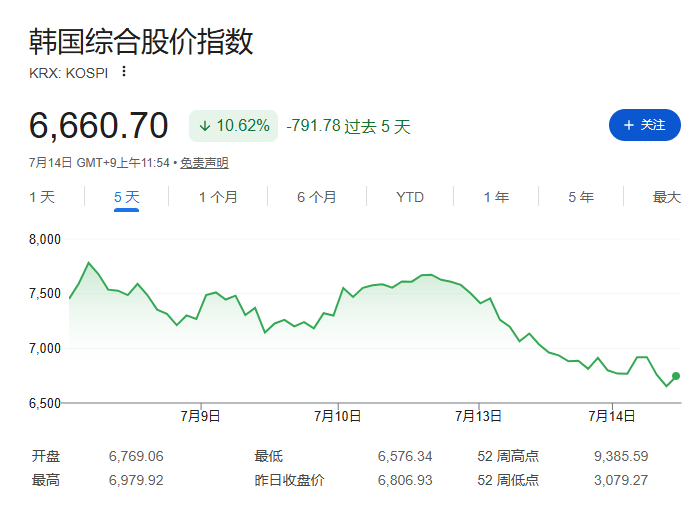
- 韩国KOSPI指数近期暴跌,单日跌超8%触发年内第七次熔断,市场普遍将矛头指向5月上线的单股杠杆ETF。
- 该产品允许投资者对三星电子等个股进行2倍押注,其“涨时助涨、跌时助跌”的放大效应在波动行情中加剧了价格偏离。
- 监管层措辞罕见严厉,金融监督院院长直言“后悔”未能阻止产品推出,并承认面临个人投资者净买入近10万亿韩元、强制清算困难的结构性困境。
- 数据证实冲击:产品上线后,KOSPI单日涨跌幅超3%的天数占比从27%飙升至52%;今年已触发35次“边车”机制,远超此前纪录。
- “F4”高层会议即将召开,讨论提高保证金、限制涨跌幅及调整杠杆比例三大潜在补救措施,但官方坦言或仅能“临时修补”。
Original author: Long Yue
Original source: Wall Street News
A financial product launched just one and a half months ago has put South Korea's top economic decision-makers on an emergency footing.
South Korea's "F4" high-level coordination mechanism will hold a meeting this Thursday to study countermeasures regarding the impact of single-stock leveraged ETFs on the stock market. This is the first time this issue has officially entered the highest-level economic coordination platform, which involves the joint participation of the Ministry of Economy and Finance, the Financial Services Commission, the Bank of Korea, and the Financial Supervisory Service.
The trigger for the event is clear: The KOSPI plunged over 8% in a single day this Monday, triggering its seventh circuit breaker of the year. Market blame is squarely directed at single-stock leveraged ETFs. These products amplify the daily price movements of individual stocks, accelerating price deviations during periods of sharp volatility and creating a magnifying effect where they "add fuel to the fire in both rallies and sell-offs." Single-stock leveraged products were officially launched on May 27, allowing investors to place 2x leveraged bets on the price movements of Samsung Electronics and SK Hynix. The returns of these products are linked to multiples of the daily price changes of the underlying assets. To achieve this return matching, daily buying or selling of the underlying assets is required, thereby further exacerbating market volatility.
Prior to Thursday's meeting, South Korean securities companies and asset management firms have planned to hold an industry meeting on Tuesday to discuss leveraged ETF issues and overall market conditions, gathering intelligence ahead of the government meeting.
Escalating Rhetoric from Regulators: The Rare Utterance of "Regret"
The tone from regulators has shifted from "concern" to "self-criticism," with admissions of facing structural dilemmas.
On July 13, Financial Supervisory Service Governor Lee Bok-hyun presided over a closed-door meeting on Yeouido with representatives from 20 asset management firms. During the meeting, he stated candidly: "There are structural issues, so it is unlikely we will provide a clear-cut answer." He further added, "Under the current circumstances, this problem cannot be solved all at once and requires continuous monitoring, revision, and improvement." This reflects the deep-seated predicament faced by financial authorities in proposing concrete solutions.
Regarding the so-called "structural issues," Lee did not elaborate. The general external interpretation is twofold: First, individual investors have already net purchased nearly 10 trillion Korean won in these products, making forced liquidation nearly impossible. Second, these products were launched only after joint amendments to enforcement decrees by the presidential office (Cheong Wa Dae), the Financial Services Commission, and the Korea Exchange. Forcing their delisting would damage the legal credibility of the relevant regulations.
He also stated: "This does not seem to be an area where any single individual can make the final decision. The authorities (the Financial Services Commission) may also need to conduct extensive deliberation. We (the Financial Supervisory Service) will do our best, but currently, we are in a position of absorbing criticism. Asset management firms should frankly share their actual needs and suggestions regarding the system. This will serve as important reference for policy decisions."
In a regular press conference on the 22nd of last month, Financial Supervisory Service Governor Lee Bok-hyun stated bluntly: "Regarding the launch of single-stock leveraged ETFs, I regret not having fought harder to prevent it." This phrasing is extremely rare in the context of South Korean financial regulation. However, the very next day after his statement, the KOSPI plunged 10%. From the 22nd of last month to the 13th of this month, the cumulative decline of the KOSPI exceeded 25%.
Earlier this month, he further stated that regulators are "seriously reviewing the unintended consequences that have emerged since the launch of these products."
South Korean Deputy Prime Minister and Minister of Economy and Finance, Koo Yun-cheol, also stated at a National Assembly meeting last week, "Given that many issues have been raised by various parties, we are currently discussing plans to remedy and minimize related problems."
Kim Yong-beom, Chief of Staff for Policy at the presidential office, stated clearly at a press conference that the F4 meeting is conducting an in-depth study on the issue of single-stock leveraged ETFs exacerbating market volatility. "If remedial measures are deemed necessary, a decision will be made at the F4 market conditions review meeting."
Three Paths Progressing in Parallel: Increasing Margin Requirements, Imposing Price Limits, Adjusting Leverage Ratio Caps
Prior to Thursday's meeting, regulators have been advancing countermeasure research through multiple parallel paths.
According to sources in the South Korean financial investment industry, financial authorities have formally requested that asset management firms submit specific proposals for improvements regarding the potential market volatility caused by single-stock leveraged ETFs. The authorities will compile industry opinions before initiating the formal formulation of plans.
Potential measures currently under market discussion include three categories: increasing margin requirements, limiting daily price fluctuation ranges, and adjusting the maximum allowable leverage ratio.
On the 14th, the Financial Services Commission will convene experts from major securities companies and asset management firms to discuss supplementary measures for single-stock leveraged products. Specific proposals include raising the minimum margin requirement (i.e., the threshold of funds investors must deposit in their accounts in advance) and strengthening pre-investment education.
However, regulatory officials have also acknowledged that the above plans "may only serve as temporary patches rather than addressing the structural roots of market volatility." This implies that even if decisions are made at Thursday's meeting, subsequent policies may still face further adjustments.
Data Confirms the Impact: Circuit Breaker Frequency Hits Historic Record
On a data level, the contrast in market volatility before and after the launch of single-stock leveraged ETFs is striking. According to statistics from NH Investment & Securities, in the 96 trading days before the product launch, the proportion of days where the KOSPI fluctuated more than 3% in a single day was 27% (26 days). In the 33 trading days after the launch up to the 13th, this proportion soared to 52% (17 days). In comparison, the U.S. S&P 500 index has not yet experienced a single-day fluctuation of 3% this year.
Data from the Korea Exchange shows that as of the 13th, the securities market has triggered 35 instances of "sidecar" (temporary trading halts, including 17 triggered by buyer-side and 18 by seller-side) this year, significantly higher than the total of 3 instances for the entire previous year. Even before the end of July, this has surpassed the historic record of 26 instances set during the 2008 global financial crisis. The market-wide trading halt mechanism (circuit breaker) has been triggered 7 times this year, exceeding half of the total 13 triggers since its introduction in the year 2000.
The Wall Street Journal also noted: "The volatility of the South Korean stock market has been further amplified by leveraged products linked to Samsung Electronics and SK Hynix."
One and a Half Months After Product Launch, Top Decision-Makers Step In
It has been about one and a half months since single-stock leveraged ETFs were listed in South Korea, and the regulatory pressure has rapidly escalated from the level of the Financial Supervisory Service to the highest economic decision-making level.
Kim Yong-beom pointed out at the press conference, "It has been about one and a half months since the related products began operating. The F4 will carefully assess their actual impact on the market."
Currently, market expectations are heating up regarding stricter restrictions on this type of product – tightening leverage ratios, raising investor entry barriers, or other structural constraints are all within the scope of discussion. As the market continues to experience violent fluctuations, external criticism over the hasty launch of these products in less than five months is also mounting.
The direction of future policy will depend on the assessment conclusions of South Korea's F4 meeting on Thursday.


