






散户大迁徙?韩股暴跌9%,41亿美元回流加密市场


- มุมมองหลัก: ดัชนี KOSPI ของเกาหลีใต้เกิด Circuit Breaker จากการร่วงลงของหุ้นเทคโนโลยีกึ่งตัวนำน้ำหนักมาก นักลงทุนรายย่อยถอนเงินจำนวนมหาศาลจากตลาดหุ้นและไหลเข้าสู่ตลาดคริปโท ปริมาณการซื้อขาย 24 ชั่วโมงของ Upbit พุ่งขึ้น 436% ยืนยันปรากฏการณ์ "ไม้กระดานหกเงินทุน" แบบเฉพาะตัวของตลาดเกาหลีระหว่างตลาดหุ้นกับตลาดคริปโทเคอร์เรนซี
- ปัจจัยสำคัญ:
- ดัชนี KOSPI ร่วงลงอย่างหนักในวันที่ 13 กรกฎาคม ถอยร่นมากกว่า 20% จากจุดสูงสุดในเดือนมิถุนายน เกิด Circuit Breaker เกือบ 30 ครั้งภายในปีนี้ ความผันผวนสูงกว่าช่วงวิกฤตการเงินปี 2008
- หุ้นเทคโนโลยีกึ่งตัวนำน้ำหนักมาก เช่น ซัมซุง อิเลคทรอนิกส์ และ SK Hynix ร่วงลงอย่างหนัก โดยรวมกันคิดเป็นประมาณครึ่งหนึ่งของมูลค่าตลาด KOSPI เป็นปัจจัยหลักที่ถ่วงดัชนี
- ราคาหุ้นของ SK Hynix หลังเข้าจดทะเบียนในตลาด ADR เผชิญกับการปรับฐานแบบ "ซื้อข่าว ขายจริง" และนักวิเคราะห์ได้ปรับลดคาดการณ์กำไรลง ทำให้ความตื่นตระหนกในตลาดทวีความรุนแรงยิ่งขึ้น
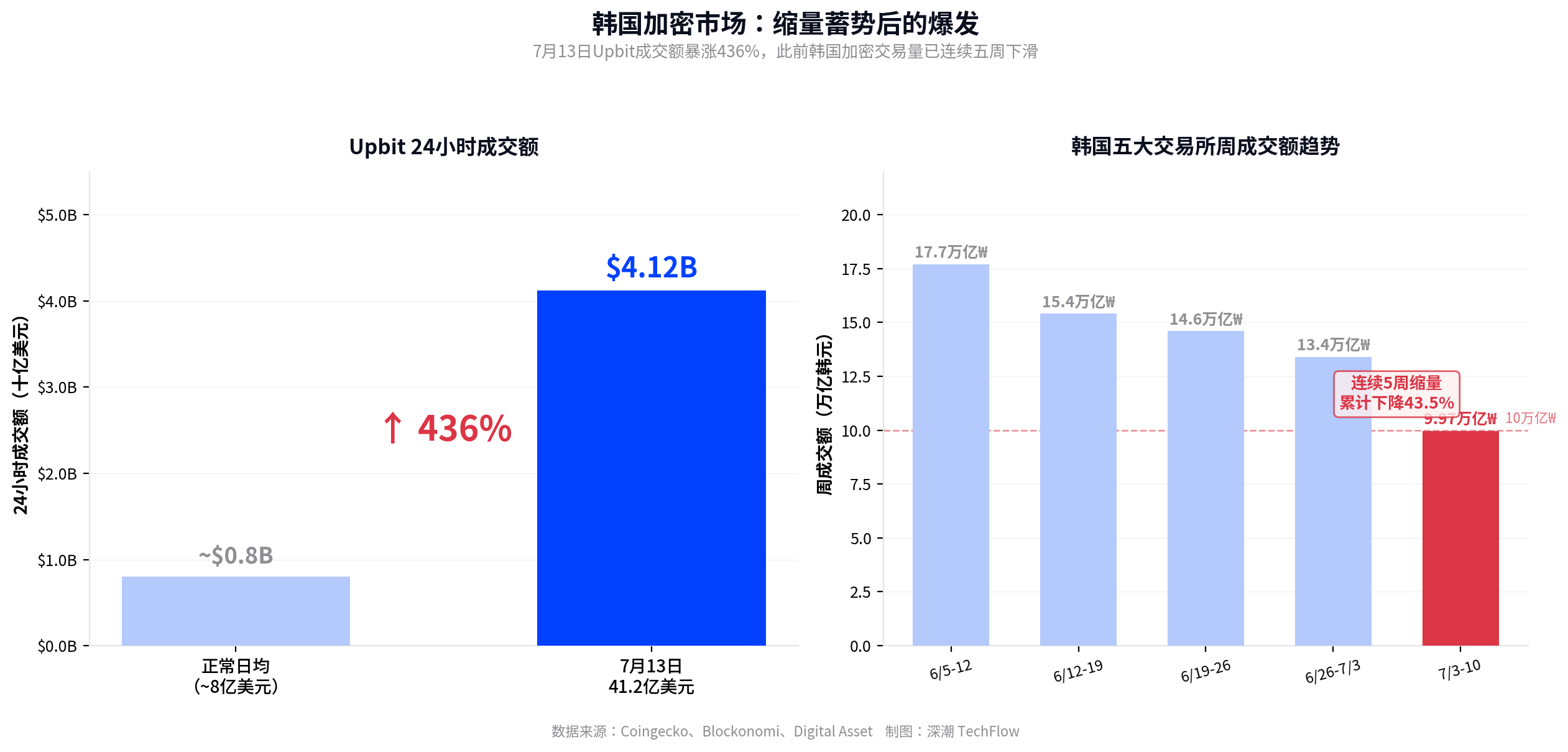
- ปริมาณการซื้อขาย 24 ชั่วโมงล่าสุดของ Upbit สูงถึง 4.12 พันล้านดอลลาร์ เพิ่มขึ้น 436% ในวันเดียว สินทรัพย์ 5 อันดับแรกที่มีปริมาณการซื้อขายสูงสุด ได้แก่ BTC, XRP, ETH, T และ BLAST
- จำนวนผู้ถือคริปโทในเกาหลีใต้มีมากกว่า 16.2 ล้านคน คิดเป็น 32% ของประชากรทั้งหมด เคยรับสินทรัพย์คริปโทสะสมมากกว่า 722 พันล้านดอลลาร์ เป็นประเทศผู้รับรายใหญ่อันดับสองของโลก
- การไหลกลับของเงินทุนนักลงทุนรายย่อยจากตลาดหุ้นสู่ตลาดคริปโทเป็นปรากฏการณ์ทางประวัติศาสตร์ของเกาหลี มักเกิดขึ้นภายใน 1-3 วันทำการหลังจาก KOSPI ร่วงลงอย่างหนัก โดยเงินทุนจะไหลเข้าและออกอย่างรวดเร็ว
Original Author: Claude, TechFlow from Shenchao
Editor's Note: South Korea's KOSPI index triggered the circuit breaker again on July 13. Samsung Electronics and SK Hynix plummeted over 7% and 12% respectively, with the index retracing more than 20% from its peak on June 19. Retail investors are voting with their feet: according to Coingecko data, trading volume on Upbit, South Korea's largest exchange, surged to $4.12 billion in the past 24 hours, a single-day increase of 436%. The top five tokens by trading volume are BTC, XRP, ETH, T, and BLAST.
The near-week-long crash in South Korea's stock market is driving retail funds toward the crypto market.
On July 13, the KOSPI index opened down 63.91 points at 7,412.03. Losses continued to widen during the session. At 10:34 a.m., KOSPI 200 futures fell over 5%, triggering the 18th sell-side sidecar this year. At the time of the trigger, the KOSPI stood at 7,162.21, down 4.20% from the previous trading day.
Samsung Electronics fell over 7.72% that day, while SK Hynix plunged more than 12%. SK Square (the largest shareholder of SK Hynix) dropped 15%, and Samsung Electro-Mechanics fell 17%.
KOSPI Retraces Over 20% from Peak, Semiconductor Super Cycle Faces Crisis of Confidence
The KOSPI has entered a technical correction from its intraday high of 9,385 points on June 19, with a cumulative retracement of over 20%.
The volatility on the Korea Exchange in 2026 has already exceeded that of the 2008 financial crisis. As of now, the exchange has triggered nearly 30 sidecars and multiple circuit breakers this year, breaking the historical record of 26 sidecars set in 2008.
Samsung Electronics and SK Hynix together account for about half of the KOSPI's market capitalization, effectively determining the index's direction. eToro market analyst Zavier Wong previously noted that the combined weight of these two stocks in the index was about a quarter at the end of last year but has now risen to around half. Any significant fluctuation in either stock can drag the entire index before the other 900-plus listed companies have a chance to react.
SK Hynix's "Buy the Rumor, Sell the News" and Earnings Expectations Downgrade Drag Down the Entire Semiconductor Sector
SK Hynix had just listed its ADR on Nasdaq on July 10, surging 12.8% on its first trading day and raising about $26 billion for the company. However, three days later on the Seoul market, the stock experienced a classic "buy the rumor, sell the news" pullback.
On July 13, Korea Investment & Securities analyst Chae Min-sook released a report predicting SK Hynix's second-quarter operating profit to be 60.4 trillion won, about 8% lower than the market consensus of 65 trillion won. She explained that SK Hynix's higher proportion of HBM (High Bandwidth Memory, a high-speed storage technology core to AI chips) sales compared to competitors led to its average selling price growth rate lagging behind the industry average.
This downward revision is particularly damaging in the current environment. Daishin Securities analyst Lee Kyung-min pointed out that due to the KOSPI's overconcentration in semiconductors, leveraged investment liquidation, and supply-demand shocks, its forward price-to-earnings ratio has fallen to levels seen during the 2008 global financial crisis. However, he also noted that valuations have now entered an undervalued range, and even a slight positive catalyst could trigger a sharp rebound.
But other voices in the market urge caution. The KOSPI's "Buffett Indicator" (market cap to GDP ratio) reached 221% in June, far higher than the average of 70.2% between 2000 and 2025, suggesting valuations still have room for adjustment.
Upbit Trading Volume Surges 436%, Funds Flow from Stock Market Back to Crypto
According to Coingecko data, Upbit's 24-hour trading volume reached $4.12 billion, a 436% increase. The top five tokens by volume are: Bitcoin, XRP, ETH, T (Threshold Network), and BLAST.
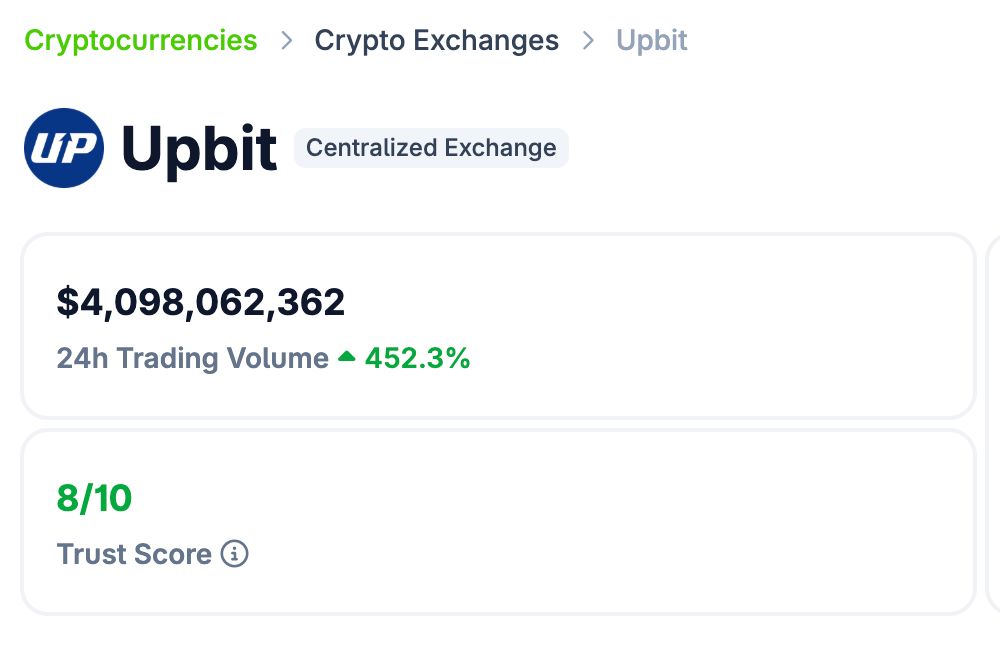
The migration of South Korean retail funds from stocks to crypto is nothing new. This latest wave closely follows the script of previous KOSPI crashes. During the KOSPI sell-off in May, XRP had already become the highest-volume crypto asset on Upbit and Bithumb, with single-day trading volume exceeding that of Bitcoin and Ethereum.
Tiger Research analyst Ryan Yoon attributes this phenomenon to South Korean retail investors aged 40 to 50, who are withdrawing funds from domestic stocks and US equities and moving them into the crypto market, with XRP being the preferred target.
Before this surge in trading volume, the South Korean crypto market had actually experienced five consecutive weeks of declining volume. From July 3 to 10, the combined trading volume of South Korea's top five won-based exchanges (Upbit, Bithumb, Coinone, Korbit, Gopax) fell 25.75% week-over-week to 9.9676 trillion won, dropping below 10 trillion won for the first time since September 2023.
The trading volume explosion on July 13 can be seen as a concentrated release after this period of suppressed accumulation. In terms of trading varieties, Threshold (T) and BLAST appearing in the top five by volume reflects the speculative habit of South Korean retail investors favoring small and mid-cap altcoins. According to Bitcoin Sistemi data, T's 24-hour trading volume on Upbit reached $68.27 million, with total trading volume on South Korean exchanges at approximately $76.75 million.
The Seesaw Effect Between South Korea's Stock Market and Crypto: A Continuously Validated Trading Logic
South Korea is one of the few markets globally where retail funds make large-scale shifts between stocks and crypto. As of now, over 16.2 million South Koreans hold crypto accounts, approximately 32% of the total population, and the number of crypto holders has surpassed stock investors. According to Chainalysis data, South Korea has received over $722 billion in cumulative crypto asset value, making it the second-largest recipient globally after the United States.
Public data shows that from July 13 to 19, stablecoin trading volume on South Korea's top five exchanges reached 2.226 trillion won (approximately $1.62 billion). The high trading enthusiasm of South Korean investors began to show as early as July 11, with aggressive buying of XRP.
Following past patterns, aggressive buying by South Korean retail investors usually concentrates in the 1 to 3 trading days after a KOSPI crash, after which trading heat gradually subsides as the stock market stabilizes. Investors should watch for: if the KOSPI finds support at current levels, the "spillover effect" funds flowing into the crypto market could retreat just as quickly.


