






จากผู้ใช้ 2 ล้านรายต่อเดือนเหลือศูนย์: Zapper ตายเพราะ DeFi ที่ "เติบโตเต็มที่"


- มุมมองหลัก: Zapper ปิดตัวลงอย่างสมบูรณ์ในเดือนสิงหาคม 2026 เนื่องจากกระแส流量ของ DeFi ลดลง รูปแบบการทำกำไรที่单一และกลยุทธ์การเปลี่ยนแปลงที่ผิดพลาด ไม่สามารถเปลี่ยนผู้ใช้รายเดือน 2 ล้านรายเป็นรายได้ที่ยั่งยืน สะท้อนถึงความยากลำบากในการ生存ของเครื่องมือ DeFi แบบ B2C ในสภาวะที่赛道เกิดปรากฏการณ์马太效应
- ปัจจัยสำคัญ:
- Zapper เคยได้รับเงินทุนกว่า 16.5 ล้านดอลลาร์สหรัฐ ในช่วงพีคครอบคลุม 14 เชน มีผู้ใช้รายเดือน 2 ล้านราย มียอดธุรกรรมสะสมกว่า 13,000 ล้านดอลลาร์สหรัฐ แต่กระแส流量ไม่ได้ถูกแปลงเป็นรายได้ที่ยั่งยืน ต้องพึ่งพาค่าธรรมเนียมการทำธุรกรรมแบบ DEX Aggregation เป็นหลัก ซึ่งในภาวะการแข่งขันที่รุนแรง อัตราค่าธรรมเนียมก็ถูกบีบให้ลดลง
- ปัญหาหลักคือเงินทุนของผู้ใช้รวมตัวกันที่โปรโตคอลชั้นนำ ความต้องการในการดำเนินการ DeFi ที่ซับซ้อนลดลง ส่งผลให้ความต้องการผลิตภัณฑ์หลักของ Zapper ซึ่งเป็นการติดตามพอร์ตโฟลิโอแบบ B2C ลดลงอย่างชัดเจน ในขณะที่ต้นทุนทางวิศวกรรมในการรักษาดัชนีข้อมูลข้ามเชนยังคงสูงอย่างต่อเนื่อง
- ความพยายามในการเปลี่ยนแปลงหลายครั้งล้วนล้มเหลว: ซีรีส์积分 NFT ในปี 2021 ราคาสุดท้ายเป็นศูนย์; แอปพลิเคชันโซเชียลบนเชน Chainchat ในปี 2023 จบลงอย่าง暗淡; การออกโทเค็น ZAP ที่วางแผนไว้ก็ถูกระงับเนื่องจากตลาดหมี
- เมื่อเปรียบเทียบกับคู่แข่ง DeBank ฝ่ายหลังได้เปรียบใน赛道เดียวกันด้วยผลิตภัณฑ์กระเป๋าเงินหนักอย่าง Rabby Wallet ความสามารถในการระดมทุนที่แข็งแกร่งกว่า และรายได้ที่มั่นคง ขณะที่ Zapper ไม่เคยหลุดพ้นจากแนวคิด B2C และเชื่อมั่นในลัทธิดั้งเดิมของ Blockchain มากเกินไป
Original author: Eric, Foresight News
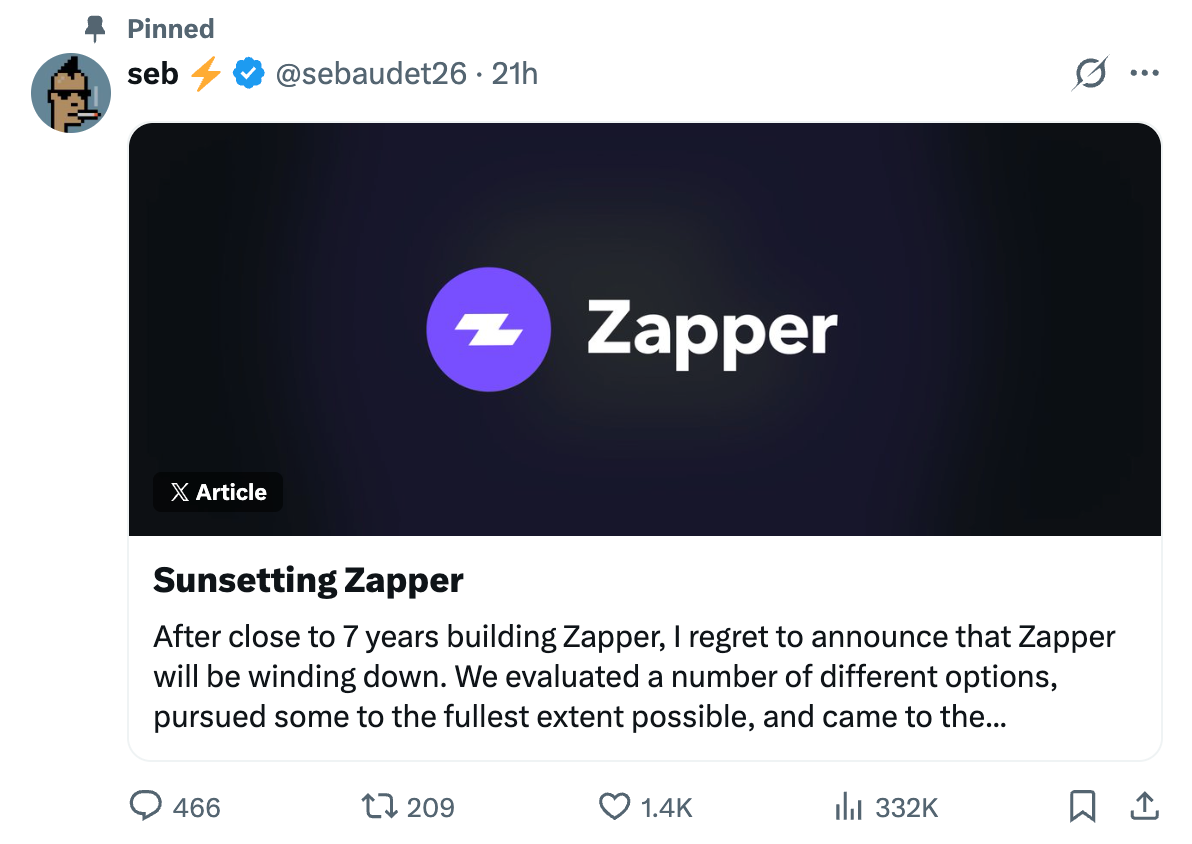
On July 8, 2026, Zapper co-founder Seb Audet posted a brief announcement on X: the platform will completely shut down on August 3rd, with its official website, mobile applications, and API services all going offline.
Last November, the shutdown of DappRadar stirred nostalgia among many veteran crypto natives. Now, a once-star project that boasted 2 million monthly active users, processed over $13 billion in transactions, and raised a total of $16.5 million in funding, has also reached a dead end.
In 2019, Zapper's predecessor, DeFiZap, won the DeFi hackathon hosted by Kyber. At that time, DeFi was still in its infancy, with the entire sector's TVL standing at just about $667 million. In May 2020, DeFiZap merged with DeFiSnap, and Zapper was officially born. In Seb's words, he was exploring DeFi at the time, and Zapper's creation initially stemmed from his own desire to build a simple portfolio tracker, never imagining it would scale to such heights.
In June 2020, Compound launched its COMP token, igniting the "DeFi Summer" that reshaped the industry landscape. Within three months, DeFi's TVL surged from roughly $700 million to over $13 billion, as retail investors flocked to yield farming. In an era where funds were scattered across various protocols, the need for a unified dashboard to monitor positions emerged naturally. Zapper, which allowed users to connect their wallets and monitor cross-protocol holdings, LPs, and yields in real-time, logically gained traction within the crypto space.
The DeFi boom fueled Zapper's rapid growth. In early 2020, it completed a $1.5 million seed round, with participants including Framework Ventures and ParaFi Capital. In May 2021, at the peak of market exuberance, Zapper raised $15 million in a Series A round, again led by Framework Ventures, with notable investors like Mark Cuban, Ashton Kutcher's Sound Ventures, and Coinbase Ventures joining.
At its peak, Zapper spanned 14 chains, over 450 DeFi protocols, and more than 7,000 tokens, boasting over 2 million monthly active users and a cumulative transaction volume exceeding $13 billion. Its "Zap" feature, enabling users to execute complex multi-step DeFi operations in a single transaction, was once its core differentiating selling point.
However, the problem lay in the fact that traffic failed to translate into sustainable revenue. Zapper's business model primarily relied on collecting small fees from DEX aggregation trades, but competition in the aggregator space was brutally fierce, continuously compressing fee margins. Meanwhile, maintaining a data indexing and real-time update system covering multiple chains and hundreds of protocols required significant and sustained engineering resources and infrastructure costs.
On the other hand, while DeFi continued to develop, the direction was not diversification but rather the concentration of capital and traffic towards leading protocols. After a brief downturn in 2022, DeFi has made significant strides forward in recent years. However, lacking attractive yields and airdrop expectations, user numbers haven't increased. Zapper's functionality leaned more towards B2C; fewer people were using it, DeFi no longer required complex operations, and competition among DEX aggregators was too fierce. At that point, the demand underpinning Zapper's strongest moat had clearly weakened.
Zapper was not unaware of the ceiling for purely tool-based products. It underwent several rounds of transformation attempts, but none were successful. In September 2021, Zapper launched a points system based on on-chain interaction behaviors. Users accumulated points through actions like check-ins, cross-chain bridging, and trading, which could be redeemed for NFTs. Over 100,000 addresses participated in minting. According to OpenSea data, the NFT collection's cumulative trading volume exceeded 1,200 ETH, worth approximately $5 million at the time. However, as time passed, the NFT collection's price eventually fell to zero, and the points system was not continued.
In October 2023, Zapper launched the on-chain social application Chainchat, where users needed to purchase channel "shares" to join group chats. The subsequent V2 version repositioned the product as a "Web3 explorer tool," attempting to expand its scope from DeFi to NFTs, DAOs, and on-chain accounts. In June 2024, Zapper announced the Zapper Protocol, planning to issue the ZAP token, aiming to build an open protocol to incentivize users to interpret and analyze on-chain information.
Yet, these attempts ultimately failed to change its fate. The ZAP token was never officially issued, the protocol plan was shelved as the market turned bearish, and Chainchat quietly faded from users' view.
Many tool-based products born in 2019 and 2020 have met their end in recent years. These products "died in various ways." DappRadar was a typical case of being left behind by the times. When all resources are consolidating towards leading protocols, without an environment of diverse flourishing, it's useless even if you aggregate every single project.
While Zapper was also affected by changes in the sector, its downfall was more attributable to strategic missteps in its own transformation.
A portfolio tracker is not a high-barrier product, but the underlying data costs are a fixed expense. Without the ability to charge for this service itself, a strongly correlated, revenue-generating product is essential. The DEX aggregator and the "Zap" feature enabling one-click multi-step operations were choices with inherent hard demand, but Zapper seemed to focus not on revenue-generating products but rather allocated more energy to cost-heavy departments.
Using the portfolio tracking feature to funnel users towards revenue-generating functions made sense in the early days. However, as user funds gradually concentrated in a few protocols and competition increased from rivals like DeBank, Zapper failed to shift its thinking in time. From its subsequent attempts, it's evident that Zapper didn't break free from its B2C mindset, persistently spinning its wheels in the "dead end" of applying blockchain thinking to consumer-facing products.
These B2C products had grand narratives, but none targeted existing pain points; instead, they tried to create demand from scratch. The fact that it could persist in the wrong direction for years also highlights, in a way, how massive the DeFi dividends were back then. Reading Seb's farewell letter, which mentioned "evaluated multiple paths and fully attempted some of them, ultimately realizing that an orderly wind-down was the best option," it's clear that no one wanted to take over even its once-prized portfolio tracker in the current market. Even if it had pivoted towards a direction like Nansen or Arkham, it might have ultimately met a neutral end through an acquisition.
Speaking of DeBank, it has also scaled back its asset tracking operations, cutting support for some low-activity chains. However, DeBank has a flagship product like Rabby Wallet and, with twice the funding of Zapper, holds more chips and enjoys more stable revenue. If you browse reviews of Rabby Wallet on X, you'll find many users in the EVM-compatible chain space believe Rabby Wallet offers a better experience and functionality than MetaMask.
In this author's view, Zapper's exit wasn't entirely due to being "thoughtless," but rather an excessive belief in blockchain maximalism. In the game of business, being overly immersed in one's own world while ignoring shifts in the objective market environment is fatal. Zapper has sounded an alarm for tool-based products still surviving in the market: DappRadar was limited by its own sector's constraints, unable to broaden revenue channels. But if there's an opportunity to transform, don't cling to past glories.


