






比特币开始独立行情,现在是反弹还是反转?


- 核心观点:比特币近期反弹并非仅因美联储主席沃什淡化通胀风险的单一因素,而是宏观预期边际转松与空头仓位被迫回补共同作用的三段式行情,但衍生品市场仍显示对下跌的防御心态。
- 关键要素:
- 美联储主席沃什提及通胀预期回落,市场先行定价“加息压力”缓解,比特币从低位反弹至6万美元附近。
- 美国就业数据走弱进一步降温加息预期,宏观层面给了价格向上理由,推动行情接力。
- 比特币跌至5.77万美元时触发约3.95亿美元杠杆清算,清掉部分多头后市场更易反弹。
- 空头平仓提供第二层推力,反弹中约2.81亿美元看空押注被清算,空头挤压加速上涨。
- 山寨币情绪回暖但未确认全面“山寨季”;以太坊和Solana领涨,而部分小币疲软,资金尚未广泛扩散。
- BTC/ETH期权看跌溢价仍高,表明交易者未完全相信趋势扭转,仍愿为下跌保护支付高价。
- 宏观变量仍是关键风险;若后续数据重指通胀粘性或美联储转鹰,市场将依同样逻辑反向定价。
Federal Reserve Chair Kevin Warsh did not announce an interest rate cut, but when discussing inflation, he stated that inflation expectations and inflation risks have receded over the past few weeks. He simultaneously reiterated that the Fed would stick to its 2% inflation target.
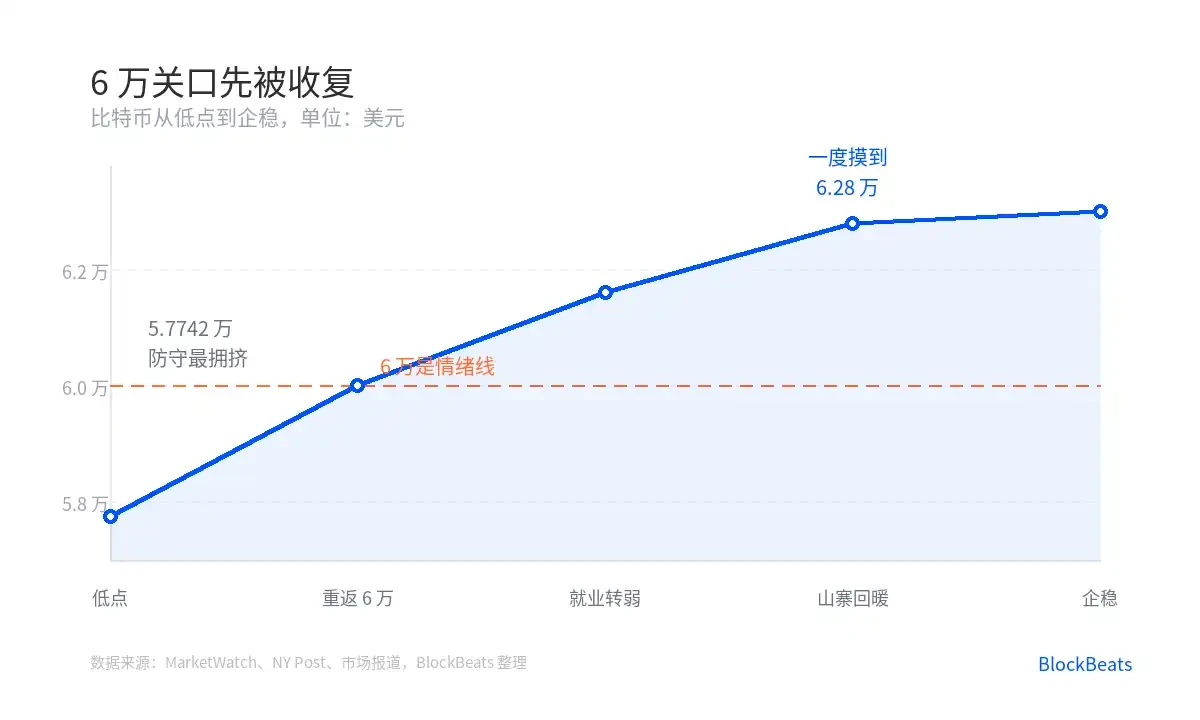
The latter part wasn't dovish, but the market latched onto the first part. Bitcoin quickly rebounded from its low point, approaching the $60,000 mark again. Subsequently, US employment data softened, expectations for rate hikes continued to cool, and the market narrative shifted from "repair" to "relay mode."
Over the past few weeks, the market's biggest fear was that the Federal Reserve would maintain high interest rates, or even re-escalate tightening expectations. For Bitcoin, the more entrenched the rate hike expectations, the narrower the valuation room for risk assets becomes, and leveraged positions become easier to liquidate.
After Warsh downplayed inflation risks, the market first repriced the "pressure of rate hikes." The weak employment data further pushed this direction. Bitcoin recovered from around $57,742 to above $60,000. While this price movement appears rapid, it essentially represents the market rolling back the previous round of panic trading.
On Deribit, traders concentrated on buying $50,000 put options. Open interest in gold perpetual futures hit a new high. Technically, a death cross appeared. These converging signals indicate the market is buying insurance against a downturn.
This differs from a typical correction. In a normal pullback, sellers simply want to exit. In a panic defense mode, traders simultaneously buy puts, safe-haven assets, and deleverage. Once prices hit critical levels, liquidations amplify the volatility.
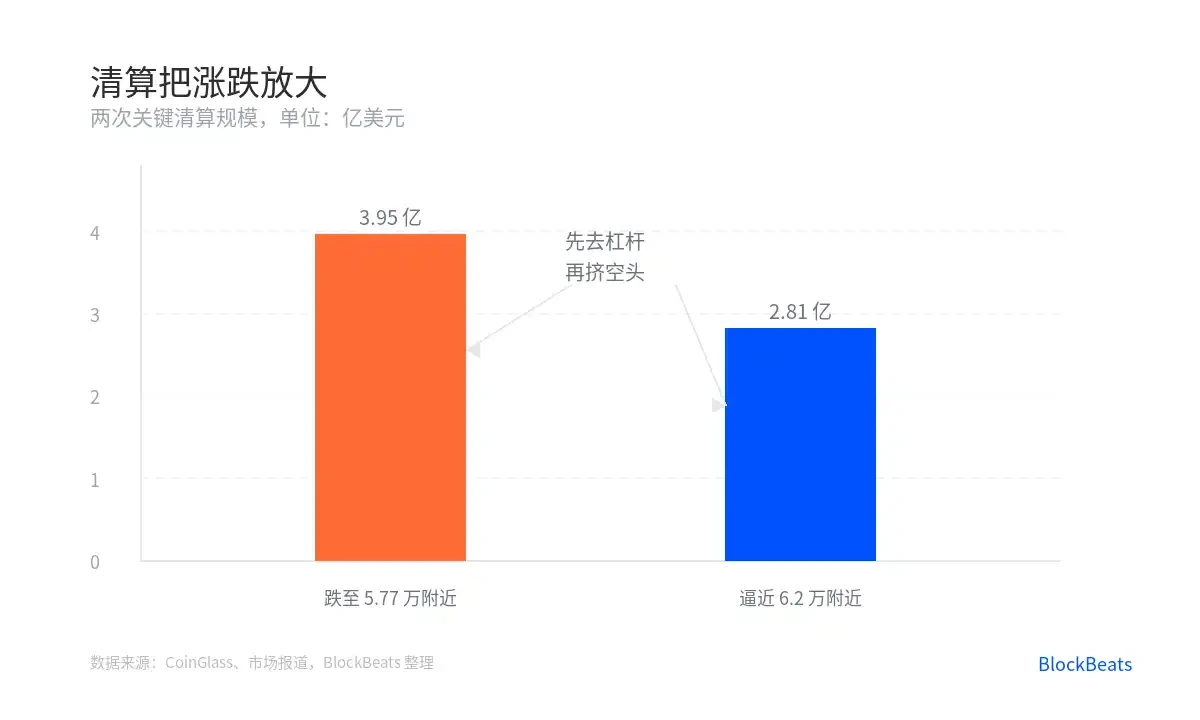
CoinGlass data shows that when Bitcoin fell to around $57,700, it triggered approximately $395 million in liquidations. This figure indicates the price decline was no longer just driven by selling pressure, but by the forced exit of leveraged positions.
After these forced exits, the market actually becomes more prone to a rebound.
The reason is straightforward. The previous decline liquidated some long leverage and pushed defensive sentiment to a high level. When macro news turns marginally accommodative, prices only need to return near key resistance levels to make short-sellers nervous. Short covering, in essence, is buying. The higher the price climbs, the more it forces bearish positions to retreat.
This is the second layer of propulsion. When Ethereum and Solana led the rally, Bitcoin briefly approached $62,000, resulting in the liquidation of approximately $281 million in short bets.
Therefore, this rebound cannot be solely attributed to one statement by Warsh. A more accurate breakdown involves three phases.
Phase one: Inflation risks were downplayed, easing market concerns about the Fed's path. Phase two: Weak employment data further suppressed rate hike expectations. Phase three: Short positions were forced to cover, accelerating the spot price increase.
Viewing only phase one, the market move could be misinterpreted as a "macro-positive catalyst." Viewing only phase three, one might mistake it for a purely technical bounce. The real structure lies in both phases occurring simultaneously. Macro conditions provided the reason for prices to rise, while positioning provided the velocity.
The reaction of altcoins also indicates this isn't a single-coin event.
After Bitcoin reclaimed $60,000, Ethereum, Solana, and Dogecoin rallied in tandem. Subsequently, Ethereum led the gains among major cryptocurrencies, rising approximately 12% over the past week. When capital begins to spill over from Bitcoin into Ethereum and Solana, the market is no longer just trading on the question "Can Bitcoin hold?"
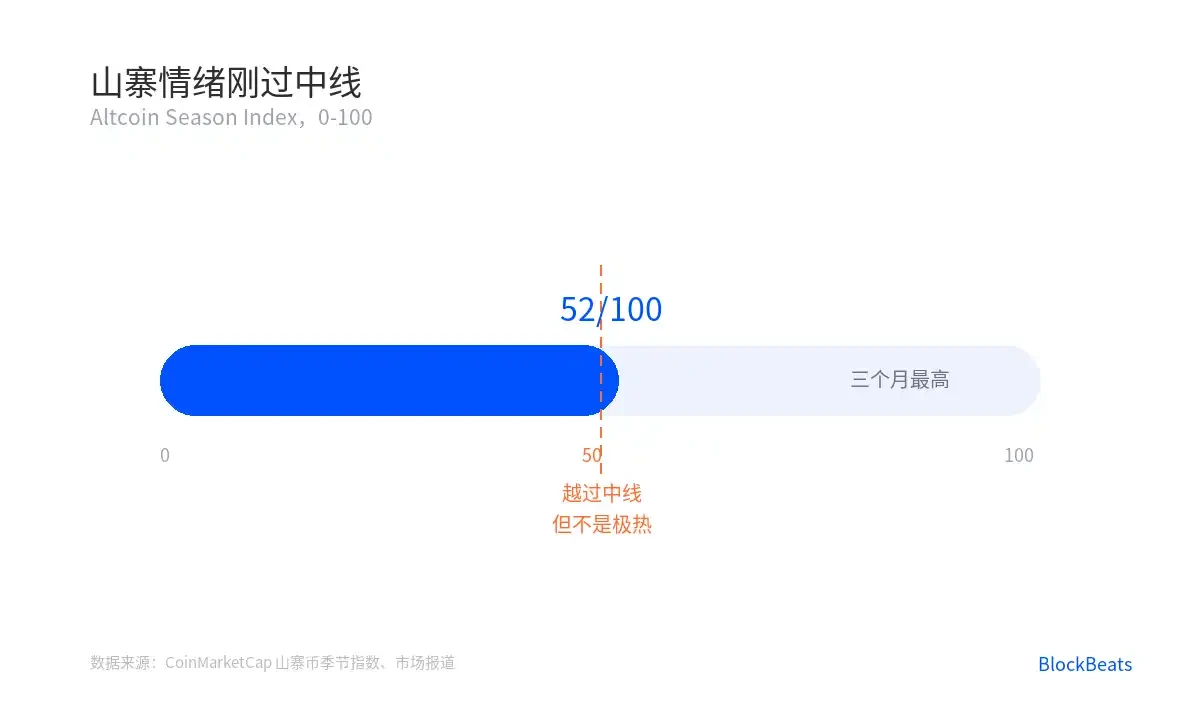
CoinMarketCap's Altcoin Season Index rose to 52/100, its highest level in three months. This level is precarious. It has just crossed the midline, indicating that risk appetite has indeed returned, but it hasn't yet reached the stage of full altcoin euphoria.
This brings us to the first point of caution. A warming altcoin sentiment doesn't confirm that altcoin season has definitively begun.
A true altcoin season usually requires broader capital dispersion. What we see now feels more like, after Bitcoin stopped falling, the market first bought back large-cap tokens with good liquidity. Ethereum and Solana managed to break out, while some small-cap coins remain weak. This divergence itself is a signal.
Second, the options market hasn't fully bought into the rebound.
The put/call skew for BTC and ETH still shows traders are willing to pay a higher premium for downside protection. Prices have rebounded, but the insurance isn't cheap yet. This detail is more sobering than the spot price.
If traders genuinely believed the trend had reversed, put option premiums would typically decline faster. The current state suggests the spot market has pulled prices back up, but the derivatives market hasn't put away its umbrella yet.
Third, short squeezes cannot continue indefinitely.
Short covering generates buying pressure, but this type of buying is one-off. It can push prices out of crowded lows, but it cannot sustain an entire trend cycle on its own. Once the liquidation wave ends, the market needs fresh spot buying to take over.
Therefore, the real metric to watch going forward isn't whether Bitcoin has crossed some round number, but who is still buying after it does. Spot ETF flows, stablecoin liquidity, the strength of follow-through from Ethereum and Solana—all of these carry more informational value than a single day's price gain.
Fourth, macro variables remain the same double-edged sword.
This rally benefited from declining inflation risks and weakening employment. Conversely, if subsequent data points to inflation stickiness again, or if the Fed's language turns hawkish again, the market will invert this same logic to price the opposite direction. Bitcoin is not an asset detached from macro factors; it simply reacts more quickly to changes in macro expectations.
The price has bounced from an overly defensive position, but the true confirmation will come when the options market is willing to drop its insurance.


