






2026年Crypto行业最大趋势:จากสงครามกลางเมืองในวงการคริปโต สู่การจัดสรรสินทรัพย์ข้ามตลาด


- มุมมองหลัก: ในปี 2026 อุตสาหกรรมคริปโตกำลังประสบกับการเปลี่ยนแปลงเชิงโครงสร้างจาก "การแข่งขันภายใน" ไปสู่ "การผสานรวมภายนอก" โดยเงินทุน Crypto จำนวนมหาศาลและเป็นระบบได้เข้าสู่สินทรัพย์หลักของระบบการเงินดั้งเดิม (TradFi) ซึ่งเป็นจุดเปลี่ยนสำคัญของอุตสาหกรรม
- ปัจจัยสำคัญ:
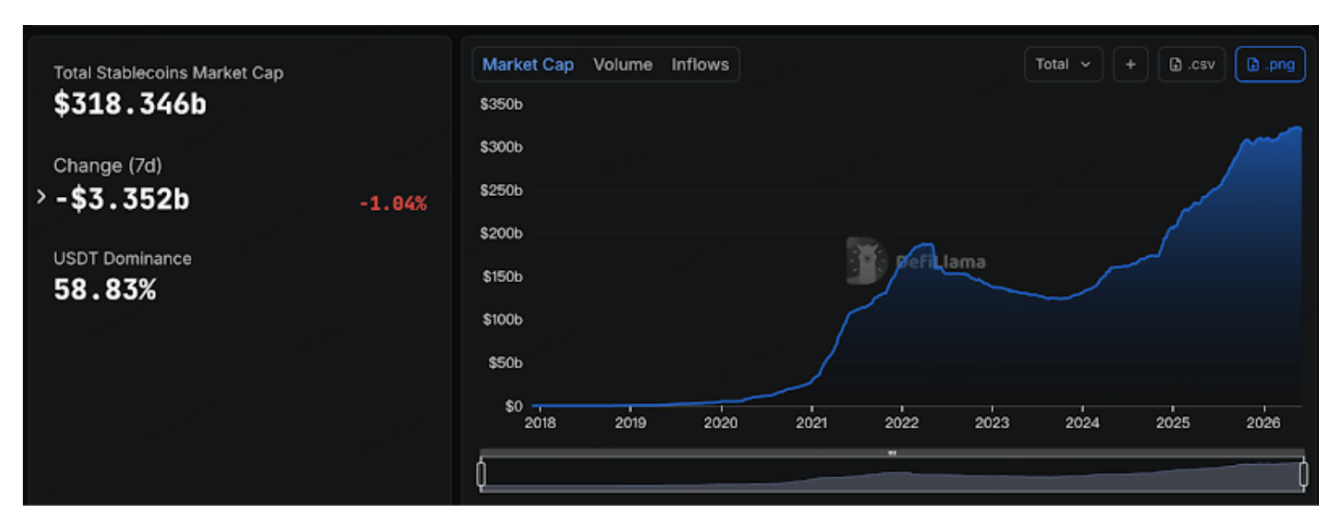
- มูลค่าตลาดรวมของ Stablecoin สูงถึงประมาณ 3200 พันล้านดอลลาร์สหรัฐ เกินกว่าทุนสำรองเงินตราต่างประเทศของหลายประเทศ แต่ในอดีตสามารถลงทุนในสินทรัพย์บนเครือข่ายได้อย่างจำกัด ทำให้มีความต้องการจัดสรรสินทรัพย์สูง
- ปริมาณการซื้อขายทองคำโทเค็นไนซ์แบบสปอตในไตรมาสที่ 1 ปี 2026 สูงถึง 907 พันล้านดอลลาร์สหรัฐ ปริมาณการซื้อขายสัญญาอนุพันธ์ถาวรของ RWA สูงถึง 524.79 พันล้านดอลลาร์สหรัฐ ซึ่งทั้งสองตัวเลขสูงกว่าทั้งปี 2025 แสดงให้เห็นถึงการเร่งตัวของเงินทุนที่ย้ายไปยังสินทรัพย์ TradFi
- การแลกเปลี่ยนต่างเปิดให้ซื้อขายหุ้นสหรัฐฯ แบบรวมศูนย์ ทำลายการแยกกลุ่มเงินทุนระหว่าง Crypto และ TradFi ช่วยให้ผู้ใช้สามารถจัดสรรเงินทุนไปยังหุ้นเทคโนโลยีสหรัฐฯ ทองคำ และสินทรัพย์เสี่ยงต่ำที่มีความแน่นอนสูงได้โดยตรงด้วย Stablecoin
- วาทกรรมของอุตสาหกรรมเปลี่ยนจาก "สงครามกลางเมือง PvP" (การแย่งชิงเปิดตัว, แย่ง TVL, แย่งความได้เปรียบด้านข้อมูล) ในปี 2023-2025 ไปสู่ "การจัดสรรสินทรัพย์ข้ามตลาด" ในปี 2026
- หุ้นโทเค็นไนซ์ให้โอกาสรับความเสี่ยงด้านราคาของสินทรัพย์ TradFi แต่ไม่ให้สิทธิ์ความเป็นเจ้าของหรือสิทธิ์ออกเสียง เส้นทางสู่หุ้นสหรัฐฯ จริงต้องแก้ไขปัญหาโครงสร้างพื้นฐานทางการเงินดั้งเดิม เช่น การดูแล, การชำระบัญชี, และการปฏิบัติตามกฎระเบียบ
- BIT เป็นแห่งแรกในเดือนกุมภาพันธ์ 2026 ที่ดำเนินการตามเส้นทาง "ช่องทางเงินทุน Stablecoin + กรอบงานโบรกเกอร์ที่มีใบอนุญาต + การถือครองหุ้นสหรัฐฯ จริง" เพื่อให้แน่ใจว่าผู้ใช้ถือหลักทรัพย์จริงและมีสิทธิ์ของผู้ถือหุ้น
- ผู้ใช้ต้องเลือกผลิตภัณฑ์ตามลักษณะของเงินทุน: การซื้อขายระยะสั้นสามารถใช้หุ้นโทเค็นไนซ์ได้ ส่วนเงินทุนระยะกลางถึงยาวควรเลือกเส้นทางการถือครองจริง และให้ความสำคัญกับความโปร่งใสของเส้นทางสินทรัพย์
Foreword: We Are Witnessing a Turning Point for an Era
By 2026, many crypto projects have been disproven by the market. Numerous tokens go to zero upon listing or crash immediately after launch, having essentially become tools for market makers to "pump and dump" retail investors. Meanwhile, the grand narrative of Web3, once envisioned, seems slow to materialize.
On the other hand, the US stock market is experiencing a boom. Under the banner of AI's advanced productivity narrative, U.S. equities have been continuously breaking new highs.
In this context, if the Crypto industry remains stuck in "player-vs-player" (PvP) battles within an existing market, or simply engages in Meme wars, its path will only become narrower. Thus, we see many exchanges collectively pushing U.S. stocks. At BIT, as early as February 2026, we had already operationalized the path of "stablecoin capital channel + licensed brokerage framework + actual U.S. stock holdings."
Zooming out, you'll find this is arguably the biggest structural shift in the Crypto industry in 2026: the industry is transitioning from "internal competition" (exchanges fighting for users, trading volume, and narratives) to "external integration" (Crypto capital flowing into core TradFi assets).
1. Why Is 2026 a "Watershed Year" for Crypto?
Let's start with some data that left a strong impression on us.
According to the latest data from DefiLlama (as of June 5, 2026), the total stablecoin market cap has reached an all-time high of approximately $320 billion. As reported by CoinDesk, this figure surpasses the foreign exchange reserves of 95 countries, including the UK and Canada.
Source: DefiLlama
What does this mean? It means the "cash pool" of the Crypto industry has grown to a size that can no longer be dismissed as a "niche market." Ironically, however, with such a massive cash pool, the types of assets available for purchase over the past few years have been surprisingly limited – mainly BTC, ETH, various Alts, Memes, and contract derivatives.
Meanwhile, the returns on endogenous assets are visibly declining. According to CoinGecko's 《RWA Report 2026》, RWA Perps (Real World Asset Perpetuals), as another tool for trading TradFi assets, reached a trading volume of $524.79 billion in Q1 2026 alone, far exceeding the $313.02 billion for the entire year of 2025. Concurrently, spot trading volume for tokenized gold in Q1 2026 reached $90.7 billion, surpassing the $84.6 billion recorded for the whole of 2025.
These two sets of data reveal a crucial fact: Crypto user funds are migrating towards core TradFi assets at an unprecedented pace.
In recent years, innovation in on-chain assets has fallen into a vicious cycle of "PvP." When endogenous high-risk assets fail to provide sustained healthy Alpha, user risk preferences begin to diverge, leading to a surge in demand for traditional macro assets (like U.S. tech stocks, gold, and other commodities).
2026 is a watershed because this "demand for allocation" is being met on a large scale on the product side for the first time.
2. Exchanges Pushing U.S. Stocks Collectively: Crypto Grabbing the "TradFi Gateway"
Currently, many exchanges are heavily promoting U.S. stocks. Although their paths differ, the direction is highly consistent: turning U.S. stocks into an "asset outlet" for Crypto users.
Why is this important? Because it breaks a market convention that has persisted for over a decade: Crypto and TradFi being two completely separate pools of capital.
In the past, to engage in macro hedging, one had to buy gold/U.S. stocks through a traditional brokerage and then open a contract position on a crypto exchange. The entire process involved bank deposits, brokerage account opening, cross-market settlement, and exchange rate losses, resulting in extremely low capital efficiency.
The current trend breaks down this isolation. The tokenized U.S. stocks or spots you hold are not just assets; they might also be used for hedging against each other. This multiplies capital efficiency.
Furthermore, in BIT's user research, a significant portion of stablecoin holders expressed strong interest in allocating to U.S. tech stocks or gold ETFs. These users haven't lost interest in Crypto; rather, they have matured enough to understand the importance of investing a portion of capital in low-risk, high-certainty assets alongside high-risk ones.
To meet this investment demand, the path BIT has chosen is the "heaviest and hardest" segment of this value chain: not issuing a token to mirror prices, but using a stablecoin capital channel to directly connect with a U.S.-licensed broker-dealer, allowing users to buy real U.S.-listed stocks. This path requires us to handle the entire traditional securities infrastructure, including securities custody, clearing, dividends, voting, corporate actions, and compliance frameworks.
Why choose this harder path? Because we believe: when the industry shifts from "trading prices" to "allocating assets," what ultimately retains users isn't the flashiest K-line chart, but who can enable users to genuinely hold assets.
3. From "PvP Civil War" to "Cross-Market Allocation": A Paradigm Shift in Crypto Narrative
Comparing the past three years with the present reveals a qualitative change in the narrative paradigm of the Crypto industry.
Dominant Theme 2023-2025: PvP Civil War
- Exchanges compete for token listing exclusivity, Launchpad slots, user growth
- Projects compete for TVL, airdrop expectations, and KOL support
- Users compete for "insider information advantage," "buy low, sell high," and first-mover narrative advantage
Dominant Theme Starting 2026: Cross-Market Asset Allocation
- Exchanges begin integrating U.S. stocks, gold, and ETFs into Crypto capital channels
- Projects start building RWA protocols (e.g., Ondo Global Markets launching 100+ tokenized U.S. stocks and ETFs in early 2026)
- Users begin using USDT to directly allocate to NVIDIA, Tesla, SPY, QQQ, PAXG
What is the underlying logic of this paradigm shift?
It's the upgrade in Crypto users' asset allocation needs.
In the past, the typical Crypto user profile was simple: high risk tolerance, pursuit of short-term windfalls, immunity to volatility. But now that the stablecoin pool has grown to $320 billion, the nature of the capital within has changed – part is institutional capital, part is "long-term parked capital" from high-net-worth individuals. Their tolerance for a single highly volatile asset is decreasing, while their sophistication in asset allocation is increasing.
When a user holds 100,000 USDT, they are unlikely to go all-in on a single Meme like in 2021. They will think: Can I allocate 30k to BTC, 20k to ETH, 30k to U.S. tech stocks, 10k to tokenized gold, and leave the remaining 10k for high-beta Alts?
This is the true mindset of a Crypto user in 2026.
4. The Price of Buying NVIDIA vs. Holding NVIDIA Stock Are Not the Same Thing
Crypto assets are often priced based on consensus, liquidity, narrative, and on-chain mechanisms. U.S. stocks, on the other hand, are the core securities assets of traditional finance, backed by the cash flows, profits, shareholder equity, corporate governance, and regulatory systems of listed companies.
Tokenized stocks are on-chain tokens designed to track the performance of publicly traded stocks in the market. They provide economic exposure (including price fluctuation and, in many cases, dividend equivalent distributions) but do not confer direct share ownership or voting rights.
This is a crucial distinction:
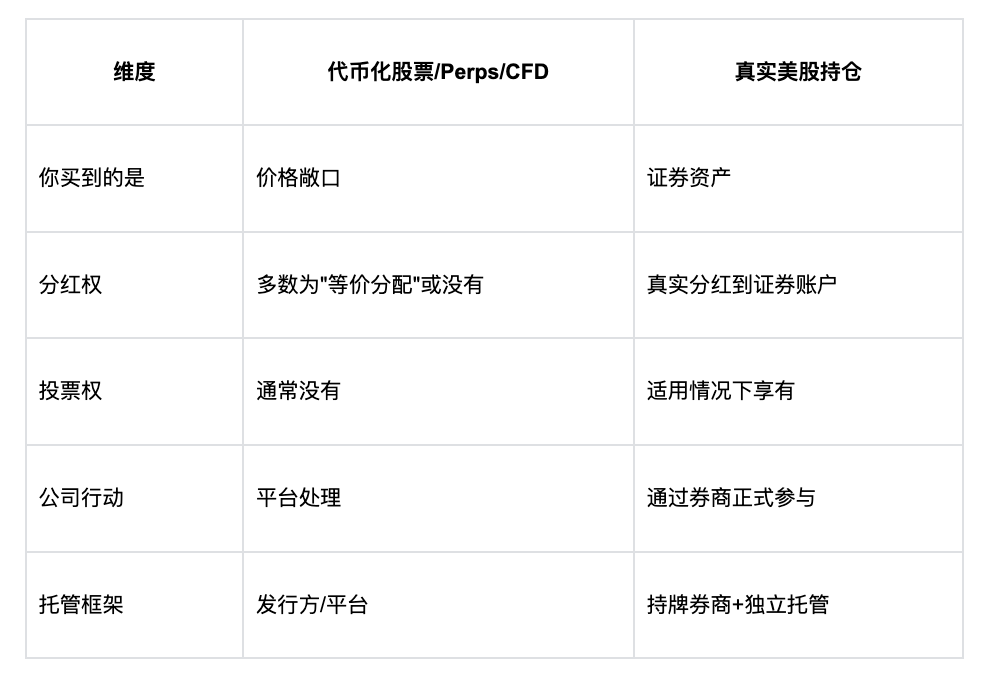
This isn't to say tokenized stocks are bad – it means they solve the problem of "can you trade the price of the stock."
But when your capital grows larger, and you start treating U.S. stocks as long-term asset allocation rather than short-term speculation, the questions change to: Am I actually buying the stock? Who is the underlying broker? If the platform has issues, how are my stock rights confirmed?
This is the fundamental reason BIT has insisted on the "real U.S. stock" path during this industry shift.
5. BIT's Position in This Trend: A Pioneer in Stablecoin Access to Real U.S. Stocks
As early as February 2026, BIT pioneered the path for "stablecoins accessing real U.S. stocks." This path includes: a stablecoin capital channel – allowing users near real-time 24/7 deposits/withdrawals using USDT/USDC; direct connection to U.S.-licensed broker-dealers; supporting tens of thousands of mainstream U.S. stocks and ETFs; and granting shareholder rights (dividends, voting, corporate actions) where applicable. BIT isn't just adding a "can also buy U.S. stocks" feature patch; it's building the financial infrastructure for "compliantly channeling digital asset capital into a real securities asset system." While other players in the industry are still competing over "who has more tokenized stocks" or "whose stock perps have higher leverage," BIT has been operating on the real asset path for at least four months longer than its peers.
6. Three Criteria for Crypto Users in 2026 to Judge
At this point, we want to offer all Crypto users reading this article three practical criteria for judgment.
Criterion One: Assess your capital nature to determine your allocation strategy
If your USDT is short-term trading capital, seeking high turnover and high beta, then stock perps and tokenized stocks may fully meet your needs. However, if it's mid-to-long-term parked capital intended for genuine cross-market allocation, you should look for products that offer a real holding path.
Criterion Two: Check the product's "depth of disclosure" to verify the path's authenticity
Before buying U.S. stocks, ask: Who is the underlying broker? Where is custody? What is the clearing path? Is the licensed entity disclosed? Is there a public compliance framework? Given the massive capital scale behind stablecoins, user demands for transparency regarding their asset path will only increase.
Criterion Three: Treat asset allocation as "portfolio management," not a "one-sided bet"
A Crypto user in 2026 should not be thinking, "Will BTC go up?" but rather, "How will my portfolio of BTC, ETH, U.S. tech stocks, tokenized gold, and stablecoin yield perform under different macro scenarios?" This represents a mature asset allocation mindset and a hallmark of the Crypto industry maturing from its adolescence.
7. Conclusion: The Biggest Opportunity for the Crypto Industry in the Next Five Years Lies in "Going Mainstream"
The biggest trend in the Crypto industry for 2026 is not a new public chain, not a new Meme, not an ETF approval. It is the first large-scale, systematic flow of Crypto capital into the core TradFi asset system.
The essence of this trend is the Crypto industry evolving from a zero-sum "game amongst ourselves" to an additive game of "connecting with global capital markets." It means the Crypto industry no longer needs to rely on "PvP" to generate liquidity, but can create value by "tapping into the real economy."
BIT's role in this trend is that of a pioneer for the stablecoin-to-real-U.S.-stock asset model. We are not competing with other exchanges over "who is better at trading U.S. stock prices." Our goal is to provide Crypto users, as their capital scales increase, risk appetites mature, and allocation needs evolve, with a genuine path into the securities asset system.
From "civil war" to "integration," from "PvP" to "cross-market allocation," from "trading prices" to "holding assets" – this is the turning point in the Crypto industry most worth remembering in 2026.
And we will continue to forge ahead on this path.
Data Sources & References
DefiLlama: June 5, 2026, Source: https://defillama.com/stablecoins
CoinGecko RWA Report 2026: Contains key data on tokenized RWAs, tokenized stocks, tokenized commodities, RWA Perps, etc. Source: https://www.coingecko.com/research/publications/rwa-report-2026
CoinDesk Stablecoin Market Report: May 26, 2026, Stablecoin total market cap reaches $322 billion, exceeding the FX reserves of 95 nations. Source: https://www.coindesk.com/markets/2026/05/26/at-usd318-billion-the-stablecoin-market-value-exceeds-the-fx-reserves-of-95-nations
Disclaimer
This content is for informational purposes only and does not constitute any investment advice or solicitation. The views expressed by guest speakers in this article do not represent the official position. Financial assets carry high volatility risk, and past performance is not indicative of future results. The availability of services provided by BIT may vary depending on regional regulatory requirements.


