More popular than SpaceX, oversubscribed by over 6,586 times, what is the Meme power behind Liuliumei (06658.HK)?


- Core Viewpoint: Liuliumei surged over 186% on its first day of listing in Hong Kong due to its stock abbreviation being homophonic with “LLM” (Large Language Model), reflecting the trend of “stock Meme-ification,” where investors speculate based on sentiment, puns, and topical relevance rather than fundamentals.
- Key Factors:
- Liuliumei’s IPO public offering received 6,586.73 times oversubscription, but the allotment rate was as low as 1.5%, indicating retail investor frenzy; international placement only saw 2.64 times subscription, suggesting institutions were not bullish.
- The stock price surge was primarily due to the abbreviation “LLM” riding on the popularity of AI concept stocks like Zhipu AI, along with the market's speculative inertia towards “Meme stocks” (such as GameStop, Chuan Da Zhi Sheng), unrelated to the company's fundamentals.
- Global stock markets are entering an era of the “attention economy,” where emotional factors like puns, abbreviations, and celebrity mentions (e.g., Trump assassination attempt causing Goertek's stock price fluctuation) are dominating short-term price movements.
- Such Meme stocks have a dual nature, combining wealth creation effects and speculative risks, including phenomena like pump-and-dump schemes and emotional marketing; investors need to be wary of the risk of buying at highs.
Original | Odaily Planet Daily (@OdailyChina)
Author | Wenser (@wenser2010 )
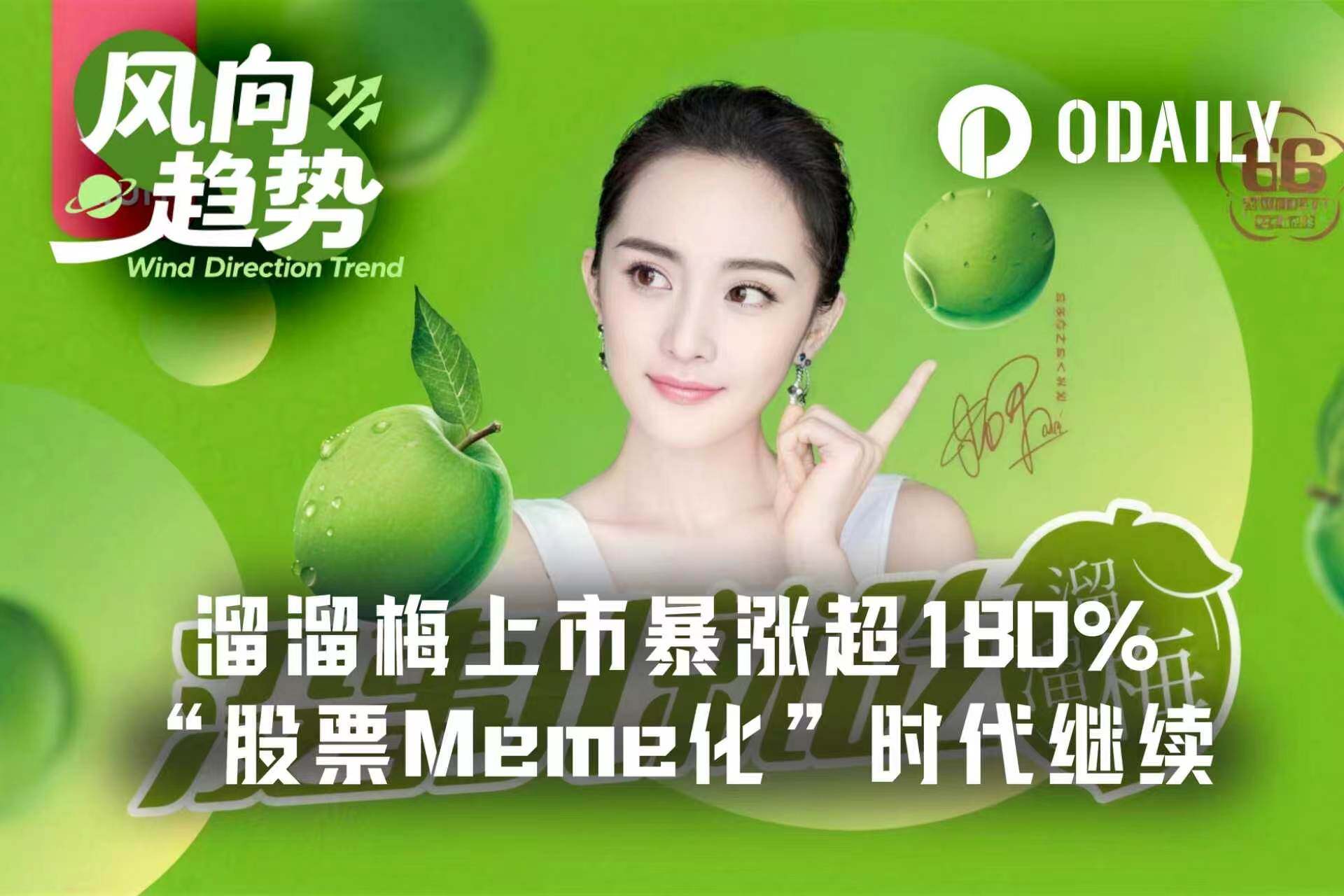
"Are you okay? Okay? If you're fine, eat a Green Plum!"
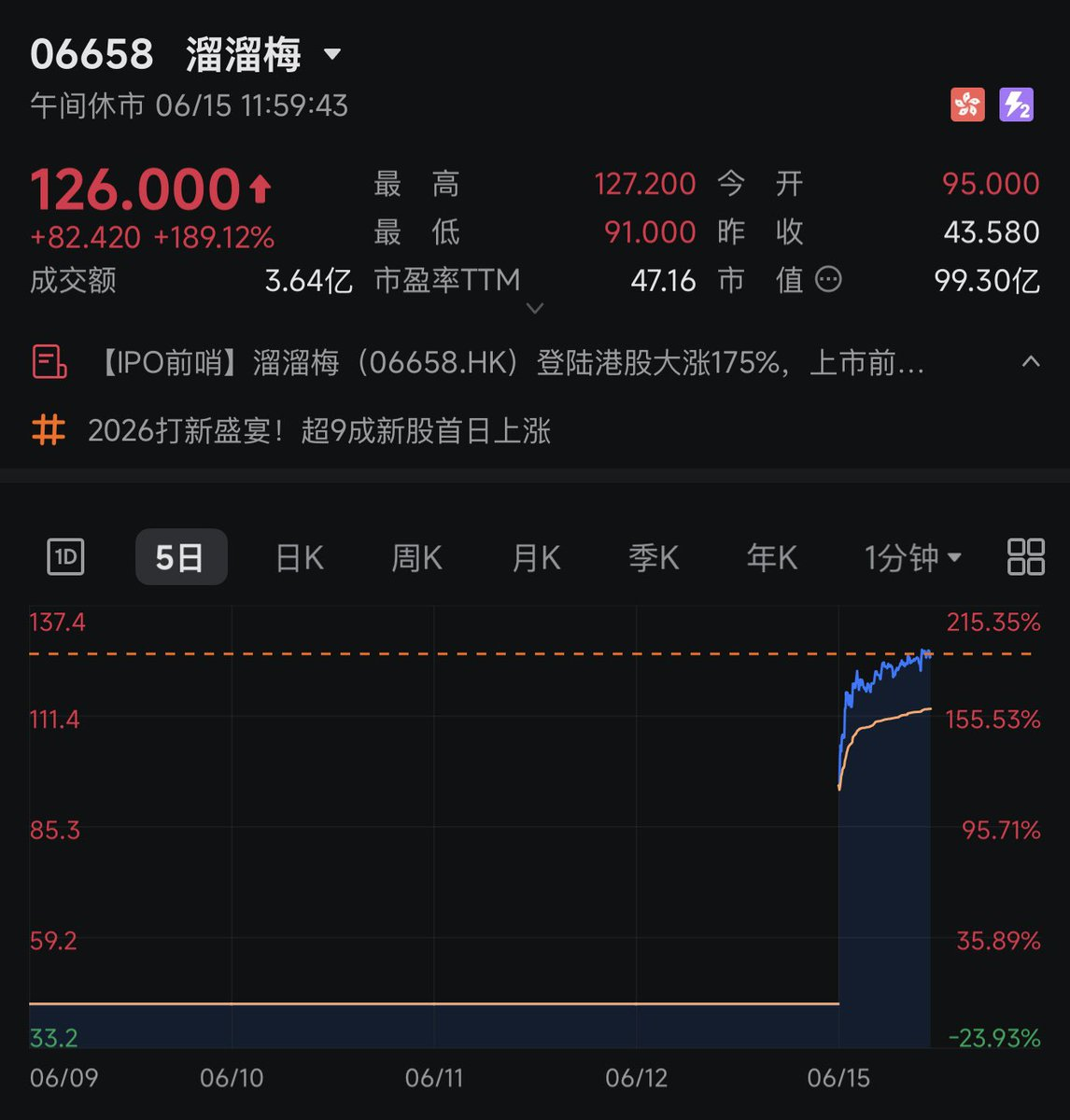
Once upon a time, a catchy ad phrase from actress Yang Mi brought Green Plum (Liuliumei) into millions of homes. Now, after decades of accumulation, its parent company officially landed on the Hong Kong Stock Exchange today, becoming the "first green plum snack stock." Its IPO price was set at 43.58 HKD, opened at 95 HKD, surging about 116% from the offer price of 42 HKD; it hit an intraday high of 127.50 HKD, with gains exceeding 190%; it has since pulled back to 125 HKD, still up over 186%.
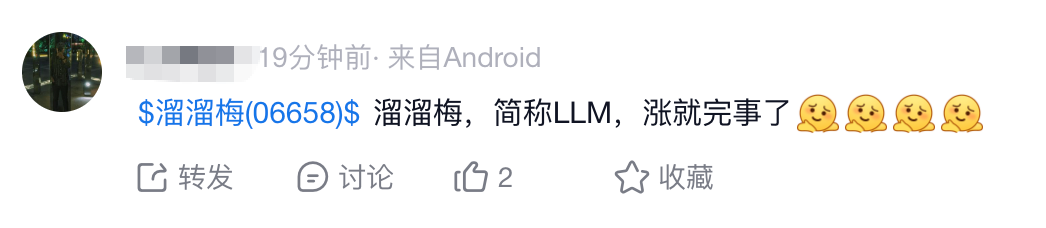
Contrary to many expectations, the surge in Liuliumei's (06658.HK) stock price is not a revival of the "new consumption, new retail, new snacks" concept. Instead, its stock abbreviation coincidentally matches "LLM" (Large Language Model), riding the wave of today's 45% surge in Zhipu AI (02513.HK).
Many are calling it a "genuine AI large language model stock," attracting a flood of speculative capital. Whether acknowledged or not, perhaps global stock markets are entering an "era of stock Meme-ification."
A New Era for Global Stock Markets: When Stocks Collide with Memes
First, let's look at the basics of Liuliumei's IPO. This marks its fourth attempt at the capital markets.
In 2019, Liuliumei failed in its bid for an A-share listing. In 2025, two applications to the Hong Kong Stock Exchange lapsed. It wasn't until May 21 this year, after a third filing update and renaming its entity from "Liuliumei Group Co., Ltd." to "Liuliumei Co., Ltd.," that it successfully listed in less than a month. It must be said, sometimes names do carry a certain mystique.
According to the company's allotment results, the public offering portion of this IPO recorded an oversubscription of approximately 6,586.73 times. The final number of publicly offered shares was 1.1465 million, accounting for about 10% of the total global offering. Around 180,500 valid applications were received, of which approximately 11,465 were accepted. The allotment ratio for one board lot was only 1.5%, meaning the probability of securing one lot was as low as 1.5%, indicating extremely intense competition. For the international placement, Liuliumei received 2.64 times subscription, with the final number of internationally placed shares being 10.3176 million, representing 90% of the total offered shares. By this comparison, the popularity of Liuliumei's IPO has surpassed that of "the number one milk tea chain stock" Mixue Bingcheng, which listed in Hong Kong last March with a public oversubscription ratio of 5,258.21 times.
In other words, institutions were not particularly bullish, yet they held 90% of the shares; retail investors were bullish but only held 10%. The main driver of the opening price surge came more from the open market, a free-for-all game between retail investors and major forces. This is precisely the power of a "Meme stock" – converting the attention captured by a meme into buying pressure in the capital market.
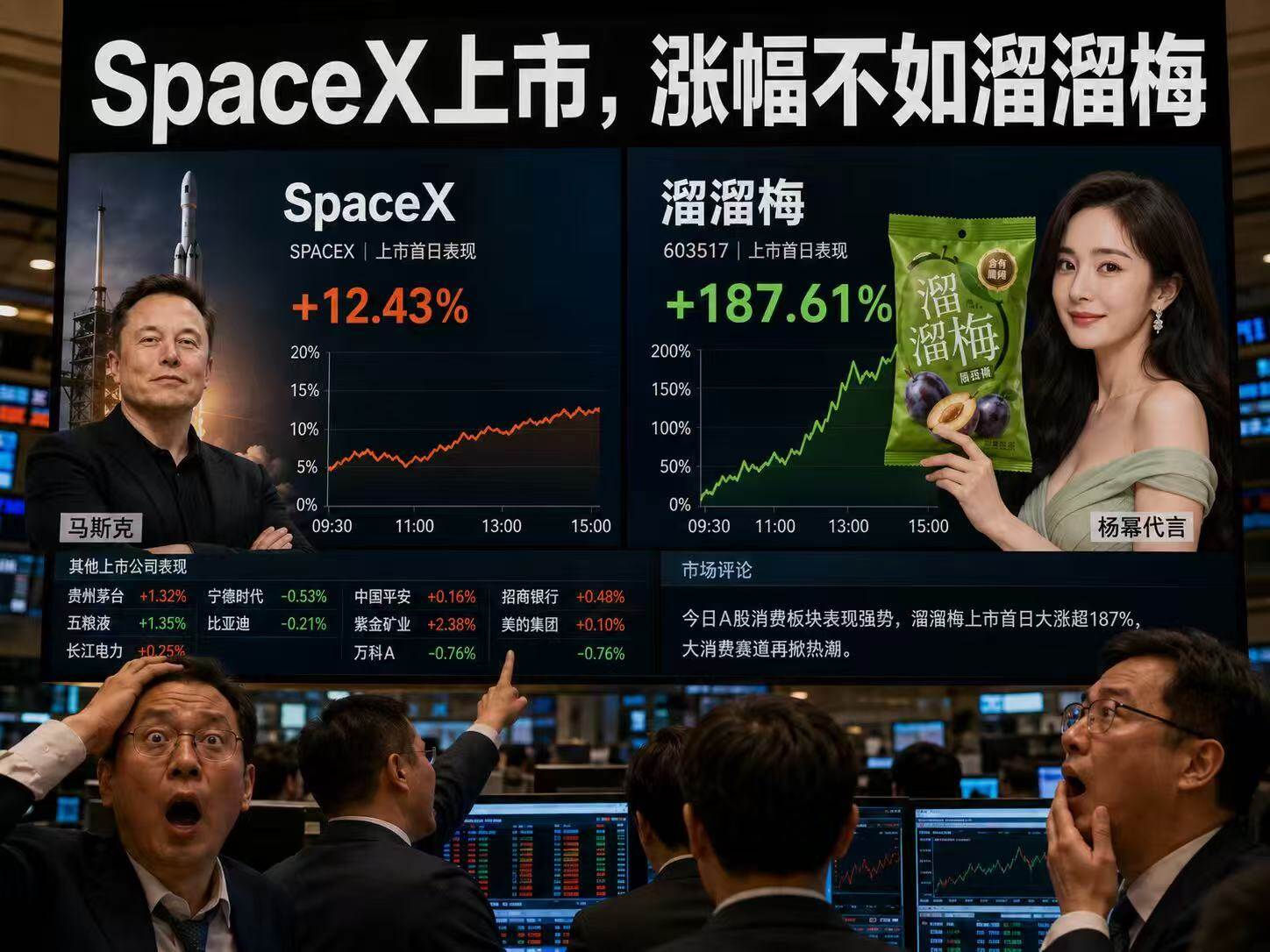
Some netizens even compared Liuliumei's opening performance to SpaceX, noting that its market gains were far more impressive.
It's worth noting that "Meme stocks" are not a new term; they are objectively a category of stocks in major capital markets like the US, Hong Kong, and China A-shares. However, the "era of stock Meme-ification" is a very recent trend, emerging in the last 1-2 years, and the crypto market has played a role in fueling this phenomenon.
The earliest Meme stocks are lost to history, but let's discuss some notable examples from recent years.
GameStop in 2021 was perhaps the starting point for many people's initiation into US Meme stocks. Led by well-known retail heavyweights like Roaring Kitty, global retail investors united to short-squeeze Wall Street hedge funds, prompting many brokerage platforms and exchanges to 'pull the plug' to avoid risk. More recently, rumors that GameStop was acquiring eBay caused market volatility and a temporary price jump.
Tesla and the recently IPO'd SpaceX have also been considered Meme stocks. These companies and their stocks are strongly linked to the highly controversial 'world's first trillionaire,' Elon Musk. Before solid business performance could prove their value, they were seen as 'high-valuation narrative-driven companies.'
Before Trump won the US presidential election in 2024, the A-share market showed early signs of unusual activity. 'Chuan Da Zhi Sheng' (a Chinese stock with a name punning on 'Trump's great victory') frequently appeared on platform hot lists and even hit multiple daily price limits. Around the same time, during Trump's campaign assassination attempt, his ear was cut by glass from a shattered bullet, causing shares of Geer (Goertek, a pun on 'cut ear') to surge intraday.
Last year, amid worsening Sino-Japanese relations, the military stock Fuer (Furui) shares surged due to a patriotic homophone (meaning 'capture Japan'), hitting the daily limit for 8 consecutive trading days and cumulatively rising over 100%, becoming one of the short-term 'demon stocks' in the A-share market.
Today's capital markets, much like the fragmented attention and emotionally charged crypto market, favor stocks and sectors that can spark widespread discussion and attention. These have become the 'focal points of attention' that stir capital and liquidity.
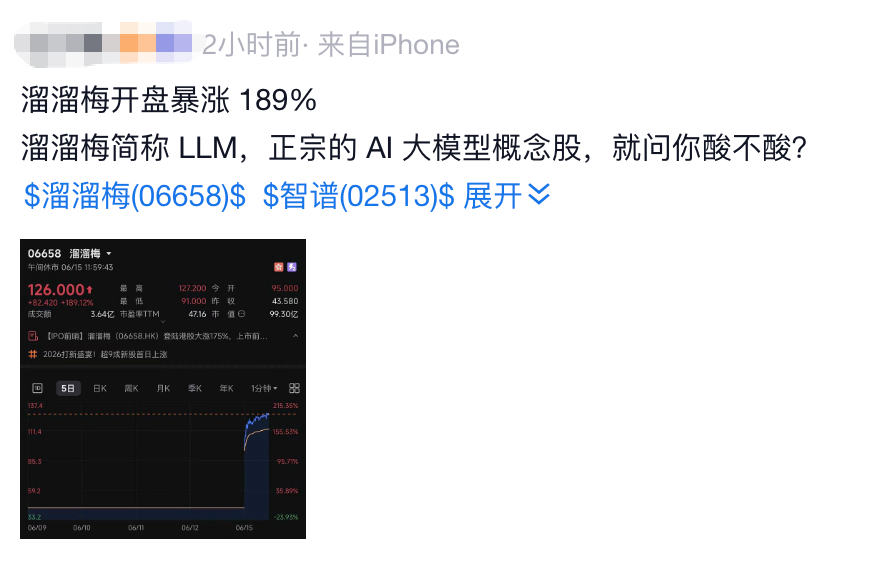
Liuliumei's surge is a prime example of this 'stock Meme-ification' era.
The Dawn of the Stock Meme-ification Era: Homophones, Abbreviations, and the AI Dividend
As the valuations of OpenAI and Anthropic approach the trillion-dollar mark, companies and stocks related to the AI industry chain – optics, communications, materials, computing power – have entered a period of explosive growth:
- Nvidia became the first company in history to surpass a $5 trillion market cap.
- Micron, SanDisk, and others hit new highs, with institutions raising their bullish price targets.
- SK Hynix and Samsung Electronics increasingly dictate the direction of South Korea's KOSPI index.
- Nvidia's founder's comment about being 'bullish on Marvell becoming a trillion-dollar giant' sent Marvell Technology (MRVL) shares higher.
- Innolight (Zhongji Innolight), mentioned by new 'stock god' Serenity, was mistranslated and associated with Inno Laser, causing the latter's stock price to surge 10% on a $300 million capital inflow.
In this great wave of 'stock Meme-ification,' any connection, however tenuous – being AI-adjacent, riding the 'large language model' hype, having a homophonic name with a hot ticker, or being mentioned by a celebrity – becomes a reason for market attention and a perfect stage for capital to flow in.
"Trump concept stocks," "US government concept stocks," "TACO trade beneficiaries" – these are all connected manifestations of this industry trend. This is a common play in the Meme coin sector, an 'attention-intensive industry' long championed by the crypto market.
Of course, the capital markets are different here, with different rules, and the scale of capital and liquidity is incomparable to the crypto market. After all, compared to the trading volumes of the US, Hong Kong, China, Japanese, and Korean stock markets, the total crypto market cap of under $3 trillion seems somewhat insignificant.
Upon its listing, SpaceX immediately ranked among the top 10 global asset classes. In contrast, BTC has fallen to 17th place on that list. It must be said, these numerical comparisons are always stark – over a decade of hard work in the crypto industry is dwarfed by the market cap of a single company's IPO.
Now, the emergence and increase of Meme stocks might have become an industry trend. Previously, Joyoung Company created products based on the viral 'Hakimi South North Mung Beans' meme, causing its stock price to rise. This illustrates a key point: for today's younger generation and investor base, investment targets that can trigger emotional volatility, capture market attention, and stir liquidity are more worthy of purchase.
Even if this fleeting chase for sentiment is only temporary, for many, 'if you can't beat them, join them' is the better strategy. Of course, objectively speaking, the rise of Meme stocks doesn't solely bring benefits like wealth effects or industry booms. Sometimes, this process also involves negative phenomena like pump-and-dump schemes, one-sided harvesting, and emotional marketing.
Just like Liuliumei's opening surge, some angrily accused it of being a 'pump to dump retail investors.' Others speculated that Liuliumei's inclusion in the 'Stock Connect' program, allowing A-share market funds to buy its shares, was the reason for the price increase. What's the truth? The reasons are undoubtedly multi-faceted and chaotic. For us, perhaps the best we can do is to go with this trend and find our own path to wealth.