Japan's Rate Hike on the Horizon: The Final Stress Test for the AI Bull Run?


- Core Thesis: The market highly anticipates the BOJ raising its policy rate to 1.0% in June. The real impact is not the rate level itself, but the continued unwinding of the yen carry trade, which could amplify volatility and trigger a valuation repricing for global high-beta assets (AI tech stocks, cryptocurrencies).
- Key Factors:
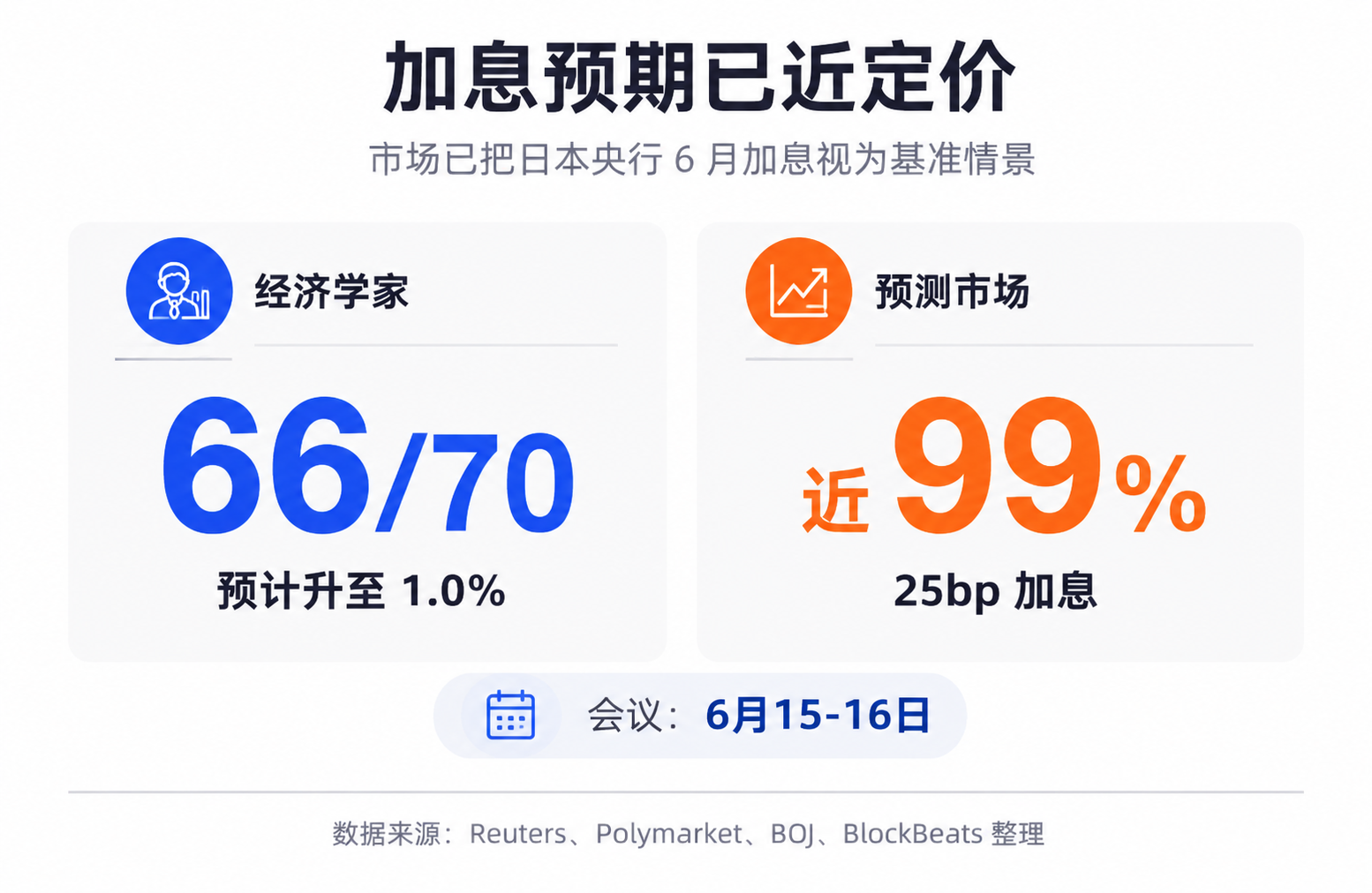
- Market Consensus: A Reuters poll shows 66 out of 70 economists expect a rate hike to 1.0% on June 16, with Polymarket's implied probability reaching 98.3%.
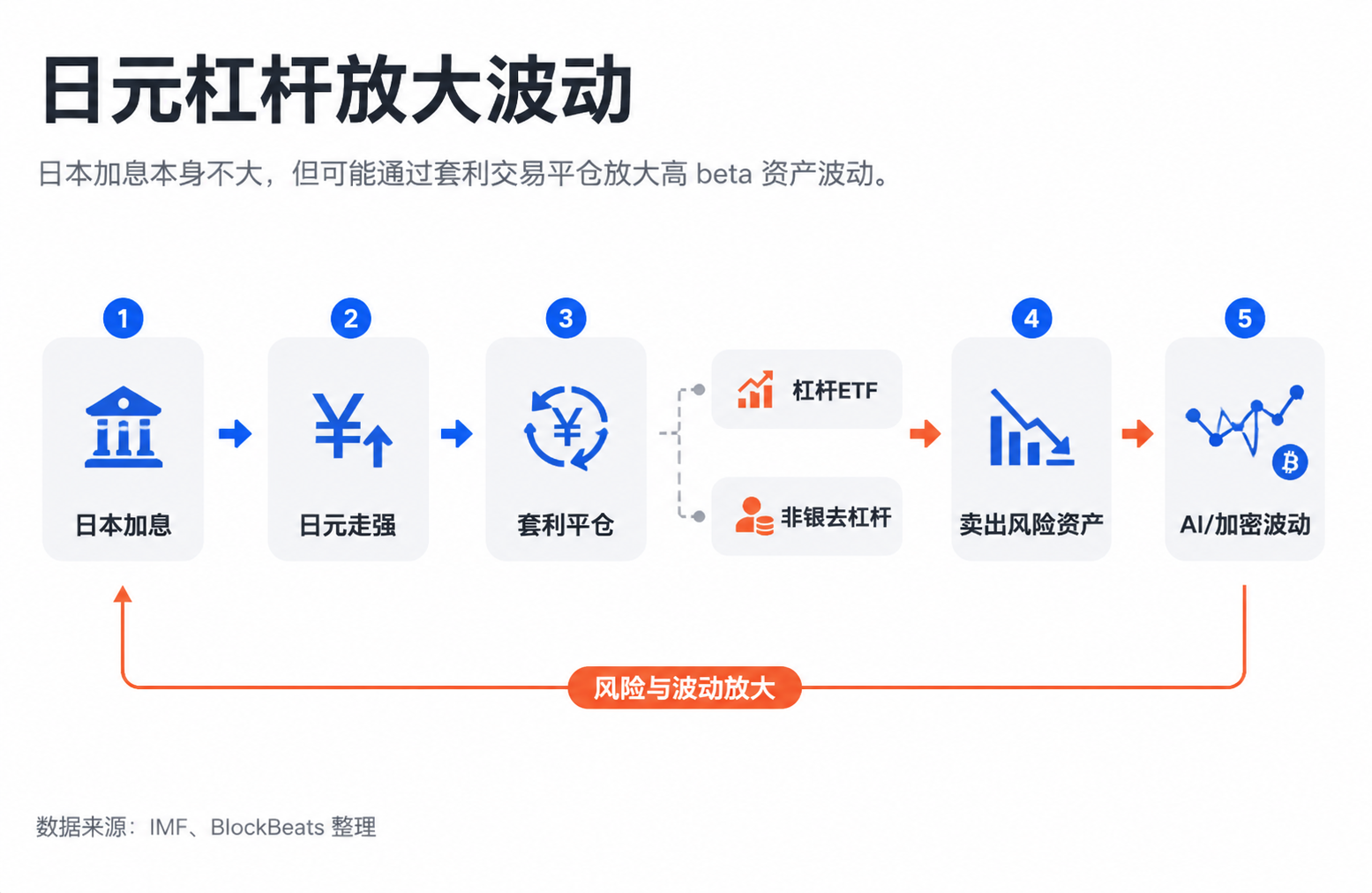
- Transmission Mechanism: The yen carry trade involves borrowing low-yielding yen to invest in high-return assets. Rate hikes and yen appreciation expectations force the closure of these positions, selling off USD-denominated and risk assets, creating a secondary amplification effect.
- Affected Assets: High-beta assets such as Nvidia (NVDA), Microsoft (MSFT), Bitcoin (BTC), Ethereum (ETH), and leveraged ETFs are highly sensitive to liquidity contraction.
- Core Risk: The market is not pricing in a 1% absolute interest rate, but rather the rising "cost of financing" for global risk assets, leading to a compression in valuation multiples for long-term growth.
- Verification Signal: Post-decision, monitor the correlation between the yen, JGB yields, and high-beta assets. If synchronized movements occur, it indicates investors are pricing in the further contraction of the carry trade chain.
TL;DR
- The market has almost priced in a rate hike by the Bank of Japan on June 16 as the base case: a Reuters survey showed 66 out of 70 economists expect a hike to 1.0%, and Polymarket odds implied approximately a 98.3% probability of a 25bp hike.
- What will truly impact global markets this time isn't Japan's rate hitting 1.0% itself, but rather that volatility in AI tech stocks, crypto, and high-leverage assets could be amplified as yen carry trades continue to unwind.
- Related assets: NVIDIA (NVDA), Microsoft (MSFT), BTC, ETH, leveraged ETFs, emerging market risk assets.
If you typically track the price movements of NVIDIA, Microsoft, Bitcoin, or Ethereum, your focus is usually on core variables like US inflation data, the Fed's interest rate path, AI-related revenue realization, and on-chain capital flows. But this week, market attention has been captured by a seemingly more distant variable: the movement of the Bank of Japan's interest rate.
The reason isn't complicated. For many years, the yen has been one of the cheapest funding currencies globally. Investors could borrow low-interest yen, convert it into dollars or other currencies, and then buy assets with higher yields and greater upside. This is the yen carry trade – simply put, borrowing low-interest yen to buy high-yield assets.
It may not directly appear in a specific AI stock or Bitcoin address, yet it affects global risk appetite and leverage costs. Now, the Bank of Japan is exiting its long-term ultra-low rate environment, and the market is re-evaluating how much longer this "low-interest credit card" can be used.
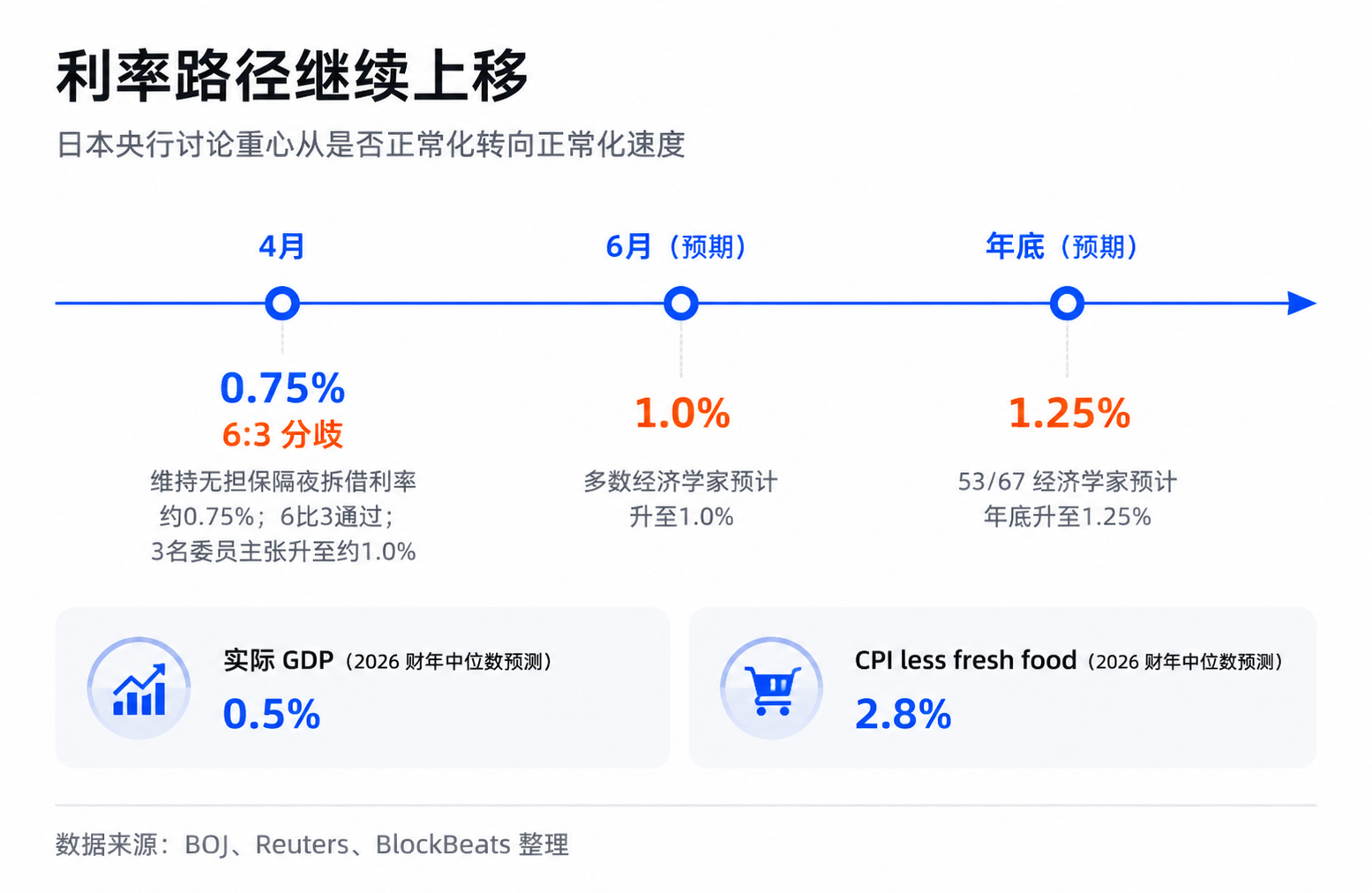
According to a Reuters report on June 10, 66 out of 70 economists expect the BOJ to raise its policy rate from 0.75% to 1.0% at its June meeting. In another survey, 53 out of 67 economists expect the rate to reach 1.25% by year-end. The meeting concludes on June 16. As of June 15, the 1.0% figure remains an expectation from the economist survey, not an announced result.
25 basis points doesn't seem like much. What the market fears isn't the number "Japan's rate reaching 1%", but rather whether assets that have relied on cheap financing, crowded positions, and high risk appetite in the past will be repriced now that long-term cheap money is becoming more expensive. AI mega-cap tech and crypto are the most sensitive endpoints on this chain.
The BOJ's Impact is on the Global Funding Foundation
You can think of the yen carry trade as a low-interest credit card. As long as the borrowing cost is low enough, the exchange rate is stable enough, and the target asset rises fast enough, investors are willing to use this card to add leverage. The yen has long played this role of a global credit card.
This card is important because it doesn't just serve the Japanese market. Low-interest yen can be converted into dollars, entering US stocks, bonds, emerging markets, commodities, and indirectly affecting risk appetite in the crypto market. When global asset prices rise, carry trades amplify liquidity. When the yen appreciates or Japanese rates rise, this chain reverses, forcing some funds to reduce positions, repay loans, and deleverage.
Therefore, investors cannot judge its market impact solely by "Japan's economic size". What the BOJ is changing isn't the earnings forecast of a specific domestic industry, but a piece of the long-term low-cost foundation in the global funding map.
The April meeting already signaled this. At that time, the BOJ maintained the unsecured overnight call rate at around 0.75%, but the vote was 6-3, with 3 members already advocating for an immediate hike to around 1.0%. In the same month's outlook report, the BOJ revised its FY2026 real GDP forecast down to 0.5% and its core CPI forecast up to 2.8%. The focus of policy discussion has shifted from whether to normalize to how fast normalization should proceed.
Market consensus remains relatively dovish: the BOJ will raise rates gradually with ample policy communication, and some yen carry trades have already been unwound in past rounds of volatility. However, risk frameworks look at a different issue. As long as residual leverage exists, what triggers volatility is often not the absolute level of rates, but the speed of change in interest rate differentials and exchange rate expectations.
For AI stocks and crypto, this speed is crucial. They are both high-beta assets, meaning they have greater price elasticity. They rise more sharply when liquidity is ample and fall faster when risk appetite declines. AI leaders have real revenue and industry trends to support them, and Bitcoin has its ETF, halving cycle, and on-chain structure, but their marginal pricing remains highly dependent on global risk appetite.
When cheap money dwindles, the market doesn't necessarily immediately negate the AI or crypto narrative, but it may lower the valuation multiples it's willing to pay for future growth.
25bp Can Be Amplified by Leverage and Exchange Rates
Looking solely at 25 basis points, a BOJ rate hike seems unlikely to shock global assets. The problem is that carry trades are not ordinary comparisons of deposit and loan rates; they are a system where leverage, exchange rates, and crowded positions are superimposed.
A typical yen carry trade has three layers of income sources: low cost for borrowing yen, high returns from the purchased asset, and the yen not appreciating or even depreciating. As long as these three points hold, the trade is comfortable. Once Japanese rates rise, the first layer's profit is compressed. If the market starts to expect the yen to appreciate, the third layer also becomes a risk. Investors not only earn less but could also lose money on the exchange rate.
This is why 1.0% itself isn't necessarily scary, but the move from 0.75% to 1.0%, followed by market expectations of 1.25% by year-end, changes investors' calculations. What carry trades fear most isn't a slow rise in costs, but everyone simultaneously realizing a trade is no longer worthwhile and rushing to close positions.
Closing positions transmits Japan's local policy decisions to global risk assets. Investors need to buy back yen to repay loans, potentially leading them to sell dollar-denominated assets, tech stocks, crypto, commodities, or emerging market positions. If many funds act simultaneously, the price decline can trigger more risk controls, margin calls, and volatility model adjustments, creating a secondary amplification.
In its April 2026 Global Financial Stability Report, the IMF noted that the unwinding of carry trades could amplify market volatility through channels like capital flows, bond yield fluctuations, leveraged ETFs, and deleveraging by non-bank financial institutions. The key point isn't that a specific decline is solely caused by the BOJ, but that this mechanism is real and can exacerbate shocks during periods of liquidity stress.
Over the past two years, the market has observed similar phenomena multiple times: momentum stocks, AI tech stocks, and Bitcoin moving in sync without a clear new Fed announcement or sudden deterioration in a single company's fundamentals. Institutional analysis often cites yen carry trade unwinding as one explanation. Strictly speaking, this only proves high temporal correlation and a plausible mechanism, not sole causation. But for trading, the correlation and transmission mechanism are already sufficient to be risk variables.
The Market is Trading on a Higher Funding Threshold
More precisely, the market isn't trading "BOJ rate hike destroying AI", but rather "a higher funding threshold for global risk assets". These are two different things.
The AI narrative still has its own trajectory. Cloud capital expenditure, GPU demand, model application adoption, and enterprise software revenue are the long-term fundamentals for companies like NVIDIA and Microsoft. Bitcoin also has its own narrative, including ETF flows, regulatory frameworks, macro haven narratives, and on-chain supply structure. The BOJ won't replace these variables.
However, during high-valuation phases, fundamentals answer whether there is long-term value, while liquidity answers what multiple the market is willing to pay for that future. When global cheap financing is more abundant, investors are more willing to pay a premium for distant growth. When financing costs rise and risk appetite falls, the same growth story might be discounted more heavily.
This is the meaning of implicit funding costs. It doesn't necessarily manifest as a higher loan rate for a specific company or a direct yen borrowing by a specific fund. It's more like the overall market leverage temperature: when money is cheap, investors are keen to chase high-volatility assets. When money gets more expensive, the market's tolerance for losses, distant profits, and valuation bubbles decreases.
Therefore, the market significance of this BOJ meeting isn't whether 1% is a high rate. In the US or many emerging markets, 1% is certainly not high. But in the context of the yen as a global funding currency, it represents a change in direction. A funding channel that has long provided cheap leverage is moving from ultra-low costs towards normal costs.
The statement "carry trades have mostly been unwound" doesn't mean the risk is gone. Some positions have indeed been reduced in past volatility rounds, and the market has already priced in the June hike. But as long as residual exposure remains in the banking system, offshore yen lending, and non-bank leverage, prices will remain sensitive to the pace of normalization.
More importantly, the yen is just one visible anchor. Global risk assets in recent years haven't relied solely on the Fed; they have also been influenced by various low-cost funding currencies, offshore liquidity, and cross-market leverage. When these funding sources simultaneously become less cheap, even if the Fed pivots to easing, it may not fully offset the marginal tightening from other monetary systems.
Post-Decision, Watch the Linkage Between Yen, JGBs, and High-Beta Assets
The verification point for this narrative is clear: after the BOJ's decision on June 16, will the market just "buy the rumor, sell the fact," or will it begin to reprice a faster normalization path?
If the BOJ hikes to 1.0% as expected by the economist survey, but the language is dovish, USD/JPY reacts calmly, and US tech stocks and crypto don't come under simultaneous pressure, then this would look more like a digested policy event. The market would refocus on AI revenue, the Fed's path, and the US earnings cycle, treating the Japan factor as a short-term disturbance.
If the decision or post-meeting statements lead the market to price in a higher path, like 1.25% or more by year-end, resulting in a rapid yen appreciation, rising JGB yields, and synchronized moves in NVIDIA, other momentum tech stocks, BTC, and ETH, then it indicates investors are trading not the 25bp hike itself, but the further contraction of the yen leverage chain.
Going forward, watch the correlation between prices: whether yen strength is accompanied by weakness in high-beta assets, whether volatility rises without any new US negative catalysts, and whether leveraged ETFs and crowded momentum stocks are the first to come under pressure. If these signals appear simultaneously, the BOJ is no longer just the BOJ; it serves as a reminder to the market that the map of global cheap money is getting more expensive.