






SpaceX Races Toward the "Largest IPO in History": Commercial Spaceflight Takes a Step into the Era of Public Market Pricing


- Core Thesis: The article argues that SpaceX's listing will shift commercial spaceflight from concept speculation to value reassessment. The key lies in identifying companies with truly sustainable business models, rather than chasing short-term sentiment.
- Key Elements:
- SpaceX is expected to go public on June 12 (ticker: SPCX) with a target valuation of $1.75 trillion, making it the world's largest IPO. Its public market pricing will serve as a valuation anchor for the entire commercial space sector.
- The long-term value of commercial spaceflight stems from technologies like reusable rockets, which lower the cost of accessing space, unlocking potential for new business models such as satellite internet and remote sensing data.
- SpaceX's business structure comprises three layers: Launch & Space Systems (engineering barriers), Starlink satellite internet (subscription revenue model), and AI & Compute (long-term upside paired with current losses).
- The commercial space sector should be viewed in tiers. Platform companies (e.g., Rocket Lab) most closely resemble SpaceX's full-stack capability logic, while satellite networks (e.g., AST SpaceMobile) and space data services (e.g., Planet Labs) have their own distinct focuses.
- Rocket Lab (RKLB) is a prime example, transitioning into a "space infrastructure platform" through the maiden flight of its medium-lift reusable rocket, Neutron, and defense contracts (e.g., the $816 million SDA project).
- SpaceX's high price-to-sales ratio of over 100x means its valuation is a core risk. If growth falls short of expectations, valuation corrections could be severe. However, its IPO will ultimately distinguish between core assets, comparable assets, and sentiment-driven assets.
Original Authors: Mike, Frank, MSX Maitong
If everything goes according to plan, SpaceX will be listed on the Nasdaq on June 12 under the ticker SPCX.
Barring any surprises, this is set to become the largest IPO in the history of global capital markets—according to the currently disclosed offering plan, SpaceX intends to raise approximately $75 billion, with a target valuation of around $1.75 trillion. This would not only surpass the fundraising scale of Saudi Aramco's IPO but also make it one of the most valuable publicly listed companies in the world from day one.
However, for the market, SpaceX's significance extends far beyond just "another star tech stock going public."
More importantly, the commercial aerospace sector—a track long caught between immense imagination and high entry barriers—has finally gained a truly meaningful public market pricing anchor. Over the past few years, investors knew the space economy was attractive. They understood that satellite internet, commercial launches, remote sensing data, and defense aerospace all had long-term potential. But it was incredibly difficult to determine what these assets were actually worth.
Once SpaceX trades at a public market price, every publicly listed commercial aerospace company will be placed on the same valuation table. Those closer to SpaceX's capability frontier, those with real orders and revenue, and those merely riding the thematic wave will all be re-evaluated by the market.
Therefore, re-understanding the commercial aerospace sector around SpaceX's listing isn't about chasing short-term sentiment. It's about answering three key questions: First, why is commercial aerospace worthy of long-term attention? Second, within the sector, which companies truly possess sustainable business models? Third, after SpaceX goes public, will it suck up capital from the sector, or lift the entire sector?
1. Commercial Aerospace: From Government Project to Commercial Asset
To understand why commercial aerospace deserves long-term focus, one must grasp the historic transformation the industry is undergoing.
For decades, reaching space was largely an extension of national capabilities. The U.S. had NASA, the Soviet Union had its space agency, later succeeded by Roscosmos. Rocket development, satellite launches, and space exploration were fundamentally large-scale, government-led projects. While commercial capital participated, it was rarely the dominant force.
The reasons are simple: prohibitively high costs, long development cycles, and high failure rates. Traditional satellite launches cost hundreds of millions of dollars, project timelines spanned years, and commercial return cycles could take decades. For most enterprises, this wasn't a track manageable with standard business models; it was part of strategic national investment.
Consequently, SpaceX's key to transforming the industry wasn't just putting rockets into space, but reshaping the cost curve of accessing it.
Reusable rockets are the core of this change. The Falcon 9's first stage can autonomously return and land after launch, and after refurbishment, perform another mission. This technology transforms launches from disposable consumables into infrastructure assets that can be amortized repeatedly. Launch costs, once hundreds of millions of dollars, have been compressed to tens of millions. With future systems like Starship maturing, costs may continue to decline.
Once the cost curve breaks downward, business models that were previously unviable start to become feasible.
Satellite internet is the most direct example. Launching thousands of satellites for a low-Earth orbit constellation was economically unimaginable in the past. But after reusable rockets lowered costs, Starlink could evolve from a grand concept into a subscription-based network serving global users.
The same logic applies to remote sensing data services. Commercial satellites imaging the Earth, tracking crops, monitoring ports, and serving defense and insurance industries were historically limited by high satellite manufacturing and launch costs, hindering large-scale commercialization. However, as satellite deployment costs fall and data processing capabilities increase, space data has the potential to transition from "high-end bespoke services" to "continuously subscribed data products."
Looking further ahead, areas like in-space manufacturing, on-orbit servicing, lunar missions, and space-based AI data centers are still in early exploration stages. But the underlying logic is consistent: only with a sustained decrease in the marginal cost of accessing space can new demands be unlocked.
Historical parallels are not uncommon. Technological breakthroughs in shale gas lowered extraction costs, reshaping the U.S. energy landscape. Smartphones lowered the barrier to mobile computing, sparking the mobile internet boom. Cloud computing transformed IT infrastructure from a one-time capital expenditure to a pay-as-you-go service, enabling SaaS to become a major industry.
Commercial aerospace is following a similar path. It's not linear growth of an existing market, but the reopening of a new market after a cost curve breakthrough.
This is why the global space economy is transitioning from a niche tech narrative to a long-term industrial one. Multiple institutions predict the global space economy could grow from approximately $630 billion in 2023 to around $1.8 trillion by 2035, driven primarily by the commercialization inflection point fueled by launch costs, satellite manufacturing, data processing, and defense demand.
2. SpaceX Through the Prospectus: What It's Doing Now
The reason SpaceX commands such high market attention is that it is no longer just a rocket company.
Based on currently disclosed information, SpaceX's business structure can be roughly broken down into three layers: Launch and Space Infrastructure, Starlink Satellite Internet, and the AI and Computing Business formed after integrating xAI.
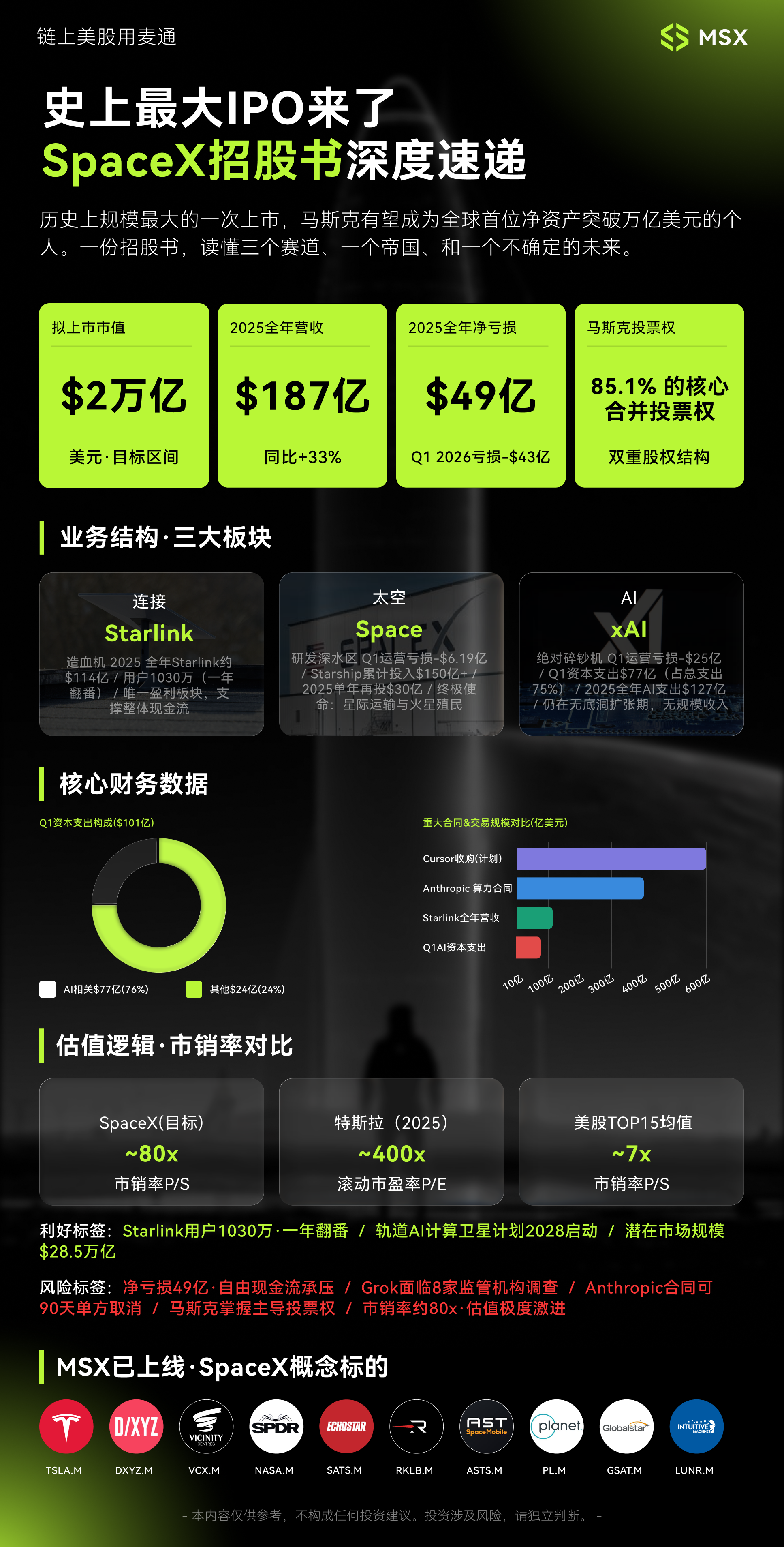
The first layer is Launch Services and Space Systems.
This is SpaceX's foundational capability and the basis for all other businesses. The Falcon 9, Falcon Heavy, Starship, and the launch ecosystem built around NASA, the U.S. Department of Defense, and commercial clients collectively form SpaceX's engineering moat. Reusability not only gives it lower costs but also enables higher mission frequency.
In the aerospace industry, high frequency itself is a moat. More launches mean more data, faster engineering iterations, and more mature cost control. This virtuous cycle is difficult for traditional aerospace companies to replicate quickly.
The second layer is Starlink.
If the rocket business proves SpaceX's engineering prowess, Starlink proves its commercialization capability. Low-Earth orbit satellite internet is essentially a global communications network. The wider its coverage, the more users it has, and the more mature its terminals become, the greater the opportunity to continuously lower marginal costs.
This is the biggest distinction between SpaceX and most other commercial aerospace companies: it doesn't just sell one-off projects; it also has recurring subscription revenue. Starlink serves individuals, enterprises, aviation, maritime, government, and defense sectors, transforming a capital-intensive space project into a revenue model closer to a telecommunications operator or internet infrastructure provider. For capital markets, this layer is also the easiest part of SpaceX's valuation to understand and model.
The third layer is the AI and Computing Business.
This is currently the most imaginative yet controversial part of SpaceX's valuation. With xAI's integration into SpaceX, the company's narrative has extended from "rockets + satellite internet" to "space infrastructure + AI infrastructure." Whether through large terrestrial computing clusters or longer-term orbital AI data centers, SpaceX is positioning itself within the infrastructure competition of the AI era.
However, this layer also introduces new uncertainties. Based on disclosed data, Starlink already demonstrates strong profitability. However, the overall SpaceX group is still burdened by high capital expenditure and losses from the AI business. In other words, SpaceX is not purely a "steadily profitable" company. It is a company that, having proven commercialization in its core business, continues to channel cash flow and capital market expectations into the next super-narrative.
This is why its valuation is so complex.
It combines the certainty of NASA and defense contracts with the growth potential of Starlink subscription revenue, and the long-term imagination of AI, Starship, Mars missions, and space data centers. It is not a traditional aerospace stock, nor simply an internet stock, but a composite giant built from engineering capability, communications networks, government orders, and AI infrastructure.
This is exactly why the market is willing to give it a trillion-dollar valuation, and also precisely where investors must remain cautious.
3. Within the Sector: Capital Drain or Sector Lift?
Having understood the long-term logic of commercial aerospace, the real question begins: within the sector, which companies deserve long-term attention?
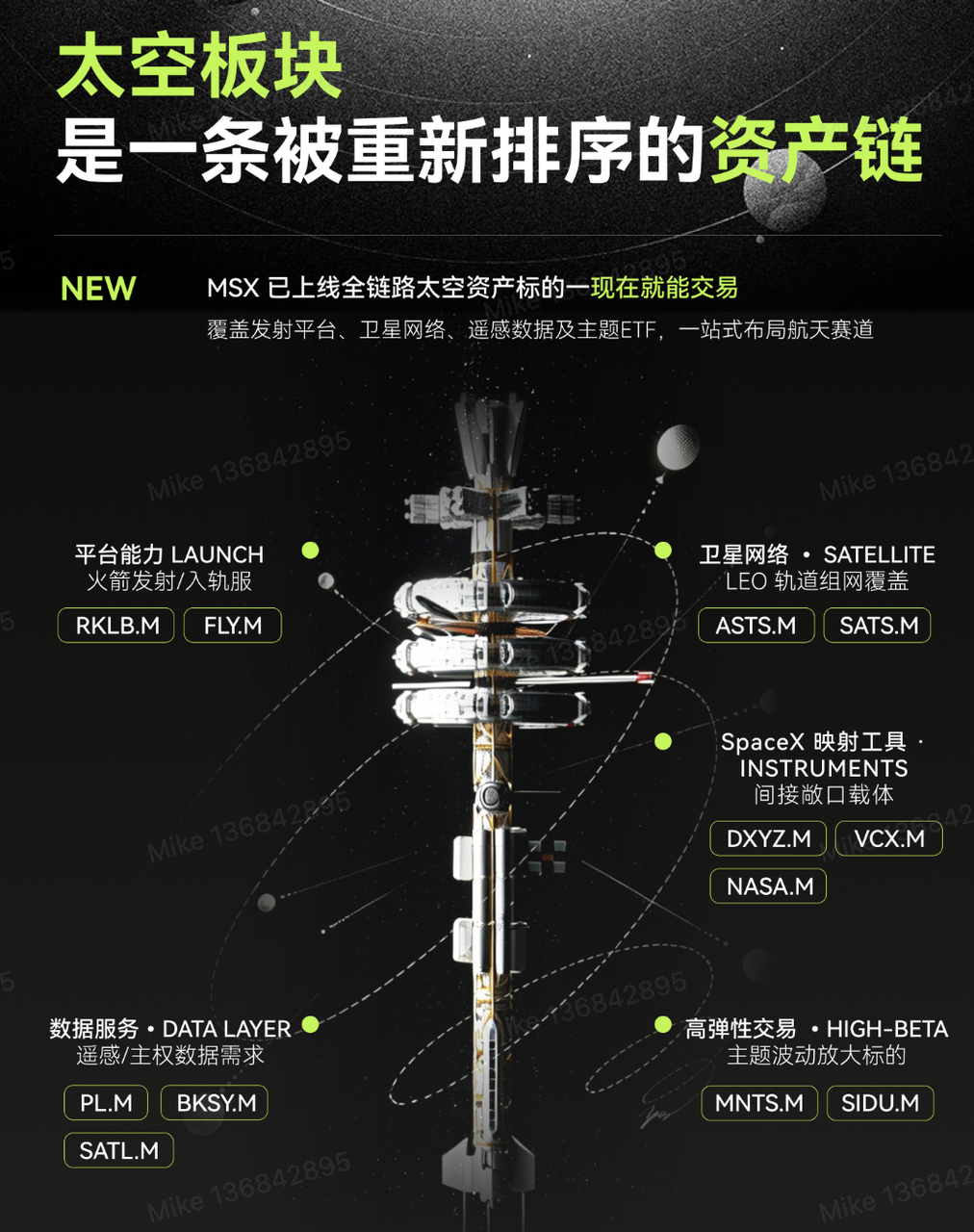
A fundamental judgment needs to be established first: Commercial aerospace is not a homogeneous sector. It contains platform companies comparable to SpaceX's logic, satellite network companies, data service companies, high-beta small-cap companies, and ETFs or closed-end funds offering indirect exposure. Therefore, the valuation logic for different assets varies significantly, as does their risk-return profile.
Without stratification, simply lumping everything under the label "space stocks" makes it easy to buy the weakest comparable assets at peak sentiment. A more sensible approach is to break down commercial aerospace into five layers:
Layer 1: Platform-Based Space Infrastructure
This layer is closest to SpaceX's publicly comparable logic. What makes SpaceX scarce isn't just its rockets, but its full-stack capability spanning launch, satellites, ground stations, communications networks, government contracts, and long-term AI infrastructure. Among listed companies, those closest to this positioning are RKLB.M (Rocket Lab) and FLY.M (Firefly Aerospace).
Rocket Lab is the most typical platform candidate among currently listed space companies. It operates the Electron small launch vehicle, has satellite and space systems businesses, and is extending into medium-lift reusable rockets with Neutron. In 2025, Rocket Lab achieved annual revenue of $602 million, with a year-end backlog of $1.85 billion, giving it relatively leading revenue visibility among publicly listed commercial aerospace companies.
On the surface, Rocket Lab's current valuation is not cheap. But the market's willingness to pay a premium is essentially pricing an identity transition: no longer just a "small rocket company," but transforming into a space infrastructure platform driven by three engines: "launch + satellites + defense orders."
The biggest catalyst for 2026 is the maiden flight of the medium-lift reusable rocket, Neutron. Management's latest guidance points to Q4. If Neutron successfully debuts, Rocket Lab will possess, for the first time, medium-lift capability comparable to the Falcon 9 for certain mission profiles, moving from the small payload market into a larger primary track. Concurrently, Rocket Lab's defense profile is strengthening. The company secured the SDA Tranche 3 project, involving 18 satellites valued at approximately $816 million, which is gradually converting from orders into revenue.
Coupled with M&A integration in areas like laser communications, space robotics, and satellite components, Rocket Lab's story is no longer just "can it launch?" but "can it become the second space infrastructure platform in the public market?"
Firefly represents the second tier in its platform capability ascent phase. The company went public in August 2025 at an IPO price of $45, raising about $868 million. Its business covers launch, lunar missions, and defense, with client resources including NASA and Lockheed Martin. However, it remains in a high-growth, unprofitable, high-volatility phase.
The advantage of such companies is their high beta. The disadvantage is equally clear: mission failures, order delays, or a decline in market risk appetite can trigger sharper valuation pressure compared to more mature platforms.
Therefore, Rocket Lab is better suited as a core sample of the commercial aerospace platform logic, while Firefly leans more towards a high-beta growth sample.
Layer 2: Satellite Network and Connectivity Services
This layer focuses on coverage, access, and long-term service revenue.
The most representative company in this layer is ASTS.M (AST SpaceMobile). Its core isn't building satellites, but creating a satellite communication network accessible by standard smartphones—often referred to as "direct-to-device" connectivity.
If this model proves viable, ASTS's potential is vast. It targets global mobile connectivity gaps, remote area networking, disaster communications, and defense communications. Theoretically, it can partner with existing mobile operators rather than completely replacing them. However, ASTS's challenges are clear: commercialization verification is still underway. Satellite deployment pace, cash burn rate, spectrum coordination, and operator partnership progress all influence its valuation realization timeline.
SATS.M (EchoStar) leans more towards a mature satellite operations platform. It has lower growth potential than ASTS but possesses more mature assets and operations, with relatively controllable volatility. For investors, this type of asset is better suited as a stable observation sample for satellite communications infrastructure rather than purely chasing high beta.
Layer 3: Space Data Services
This is the layer within the space economy most likely to transition from "concept stock" to "operational asset."
The representative company is PL.M (Planet Labs). Its logic is straightforward: selling continuously updated Earth observation data. Agriculture, insurance, energy, ports, defense, and government governance are all potential use cases for its data.
In fiscal year 2026, Planet Labs reported revenue of approximately $308 million, a year-end backlog of $900 million, and achieved positive Adjusted EBITDA for the first time. This is significant, as it indicates the company is moving from "burning cash to tell a story" toward a phase of "business self-sustainability."
In comparison, BKSY.M (BlackSky) is more focused on spatial intelligence and defense subscription logic. Its core appeals are high-frequency remote sensing, AI analytics, international clients, and government contracts. Its business model is closer to a "spatial intelligence service provider," with defense and sovereign needs as its vital support.
SATL.M (Satellogic) has a smaller market cap, offering higher beta but weaker certainty. It is better suited as a high-beta supplementary sample rather than a core sector asset.
Layer 4: High-Beta Small Caps
Companies like MNTS.M (Momentus) and SIDU.M (Sidus Space) belong to this fourth layer.
Their common characteristics are small market capitalizations, early commercialization stages, and high volatility. Pricing relies more heavily on events, themes, and technology validation. When the sector heats up, these are often the first to move, as only a small trading volume is needed to push prices. However, when the market shifts from sentiment back to comparative valuation, they are also the first to be re-evaluated.
Layer 5: SpaceX Mapping Tools
Before SpaceX's official listing, another type of option emerged in the market: gaining indirect exposure to SpaceX through ETFs, closed-end funds, or pre-IPO vehicles.
For example, DXYZ.M, VCX.M, and NASA.M are tools that have, to varying degrees, captured the scarcity trading opportunity before SpaceX's IPO.
DXYZ's core logic is "SpaceX anticipation trading + scarce private tech assets." It provides public market investors with a channel to indirectly trade a private giant.
VCX is more like a basket of unlisted tech assets, containing not only SpaceX but also other AI and pre-IPO tech companies. Therefore, its pricing logic is closer to the overall risk appetite for unlisted tech assets.
NASA.M functions as a combination of a space-themed ETF and a SpaceX exposure tool. Listed at the end of March 2026, it quickly attracted capital based on the SpaceX IPO anticipation, becoming one of the most watched space-themed vehicles in the market.
However, these tools face a very real problem: once SpaceX itself is publicly traded, the scarcity value of these alternatives will diminish.
When SPCX cannot be bought directly, the market is willing to pay a premium for alternative exposure. But when SPCX becomes directly tradable, some capital may flow from these alternatives to the original. This doesn't necessarily mean these tools will lose value entirely, but their pricing logic will change: from "the only entry point" to "a portfolio allocation component."
This is a key reason why the space sector may see significant divergence after the SpaceX IPO.
Finally, it's worth noting that as the core holdings of MSX Q2 Top Picks, the four stocks RKLB.M, YSS.M, BKSY.M, and PL.M all recorded positive returns, with an average gain of over 100%.
Final Thoughts
Of course, commercial aerospace being worthy of long-term attention does not mean every price point is worth chasing.
SpaceX's current target valuation of approximately $1.75 trillion corresponds to a price-to-sales ratio close to 100 times its 2025 revenue. This valuation implies the market has already priced in years of future growth, including Starlink's expansion, Starship's maturation, the explosion of the AI computing business, and the long-term commercialization of space infrastructure.
If post-IPO earnings growth falls short of expectations, or Starlink user growth decelerates, or AI business capital expenditure continues to increase, a valuation correction could be severe.
A high valuation itself is one of SpaceX's biggest risks.
Nevertheless, the true significance of the SpaceX IPO is that it will force the market to more clearly distinguish between core assets, comparable assets, and mere sentiment assets.
For investors, the most worthy long-term focus in commercial aerospace isn't the word "space" itself, but those companies that can turn imagination into orders, orders into revenues, and revenues into cash flow after the cost curve declines.
Going forward, the real dividing line in the commercial aerospace sector will no longer be how grand the story is, but who can prove what they stand on.
The answer will soon be revealed.


