






美国CPI前瞻:整体通胀或破4创三年新高,核心通胀或显著低于预期


- ประเด็นหลัก: อัตราเงินเฟ้อโดยรวมของ CPI เดือนพฤษภาคมของสหรัฐฯ อาจพุ่งทะลุ 4% สูงสุดในรอบสามปี เนื่องจากราคาพลังงานที่สูงขึ้น แต่เงินเฟ้อพื้นฐานอาจชะลอตัวลง เนื่องจากที่อยู่อาศัย ค่าเบี้ยประกันรถยนต์ และปัจจัยอื่นๆ ปรับตัวลดลง ทำให้อัตราการเติบโตแบบเดือนต่อเดือนอาจต่ำกว่าที่ตลาดคาดการณ์ไว้ ส่งผลให้แนวโน้มของทั้งสองตัวแปรแตกต่างกันอย่างชัดเจน
- ปัจจัยสำคัญ:
- ธนาคารชั้นนำ 5 แห่งคาดการณ์ว่า CPI โดยรวมเดือนพฤษภาคมจะอยู่ที่ 4.17%-4.3% เมื่อเทียบเป็นรายปี ซึ่งสูงกว่า 3.81% ในเดือนเมษายน โดยพลังงานเป็นปัจจัยขับเคลื่อนหลัก โดยอัตราการเติบโตแบบปีต่อปีอาจเข้าใกล้ 24%
- การคาดการณ์ CPI พื้นฐานแบบเดือนต่อเดือนอยู่ที่เพียง 0.17%-0.22% ซึ่งต่ำกว่าที่ตลาดคาดการณ์ไว้ที่ 0.27%-0.30% อย่างมีนัยสำคัญ สาเหตุหลักมาจากค่าเช่าที่อยู่อาศัยที่ลดลง (ค่าเช่าเทียบเท่าเจ้าของบ้านลดลงเหลือประมาณ 0.22% ต่อเดือน) และคาดว่าราคาประกันรถยนต์จะลดลง
- ราคาน้ำมันเบนซินได้แตะจุดสูงสุดและเริ่มปรับตัวลงตั้งแต่วันที่ 20 พฤษภาคม UBS คาดการณ์ว่าสิ่งนี้จะทำให้ CPI โดยรวมในเดือนมิถุนายนลดลงประมาณ 0.13% แบบเดือนต่อเดือน ซึ่งบ่งชี้ว่าเดือนพฤษภาคมอาจเป็นจุดสูงสุดของอัตราเงินเฟ้อในรอบนี้
- เงินเฟ้อพื้นฐานไม่ได้ชะลอตัวลงในทุกภาคส่วน ราคาตั๋วเครื่องบินคาดว่าจะเพิ่มขึ้น 1.3%-2% เมื่อเทียบเป็นรายเดือน เนื่องจากต้นทุนเชื้อเพลิงที่สูงขึ้น ขณะที่สินค้าไอทีและราคาบริการบางประเภทยังคงมีแรงกดดันขาขึ้น
- ราคาจากตลาดสวอปเงินเฟ้อ (4.27%-4.28%) บ่งชี้ถึงแนวโน้มที่ดอลลาร์สหรัฐจะแข็งค่าขึ้นถึง 0.48 ส่วนเบี่ยงเบนมาตรฐาน การวิเคราะห์ข้อมูลในอดีตชี้ให้เห็นว่าความเบี่ยงเบนดังกล่าวมักจะผลักดันให้ดัชนี DXY เพิ่มขึ้นประมาณ 0.14% ภายใน 1 ชั่วโมงหลังจากการประกาศข้อมูล
Original author: Long Yue
Original source: Wall Street News
At 20:30 Beijing time tonight, the U.S. Bureau of Labor Statistics will release the May CPI data. This is also the most closely watched heavyweight inflation data by the market before the next policy interest rate meeting of Fed Chair Walsh next week.
According to information from the Wind Trading Desk, four major Wall Street institutions – Goldman Sachs, UBS, Deutsche Bank, and Morgan Stanley – have intensively released forward-looking reports on the eve of the data release. The four institutions have different numerical forecasts, but their directions are similar: Overall inflation may be quite high, but core inflation may not be as hot. Energy prices push up the overall CPI, while factors like rent and car insurance pull down the core CPI.
Overall CPI may break above 4% to a three-year high, core CPI may be below consensus
From the forecasts, the four institutions' predictions for the May year-over-year overall CPI are concentrated in the range of 4.17%~4.3%, all higher than the 3.81% in April. However, the month-over-month core CPI forecasts are generally lower than the market consensus.
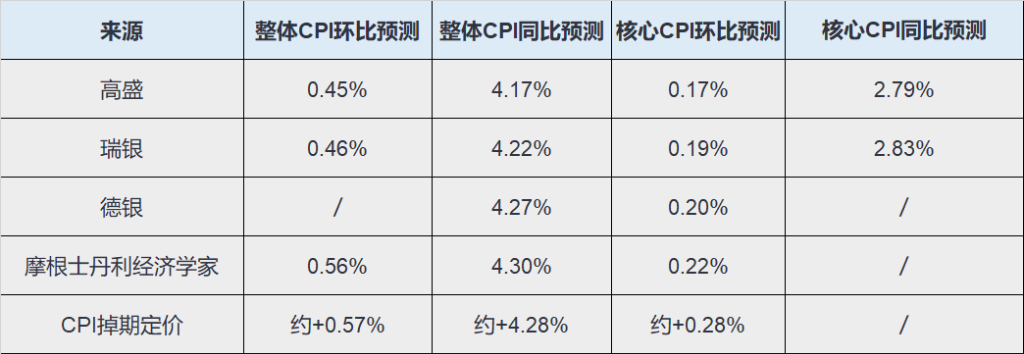
The trends of overall inflation and core inflation show a clear divergence.
The "worrying" part is overall inflation. The year-over-year forecasts from Goldman Sachs, UBS, Deutsche Bank, and Morgan Stanley are all above 4%. Deutsche Bank's estimate of 4.27% and Morgan Stanley's estimate of 4.30% are 46-49 basis points higher than in April, and would be the highest since April 2023.
The "pleasing" part is core inflation. Excluding food and energy, the month-over-month core CPI may only be 0.17%-0.22%, significantly lower than the mainstream market expectation of 0.27%-0.30%.
Overall inflation may break 4%: Energy is the "main culprit"
Energy will be the core driving force behind this potential inflation spike.
Following the outbreak of the Iran war, U.S. retail gasoline prices surged, driving energy commodity prices up by an estimated ~6% to 7% month-over-month in May, with the entire energy category rising by nearly 4% month-over-month. This effect directly pushed the year-over-year overall CPI from 3.81% in April to between 4.17% and 4.3% in May.
Deutsche Bank's calculations show that year-over-year energy inflation could be approaching 24%; in February, this figure was still only 0.5%.
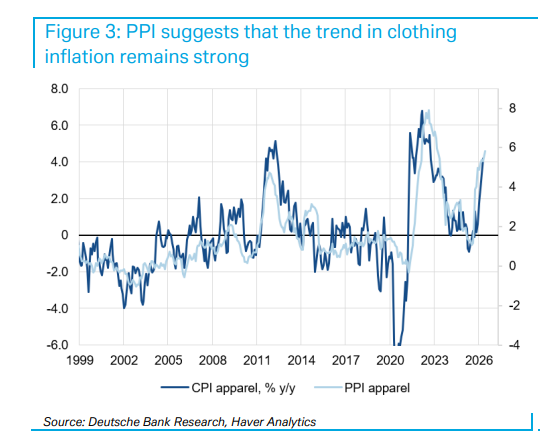
The increase in airfare represents one of the most direct transmission chains. Rising fuel costs directly push up airline operating costs, with airfare prices expected to rise 1.3% to 2% month-over-month in May.
The good news is that gasoline prices have fallen by about 40 cents per gallon since peaking on May 20. UBS expects this will cause the month-over-month overall CPI to fall by approximately 0.13% in June, bringing the year-over-year figure back to around 3.81%. In other words, May is likely the peak for this round of overall inflation.
Why core inflation may be lower than expected: Housing is cooling down again
Core CPI excludes food and energy. Precisely because it excludes these two hottest components, the core data for May will appear much more moderate.
Within the U.S. CPI, housing carries a very high weight, about 35%.
Both Goldman Sachs and UBS predict that Owners' Equivalent Rent (OER) and rent of primary residence will increase by about 0.22% to 0.23% month-over-month in May, continuing the slowing trend. These two components rose by 0.53% and 0.55% month-over-month, respectively, in April. Deutsche Bank also cited "still moderate housing inflation trends" as one reason for the softer core inflation.
Due to the large weight of OER, even a decline from around 0.5% to just over 0.2% can significantly depress the core CPI reading.
Car insurance is also a cooling factor.
Goldman Sachs expects car insurance prices to fall by 0.1% month-over-month in May. Its online data model suggests that premium changes provide a downward signal for car insurance CPI. Deutsche Bank also noted that car insurance is expected to be weak again.
Used cars also show no significant upward pressure. Goldman Sachs expects used car prices to be flat and new cars to rise by 0.1%; UBS expects a 0.26% decline in used cars and a 0.10% decline in new cars.
This means that several items that have frequently disturbed U.S. core inflation in recent years – housing, car insurance, and used cars – are not providing strong inflation signals this time. In other words, the soft May core CPI is not just due to a "sudden cooldown" of a single component.
Core inflation isn't cooling across the board: Airfares, IT goods, and some services still under pressure
Core CPI being below consensus doesn't mean all core components are cooling down.
Airfares represent an upward component.
Goldman Sachs expects airfare prices to rise by 2% in May. UBS expects a rise of 1.34%. The reason is that jet fuel prices remained high for most of May and could be passed through to ticket prices.
There is significant disagreement on hotel price forecasts. Goldman Sachs expects hotels to rise by 0.2%; UBS, based on Smith Travel Research data, lowered its accommodation forecast, expecting out-of-home lodging prices to fall by 0.77%. However, UBS also cautions that the CPI measures prices at the time of booking, while STR data is closer to prices at the time of stay. This time lag could present upside risks, potentially reflecting World Cup-related demand early.
Goods also show some stickiness.
UBS expects core goods prices to rise 0.08% month-over-month, falling between March's 0.11% and April's 0.03%. Its judgment is that the impact of tariffs on 12-month core goods inflation may have passed its peak slightly, but residual transmission effects will still keep monthly core goods prices slightly positive for the remainder of this year.
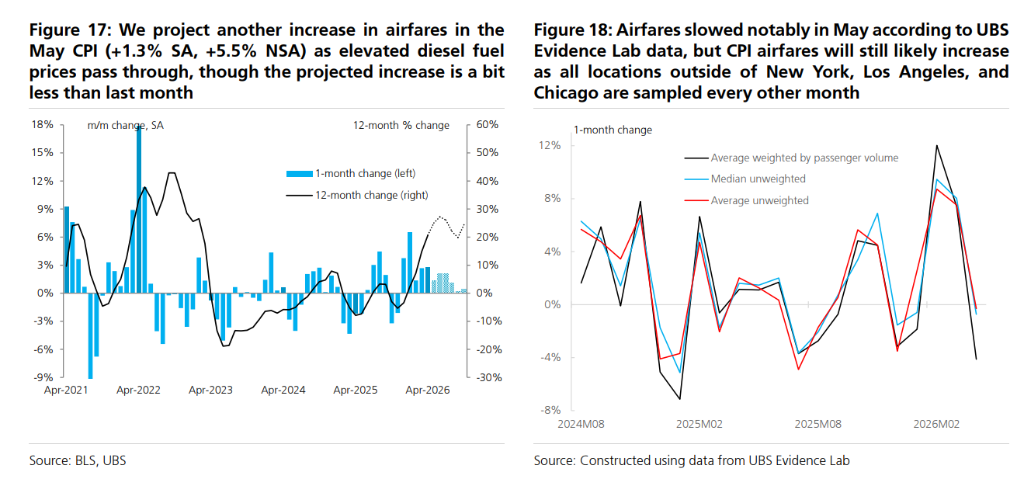
Deutsche Bank also mentioned that import prices show IT goods prices still have strong momentum, partly due to high global memory chip prices. Meanwhile, apparel PPI indicates that apparel inflation trends remain strong, although import prices are weak, suggesting CPI momentum may slow compared to previous months.
The services component is more complex.
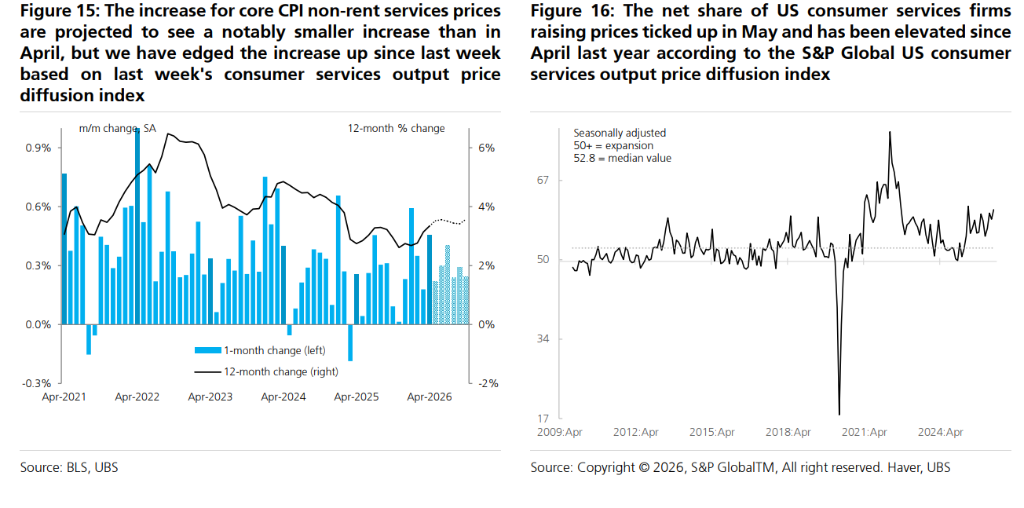
UBS raised its forecast for non-rent core services prices from 0.17% to 0.21%, citing the S&P Global U.S. Services Output Price Diffusion Index, which showed that the proportion of consumer services firms raising prices in May increased, reaching its second-highest level since 2009, aside from the pandemic anomaly period.
What to really watch tonight: It's not just an overall inflation rate above 4%
The headline figure for May CPI may look high, but the breakdown is more critical.
If overall CPI is high, primarily driven by gasoline and energy, the market will likely assess its sustainability in light of falling gasoline prices in June.
If core CPI is significantly below expectations, the market will continue to look at where the disinflation is coming from: is it a slowing trend in housing, or a one-time seasonal drag?
If airfares, IT goods, and non-rent services continue to be strong, the credibility of the core inflation cooldown will be diminished.
So, this CPI report could deliver two messages to the market simultaneously:
On one hand, overall inflation has broken above 4% again, potentially hitting its highest level since April 2023.
On the other hand, core inflation may be only around 0.2%, significantly below market consensus.
This is what makes tonight's CPI report most difficult to trade: the overall inflation looks hot, but core inflation may not be so hot; oil prices push the headline up, while housing and car insurance pull the core down.
Inflation Swap Pricing: The market is betting on a USD upside surprise
The interest rate swap market currently prices the May overall CPI at 4.27% to 4.28%, slightly above the Bloomberg survey median of 4.2%.
A framework from Morgan Stanley strategist Molly Nickolin shows that inflation swap pricing has correctly predicted the direction of year-over-year inflation 9 times out of the last 12 CPI releases. The current pricing implies an upside deviation of about 0.48 standard deviations relative to economist expectations.
Based on historical backtesting, a 0.48 standard deviation upside surprise typically corresponds to the DXY dollar index rising about 0.14% within one hour of the release. Among all G10 currencies, the Swedish Krona (SEK) tends to perform the weakest on "dollar-bullish" CPI release days, showing the largest average decline.
Looking ahead: Oil prices are the biggest variable for the inflation path
The trajectory of core CPI in the coming months depends on how long oil prices stay elevated.
The current baseline forecast is for month-over-month core CPI to remain around 0.2%. However, if the Middle East situation persists and the expected decline in oil prices falls short, upside risks become more prominent – high oil prices not only directly boost energy prices but also continue to permeate core inflation through intermediate channels like airfare and transportation.
Deutsche Bank's longer-term forecast is more pessimistic: Even if oil prices begin to fall in June, year-over-year energy inflation is expected to remain above 10% until early 2027 before turning negative. Core services inflation (excluding rent/OER) is also expected to remain above 3% for an extended period.


