






AAOI Rises Over 10% Against the Trend; "New Stock God" Serenity Predicts Potential for Further Doubling


- Core Thesis: On June 4, 2025, Broadcom's weaker-than-expected guidance triggered the first significant valuation correction in the AI sector. AI and semiconductor stocks faced selling pressure, yet optical communications company AAOI bucked the trend with a surge of over 10%. This signals that the market is beginning to adopt "differentiated pricing" within the AI sector, with capital concentrating on the "physical bandwidth bottleneck" narrative of optical communications.
- Key Factors:
- Broadcom's FQ2 results exceeded expectations, but its Q3 guidance fell short. The CEO revealed that Google might diversify its supply chain, raising concerns about a potential erosion of the AI valuation premium and erasing approximately $300 billion in market value.
- The sell-off in the AI sector spread to stocks like Micron (-7%) and AMD. Capital rotated into traditional Dow Jones industrial stocks, indicating a structural reduction of positions rather than a systemic shift to risk aversion.
- Bridgewater's Ray Dalio joined the chorus warning of excessive AI valuations, echoing previous warnings from JPMorgan and Apollo's CEO.
- AAOI surged 11.76% against the trend, benefiting from Rosenblatt raising its price target to $220. The core logic includes Amazon's 800G optical module revenue, Oracle certification, and demand for 1.6T products.
- Fundamental support for AAOI includes cumulative orders exceeding $324 million, the expansion of its Texas plant to a monthly capacity of 700,000 units by 2027, and management guidance for annual optical module revenue of $1.4 billion.
- Risks facing AAOI include: Q1 results missing expectations (net loss of $14.3 million), delays in 800G mass production, executives selling $12.6 million in shares near the high, and a valuation that already prices in extremely high execution rates.
- AAOI's strength stems from the scarcity in the optical communications supply chain (e.g., InP substrates, tight 800G capacity). Its narrative does not directly overlap with Broadcom's customer concentration issues.
Original Author: Ada, Deep Tide TechFlow
On June 4, Eastern Time, US tech stocks experienced a sharp shock triggered by Broadcom's fiscal guidance, causing the first crack in the AI valuation narrative.
Broadcom's reported FY2Q results were not poor in themselves, with revenue of $22.2 billion and EPS of $2.44 both beating consensus estimates, and AI semiconductor revenue growing 143% year-over-year. However, its guidance for the current quarter failed to meet the market's already elevated expectations. CEO Hock Tan also revealed during the conference call that a major custom chip customer, Google, might diversify its supply chain, and stated that the expansion of the chip business would drag on gross margins. This combination punctured the core narrative that had supported AI trades over the past few months, leading to intense capital rotation that day.
The Dow Jones Industrial Average surged 1.7% in a single day, driven by traditional sectors, reaching a new all-time high. However, the Nasdaq Composite Index closed down 0.09%, and the Nasdaq 100 fell 0.5%. Within this "barbell-style" market divergence, prominent AI and semiconductor stocks faced broad selling pressure: Broadcom -12.59%, Micron -7%, Marvell fell as much as 7% pre-market, and AMD dropped over 4% pre-market.
Amid this widespread sell-off, AAOI staged an independent rally that ran counter to the sector's sentiment.
Broadcom's Guidance Bursts Expectations, First De-rating of the AI Sector
Broadcom became the catalyst for the AI trade's collapse this time, not because its results were poor, but because its guidance failed to match the market's expectations, which had been driven to the top.
During the earnings call, Hock Tan disclosed that AI chip sales for the current fiscal year (ending October) would reach $56 billion. While massive, this figure fell short of market expectations. Coupled with his comments about Google diversifying its supply chain, the market began to question the valuation premium Broadcom had enjoyed over the past year, supported by its ASIC business. During the session, Broadcom touched a low of $403, erasing approximately $300 billion in market value for the day, marking its largest single-day decline since January 2025.
The selling pressure then spread across the entire AI computing power chain. The storage sector also fell simultaneously. Micron, seen as a key supplier of HBM for AI accelerators and deeply tied to AI capital expenditure sentiment, dropped about 7% in a single day. Other storage-related stocks like SanDisk and Western Digital also weakened. Despite CrowdStrike's own Q2 revenue guidance being respectable, it was indiscriminately sold off amidst the overall cooling of AI trades.
Bridgewater Associates founder Ray Dalio joined the warnings against AI valuations that day, clearly distinguishing "buying AI stocks" from "investing in AI technology," cautioning that current valuations "could be getting excessive." This echoes the recent, consecutive warnings about AI capital expenditure and high valuations from JPMorgan Chase CEO Jamie Dimon and Apollo CEO Marc Rowan.
The direction of capital rotation also carries a signal. It flowed towards traditional economic stocks represented by the Dow Jones, rather than a total exodus from risk assets. This suggests the market was not engaging in a systemic risk-off move, but rather a structural reduction within the AI sector.
AAOI's Independent Move: Up Over 10% in a Day, Hitting New Short-Term Highs Intraday
In this environment, AAOI posted an 11.76% single-day gain, climbing from around $171 during the session to a high of $209.64, closing at $202.89, in stark contrast to the sharp declines of Broadcom and Micron.
AAOI had already experienced several rounds of violent fluctuations. The stock hit an all-time high of $233.67 on May 13, fell 9% on May 29, rebounded 17.18%-18.81% on June 1, and then staged an independent 11.76% rally on June 4. In the past 30 days alone, there have been more than four trading sessions with single-day swings exceeding 10%. This level of volatility has become the norm for AAOI's current valuation structure; its trading volume on May 11 was 214% of its three-month average.
The medium-term catalysts driving AAOI's strength are relatively clear. On May 8 (the day after the company reported Q1 results), Rosenblatt raised its price target for AAOI from $140 to $220 in one go, reiterated a "Buy" rating, and designated it a "Top Pick." Raymond James simultaneously raised its target from $72.50 to $160, while B. Riley raised its target to $129 but maintained a Neutral rating. Rosenblatt's core logic included the commencement of revenue from Amazon for 800G optical modules; the potential for qualification certification with Oracle to open a second revenue stream; and a comprehensive demand uplift for AAOI's products across 100G, 400G, 800G, and the emerging 1.6T generations.
The supporting data for the company's fundamentals are also concrete. AAOI has publicly disclosed cumulative orders for 800G and 1.6T optical modules exceeding $324 million. In April 2026, it received a $20.9 million grant from the Texas Semiconductor Innovation Fund to expand its factory in Sugar Land, Texas, to 210,000 square feet. It also announced an additional 388,000 square feet of capacity in Pearland, targeting a monthly production capacity of 700,000 units for 800G and 1.6T optical modules by 2027. Management guided for optical module business revenue to reach an annualized run rate of $1.4 billion by Q3 2027.
However, AAOI's fundamentals are not without blemishes. Its actual Q1 2026 results missed expectations, with a GAAP net loss of $14.3 million and revenue of $151.1 million, both slightly below consensus estimates. Its Q2 guidance for adjusted EPS is between -$0.03 and +$0.03, placing it near the breakeven point. When maintaining its Neutral rating, B. Riley pointed out that AAOI's 800G volume production would be delayed until the second half of the year and highlighted execution risks related to over-reliance on customer forecasts. Furthermore, AAOI executives collectively sold approximately $12.6 million worth of stock in mid-May. While their remaining holdings are still substantial, the timing of the sales coincided with the stock's elevated price.
In short, AAOI currently sits within the tension of "a very strong narrative, relatively weak Q1 earnings, and a significant valuation premium," which is the fundamental reason for its ability to generate high single-day price volatility.
It's worth noting that AAOI also has a potential additional driver. An individual known in Chinese crypto circles as "New Stock God" Serenity has posted multiple times expressing a bullish view on AAOI, calling it his favorite optical communication exposure in the US stock market. He started building a position at $28, suggesting it could be "the next SanDisk."
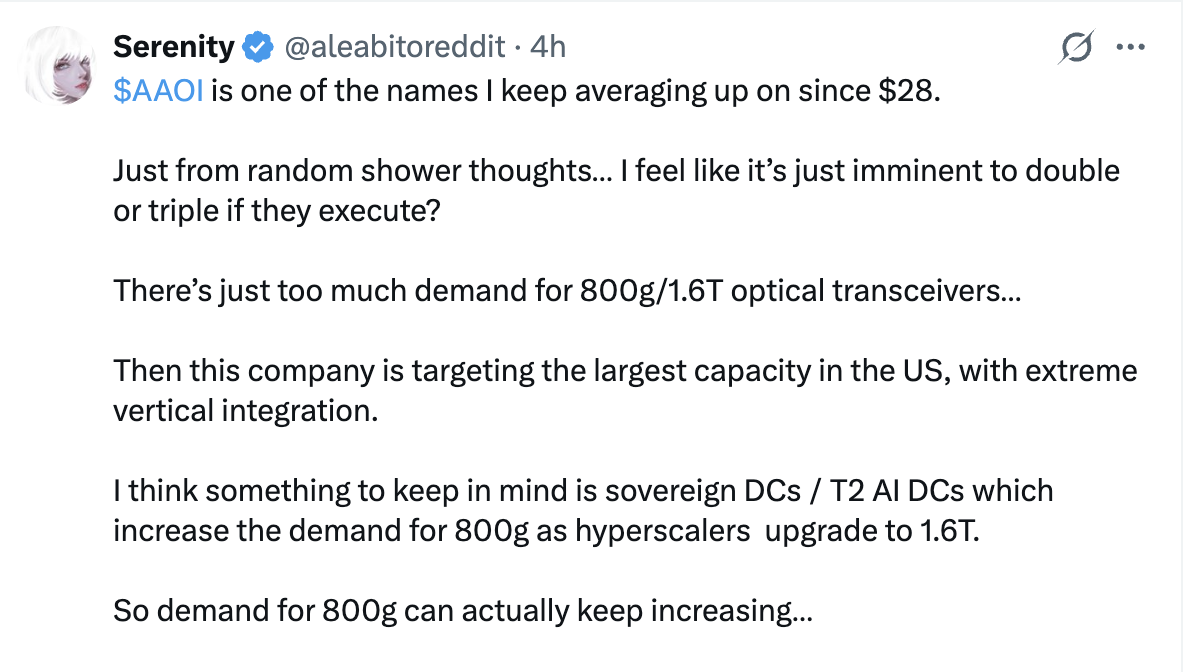
The Logic Behind Outperformance: 'Differential Pricing' Within the AI Sector
AAOI's contrarian strength on June 4 should not be interpreted as a counterexample to AI valuation concerns, but rather as an early signal that the market is beginning to engage in "differential pricing" within the AI sector itself.
One of Serenity's public judgments in April was that the resilience of optical communication stocks might surpass that of large-cap tech stocks: "Even if the S&P 500 falls another 20%, optical communication companies could still outperform." His logic is rooted in supply chain scarcity: InP substrates, laser sources, and 800G optical module production capacity are all in a state of structural tightness in the short to medium term, placing pricing power on the supply side rather than the demand side.
The sell-off triggered by Broadcom's guidance was essentially a correction to the "custom ASIC + major customer concentration" narrative, not a correction to the overall demand for AI infrastructure. From this perspective, optical communication stocks, which are strongly linked to downstream computing power deployment, do not directly overlap in narrative with Broadcom's core issues (customer concentration, Google possibly diversifying supply chain).
However, risks remain. AAOI's current stock price implies valuations that already embed extremely high execution expectations. The market assumes it will achieve a $1.4 billion annualized optical module revenue run rate by Q3 2027 and maintain high gross margins. If the Q2 or Q3 financial reports fail to validate the 800G production ramp, or if any volatility emerges concerning customer concentration risk (Amazon, Microsoft), the valuation structure could face sharp reversals. The actual Q1 financial report was already weak; this crack is currently masked by the narratives of order growth and capacity expansion, but it has not been fully resolved.
For observers in the Chinese market, the noteworthy aspect of AAOI's contrarian move this time is not the gain itself, but the directional choice of capital differentiation within the market. When the overarching AI narrative began to show its first crack, investors' willingness to add positions in AAOI precisely when Broadcom was tumbling speaks volumes. It suggests a judgment that Broadcom's problems are not synonymous with the issues facing all AI capital expenditure, and that optical communication remains a recognized "physical bottleneck" narrative. Whether this judgment holds true will ultimately depend on the actual financial results of the coming quarters.


