






Four valuation anchors, one Musk premium: The real divide over SpaceX's IPO


- Core Thesis: SpaceX's IPO is priced at $135 per share, valuing the company at approximately $1.77 trillion. The central debate is whether it should be viewed as an infrastructure complex (space transportation, Starlink connectivity, AI compute power) rather than a traditional rocket company, leading to a profound valuation divide on Wall Street.
- Key Elements:
- SpaceX plans to issue 555.6 million shares, with net proceeds of approximately $74.4 billion, or about $85.7 billion if underwriters exercise their over-allotment option. The stock will trade under the ticker SPCX on the Nasdaq.
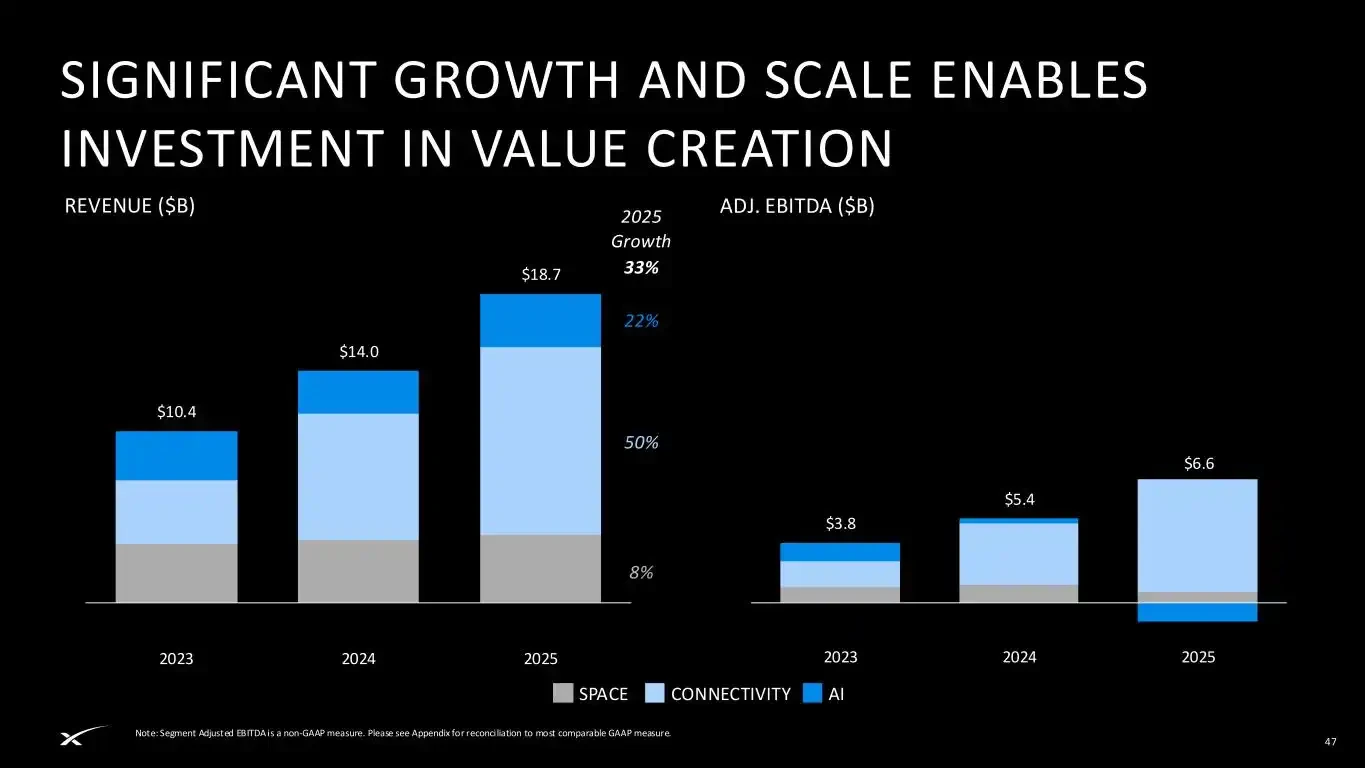
- The company operates across three segments: Space (rockets, generating $4.1 billion in revenue in 2025), Connectivity (Starlink, $11.4 billion in revenue with $7.2 billion in adjusted EBITDA), and AI (xAI/Grok, $3.2 billion in revenue with an adjusted EBITDA loss of $1.2 billion).
- Total revenue for 2025 is $18.7 billion, with adjusted EBITDA of $6.6 billion. However, GAAP net loss stands at $4.9 billion, and capital expenditures reach $20.7 billion, leaving the path to profitability unclear.
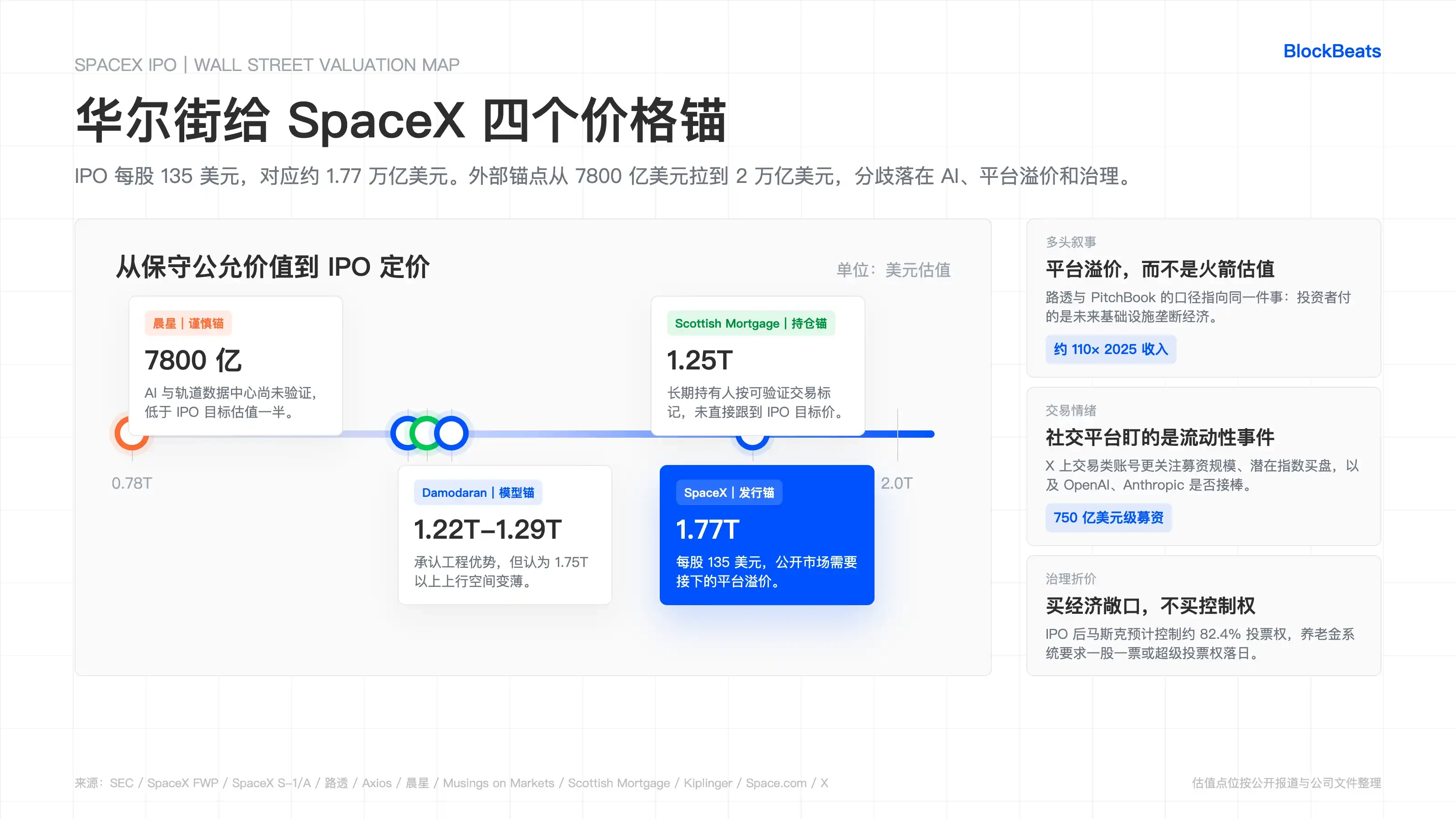
- Valuation divergence is significant: Morningstar puts fair value at $780 billion, NYU's Damodaran model yields a baseline of $1.22 trillion, long-term holder Baillie Gifford holds its stake at a $1.25 trillion valuation, while SpaceX itself prices at $1.77 trillion.
- The governance structure raises concerns: Post-IPO, Musk would control approximately 82.4% of the voting power through super-voting shares (Class B with 10 votes per share). The New York City and State Comptrollers, along with CalPERS, are demanding a one-share-one-vote structure or a sunset clause.
$135 per share, 555.6 million shares, $1.77 trillion.
SpaceX has set its IPO price here. According to the S-1/A submitted by SpaceX to the SEC on June 3 and the FWP roadshow materials filed on June 4, the company plans to issue 555.6 million shares of Class A common stock at an offering price of $135 per share. The stock is expected to be listed on Nasdaq and Nasdaq Texas under the ticker SPCX. After deducting underwriting discounts and offering expenses, the company estimates net proceeds of approximately $74.4 billion. If underwriters fully exercise their additional purchase option, net proceeds could reach approximately $85.7 billion.
The real question the roadshow presents to the market is not "what a rocket company is worth." Repeatedly, SpaceX's materials discuss another matter: space transportation, satellite connectivity, and AI computing power are being integrated into a single balance sheet.
According to the same FWP roadshow materials, SpaceX claims to be the only company simultaneously building hardware and software infrastructure across three layers: space, connectivity, and AI. The space business is responsible for lowering the cost of reaching orbit, Starlink extends connectivity beyond ground, sea, air, and mobile networks, and the AI business weaves xAI, Grok, X, and the Colossus computing cluster into a single narrative.
SpaceX Roadshow Document
The data it presents is vast. According to the roadshow materials, since 2023, SpaceX has been responsible for over 80% of the world's orbital mass, has conducted approximately 650 launches, operates over 9,600 Starlink satellites, has roughly 10.3 million Starlink subscribers across 164 countries and regions, Grok and X have about 550 million monthly active users, X sees approximately 350 million daily posts, and the nominal power consumption of its AI computing infrastructure exceeds 1GW.
This is where Wall Street's biggest divergence lies.
SpaceX says it is selling infrastructure. Skeptics argue it is packaging infrastructure, AI, and Elon Musk's personal premium together for sale.
Let's first look at the hardest data point in the roadshow. Connectivity is currently the part that most resembles a "public company business." According to the roadshow, Connectivity generated $11.4 billion in revenue for 2025, with an adjusted EBITDA of $7.2 billion, up from $7.6 billion in revenue and $3.8 billion in adjusted EBITDA in 2024. The Space segment brought in $4.1 billion in revenue in 2025, with an adjusted EBITDA of $700 million. The AI segment generated $3.2 billion in revenue in 2025, with an adjusted EBITDA loss of $1.2 billion.
Combined, these three figures present a highly uneven SpaceX. Starlink is profitable, rockets provide deployment capability, and AI is burning cash while contributing valuation flexibility.
According to the roadshow materials, SpaceX's total revenue for 2025 was $18.7 billion, with an adjusted EBITDA of $6.6 billion, but a GAAP net loss of $4.9 billion. Capital expenditure rose from $4.4 billion in 2023 to $11.2 billion in 2024, and further to $20.7 billion in 2025. By the first quarter of 2026, the company still recorded a GAAP net loss of $4.3 billion.
In stock market terms, this is not a mature profit stock. It's a stock that sells future infrastructure control rights to the public market in advance.
Wall Street's initial reaction is to acknowledge the story has changed.
Fund manager Mike Alves wrote that investors shouldn't just focus on the headline valuation of $1.75 trillion to $2 trillion; the real question is whether SpaceX is building the infrastructure layer of the next-generation economy. University of Colorado Boulder finance associate professor Shaun Davies also describes SpaceX as a hybrid of aerospace, communication infrastructure, defense technology, and AI. Scott Pace, director of the Space Policy Institute at George Washington University, aligns more closely with the roadshow narrative, believing growth is driven by the novel combination of communications, data, and AI through space.
This is the core logic of the bullish camp. Don't apply Boeing, AT&T, or traditional aerospace frameworks to SpaceX. It's selling a hard-to-replicate infrastructure gateway.
Reuters noted that at least one major SpaceX institutional investor privately doesn't benchmark SpaceX against Boeing or AT&T, but against companies like Palantir, GE Vernova, and Vertiv that have been revalued by the AI infrastructure theme. PitchBook analyst Franco Granda stated directly in the same report that investors today are paying a platform premium, betting on tomorrow's monopoly economy of infrastructure.
But this algorithm also has its awkwardness. At a $1.75 trillion valuation, SpaceX trades at roughly 110 times its 2025 revenue estimate. Even Palantir is cheaper on some metrics. According to S&P Capital IQ data, based on a market cap of $1.75 to $2 trillion and revenue over the past twelve months ending March 31, 2026, SpaceX's price-to-sales ratio is approximately 90 to 103 times, exceeding all of the Magnificent Seven and significantly higher than Tesla's roughly 16 times price-to-sales ratio at the time.
Bulls can accept this price because they don't see SpaceX as a rocket company. Bears cannot accept it for the same reason – SpaceX is no longer just a rocket company.
The valuation divergence becomes clear from here.
The first line is $780 billion. Morningstar analyst Nicolas Owens, after initiating coverage on SpaceX, estimated its fair value at $780 billion, less than half the IPO target. Owens' concerns center on the AI business; he believes Grok is not currently a leading AI lab, technologies like orbital data centers are unproven, and investors might find a more attractive entry point post-IPO.
The second line is between $1.22 trillion and $1.29 trillion. Aswath Damodaran, professor of finance at NYU Stern School of Business, using available limited financial data, gave a base valuation of $1.22 trillion, with a median of $1.29 trillion after 10,000 simulations. While acknowledging SpaceX as an engineering marvel with significant competitive advantages, his bottom line is clear: priced at $1.75 trillion or even $2 trillion, the buyer has little upside potential.
The third line is $1.25 trillion. Scottish Mortgage, managed by Baillie Gifford, held SpaceX at a $1.25 trillion valuation as of March 31, 2026, emphasizing that the valuation is based on verifiable transactions, not media rumors. This number is interesting. Scottish Mortgage is a long-term holder. It's not bearish on SpaceX, but it hasn't directly marked its holdings up to $1.75 trillion.
Above all that is SpaceX's own price for the public market: $1.77 trillion.
Put these four numbers together, and that's the real SpaceX on Wall Street right now.
It's not a simple buy or sell signal. It's more like a price band. $780 billion is the conservative anchor from fundamentalists; $1.22 to $1.29 trillion is Damodaran's compromise between narrative and discounted cash flows; $1.25 trillion is the mark from an existing institutional holder; $1.77 trillion is the price SpaceX is ready for the public market to accept.
On social media, trading sentiment is more direct. Accounts like Ticker Wire, Surmount, and VirtualBacon on X focus less on discounted cash flow analysis and more on the $75 billion raise, the $1.75 trillion valuation, potential index buying, and the trading rhythm where OpenAI and Anthropic might follow SpaceX's IPO. They treat SpaceX as a liquidity event, not a company needing slow dissection in Excel.
This is also the warning from Scott Sacknoff. The manager of the SPADE Defense Index believes the SpaceX IPO has pushed mainstream investor enthusiasm close to the level of irrational exuberance, with publicly traded space companies already up 60% to 100% year-to-date. At a $1.75 trillion valuation, it's more likely traders who profit, rather than buy-and-hold investors.
Traders focus on supply and demand; long-term investors focus on the valuation realization path.
This path has three checkpoints.
The first checkpoint is Starlink. It must continue converting user growth, ARPU, mobile connectivity, and enterprise/government contracts into cash flow. SpaceX's roadshow places Connectivity in a $1.6 trillion total addressable market (TAM), with Starlink Broadband corresponding to $870 billion and Starlink Mobile to $740 billion. This TAM is large, but the public market will first scrutinize revenue quality, not just TAM.
The second checkpoint is AI. SpaceX's roadshow pegs the long-term AI opportunity at $26.5 trillion and outlines a roadmap for deploying AI computing satellites starting in 2028. Reuters Breakingviews on April 24 called this market claim "planet-sized absurdity," simply because a $28.5 trillion TAM exceeds one-fifth of global GDP. This isn't to say AI lacks value, but SpaceX is betting its valuation elasticity on the hardest-to-verify segment.
The third checkpoint is the governance discount. According to SpaceX's S-1/A, upon completion of this offering, Musk will control approximately 82.4% of the voting power of the common stock. Class B common stock has 10 votes per share, Class A has 1 vote per share. A public letter to SpaceX on May 13 from the New York City Comptroller, the New York State Comptroller, and the CalPERS CEO stated that the three entities collectively manage over $1 trillion in assets and demanded SpaceX adopt a one-share-one-vote structure or implement a sunset clause of no more than seven years for the super-voting rights.
Kiplinger's Mike Alves offers a bullish interpretation of this. He argues that while such control rights might be a deal-breaker in ordinary companies, the market for SpaceX might prioritize "gaining exposure" over governance. The subtext here is that investors aren't buying governance rights; they're buying an option on Musk continuing to lead.
This roadshow rewrites SpaceX from a rocket company into an infrastructure complex. Wall Street now needs to decide how much of this complex is real cash flow, how much is a future technology roadmap, and how much is the Musk premium.
Looking only at the roadshow, SpaceX has told a very complete story. Rockets lower costs, Starlink connects users, AI absorbs computing demand, and orbital computing raises the ceiling.
Looking at Wall Street's reaction reveals another equally complete story.
Morningstar is waiting for a lower price. Damodaran is waiting for a major correction. Scottish Mortgage didn't mark its holdings to the IPO target price. PitchBook and some institutions are willing to find reasons for the platform premium. Trading accounts are eyeing potential index buying and short-term liquidity. Pension systems are focused on control rights.
SpaceX's rockets are uncontroversial. The debate lies in how much investors are willing to pay for the entire sky that follows those rockets.


