






President Q1 Position Disclosure: Is Trump's Money Rapidly Flowing into AI Infrastructure?


- Core Thesis: Trump-affiliated accounts underwent massive portfolio adjustments in Q1 2025 (over 3,700 trades exceeding $220 million in total value). The core directional shift involved flowing out of legacy platform tech (Microsoft, Amazon, Meta) and defensive assets, with systematic accumulation of AI infrastructure supply-side investments represented by semiconductors, AI hardware, and enterprise software. This reflects a judgment on future industry directions and policy priorities.
- Key Factors:
- Large-scale reduction of legacy tech giants: The stock account's largest Q1 sell-offs targeted Microsoft, Amazon, and Meta, each hitting the highest disclosure bracket of $5 million to $25 million. It also reduced positions in defensive assets like dividend-focused ETFs, indicating an elevated risk appetite.
- Systematic accumulation across the entire AI value chain: Purchased targets covered the full spectrum of the AI infrastructure chain, including semiconductors (Nvidia, Broadcom, AMD, Intel), AI hardware (Dell, Intel), enterprise software (Oracle, ServiceNow), and EDA tools (Synopsys), reflecting an all-round bet on AI infrastructure.
- Policy sensitivity and timeline controversy: In the case of Dell, the related account established a position (February 10th), followed by Trump's public endorsement. Dell subsequently secured a government contract. This timeline has drawn significant market attention regarding the link between trading and public policy.
- Coexistence of core holdings and offensive positions: While increasing exposure to AI infrastructure, the account also purchased S&P 500 ETFs, Russell 1000 ETFs, and bonds, maintaining overall market exposure and liquidity. The strategy involved actively adding thematic positions on top of a broad-based asset foundation.
- Structural trend signals: This portfolio shift highlights three structural clues: the AI trade moving from models to infrastructure supply; diversification of semiconductor investment targets (beyond just Nvidia); and the AI adaptation of enterprise software emerging as a potentially undervalued link.
Original Author: Mike, Frank, MSX Maitong
Since 2025, two men’s "calls" have been the most effective in the market.
One is Jensen Huang. As long as he steps onto the stage at a press conference, talking about GPUs, Blackwell, or data centers, the market starts reimagining the ceiling of AI. The other is Donald Trump. Beyond directly calling out specific stocks, his public statements and policy implementations can influence the expectations of an entire industry chain.
Interestingly, Trump recently filed his personal financial disclosure with the Office of Government Ethics (OGE) as required by law, including his stock holdings, funds, transaction records, and value ranges. While the disclosure documents cannot prove that every transaction was personally decided by Trump himself, nor can it be simply interpreted as explicit buy or sell recommendations, it at least provides a window for observation:
When a person with the most policy influence sees their related accounts begin obvious directional adjustments, the market naturally cares about what industrial judgment this reflects.
After an in-depth analysis, MSX found that the most noteworthy aspect of this Q1 disclosure is precisely that Trump-related accounts began intensive trading, with a clear direction towards AI infrastructure, specifically significantly compressing positions in some old-platform tech and defensive assets, while increasing allocations to the supply side of AI infrastructure.
Without a doubt, as the ultimate decision-maker of US policy, his portfolio structure, to some extent, reflects his judgment on future industrial directions and serves as a window for ordinary investors to understand what the world’s most powerful "smart money" is thinking.
1. $220 Million in Trading Volume, Over 3,700 Transactions
Looking first at the most straightforward data, it can be described as a model of "diligent trading."
According to the disclosure documents, Trump-related accounts completed a total of 3,711 securities transactions in Q1. Roughly calculated based on actual trading days, this equates to nearly several dozen trades per day. Cumulatively calculated at the lower end of the declared ranges, the trading volume has exceeded $220 million. This is clearly not a dormant, passive account; it’s approaching the quarterly trading volume of a small to mid-sized hedge fund.
What’s more interesting is the stark contrast with his investment style during his first term (2017-2021). Back then, disclosures showed he held around 100 individual stocks, covering finance, healthcare, industry, and other sectors. It was more akin to a diversified blue-chip portfolio. After entering the White House, he entrusted his assets to family and related institutions, significantly reducing individual stock holdings, and the active trading characteristic was not as pronounced.
It's worth noting that previously, Obama invested in Treasury bonds and diversified mutual funds, while Biden completely refrained from trading stocks during his tenure. Past presidents generally chose to divest assets or establish blind trusts to avoid conflicts of interest. Trump’s approach during his second term has completely broken this precedent.
Breaking it down further reveals a highly thematic portfolio adjustment.
Let's first look at where the money came from.
In the first quarter, the largest sales from Trump-related accounts were concentrated in Microsoft, Amazon, and Meta. According to the declared ranges, these transactions hit the highest bracket of $5 million to $25 million. These three companies are undoubtedly core assets among US tech stocks, but they share a common trait—they represent the super winners of the previous era of consumer internet, advertising platforms, e-commerce, and cloud services.
Microsoft has software and cloud, Amazon has e-commerce and AWS, and Meta has social networks and advertising systems. They aren’t lacking an AI story; in fact, they are all major players in AI investment. However, from a portfolio perspective, these companies have already fully benefited from valuation gains in recent years. Therefore, large-scale reductions don't necessarily equate to a bearish view, but more accurately, they represent a reduction in the weight of old-platform tech positions.
It’s particularly important to note that the disclosure documents don't show a complete liquidation of these companies. Some small buy records still exist for certain holdings. This structure of "selling large, buying small" looks more like an active compression of exposure rather than a complete exit.
Also appearing on the list of major sales are defensive-style ETFs like the Vanguard Dividend Appreciation ETF. This suggests the capital outflow isn't just from old-tech giants but also includes some defensive, stable assets.
This is crucial. If it were just selling Microsoft, Amazon, and Meta to buy another set of tech stocks, it would only be internal rotation within the tech sector. But if even defensive ETFs are being reduced, it indicates a potential increase in the portfolio's overall risk appetite. Capital is moving from stable, old-platform assets towards more offensive industrial directions.
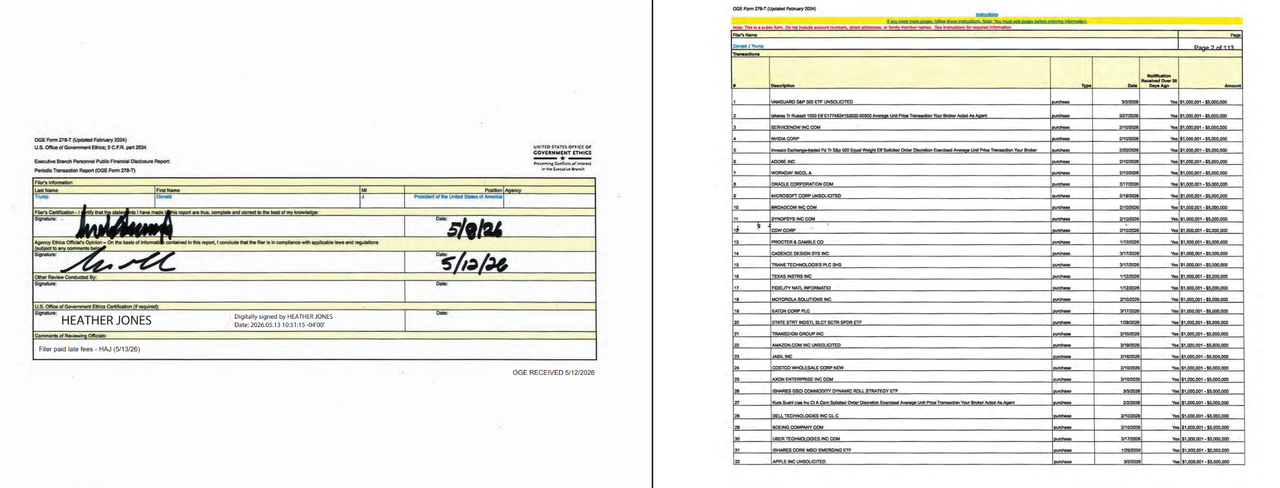
So, where did the money go?
The answer is also clear—semiconductors, AI hardware, enterprise software, consumer electronics, broad market indices, and some bonds and preferred stocks.
2. From Chips to Servers to Enterprise Software: Systematic Coverage of the AI Infrastructure Chain
If it were just buying Nvidia, it would only be a bet on the leading AI computing power company. But what's more noteworthy in this disclosure is that the Trump-related accounts didn't buy a single target; they bought a whole chain of AI infrastructure.
The first layer is semiconductors. Nvidia, Broadcom, Texas Instruments, Intel, AMD, Micron, and Marvell all appear on the buy or increase list. This includes GPUs and CPUs, analog chips, memory and interconnect, the leading commercial AI computing powerhouse, and representatives of US domestic manufacturing with stronger policy attributes. It's full-chain coverage.
Nvidia and Broadcom need no introduction. The former is the core target for AI computing power, while the latter benefits from the trend of custom chips, networking chips, and large cloud vendors developing their own chips. AMD corresponds to the alternative narrative for GPU and data center computing power, Micron corresponds to memory demand, and Marvell corresponds to interconnect, custom chips, and high-speed data transmission.
What's even more interesting is that Synopsys and Cadence are also on the buy list. These companies deal in EDA tools, i.e., chip design software. Average investors might not think of them first, but in the semiconductor industry chain, they are the "shovel sellers" in a very upstream position. Almost every complex chip, from design to tape-out, relies on these tools. This further illustrates that this portfolio adjustment isn't just chasing the hottest AI leaders but extends upstream and into the underlying tools along the semiconductor supply chain.
The second layer is AI hardware and servers, with Dell being the most sensitive and discussed target. The disclosure documents show that Trump-related accounts established a DELL position ranging from $1 million to $5 million on February 10. Months later, Trump publicly endorsed Dell's hardware products. Subsequently, Dell received major government-related contracts, and its stock price strengthened significantly.
This timeline is sensitive precisely because the account buys came first, followed by the public endorsement, then government procurement and a stock price increase. From a rigorous standpoint, the disclosure documents alone cannot prove causation between the trades, public statements, and subsequent contracts. However, from a market observation perspective, such trades naturally attract attention because they hit several highly sensitive nodes: AI hardware, government procurement, and presidential public statements.
Intel presents another type of sensitivity. Unlike Dell, Intel’s core logic isn't just commercial but also political. The US government had already decided on a major equity investment in Intel, making it a core target for US semiconductor domestic manufacturing, supply chain security, and industrial policy. Against this backdrop, Trump-related accounts buying INTC multiple times in Q1 naturally leads to amplified interpretation by the market.
Nvidia represents the commercial winner of AI computing power, while Intel represents the domestic manufacturing base the US government wants to prop up. The logic differs, but both point in the same direction: AI infrastructure is no longer just a market theme; it’s becoming a direction jointly driven by industrial policy and fiscal resources.
The third layer is enterprise software. Companies like Oracle, ServiceNow, Adobe, and Workday also appear on the buy list. Unlike Nvidia, Dell, or Intel, they don't provide computing power or hardware. Instead, they embed AI directly into enterprise workflows. Oracle corresponds to databases and cloud infrastructure, ServiceNow to enterprise process automation, Adobe to creative and marketing productivity, and Workday to human resources and financial management systems.
The logic for this line is also clear: AI cannot just stay in models and chatbots; it must enter real corporate budgets, daily office work, customer service, marketing, finance, HR, development, and data analysis processes. Ultimately, the biggest advantage of enterprise software companies is that they are already embedded in their customers' workflows. Once AI functionality becomes a default capability of this software, it brings not just a new narrative but potential changes in renewal rates, pricing power, module upgrades, and customer stickiness.
Therefore, what’s truly noteworthy in this disclosure isn't just which AI hardware companies were bought, but also the fact that the AI-fication of enterprise software is becoming another important clue.
The fourth layer is consumer electronics. For instance, Apple received a substantial increase, with multiple additional buy records. Compared to pure AI chips and enterprise software, Apple is more like a representative of the AI terminal entrance. Whether it can truly realize the AI device cycle is still debated by the market. However, in a portfolio covering AI infrastructure and application ends, Apple is clearly an unavoidable super entrance.
Additionally, the fifth layer involves broad market indices like S&P 500 ETFs, Russell 1000 ETFs, and QQQ, which also appear on the large-scale buy list. This indicates that these accounts aren't completely detached from the overall market, unilaterally betting on a single theme. Instead, they actively increase exposure to AI infrastructure and key industry chains while retaining overall exposure to the US equity market.
Simultaneously, the disclosure documents also show numerous bond trades, including municipal bonds, corporate bonds, high-yield bond ETFs, and bank preferred stocks. The municipal bonds cover multiple states, while the corporate bonds include Netflix, Occidental, CoreWeave, etc.
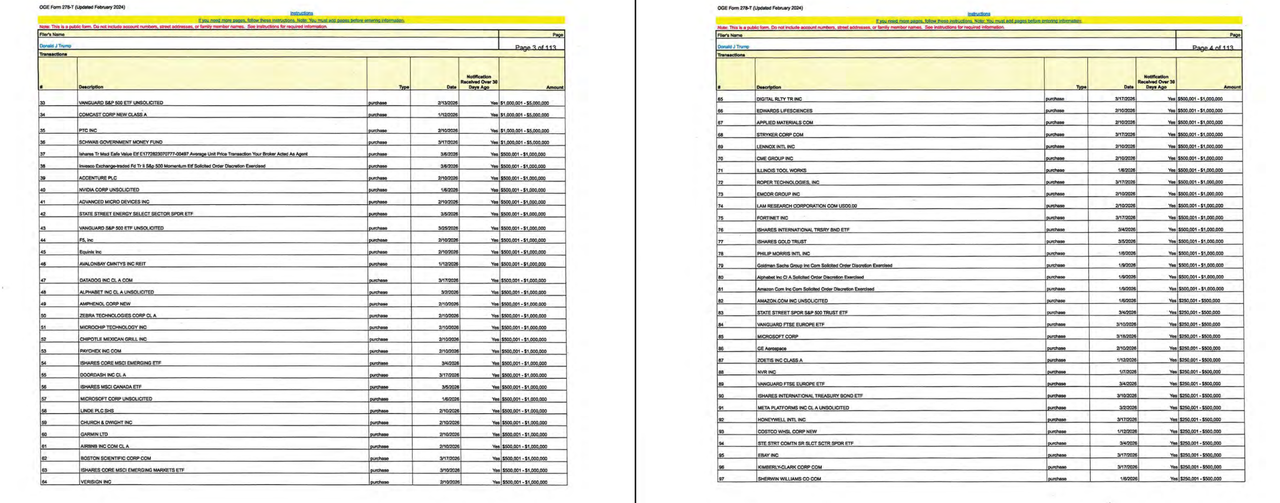
So, from a portfolio perspective, we can derive a clear investment self-portrait. On one hand, broad market indices, bonds, and preferred stocks are used to maintain a base position and liquidity. On the other hand, semiconductors, servers, enterprise software, and AI infrastructure targets are used to enhance offensive capability.
3. Can You Copy This?
Seeing such disclosures, many people's first reaction might be, "Can I follow these buys?"
But directly copying the trades isn't very meaningful. The reasons are simple:
- First, OGE disclosures have a time lag. By the time ordinary investors see the documents, the trades have long been executed.
- Second, the disclosed amounts are ranges, not exact figures. For example, the range is $1 million to $5 million or $5 million to $25 million, with huge gaps in between, making it difficult to judge the true position weight.
- Third, the related accounts might be independently managed by third-party institutions. The public doesn't know if each trade is an active judgment, portfolio rebalancing, or model-based allocation.
Therefore, this disclosure is not suitable as a short-term trading signal.
Its true value lies in showing us a larger directional shift. The most sensitive "smart money" is moving from old-platform tech and some defensive assets to the supply side of AI infrastructure. Specifically, capital is moving from the core assets of the previous internet cycle—advertising, e-commerce, traditional cloud services—to chips, servers, storage, interconnect, domestic manufacturing, and the AI-fication of enterprise software.
This direction overlaps somewhat with current US policy priorities.
After all, semiconductor domestic manufacturing, supply chain security, AI infrastructure, government procurement, and enterprise digitalization are not just market stories. They are directions jointly driven by policy, fiscal resources, industry, and capital. The significance of targets like Intel goes beyond performance elasticity; it represents the US desire to regain initiative in advanced manufacturing and the chip supply chain.
This is precisely why the increase of Intel in Trump-related accounts is most noteworthy. It doesn't necessarily mean Intel is the best chip stock, but it shows that within the AI infrastructure line, the market currently prefers to focus on who stands at the most concentrated junction of policy resources. Similarly, the Dell case illustrates that AI infrastructure isn't just happening at the GPU level. Servers, hardware, government procurement, and enterprise deployment will all become parts of AI capital expenditure materializing into the real world.
Therefore, for ordinary investors, the truly valuable lessons from this disclosure aren't specific stocks but three structural clues.
- AI trading is moving from models and applications to infrastructure: In the past, buying AI was more about buying large model imagination and computing power expectations. Now, capital is beginning to focus more on who can provide chips, servers, storage, networking, packaging, design tools, and enterprise software.
- Semiconductors are no longer just about Nvidia: Nvidia remains the most core target, but this disclosure shows that capital is also covering industry chain nodes like Broadcom, AMD, Micron, Marvell, Intel, Synopsys, and Cadence. The deeper AI infrastructure goes, the less it's a story of a single leader, but rather a re-pricing of the entire supply chain.
- The AI-fication of enterprise software might be the most undervalued component: Hardware is responsible for building computing power; enterprise software is responsible for putting AI to use. The value of companies like Oracle, ServiceNow, Adobe, and Workday isn't about whether they can tell a brand-new AI story. It's about whether they can embed AI into existing workflows and convert it into revenue through customer stickiness and product upgrades.
As for the large-scale sales of Microsoft, Amazon, and Meta, don't simply interpret them as "these companies are going to fall." More accurately, this is a signal of capital reallocation. After old-platform giants have rallied significantly, capital naturally starts looking for assets closer to the next wave of capital expenditure, closer to policy support, and closer to infrastructure construction.
Regardless, the era dividends of the consumer internet haven't disappeared. However, AI infrastructure, semiconductor localization, and the AI-fication of enterprise software are indeed accelerating as the main themes capital prefers to chase in the next phase.
This is precisely the most noteworthy aspect of this Q1 portfolio adjustment disclosure from the world's most powerful person.


