






如何定义“真实美股”:链上代币、价格合约与券商直连的差异各类产品虽然都号称能让用户接触美股行情,实际卖的却是完全不同的资产。- 核心观点:2026年以稳定币购买美股产品的三种主流模式(代币化股票、股票永续合约、券商直连模式)在风险收益、法律权利和底层逻辑上截然不同,仅券商直连模式能真正实现持有美股的完整权益,且该模式下合规架构(如接入美国清算体系)是保障用户资产安全的关键。
- 关键要素:
- Tokenized Stocks(如Ondo Finance)持有链上经济映射,股东身份在发行方,支持DeFi组合,但权益不完整且股息非现金入账。
- Stock Futures追踪价格,与股票所有权无关,资金费率年化可能超100%,适合短周期价格博弈而非长期持有。
- 券商直连模式(如BIT)通过持牌经纪商接入NSCC/DTC清算体系,是唯一实现真实股权、现金股息和正式投票权的路径。
- 在券商直连模式中,资产保护取决于底层架构:Fully Disclosed IB路径SIPC保护最清晰,Omnibus IB路径保护通过客户协议传导。
- 关键差异还包括长期持仓成本:券商直连模式无资金费率,仅含传统交易成本;Tokenized Stocks有申赎价差,Stock Futures有持续资金费率。
- 核心观点:2026年以稳定币购买美股产品的三种主流模式(代币化股票、股票永续合约、券商直连模式)在风险收益、法律权利和底层逻辑上截然不同,仅券商直连模式能真正实现持有美股的完整权益,且该模式下合规架构(如接入美国清算体系)是保障用户资产安全的关键。
- 关键要素:
- Tokenized Stocks(如Ondo Finance)持有链上经济映射,股东身份在发行方,支持DeFi组合,但权益不完整且股息非现金入账。
- Stock Futures追踪价格,与股票所有权无关,资金费率年化可能超100%,适合短周期价格博弈而非长期持有。
- 券商直连模式(如BIT)通过持牌经纪商接入NSCC/DTC清算体系,是唯一实现真实股权、现金股息和正式投票权的路径。
- 在券商直连模式中,资产保护取决于底层架构:Fully Disclosed IB路径SIPC保护最清晰,Omnibus IB路径保护通过客户协议传导。
- 关键差异还包括长期持仓成本:券商直连模式无资金费率,仅含传统交易成本;Tokenized Stocks有申赎价差,Stock Futures有持续资金费率。


- 核心观点:2026年以稳定币购买美股产品的三种主流模式(代币化股票、股票永续合约、券商直连模式)在风险收益、法律权利和底层逻辑上截然不同,仅券商直连模式能真正实现持有美股的完整权益,且该模式下合规架构(如接入美国清算体系)是保障用户资产安全的关键。
- 关键要素:
- Tokenized Stocks(如Ondo Finance)持有链上经济映射,股东身份在发行方,支持DeFi组合,但权益不完整且股息非现金入账。
- Stock Futures追踪价格,与股票所有权无关,资金费率年化可能超100%,适合短周期价格博弈而非长期持有。
- 券商直连模式(如BIT)通过持牌经纪商接入NSCC/DTC清算体系,是唯一实现真实股权、现金股息和正式投票权的路径。
- 在券商直连模式中,资产保护取决于底层架构:Fully Disclosed IB路径SIPC保护最清晰,Omnibus IB路径保护通过客户协议传导。
- 关键差异还包括长期持仓成本:券商直连模式无资金费率,仅含传统交易成本;Tokenized Stocks有申赎价差,Stock Futures有持续资金费率。
By 2026, using stablecoins to buy US stocks has become a mainstream trend. However, behind the phrase "buying US stocks with USDT," various products, while all claiming to offer users exposure to the US stock market, are actually selling completely different assets. Some products convert US stock economic exposure into on-chain tokens; others launch perpetual contracts tracking US stock prices; and still others provide real US stock trading services through licensed broker-dealers. The risk-return profiles, rights structures, and underlying logic of these three approaches are entirely different.
1. Overview of US Stock Trading Platforms
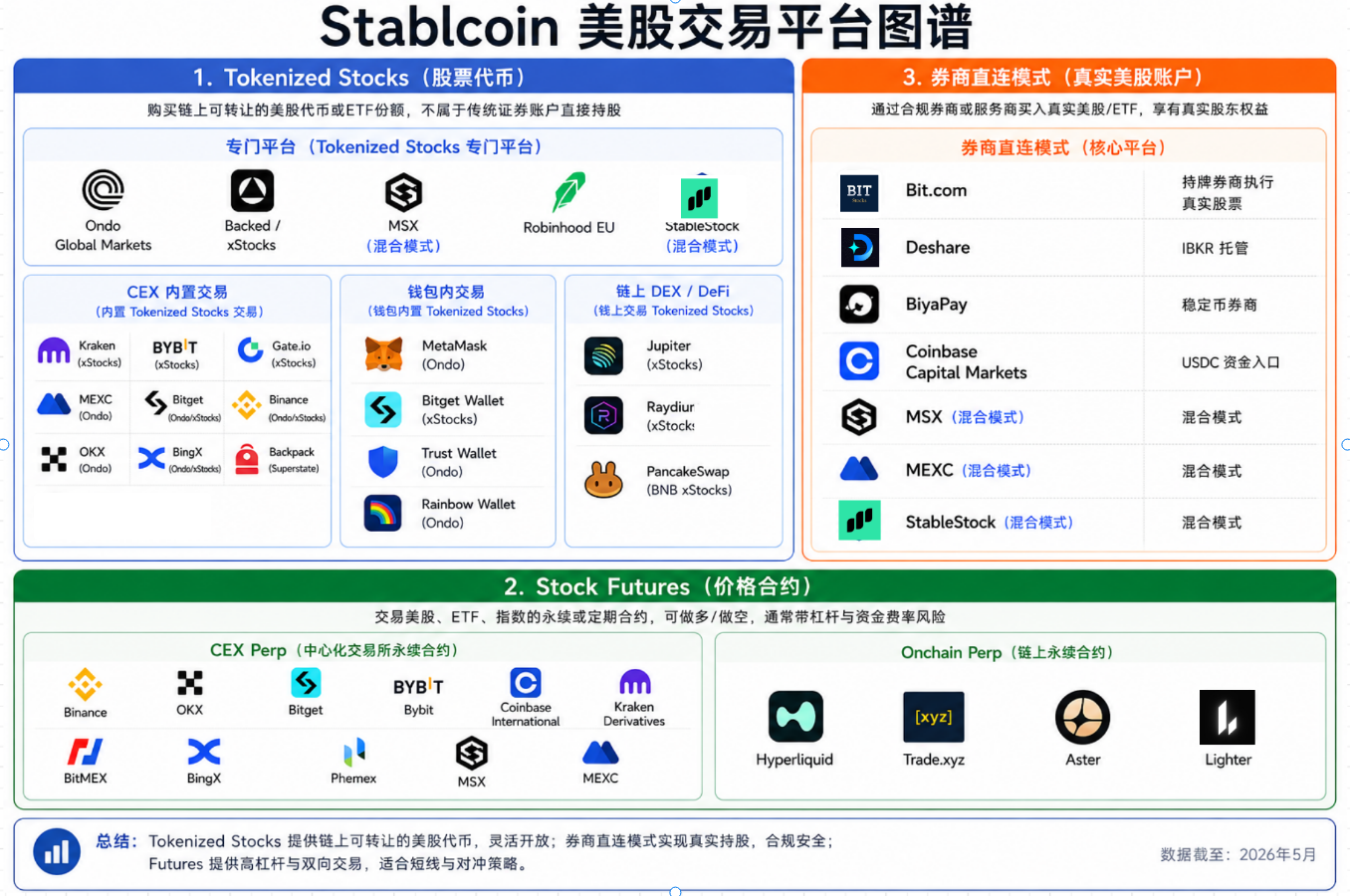
The mainstream solutions currently on the market for "buying US stocks with USDT" can be clearly categorized into three types: Tokenized Stocks, Stock Futures, and the Brokerage Direct Model.
1. Tokenized Stocks
Tokenized Stocks are typically held by the issuer or its SPV/custodial arrangement. Users hold the economic rights represented by the on-chain tokens, not the direct shareholder status in a traditional securities account. The most representative issuer, Ondo Finance, has a TVL exceeding $1 billion, supporting over 200 major stocks and ETFs; the overall market size has reached tens of billions of dollars.
2. Stock Futures
Stock contracts are the most efficient trading tools, but they have the least connection to "holding US stocks" — users are buying a price contract, with no legal link to stock ownership.
In 2026, several major trading platforms have launched stock-related perpetual/CFD products, with significant differences in the number of underlying assets, leverage multiples, and available regions (roughly ranging from 5x to 25x). On-chain platforms represented by Hyperliquid HIP-3 / Trade.xyz are also expanding the market for perpetual contracts on traditional assets, with the core value proposition being to allow global traders to express bullish or bearish views on traditional asset prices using stablecoins.
3. Brokerage Direct Model
The operational logic of the Brokerage Direct Model is similar to traditional brokerages: users execute purchases or sales of stocks or ETFs through a Broker-Dealer, and the assets are held within the U.S. clearing and custody system. It is the only one of the three models that results in actually buying the stock itself. However, it should be noted that significant differences exist among platforms operating under this model.
Source: Public Information Compilation
2. Comparison of Differences in US Stock Trading Products
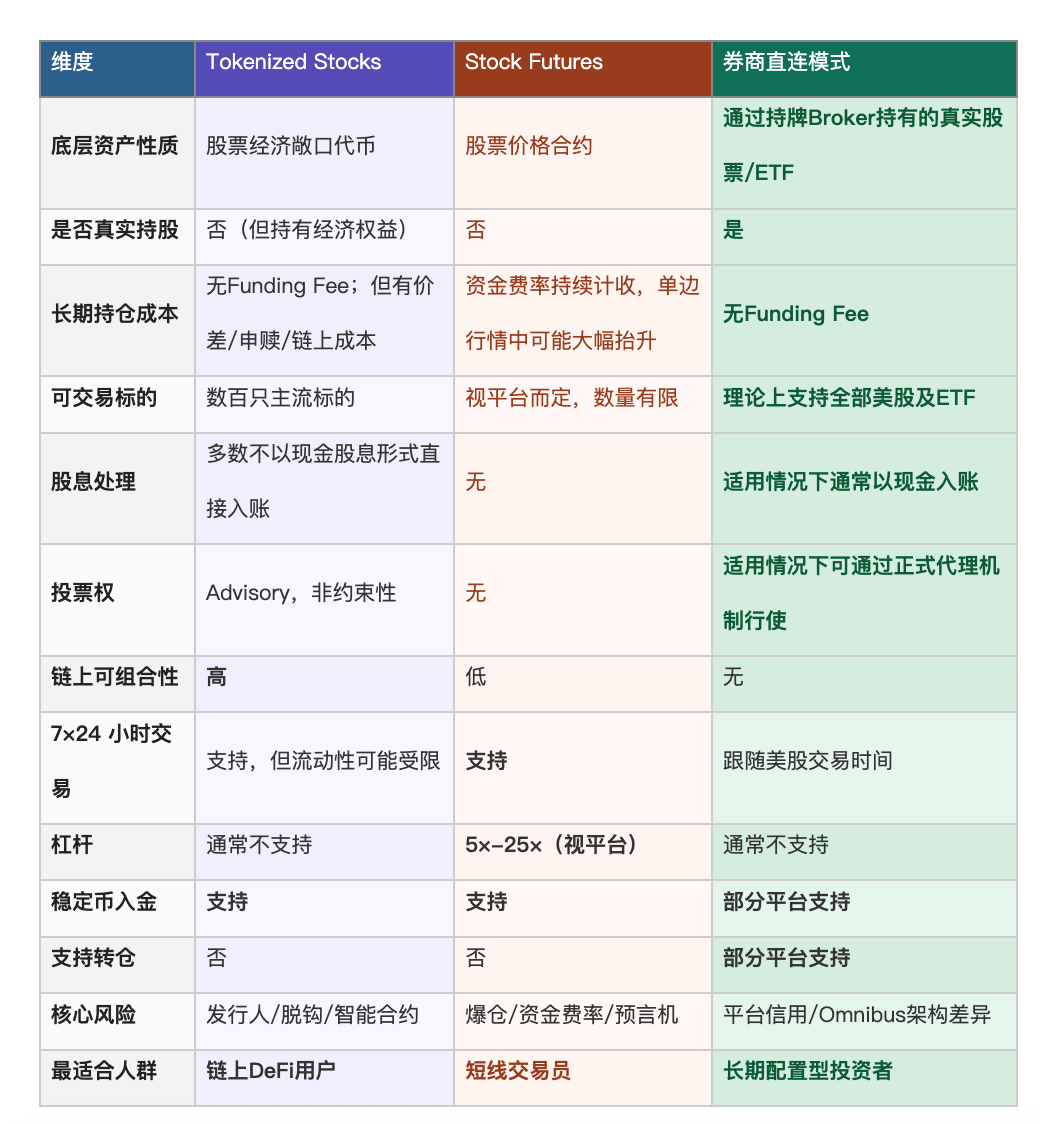
The differences among the three models are not only evident in the trading experience but are more crucially reflected in three core dimensions: legal rights, holding cost structure, and regulatory protection.
Source: Public Information Compilation
(1) Tokenized Stocks
The essence of Tokenized Stocks is the "on-chain shadow" of a stock — convenient and composable, but with incomplete rights; the shareholder status resides with the issuer.
On-chain composability is the true differentiating advantage of this model: tokens can be used as collateral in DeFi lending protocols to earn additional yields, can be traded 24/7 on-chain, and can be purchased in fractional shares — things that traditional securities accounts cannot do. The limitations are equally clear: shareholder status lies with the issuer, not the user; on most platforms, dividends are not credited directly as cash; and voting rights are advisory in nature, without legal binding force. While there are no Funding Fees, the bid-ask spread for subscription/redemption, on-chain gas fees, and market-making spreads all constitute holding costs.
(2) Stock Futures / Equity Perps
Stock Futures are "price betting tools" for stocks — efficient, flexible, 24/7, but funding rates erode holding costs over the long term, and they have nothing to do with actually owning the stock.
Stock Futures are the path most familiar to cryptocurrency traders — margin, take-profit/stop-loss, going long or short on both sides — the operational logic is identical to trading BTC perpetuals, only with a different underlying asset, operating 24/7 without trading halts. The core cost is that funding rates can skyrocket during trending markets, with annualized costs reaching double digits or even exceeding 100%, acting as a chronic drain on a "buy and hold" strategy; after the contract is closed, there are no shareholder rights whatsoever, leaving only a USDT profit or loss.
(3) Brokerage Model
The Brokerage Model is the path closest to "buying a stock" — offering the most complete rights and the cleanest long-term holding costs, at the expense of on-chain composability and 24/7 trading.
The Brokerage Model provides the most complete rights: real stocks, cash dividends credited directly, formal voting rights (where applicable), and coverage of thousands of instruments. The main limitations are that trading hours follow the US stock market open, holdings are not on-chain, and they cannot interact with the DeFi ecosystem. It's important to note that the brokerage architecture differences between platforms directly affect the transmission path of user rights, making it worthwhile to understand the specific compliance structure before choosing a platform.
3. How to Define "Actually Buying US Stocks"
While the three paths cater to somewhat different user groups, for users looking to conveniently use stablecoins for long-term US stock allocation, the advantages of the Brokerage Model are quite direct — each of its core differentiating points precisely addresses the most prominent shortcomings of the other two models, including:
Advantage 1: No Funding Fee, Cleanest Long-Term Cost Structure
Holding spot US stocks does not involve the concept of funding rates. Holding the same underlying asset for a full year incurs no additional funding rate cost, regardless of market sentiment.
Annualized holding costs for Stock Futures can reach high double digits during strong market trends; Tokenized Stocks have no Funding Fee but incur bid-ask spreads and on-chain transaction costs. Comparatively, the holding cost structure for real spot US stocks is the cleanest among the three.
Advantage 2: Depth of Coverage Incomparable by the Other Two Models
The Brokerage Model covers thousands of US-listed stocks and ETFs, far exceeding the approximately 200-260 offered by Tokenized Stocks and the limited selection of Stock Futures. For users needing to allocate to mid-cap companies, sector ETFs, or REITs, the Brokerage Model is a more reliable way to deploy stablecoins.
Tokenized Stocks and Stock Futures mainly cover high-profile, popular instruments, offering virtually no choices for allocating to mid-cap stocks, sector ETFs, or REITs. In terms of the sheer number of available instruments, the Brokerage Model currently has no competitors.
Advantage 3: Real Shareholder Rights – A Difference in Nature, Not Degree
When holding real stocks, dividends are typically credited to the account in cash; voting rights, where applicable, can be exercised through formal proxy voting mechanisms (specific rights subject to account structure and regional limitations).
Stock Futures have no shareholder attributes whatsoever; the so-called voting for Tokenized Stocks is merely "expressing a preference to the issuer" without legal binding force. The Brokerage Model is the only path among the three where shareholder rights exist at the legal level.
Advantage 4: Stablecoin On-Ramp, Reducing Reliance on Traditional Banking Channels
Some brokerage intermediary platforms support USDT/USDC deposits and withdrawals, reducing dependence on traditional USD wire transfers. For users without overseas bank accounts, this represents a substantial lowering of the entry barrier.
Traditional Hong Kong or US stock brokerages typically require bank wire transfers, which is problematic without an overseas account. Supporting stablecoin deposits is the greatest practical advantage for platforms offering this feature.
Advantage 5: Transferable Holdings, Open Exit Path
Under the Brokerage Model, if the platform supports standard securities transfer mechanisms like ACATS / DTC, users can directly migrate their positions to other licensed brokerages without needing to sell and re-establish positions. This means the exit path is open, and users are not passively locked in due to changes on the platform.
Tokenized Stocks can only be redeemed for stablecoins, and closing a Stock Futures contract leaves only USDT; neither offers the option of position transfer. Being able to transfer positions means users won't be passively tied to a single platform.
However, the "Brokerage Model" is not monolithic. Platforms all claiming to offer "real US stocks" can have vastly different underlying broker architectures — which directly determines where user assets are held, how SIPC protection is conveyed, and whether users can effectively assert their rights if the platform encounters problems.
While US stock trading appears to occur on the NYSE or Nasdaq, what truly determines the change in ownership of funds and securities is the clearing and settlement system regulated by the SEC. The entire system revolves around the DTCC: the DTC (Depository Trust Company, holding assets over $100 trillion), which handles the final settlement for virtually all US stock trades.
The most critical mechanism in the system is CCP novation (Central Counterparty novation) — upon any trade execution, the NSCC immediately becomes the central counterparty for all transactions. This central counterparty mechanism reduces direct counterparty risk resulting from a Broker's bankruptcy. The core point is that user assets entering this clearing system share the same underlying infrastructure as clients of large, established brokerages — they are not on any public blockchain, not in a platform's proprietary accounts, and not dependent on the platform's own balance sheet.
Currently, the industry has four mainstream architectures for accessing the clearing system, differing in capital requirements, client identity disclosure, and the SIPC transmission path:
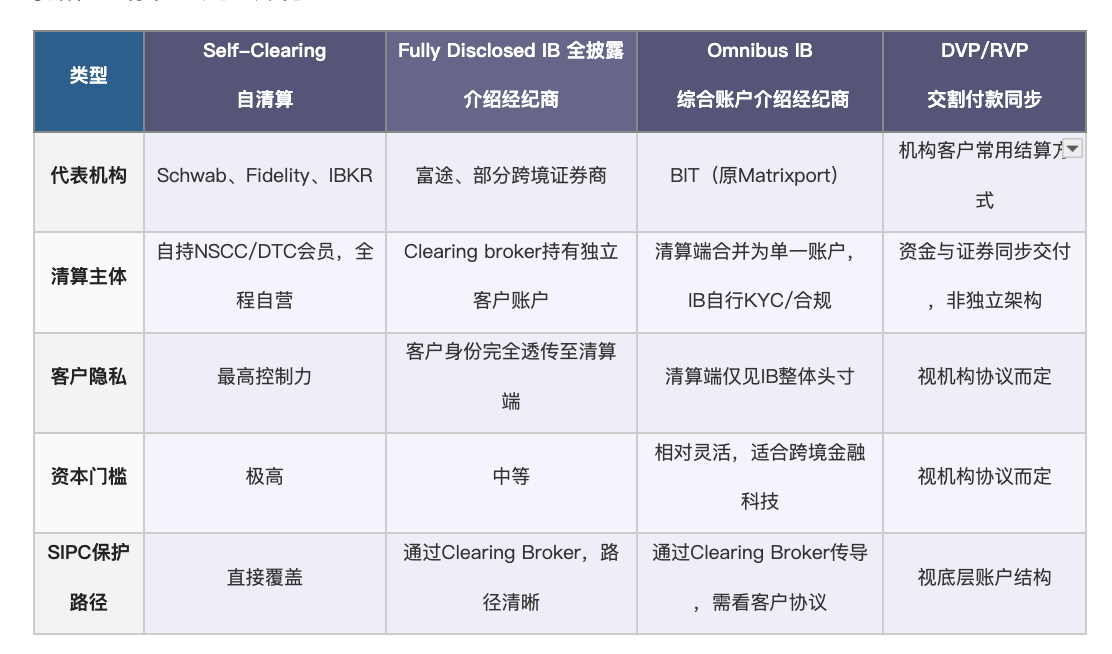
Source: Public Information Compilation. Note that DVP/RVP are commonly used settlement methods for institutional clients and are not directly parallel to retail brokerage architectures.
For users:
- Fully Disclosed IB: Client identity is fully passed through to the Clearing Broker, offering the clearest path for SIPC protection, suitable for users who value legal certainty.
- Omnibus IB: The clearing firm only sees the IB's aggregate position. SIPC protection is conveyed through the Clearing Broker, and the specific path depends on the client agreement — this is a more common access model for international cross-border securities services.
- Self-Clearing: Directly holds NSCC/DTC membership, offering the most direct protection, but with extremely high capital requirements. Typically only large, established brokerages like Schwab, Fidelity, and IBKR qualify.
So, when a platform claims to offer "real US stocks," the truly important question to ask is: Through which architecture does it access the U.S. clearing system? And at which level are user assets protected?
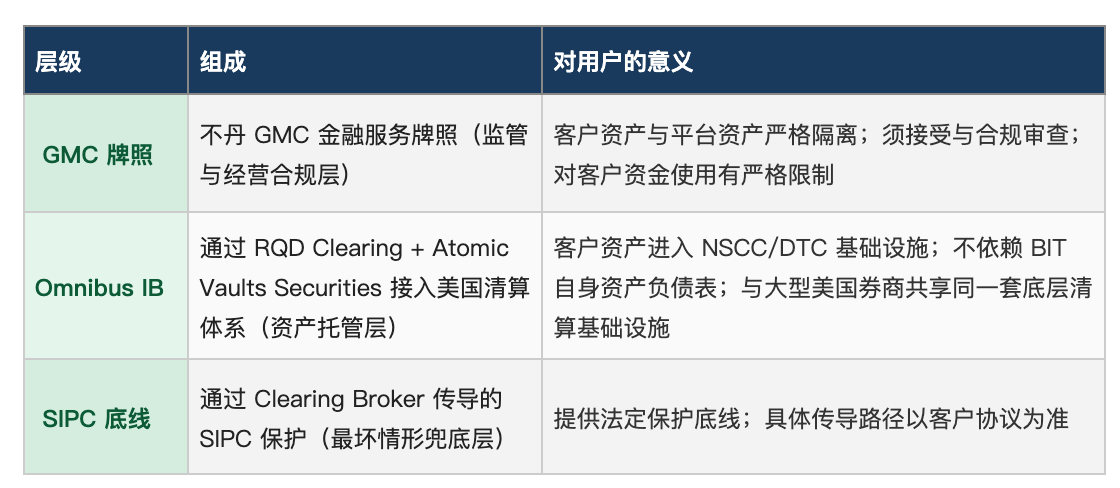
Taking BIT (formerly Matrixport) as an example, its compliance architecture consists of three layers:
- Layer 1: The GMC License addresses the issue of "whether user assets are segregated." The Royal Monetary Authority of Bhutan GMC License has a strong core requirement for the segregation of client funds from the firm's own funds. User assets are held by an independent custodian and subject to oversight. This means BIT cannot use user stocks for the platform's own financing or positions — this is the first institutional safeguard distinguishing it from opaque platforms and a prerequisite for "real holding."
- Layer 2: The Omnibus IB architecture addresses the core issue of "where user assets actually are." BIT accesses NSCC clearing and DTC custody through two U.S. licensed Clearing Brokers. Both institutions can be independently verified via FINRA BrokerCheck. The US stocks purchased by users through BIT are ultimately held in custody at these two institutions, not in BIT's own accounts or internal ledgers. These assets share the same U.S. securities clearing and custody infrastructure as clients of Schwab and Fidelity.
- Layer 3: SIPC protection addresses the issue of "how losses are covered in the worst-case scenario." Because BIT's clearing firms are SIPC members, this layer of protection can be conveyed to end-users through the account structure and client agreement by the Clearing Broker, providing a statutory safety net (the specific transmission path is subject to the terms of the client agreement).
Source: Public Information Compilation
4. Conclusion
Buying US stocks with USDT leads to three fundamentally different assets depending on the path chosen. Tokenized Stocks represent an on-chain economic mapping, with shareholder status residing with the issuer. Stock Futures track the price and have nothing to do with holding the stock. The Brokerage Model is the only path that leads to actually buying the stock itself — offering the most complete rights and the cleanest long-term holding costs. Even within the Brokerage Model, differences in architecture dictate the actual level of asset protection. The transparency and verifiability of the underlying clearing institution and compliance architecture are worth carefully verifying before selecting a platform.
This article is for educational and informational purposes only and does not constitute investment advice. It should not be construed as a recommendation to buy, sell, or hold any security or financial instrument. All investments involve risk. Readers should conduct their own thorough research and consult a licensed financial advisor before making any investment decisions.


