






爆肝 10000 字穿透 Hyperliquid ,11 人团队、零 VC,如何主导链上永续市场?


Conflict of Interest: This article was not paid for.
One of the most surprising stories in the crypto industry over the past two years originates from a small team of about a dozen people based in Singapore.
This company, founded just three years ago with a market cap of tens of billions of dollars, never took a penny of VC funding. Its 11 employees generated over $900 million in profit last year, making it one of the highest profit-per-employee companies on Earth.
The Founder Who Doesn't Network, Tweet, or Speak Out
The story of Hyperliquid revolves almost entirely around one person—Jeff Yan (X handle @chameleon_jeff).
Jeff's parents are Chinese immigrants. His parents divorced when he was in third grade, and he was raised by his mother, an accountant who often worked overtime during tax season and frequently reminded him that "there will always be someone better than you." Jeff represented the US at the International Physics Olympiad, winning a silver medal in Estonia in 2012 and a gold medal in Denmark in 2013.
He graduated from Harvard in 2017 with a degree in Computer Science, then joined high-frequency trading firm Hudson River Trading as an algorithm developer. In early 2020, he pivoted to crypto, founding market maker Chameleon Trading, and eventually co-founding Hyperliquid.
The name "Chameleon" comes from his high school gaming ID and his fascination with the animal. He genuinely appreciates chameleons for themselves, explaining in a podcast that their eyes can move independently in different directions, they have "two toes forward, three toes back," and possess a powerful ballistic tongue, making them seem like "aliens on Earth."
Before Hyperliquid, Jeff lived in Puerto Rico, running one of crypto's largest anonymous trading operations, Chameleon Trading, almost single-handedly. He moved to Puerto Rico in late 2019, started market making with $10,000, and grew his fund thousands of percentage points annually for two and a half years, achieving financial independence by age 27.
The founder's personal style is quite extreme. Jeff is not money-driven and lives a minimalist lifestyle, wearing the same clothes daily and cutting his own hair to save time. He works at least 14 hours a day, sometimes 100 hours a week, believing most people are "generally too soft." Following an incident where someone followed him into his apartment elevator after increased public exposure as Hyperliquid's founder, he adopted strict security measures, including moving, hiring bodyguards, and being accompanied by two private security personnel when outside.
According to a senior crypto executive who knows both Jeff and SBF, Yan's image is more refined, professional, and genuine—"Jeff cut his hair, SBF didn't," "SBF's shorts were too long and didn't fit, Jeff looks clean and sharp." This contrast in appearance and style from the FTX era has become part of the Hyperliquid narrative.

Hyperliquid Founder Jeff
Predecessors
Jeff's earliest venture was in prediction markets. In April 2018, influenced by the rise of crypto and Ethereum, he co-founded a blockchain-based prediction market called Deaux within the Binance Labs incubator. The project experimented with off-chain matching plus on-chain settlement, but ultimately failed to gain traction, attracting only about 100 users before shutting down.
His real first taste of success came from Chameleon. In May 2023, Yan put the strategies Chameleon had validated over years into an on-chain vault called HLP (Hyperliquidity Provider). Users could deposit $10 or $10 million, free of management fees and performance fees. The vault ran automated strategies, allocating every dollar of profit back to depositors, with all accounts on-chain. If FTX had been built this way back then, Alameda's hole would have been visible to the world.
HLP is key to understanding Hyperliquid. It provides liquidity to the exchange while offering regular users a zero-fee "high-frequency strategy entry point."
One early user described that regular people could invest in a high-frequency trading strategy with zero fees, something historically unprecedented.
"I would have willingly paid Jeff a 2% management fee and a 50% performance fee just to get into this strategy."
Starting in the second half of 2023, users traded on the platform and accumulated points weekly. The points calculation rules remained confidential, published weekly on Fridays by iliensinc. Community members gathered on Discord each week around this event to compare their yields.
Jeff later stated that "rewarding real users is key" and the points program "may have reduced the bot ratio from 99% to 20%."
In January 2024, Yan published a four-line manifesto:
No investors.
No paid market makers.
No fees to the dev team.
No insiders.
This formally established the project's neutral stance. The HYPE token airdrop was completed on November 29, with the team's portion subject to time-based unlocking, and no allocation was given to investors.
How "No VC" Became a Product Strategy
Hyperliquid's rejection of VCs is a deliberate strategy. Yan and the team decided not to raise funds from VCs, having already earned a substantial amount from their crypto trading operations. Yan self-funded the costs, believing that "if you want to build a truly credible neutral platform where anyone can build on top, the important principle is that there can be no insiders."
"We are self-funded and didn't need to raise at all, so the decision was simple."
This choice had a subsequent effect: without allocating shares to VCs, the team could distribute nearly all of the 31% genesis supply to real users. When the platform launched HYPE, 31% of the supply was directly allocated to users based on trading activity, one of the most user-centric distributions in crypto history. The remaining allocation was for future community rewards (38.88%), core contributors (23.80%), the foundation (6.00%), community grants (0.30%), and a minimal amount for protocol upgrades.
Jeff decided not to sell equity to VCs; thus, VCs naturally couldn't demand preferential allocations, ensuring this distribution structure could be realized.
CEX Experience × DEX Transparency (The Boring Technical Part)
Hyperliquid is an independent Layer 1 blockchain built specifically for trading, operating independently of ecosystems like Ethereum or Solana.
The network is secured by HyperBFT. This is a BFT consensus protocol designed from the ground up for high latency and high throughput, tolerating up to one-third of the staked share being malicious nodes.
HyperBFT supports approximately 200,000 transactions per second with a block time of 0.07 seconds. Holders delegate HYPE to validators, and the system selects 24 active validators based on staking weight. Each round of transactions requires a supermajority of over 2/3 staked quorum, and a 7-day unbonding queue prevents large-scale consensus attacks.
The chain itself is divided into two layers. The complete execution state, including HyperCore and HyperEVM, is secured by HyperBFT. Every order placement, cancellation, execution, and liquidation happens on-chain with single-block finality. Hyperliquid uses a non-custodial model; the platform does not take control of user funds. It is best known for perpetual and spot trading in cryptocurrencies, equities, commodities, and forex. Users can also lend, borrow, mint, and transfer assets. HyperEVM is an EVM-compatible execution layer allowing users and developers to build applications using smart contracts.
HyperEVM enables DeFi applications deployed by external developers to directly connect to Hyperliquid's on-chain liquidity and order book, transforming the exchange into underlying infrastructure that other projects can build upon, creating an open ecosystem platform. HyperEVM went live on February 18, 2025, allowing EVM smart contracts to access native trading liquidity without the need for cross-chain bridges.
The matching mechanism itself is designed with anti-front-running features.
Jeff identified a common problem: high-frequency traders use bots to quickly consume orders after market makers place them, forcing market makers to widen spreads for self-protection, ultimately costing regular users more.
Hyperliquid solves this by reducing the priority of fast order consumption, giving market makers a fair chance to update their quotes, leading to tighter spreads.
The matching engine uses a price-time priority and allows special order types like cancel-or-flip or post-only to take precedence over regular orders under certain conditions, ensuring market makers can adjust quotes without being front-run by faster traders.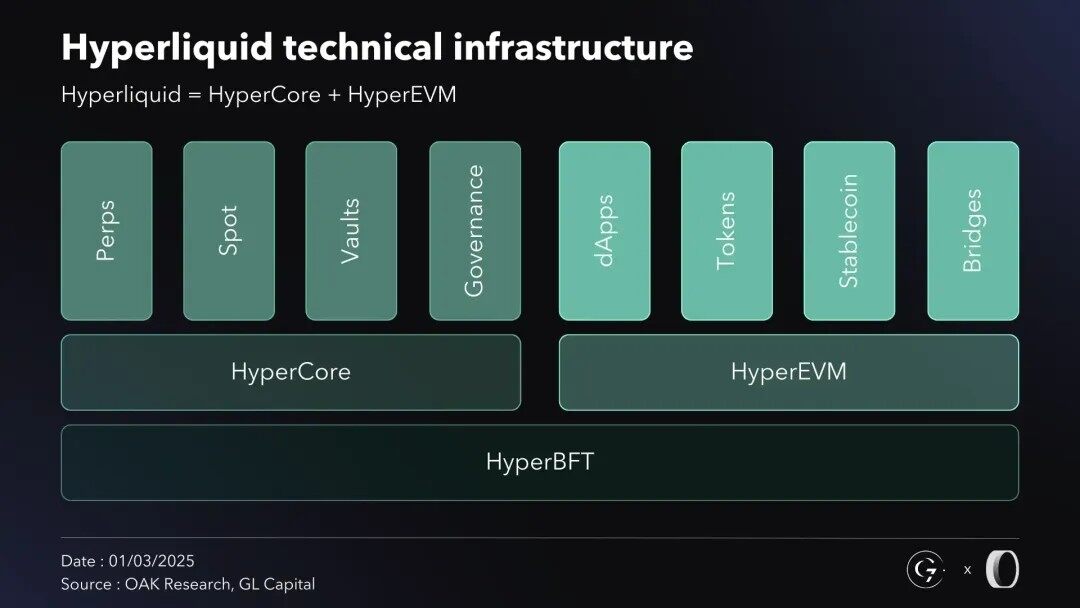
' fill='%23FFFFFF'%3E%3Crect x='249' y='126' width='1' height='1'%3E%3C/rect%3E%3C/g%3E%3C/g%3E%3C/svg%3E) Hyperliquid Deep Dive: Understand HYPE and HLP Model
Hyperliquid Deep Dive: Understand HYPE and HLP Model
The Most Frequently Cited Airdrop
HYPE has a circulating supply of 222 million and a total supply of 1 billion. At the current price, its FDV is approximately $60.27 billion. The allocation is distributed as follows: future releases and community rewards 38.89%, genesis distribution 31.00%, core contributors 23.80%, Hyper Foundation budget 6.00%, community grants 0.30%, and HIP-2 Hyperliquidity 0.01%.
The airdrop in November 2024 distributed approximately 310 million HYPE, equivalent to 31% of the total supply. In both absolute quantity and dollar value distributed to real users, it was one of the largest in crypto history.
The airdrop was completed on November 29, 2024, distributing HYPE to over 90,000 eligible users. This stands in stark contrast to many projects that allocate large amounts of tokens to VCs.
Core contributor allocations have a lock-up schedule. Over 61% of the HYPE supply remains locked. The genesis distribution immediately released approximately 310 million HYPE to early protocol participants and community members, while reserving about 237 million for core contributors, subject to a one-year cliff followed by 24 months of gradual unlocking.
Most allocations use a cliff-based release mechanism, with the entire unlocking schedule extending into 2027. The next unlock is scheduled for June 6, 2026, targeting core contributors.
The most critical design element is the buyback. Hyperliquid uses 99% of its fees to repurchase HYPE, driving the token price beyond $62. This buyback is an on-chain mechanism executed automatically by the protocol block-by-block, converting transaction fees into HYPE purchases regardless of market conditions. Since its launch, the protocol has generated over $1.16 billion in revenue, almost all of which has been used to buy back its own token. In Q3 2025 alone, it repurchased $316.8 million worth of HYPE.
This structure creates continuous buy pressure beneath the token. The underlying business remains strong. Hyperliquid has become one of the dominant players in decentralized perpetual exchanges, supported by real transaction fees without relying on inflationary token incentives. However, risk arises from this—HYPE's price is increasingly linked to the trading volume of a single exchange.
HYPE has a fixed total supply of 1 billion, with over 70% allocated to the community and 97% of transaction fees used for token buybacks. The protocol has generated $1.24 billion in cumulative fees, with an annualized revenue of $800 million to $1 billion, placing it among the top fee producers in DeFi.
The buyback flywheel also has its vulnerabilities.
This relationship is bidirectional. As crypto activity cools down, buybacks decline along with revenue. Hyperliquid's quarterly buybacks decreased from $316.8 million in Q3 2025 to $192.3 million in Q1 2026, a drop of approximately 40% over two quarters. Meanwhile, more locked tokens will enter circulation, creating potential selling pressure that the Assistance Fund needs to absorb.
From Developer Sandbox to Trillions in Volume
Hyperliquid's growth wasn't linear; it was explosive. In 2023, Yan launched Hyperliquid on his self-developed L1. The early version looked like a developer sandbox but offered sub-second finality, an on-chain order book, and a user experience close to Binance. Within months, daily volume surpassed $1 billion, and monthly volume exceeded $10 billion.
By mid-2025, it was directly competing with CEX giants.
In mid-2025, Hyperliquid's monthly volume reached $2.48 trillion, a scale comparable to Binance and Coinbase. It took two years to grow from zero to 545,000 users. Jeff himself said:
"We don't have a marketing department. The community does a better job than all CEX marketing departments combined."
By early 2026, its market cap was pushed to another level.
HYPE is among the top ten crypto assets by market cap, hovering around $11 billion less than two years after its trading debut. On May 15, 2026, Bitwise launched BHYP, the first US spot Hyperliquid ETF to natively include staking.
On-chain growth wasn't limited to trading. In early 2025, the platform launched HyperEVM, allowing developers to build financial applications directly on the Hyperliquid chain. The ecosystem expanded rapidly. CDP protocol Felix manages over $400 million in assets, and lending protocol HyperLend manages $380 million.
Over the past 12 months, Hyperliquid's trading volume reached $1.8 trillion, accounting for over 10% of global perpetual contract volume and over 70% of DEX perpetual volume. After its launch in 2023, daily trading volume reached $1 billion within 100 days. By mid-2025, monthly volume hit $2.48 trillion, placing it alongside Binance and Coinbase. In two years, the platform accumulated over 545,000 users from zero.
Jeff Yan rarely speaks publicly, avoids social media, and never took VC funding, yet was still named to CoinDesk's Most Influential 2025 list.
His creation, Hyperliquid, processes about $10 billion in daily volume. DefiLlama shows October's monthly volume at $308 billion. The platform has over 570,000 users, and its proprietary chain matches the speed and stability of


