






เมื่อ Crypto "ซ่อน" อยู่ในระบบการเงินแบบดั้งเดิม: ตลาดการคาดการณ์, สเตเบิลคอยน์ และหุ้นโทเคน กำลังก้าวสู่กระแสหลักได้อย่างไร


- มุมมองหลัก: เส้นทาง "การยอมรับจากคนทั่วไป" ของสกุลเงินดิจิทัลกำลังกลับทิศทาง โดยไม่จำเป็นต้องให้ผู้ใช้เข้าใจเทคโนโลยีบล็อกเชนก่อนอีกต่อไป แต่จะใช้เทคโนโลยีนี้เป็นโครงสร้างพื้นฐานเบื้องหลัง ผ่านสามเส้นทางหลัก ได้แก่ ตลาดการคาดการณ์, สเตเบิลคอยน์ และหุ้นโทเคน เพื่อฝังตัวและปรับเปลี่ยนระบบการเงินแบบดั้งเดิมและสถานการณ์การใช้งานของคนทั่วไปอย่างจริงจัง
- องค์ประกอบสำคัญ:
- การขยายฐานผู้ใช้ของตลาดการคาดการณ์ขึ้นอยู่กับเหตุการณ์สาธารณะที่มีอุปสรรคทางความรู้ต่ำ เช่น ฟุตบอลโลก โดยแปลงการประเมินความเสี่ยงที่ซับซ้อนให้เป็นความน่าจะเป็นที่เข้าใจง่าย ซึ่งกำลังพัฒนาเครื่องมือซื้อขายเหตุการณ์ไปสู่โครงสร้างพื้นฐานทางการเงินอย่างค่อยเป็นค่อยไป
- จุดแข่งขันของสเตเบิลคอยน์กำลังเปลี่ยนจากปริมาณที่มีอยู่บนเครือข่ายไปสู่สถานการณ์การชำระเงินและการหักบัญชีที่สอดคล้องกับกฎระเบียบ เช่น Open USD ที่ให้รางวัลผลตอบแทนจากทุนสำรองแก่คู่ค้าช่องทาง กำลังกลายเป็นองค์ประกอบการโอนเงินที่ธุรกิจแบบดั้งเดิมสามารถเรียกใช้ได้
- ตลาดหลักทรัพย์แบบดั้งเดิม (เช่น ICE) และแพลตฟอร์มคริปโต (เช่น OKX) ร่วมมือกันเปิดตัวหุ้นโทเคน ซึ่งเป็นสัญญาณว่าสินทรัพย์แบบดั้งเดิมได้เข้าสู่บัญชีบนเครือข่ายอย่างเป็นทางการ ผลักดันให้กระเป๋าเงินกลายเป็นจุดเข้าใช้งานแบบครบวงจรสำหรับการจัดการสินทรัพย์ทั่วโลก
- หุ้นโทเคนจำเป็นต้องอธิบายความแตกต่างทางกฎหมายอย่างชัดเจน (เช่น ความเป็นเจ้าของและสิทธิในผลประโยชน์) สิทธิ์ของผู้ใช้ปลายทางยังคงขึ้นอยู่กับผู้ออกหลักทรัพย์และผู้รับฝากทรัพย์สินภายนอกเครือข่าย ซึ่งไม่ได้หมายความว่าจะเท่ากับสิทธิ์ของผู้ถือหุ้นแบบดั้งเดิมโดยอัตโนมัติ
For a long time, when the crypto industry talked about "mass adoption," it usually pointed to a few relatively familiar metrics:
For example, how many people hold Bitcoin, how many addresses interact with on-chain protocols, and how many users have started using wallets, exchanges, and DeFi.
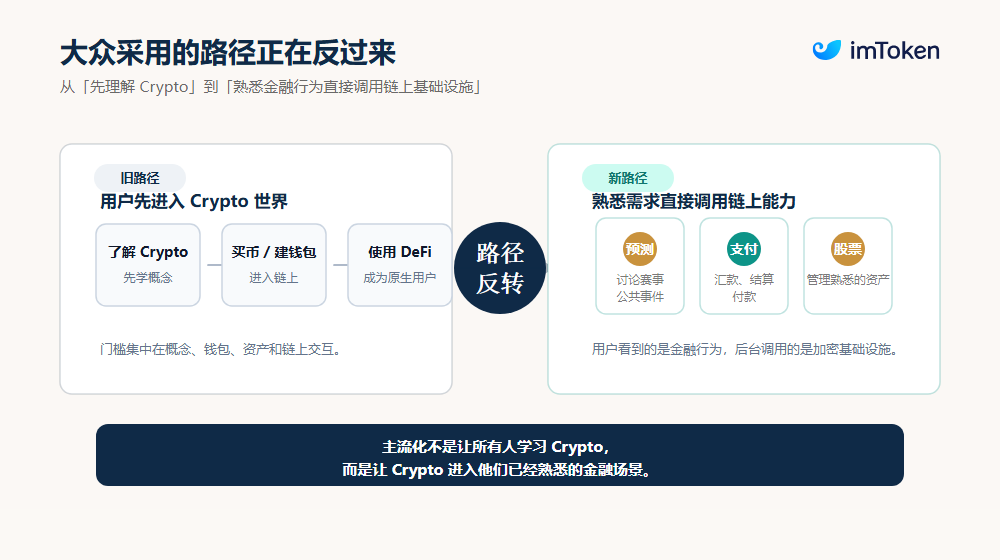
This implies a relatively linear assumption: ordinary users need to first understand Crypto, then purchase crypto assets, create a wallet, and eventually gradually enter the on-chain world.
However, recent changes may be reversing this path. Users don't necessarily need to understand blockchain first before they start using crypto infrastructure. Instead, pre-existing needs like prediction markets, cross-border transfers, and stock trading are actively absorbing crypto technology. While these seem to belong to three different tracks and penetration is not happening along the same path, they all point to the same shift:
Crypto is transforming from a new financial system that requires users to actively enter, into infrastructure that traditional finance and mass applications can directly invoke.
1. Prediction Markets: From On-Chain Event Trading to Probability Pricing Tools
As we all know, prediction markets are not a new concept.
Especially in the crypto world, early in Ethereum's development, the prediction market Augur was the first DApp on Ethereum, which initially verified that any event with an objectively verifiable outcome could be transformed into an on-chain contract. Through the buying and selling of real funds, it could project the market's judgment of the future.
However, for a long time afterward, prediction markets were simply dismissed as "on-chain gambling" and never truly broke out of the crypto-native circle. Early users of platforms like Polymarket were indeed mainly crypto-native groups familiar with wallets, stablecoins, and on-chain trading:
On one hand, the barriers to using wallets, stablecoins, and on-chain trading limited ordinary users' participation; on the other hand, even though Polymarket once broke through to the mainstream with events like the US election, its core participants remained primarily traders familiar with Crypto.
But the 2026 FIFA World Cup in the USA, Canada, and Mexico provides a broader, more mainstream window for prediction markets (see related article: World Cup Frenzy, Prediction Markets Join the Table: How Are Polymarket and Others Tearing Open the Door to Mass Adoption?).
Compared to monetary policy, economic data, and political elections, football matches require almost no extra knowledge or education. Who will advance from the group stage, which team will reach the semi-finals, whether a certain player can become the top scorer – these are questions that fans discuss every day anyway.
What prediction markets do is merely aggregate these scattered opinions into a price that can change in real-time. This is why, for prediction markets to truly break through to the mainstream, changes in the regulatory environment alone are insufficient. They also require an event that is large enough and intuitive enough, and the World Cup perfectly meets these conditions.
Many of Crypto's past breakthrough moments often occurred when "high-knowledge-barrier technology" met "low-knowledge-barrier scenarios." For instance, NFTs broke through because they tied on-chain assets to avatars, art, and community identity; Memes spread rapidly because they compressed complex financial behavior into simple emotions and cultural symbols.
Similarly, the entry point for prediction markets to reach a wider user base may not be macroeconomic data or complex political contracts, but rather scenarios like sports, entertainment, and events that the public is already willing to discuss.
The uniqueness of the World Cup lies in its inherent possession of three conditions.
- First, it enjoys broad global consensus. Even non-hardcore fans can understand basics like who wins, who loses, who advances, and who will be champion.
- Second, it features high-frequency information flow. Pre-match lineups, player form, injury updates, tactical changes, and the game's progress continuously alter market expectations.
- Third, it has strong social attributes. Watching a game is not an isolated activity; it's accompanied by group chats, shares, discussions, debates, and emotional resonance.
At the same time, the competitive boundaries of prediction markets are constantly expanding. Recently, they are no longer confined to vertical platforms like Kalshi or Polymarket; they are increasingly being integrated into traditional brokerages, crypto trading platforms, and even media products.
The reason is not complicated. Although traditional financial markets already have a vast array of risk pricing tools like options, futures, and interest rate swaps, these products typically have a high barrier to understanding. Ordinary users find it difficult to read market judgments directly from the prices. Prediction markets, however, compress complex issues into a more intuitive probability.
This is also key to why prediction markets might enter the infrastructure of traditional finance. They offer not just another way to bet, but a low-barrier, real-time updated expected pricing tool.
Of course, this path is still accompanied by significant controversy.
How events should be defined and settled, whether insiders can participate, whether financial event contracts constitute insider trading, and whether sports contracts should be subject to federal derivatives regulation or state gambling regulation – none of these issues are fully clarified yet. As the market scale grows, some Wall Street institutions have already begun restricting their employees from participating in prediction market trading involving economic data and corporate events.
Nevertheless, the process of prediction markets gaining mainstream recognition is precisely the process of them transforming from an "open event trading experiment" into a component of financial market infrastructure.
2. Stablecoins: From Crypto Assets to the Foundation of Payments and Settlements
If prediction markets are bringing a crypto-native product into the mainstream, then stablecoins are taking a different path – they are gradually becoming hidden behind traditional payment products.
For most crypto users, stablecoins have long served as a medium of exchange. Users buy and sell other tokens with USDT or USDC, transfer funds between different exchanges, or deposit them into DeFi protocols to earn yields. Therefore, the issuance scale has long been considered the primary metric for measuring a stablecoin's competitiveness.
But moving into the next phase, the competitive focus for stablecoins may no longer be just on-chain inventory, but rather who can secure compliance positions earlier and penetrate real-world scenarios like payments, settlements, and cross-border transfers.
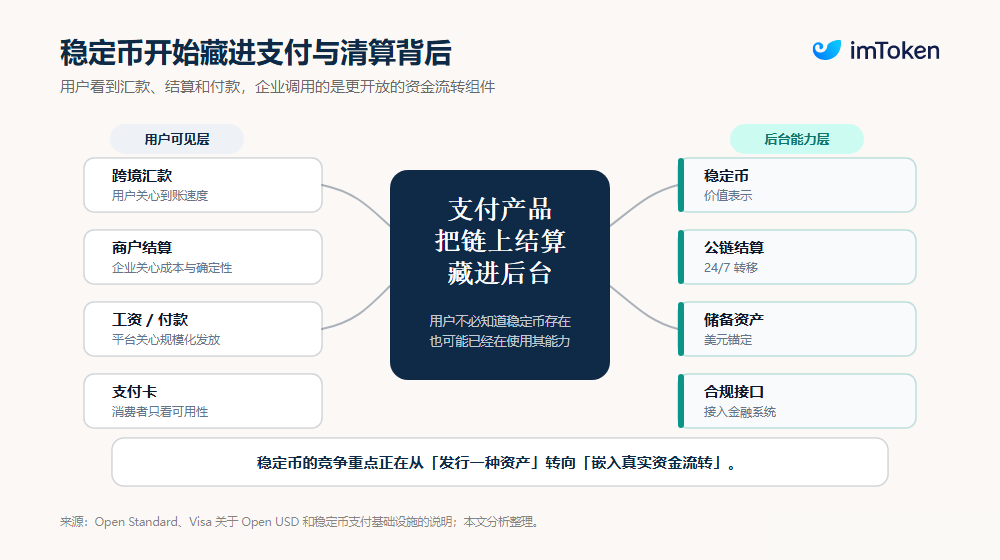
One of the most discussed cases recently is Open USD, launched by the Open Standard, a consortium involving over 140 payment, banking, tech, and crypto enterprises.
Unlike the traditional model where returns from reserves are primarily captured by a single issuing entity, Open USD allows partner enterprises to mint and redeem for free. It plans to distribute the income generated by the reserves to the partners driving its usage, after deducting management fees.
Introductions by Visa and Stripe have also defined OUSD as shared infrastructure for global capital flows. The truly noteworthy aspect of this design is not just another dollar stablecoin entering the market, but its attempt to adjust the long-standing profit distribution model for stablecoins – in the past, issuers typically captured most of the income generated by the reserve assets, while wallets, exchanges, payment companies, and fintech platforms bore the costs of user acquisition, product integration, and actual distribution.
If reserve yields can be further tilted towards channels and usage scenarios, the competitive logic for stablecoins will also change. This explains why the entry of entities like Stripe, Visa, Mastercard, and Zelle is more significant than simply adding another on-chain asset.
Ultimately, stablecoins are transforming from a Crypto product that users need to actively hold and manage into a capital flow component that traditional enterprises can directly invoke. Users might see a cross-border remittance, a merchant settlement, a corporate payment, a salary disbursement, or a payment card, but the backend might be using stablecoins and a public chain settlement network. Users may not even need to know stablecoins exist to be using their settlement capabilities.
Concurrently, some stablecoin products lacking real distribution channels and usage scenarios are exiting the market. This further illustrates that completing an issuance does not automatically grant a stablecoin value.
As the underlying technology gradually becomes standardized, the true moat will increasingly come from licensing and regulatory compliance capabilities, as well as the ability to embed into a commercial scenario that generates continuous transaction demand.
This also means that in the future, the ultimate competition for stablecoins may not be against other stablecoins, but potentially against bank card networks, cross-border remittance systems, bank deposits, and corporate treasury infrastructure.
3. Tokenized Stocks: Traditional Assets Begin Entering On-Chain Accounts
Compared to prediction markets and stablecoins, tokenized stocks present a more direct path of convergence.
It's not about introducing a crypto product to traditional users, but about moving stocks, ETFs, funds, and other traditional assets into accounts primarily used for storing and trading crypto assets.
In the past half-year, almost all major crypto trading platforms have been rushing into this space. Simultaneously, ICE, the parent company of the New York Stock Exchange, made a strategic investment in OKX. The two parties plan to collaborate around regulated US crypto futures, ICE market products, and tokenized stocks related to the New York Stock Exchange. As of writing, OKX has just announced plans to launch tokenized US stock products.
From a market structure perspective, this collaboration carries strong symbolic meaning. In the past, crypto exchanges tried to offer users exposure to stock prices through synthetic assets, perpetual contracts, or third-party issuers. Now, the operators of a traditional exchange are directly participating in product design, price data, compliance, and on-chain market infrastructure construction.
On the user-facing entry point, similar changes are already underway. Beyond vertical applications, from trading platforms to wallets to on-chain DEXs, from Robinhood to Interactive Brokers, everyone is trying to expand into a comprehensive financial account capable of simultaneously handling crypto assets, stocks, and even commodity trading.
However, tokenized stocks are also the most prone to conceptual confusion.
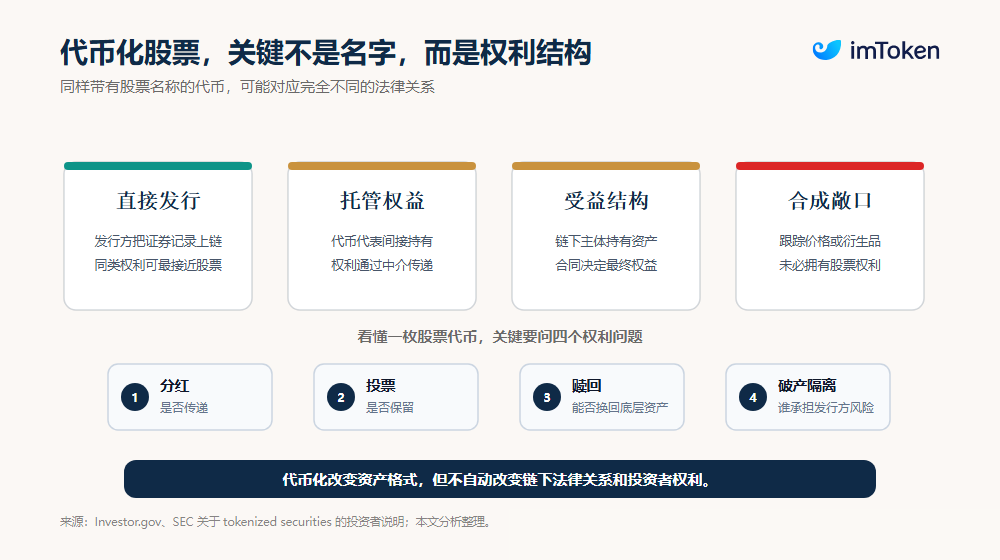
A token named 'Apple,' 'Nvidia,' or 'Tesla' does not necessarily mean the user directly holds common shares of the corresponding company. Different products may represent: direct ownership of the actual stock, beneficial interests held by an SPV holding the stock, debt instruments promised for redemption by the issuer, or merely derivatives tracking the stock price.
These models can differ significantly in terms of dividends, voting rights, redemption rights, bankruptcy remoteness, and investor protection. Even if the token circulates on a public chain, the legal relationships that determine the user's ultimate rights often still reside in off-chain issuing entities, custodians, and legal contracts. Most current RWA systems also employ a hybrid architecture.
Therefore, tokenization does not automatically equal liquidity, nor does it automatically mean users have exactly the same rights as traditional shareholders. However, these limitations do not prevent tokenized stocks from becoming an important entry point.
Once issues of compliance, custody, and shareholder rights are gradually resolved, stocks will no longer only exist within brokerage accounts. They can be in the same on-chain account as stablecoins, be divided into smaller units, be traded across different regions and time zones, and potentially be used for collateral, lending, automated investing, and programmatic asset allocation.
At that point, wallets and trading platforms will no longer just compete on the storage and trading of crypto assets, but on who can become the unified gateway for users to manage their global assets.
Final Thoughts
To be honest, this is somewhat reminiscent of the scene in "The Heaven Sword and Dragon Saber" where Zhang Sanfeng teaches Zhang Wuji Tai Chi, repeatedly asking him how much he remembers. Only when Zhang Wuji replies that he has completely forgotten does he truly grasp the essence.
Perhaps the mainstreaming of Crypto will undergo a similar process – the true mark of maturity is not that everyone remembers the concepts of blockchain, wallets, and stablecoins, but that users gradually become unaware of these technologies' existence, allowing Crypto to slowly disappear behind the products.
Of course, if we look closer, from prediction markets to stablecoins to tokenized stocks, the ways crypto technology enters traditional finance are not identical:
- Prediction markets bring the product logic formed within the crypto world to the mass market, transforming events and uncertainty into probabilities that can be traded in real-time;
- Stablecoins embed on-chain settlement capabilities into payments, remittances, and corporate capital flows, allowing users to utilize a new capital network without understanding blockchain;
- Tokenized stocks bring traditional assets into on-chain accounts, gradually enabling wallets, exchanges, and public chains to become new channels for the issuance, trading, and settlement of traditional securities.
These correspond to penetration at three levels: product, capital, and assets. For the industry, this may signify a new path to mass adoption, which is no longer requiring every user to first become a Crypto user, but letting on-chain technology actively adapt to the financial needs users are already familiar with.
Correspondingly, the role of wallets will also change.
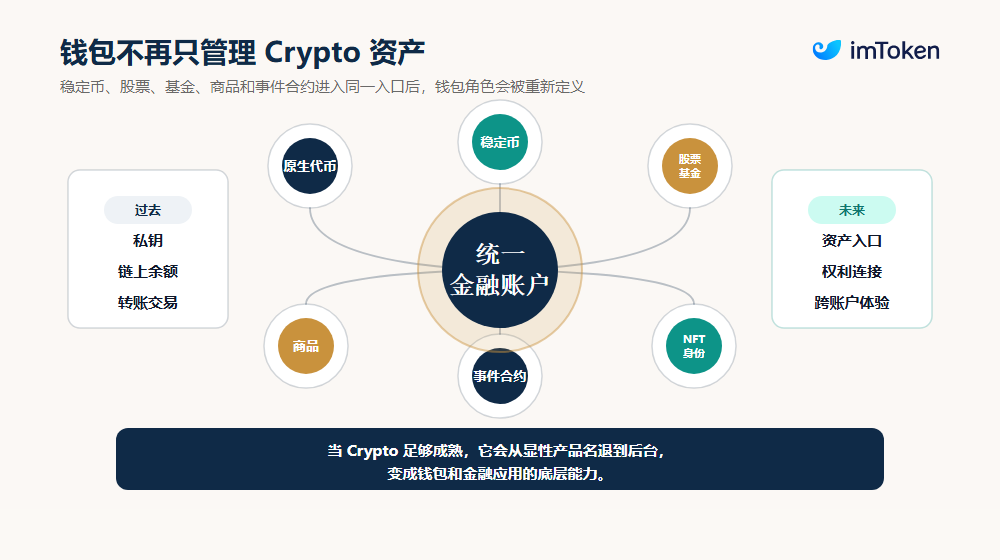
After all, when a wallet no longer contains only native tokens and NFTs, but gradually includes stablecoins, stocks, funds, commodities, and event contracts, it needs to handle not just private keys and on-chain balances, but also how to lower the usage barrier for different assets and better connect on-chain and off-chain account systems.
Imagine when a person can use imToken to send money instantly to family and friends overseas, trade the probability of an event on imToken, or buy a small portion of US stocks. They might not necessarily think they are "using Crypto."
It is precisely in this state, where it no longer needs to be repeatedly emphasized, that crypto technology can truly move from a relatively niche, isolated market into the broader financial and commercial world.


