






Bitwise Report: RWA and Prediction Markets Continue to Reach New Highs, Crypto is Bottoming Out


- Core Viewpoint: Bitwise's Q2 2026 report shows that despite the crypto market experiencing its third consecutive quarter of negative returns (Bitcoin down 52%), spot ETF outflows of $4.9 billion, and a decline in on-chain activity, tokenized RWAs ($33 billion), prediction markets ($1.8 billion in open interest), and crypto stocks (+23%) have performed strongly. Revenue from the application layer reached $5.9 billion, with fundamentals already much stronger than the bear market bottom of 2022.
- Key Elements:
- Market Performance: The Bitwise 10 Index fell 15.4% in Q2, Bitcoin dropped below $60,000, the crypto winter has lasted 9 months, and spot ETFs saw net outflows of $4.9 billion, the worst quarter on record.
- Policy Stalemate: The CLARITY Act is stuck in the Senate over ethics clauses, reducing the probability of passage in 2026 to 40%; Q3 is a key window, and its passage could signal a bear market bottom.
- Stablecoin & RWA Expansion: Tokenized RWA scale reached $33 billion in Q2 (+45% year-to-date), stablecoin supply maintained near $300 billion, and the GENIUS Act will catalyze on-chain growth in Q3.
- DeFi Resilience: While Bitcoin fell 22% in Q2, the Bitwise DeFi Index fell only 4%; Aave generated approximately $900 million in revenue over the past year, with improved tokenomics and institutional adoption driving a quiet revaluation.
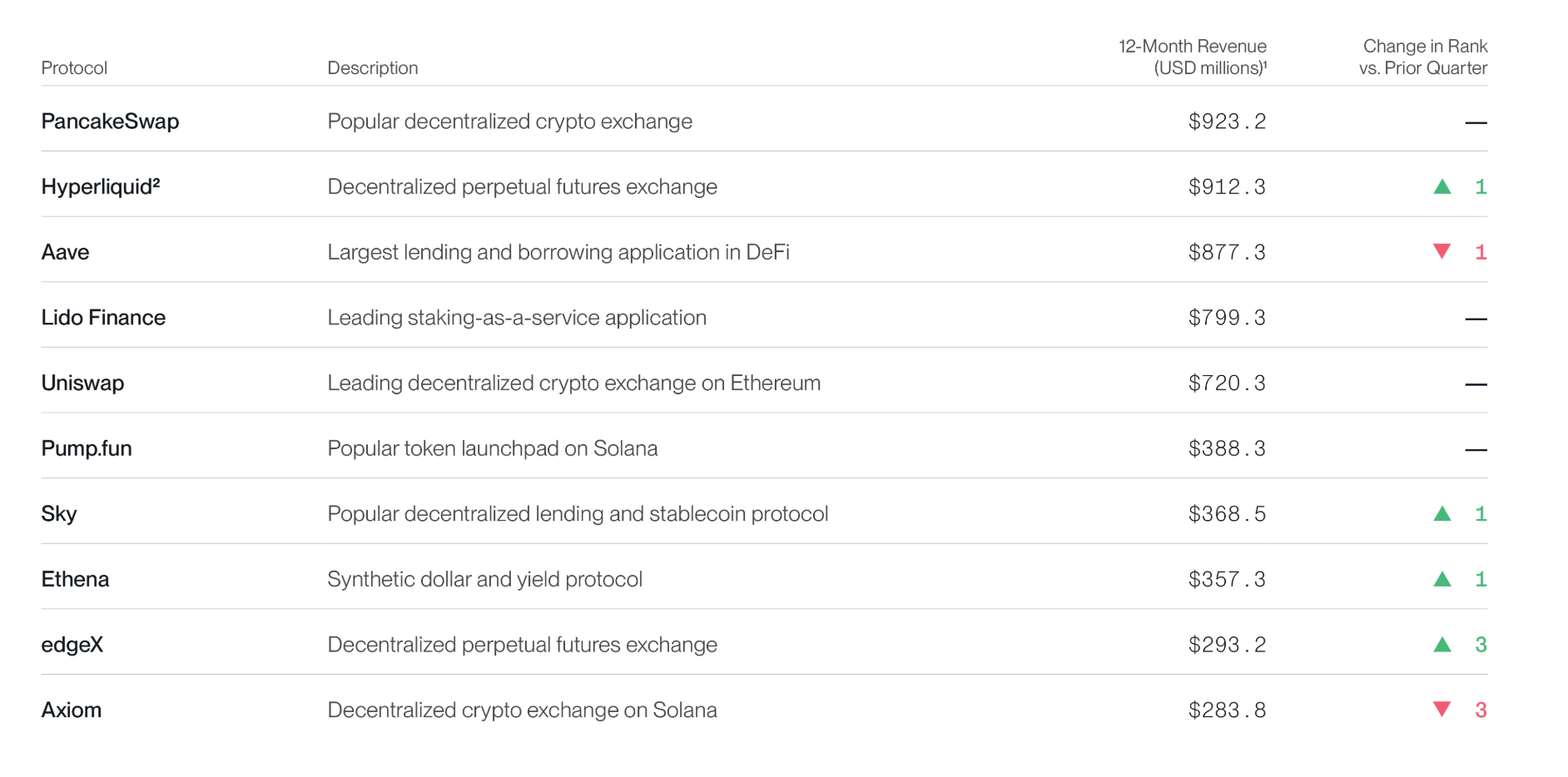
- Significant Application Revenue: The top 10 crypto applications generated a combined $5.9 billion in revenue over the past 12 months, with PancakeSwap, Hyperliquid, and Aave each close to $1 billion, maintaining stable profitability even in a bear market.
- Low Correlation of Crypto Stocks: The Bitwise Crypto Innovators 30 Index posted a 23% return in the first half of the year, more than double that of U.S. stocks, and has lower 90-day rolling correlation with most other asset classes.
- Fundamental Comparison: Ethereum transaction activity has increased 13-fold compared to Q2 2022, DeFi TVL has risen over 60%, and stablecoin scale has doubled. Only prices have not yet reflected fundamental improvements.
Original from Bitwise
Compiled by Odaily Planet Daily, Qin Xiaofeng (@QinXiaofeng 888 )

Editor's Note: Crypto asset management firm Bitwise recently released its Q2 2026 report.
The report states that the Bitwise 10 Large Cap Crypto Index fell by 15.4%, with 8 of its 10 constituent assets posting negative returns; spot Bitcoin ETFs saw outflows of $4.9 billion, marking the worst quarter on record; on-chain transaction activity, trading volume, and DeFi assets all declined, while the correlation between cryptocurrencies and equities increased.
Of course, there were bright spots in the market. Open interest in prediction markets hit an all-time high of $1.8 billion, with quarterly trading volume reaching $43 billion; the total value of tokenized real-world assets reached $33 billion in Q2, up 45% from the start of the year; crypto equities also performed well, with the Bitwise Crypto Innovators 30 Index rising 30.6%, largely driven by AI-related Bitcoin mining companies.
"Overall, the situation is challenging. What's worse is that this feeling of difficulty is very real. While there is no statistical indicator to measure 'sentiment,' the current atmosphere in the crypto industry is among the worst I've seen in my eight years in the space. One reason: This is our third consecutive quarter of negative returns, the longest losing streak since 2022 (which saw four consecutive quarters of negative returns)," wrote Matt Hougan, Chief Investment Officer at Bitwise.
Below are some key data charts excerpted from the report. Enjoy~
——————————
Top 10 Key Events in Q2
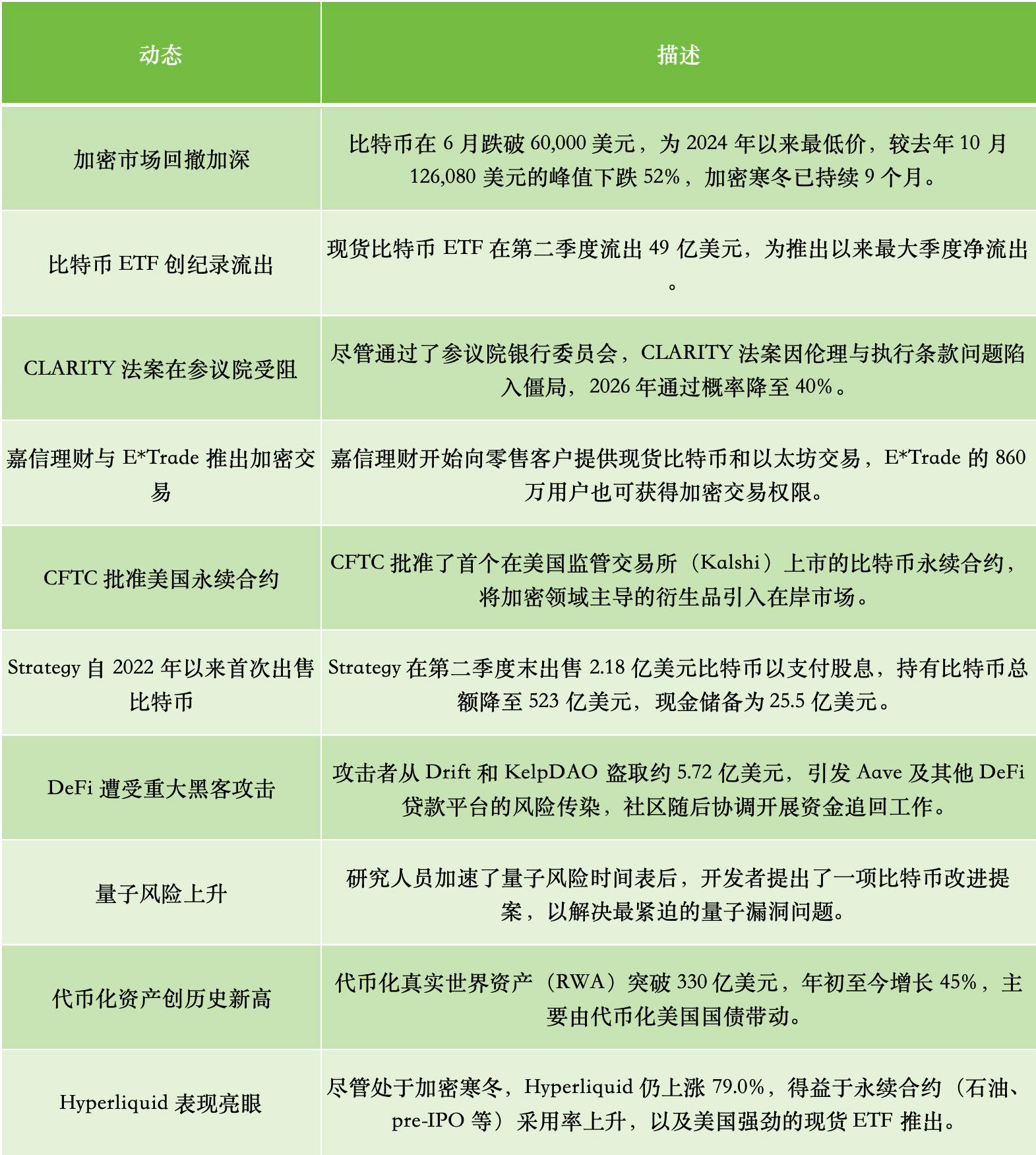
In Q2, we saw Strategy, which once vowed to "never sell," sell Bitcoin, starting with small test transactions before eventually selling $218 million worth of Bitcoin at the end of June to pay dividends.
Influenced by these sales, Bitcoin fell below $60,000 in June, hitting its lowest price since 2024. It is down 52% from its peak of $126,080 (October last year), and the crypto winter has now lasted nine months. Meanwhile, spot Bitcoin ETFs saw outflows of $4.9 billion in Q2, the largest quarterly net outflow since their launch.
On the policy front, the much-anticipated "CLARITY Act" has not progressed smoothly in the Senate, stalled by ethical and enforcement clause issues. The probability of its passage in 2026, as reflected in prediction markets, has also dropped to 40%.
Here are the top 10 crypto events in Q2 as summarized by Bitwise:
Q3 Quarterly Outlook
Q3 is crucial for the fate of the CLARITY Act. This market structure bill passed the Senate Banking Committee in Q2 but stalled due to ethical clauses related to the President's family's crypto interests. Prediction markets show its probability of passing in 2026 is near 40%, down from 75% in mid-May. We believe passage before the November midterm elections is unlikely. However, bills with such probabilities often manage to pass, so we think CLARITY still has a chance. If the bill passes, we believe it could mark the bottom of this bear market; if it fails, short-term volatility is expected, followed by a gradual easing of uncertainty as the industry advances under a pro-crypto SEC and CFTC.
Stablecoin expansion post-GENIUS Act. July marks the final sprint before the GENIUS Act takes effect in January 2027, with regulators needing to finalize rules in Q3. We expect a wave of large enterprises to announce stablecoin projects before the official launch, such as the recently revealed OpenUSD, backed by Stripe, BlackRock, Visa, Coinbase, and approximately 140 other companies. Since last autumn, stablecoin supply has remained near $300 billion, showing resilience during the crypto market sell-off. We believe accelerating stablecoin growth ahead of the January effective date will act as a catalyst for public chains like Ethereum and Solana in Q3.
The Walsh-led Federal Reserve. The Federal Reserve has a new chair, Kevin Walsh, and the market knows little about his policy style. The first signals will come in Q3: the July FOMC meeting and the Fed's annual symposium in Jackson Hole in late August. So far, Walsh has kept interest rates unchanged and hinted at no rush to cut. By the end of the quarter, we should have a clearer picture of the Fed's direction than we do now. It's too early to predict the rate path, but the Fed sets the tone for all risk assets, and any outcome will be quickly priced in by the market.
The quiet revaluation of DeFi. Over the past month, Bitcoin has fallen about 22%, while Bitwise's DeFi index has only dropped 4%. DeFi is typically much more volatile than Bitcoin, so this resilience is rare and has largely gone unnoticed. We believe DeFi is undergoing a quiet revaluation: tokenomics are improving, the gap between usage and token value is narrowing, real institutions are building on protocols like Morpho and Jupiter, and Aave alone has generated approximately $900 million in revenue over the past year. We expect DeFi's outperformance to continue in Q3, a shift that the market often recognizes with a lag.
Significant Divergence Between Crypto Equities and Crypto Assets
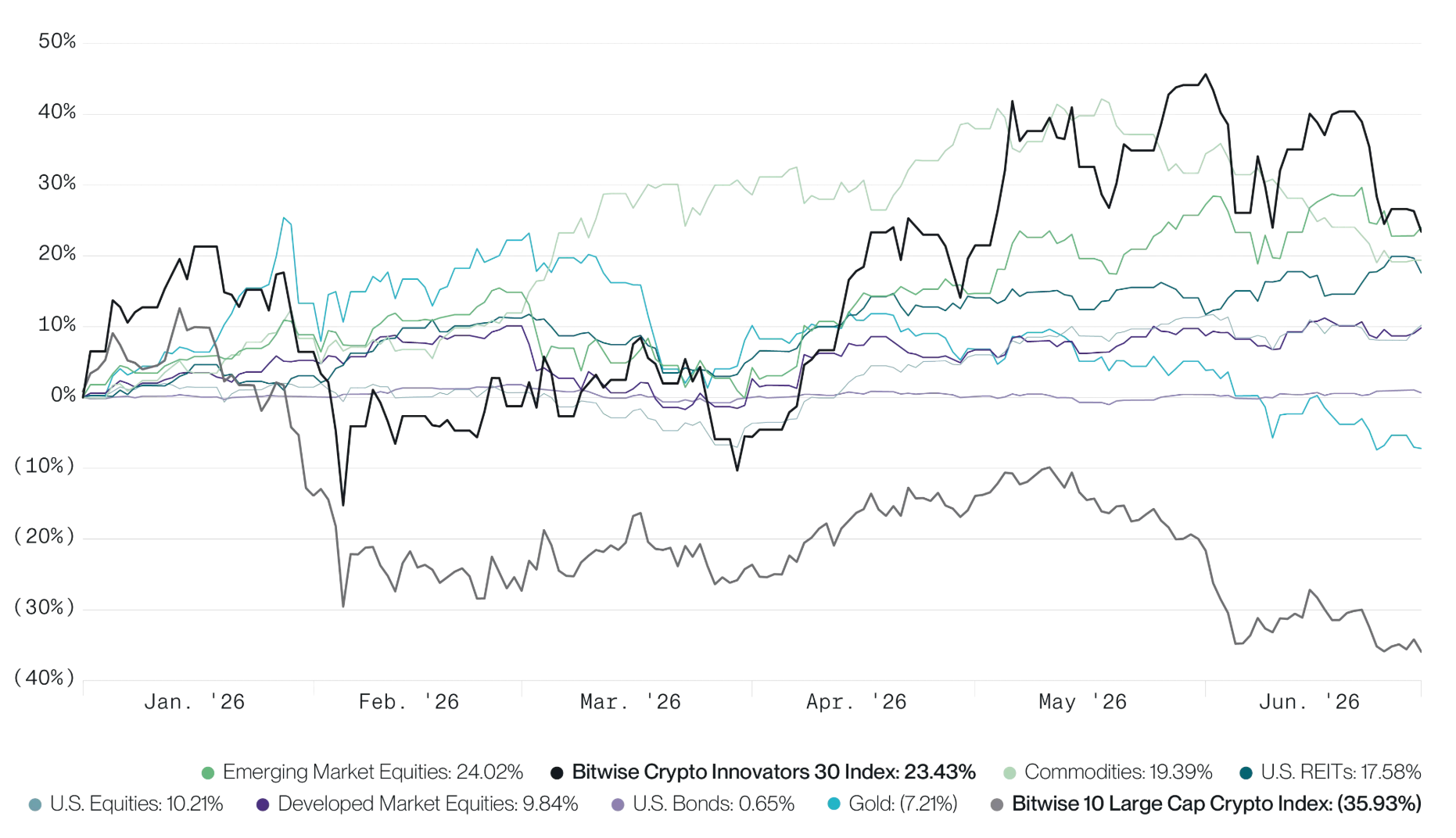
Halfway through 2026, crypto asset prices are down 36%. Among other major asset classes, only gold posted a decline, falling 7%, while the rest were up. This is one reason the current crypto winter feels particularly harsh—it is a lonely winter.
Notably, however, crypto equities returned 23% in the first half of the year, outperforming all major asset classes except emerging market equities. In fact, the Bitwise Crypto Innovators 30 Index, which tracks the 30 largest publicly listed companies in the crypto economy, delivered more than double the returns of US equities.
This indicates that even in a bear market, investment opportunities in the crypto space continue to emerge. Bitcoin miners are benefiting from tailwinds related to AI; stablecoin issuers and tokenization platforms are riding the wave of Wall Street adoption; the connection between traditional finance and the crypto world is growing stronger. While I expect crypto assets to rebound in the second half of the year, the first half has reinforced a key insight: Crypto is not a monolith but a diverse, dynamic field that should be viewed with a broader perspective.
Performance of cryptocurrencies vs. major asset classes:
Source: Bloomberg. Data as of June 30, 2026
Crypto Applications Generate Significant Revenue
Over the past 12 months, the top 10 crypto applications generated a combined revenue of $5.9 billion. The top three (PancakeSwap, Hyperliquid, and Aave) each generated close to $1 billion in revenue. These are legitimate businesses earning fees from trading, lending, and staking—even in a bear market.
Top 10 crypto applications by revenue, as shown below:
Source: Token Terminal, data from January 1, 2025, to June 30, 2026
(1) Revenue consists of total fees paid by users; (2) Hyperliquid revenue excludes HyperEVM fees
The Bull Market for Real-World Assets (RWA)
US Treasury Secretary Scott Bessent himself said a few weeks ago: "Digital assets, stablecoins, tokenization, and new payment systems will help shape the future of money."
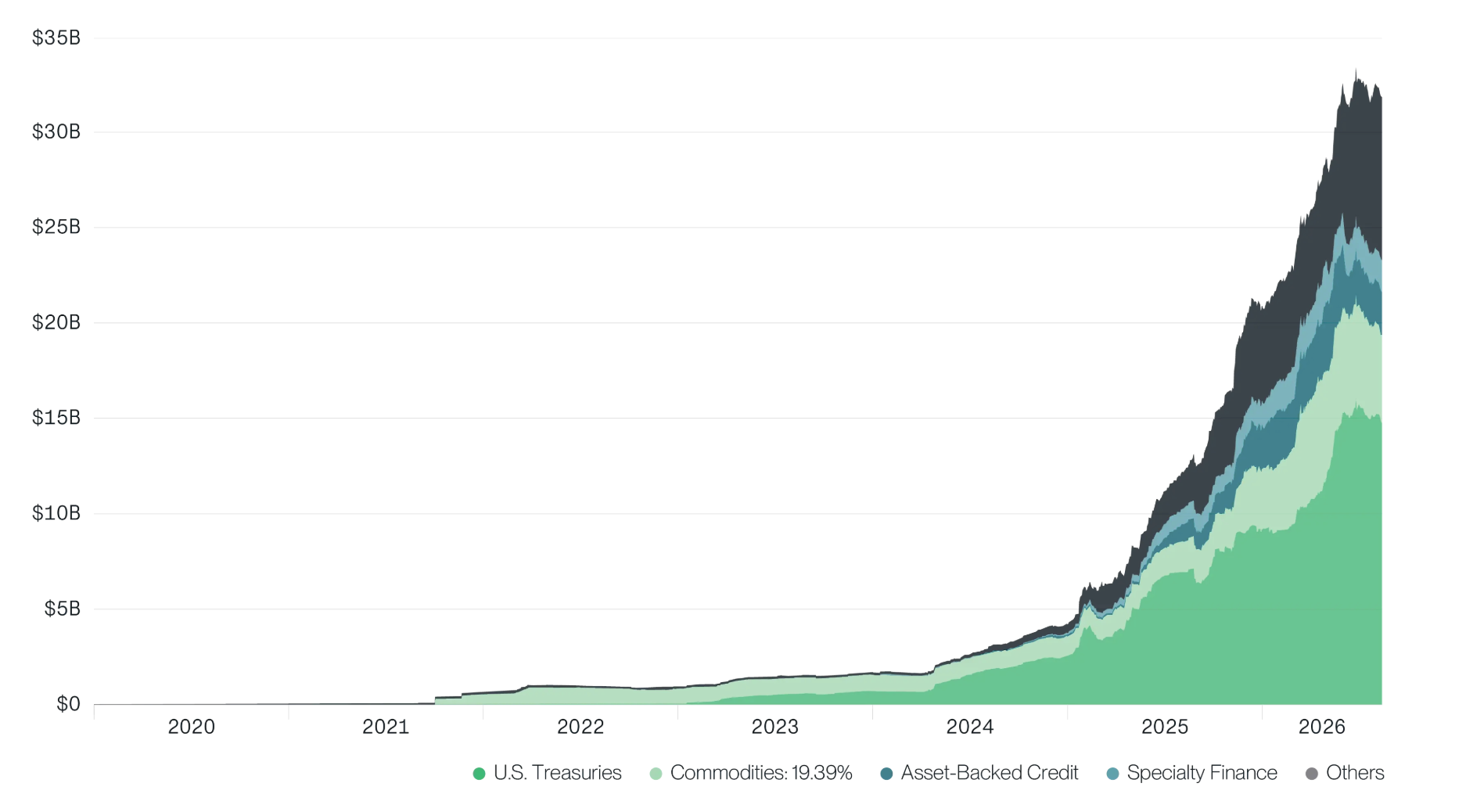
In a sense, the future he describes is already here. Tokenized real-world assets (RWA) reached a record $33 billion in Q2, growing 12% in the quarter and 45% year-to-date, with tokenized US Treasuries, corporate credit, equities, and venture capital growing particularly fast.
When I see this chart, I see the world's largest asset managers moving assets onto the blockchain at full speed, which is worth paying attention to.
Total Value of Tokenized Real-World Assets (RWA), as shown below:
Source: RWA.xyz, data from January 1, 2020, to June 30, 2026
Note: The chart above omits stablecoin issuers like Circle and Tether.
Prediction Markets Continue to Expand
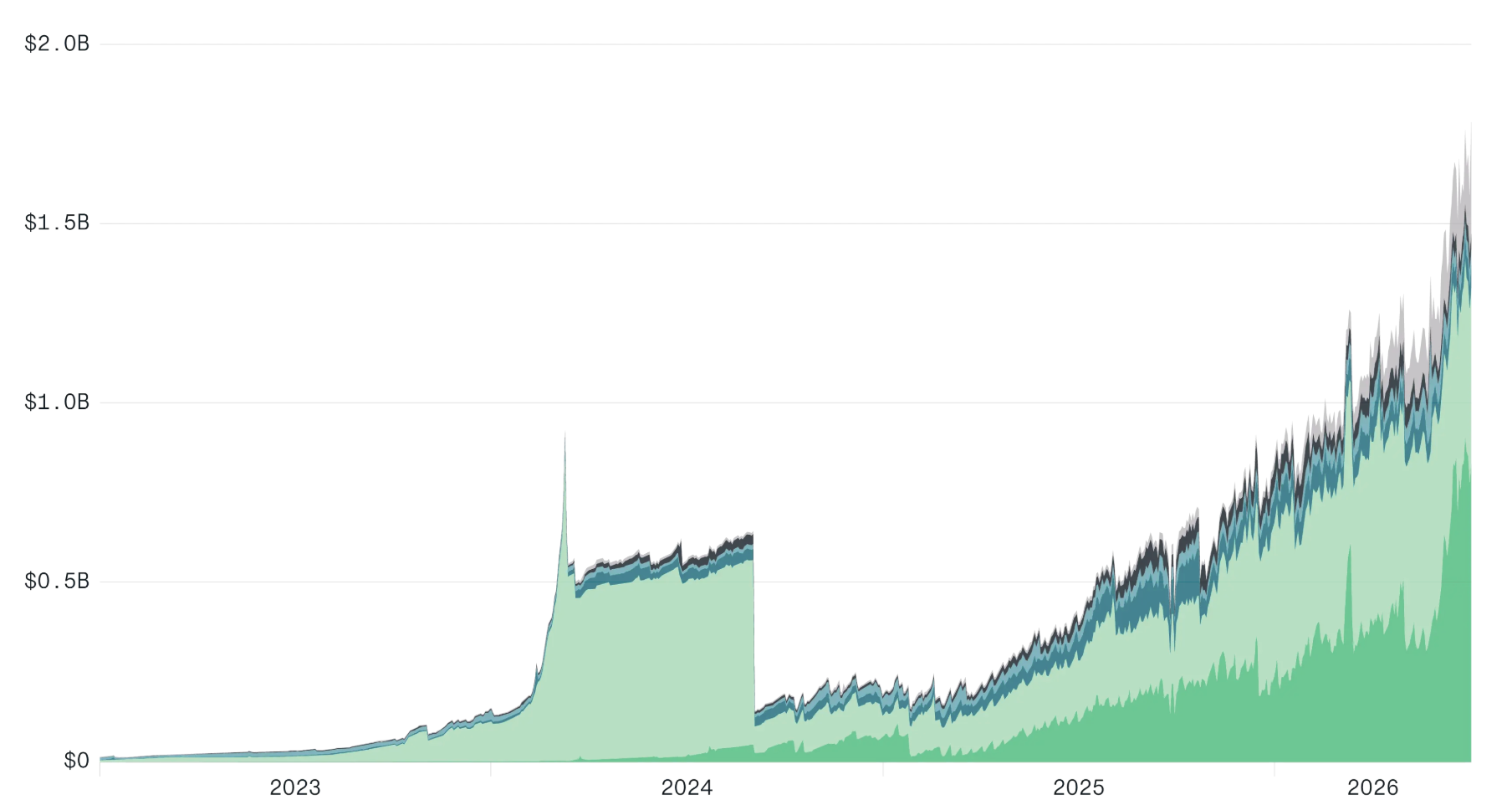
In Q2, open interest in prediction markets hit an all-time high of $1.8 billion, with the sports category becoming the largest sector. Quarterly trading volume also set a record, reaching $43 billion.
Applications like Polymarket demonstrate the stealthy adoption of cryptocurrency by retail users: Millions of people are using crypto infrastructure to trade outcomes of real-world events, but most are unaware or unconcerned that crypto provides the underlying technology.
With the US midterm elections approaching, trading volume and open interest in prediction markets are likely to hit new all-time highs multiple times this year. After all, politics was the category that brought prediction markets into the mainstream in 2024, and the market has tripled in size since then.
Open Interest in Prediction Markets, as shown below:
Source: Blockworks Research, data from January 1, 2023, to June 30, 2026
Crypto Equities Have Low Correlation with Major Assets
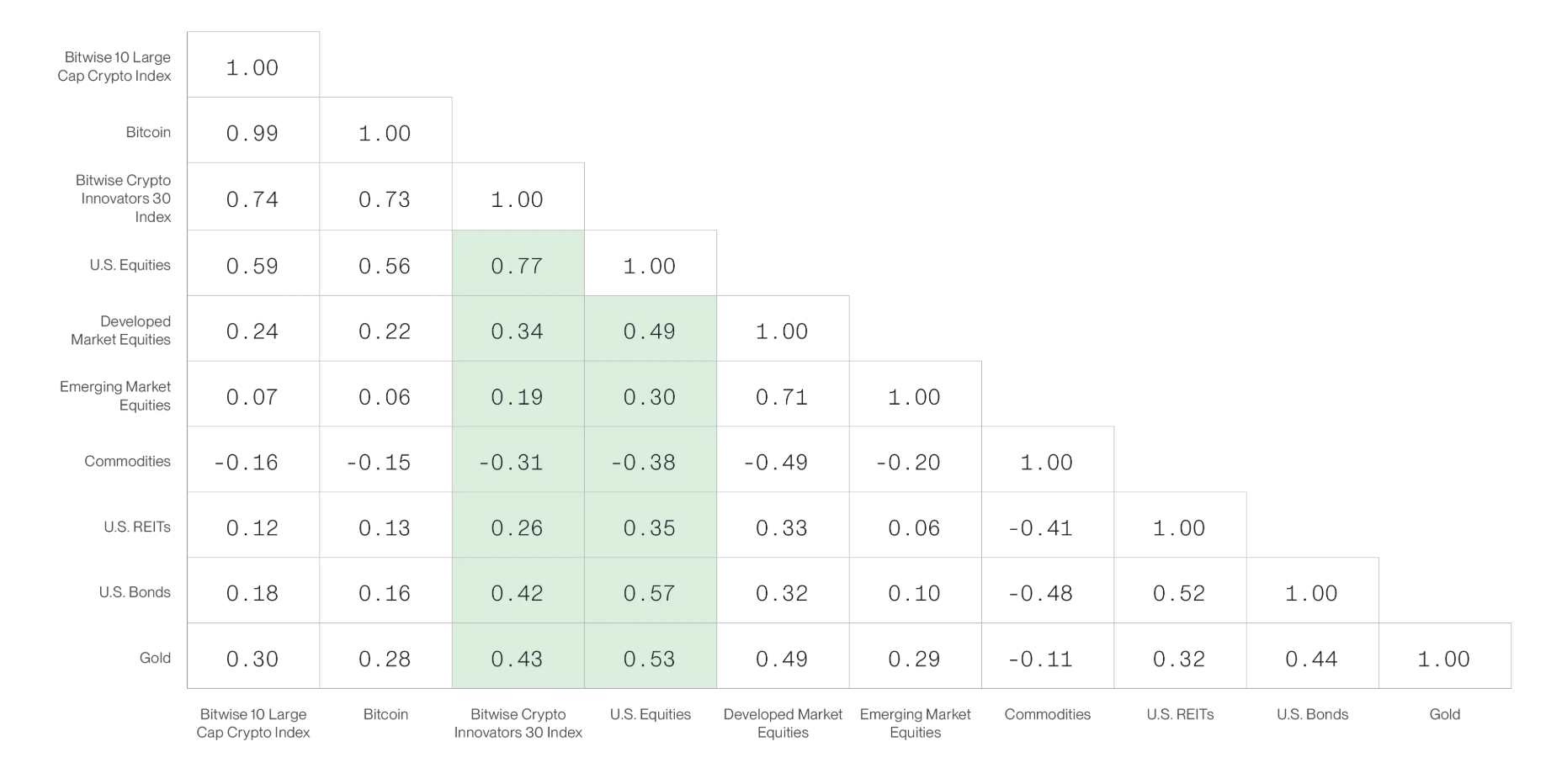
Returning to crypto equities, one of the most interesting charts is the 90-day rolling correlation of the Bitwise Crypto Innovators 30 Index with other major asset classes. Notably, compared to US stocks, the index has a lower correlation with almost all other classes, including developed market equities, emerging market equities, US REITs, US bonds, and gold. (The only exception is commodities, where both correlations are negative.)
In other words: In the first half of 2026, crypto equities delivered more than double the returns of US stocks while having a lower correlation with almost every other asset in a portfolio. This combination of return and diversification is enough to excite any investor.
Correlation of Selected Assets and Asset Classes (90-day rolling), as shown below:
Source: Bloomberg, data as of June 30, 2026
Conclusion
As you flip through these pages, take a close look at the charts. Nearly all metrics—prices, on-chain activity, trading volume—are well below their respective all-time highs. This isn't surprising given that prices have fallen over 50% from their peak last October.
But when you compare the same data cyclically to the previous bear market bottom of 2022, the picture is drastically different. Ethereum transaction activity has grown roughly 13x compared to Q2 2022. Total value locked in DeFi has risen over 60%. Stablecoin supply has roughly doubled. It seems that only price has truly failed to keep pace.
I believe this accurately reflects where we actually are: The market is pricing an industry at bear-market levels that is already twice the size of the last cycle's bottom—an industry with deeper liquidity, stronger fundamentals, and Wall Street finally stepping on-chain.
Such foundations cannot stop the winter, but they determine what grows in the spring.
That's my take on this quarter. Of course, none of these 50+ charts can answer the question we've been asked most frequently: "Has the crypto price bottomed?" But they do point to the resilient fundamentals of the crypto space—an ecosystem where usage, revenue, and adoption continue to grow despite the bear market.
To me, that's what makes this a fascinating space—and the foundation upon which the next cycle will be built.


