






玩家何一:来都来了,那就把门拆掉


- 核心观点:币安联合创始人何一入选《财富》“商界最具影响力女性”榜单,标志着加密行业从边缘走向主流;她阐述了币安通过降低金融门槛、服务全球未银行化人群,以及推动去中心化金融与AI结合的长期愿景。
- 关键要素:
- 何一成为首位登上《财富》该榜单的加密原生高管,代表行业主流认可度提升。
- 过去5年,超过3400万人通过Binance Pay完成汇款,累计规模超870亿美元,为用户节省超50亿美元汇款费用。
- 币安用户已超3亿,目标进一步扩展至30亿,覆盖全球尚未进入正规金融体系的成年人。
- 币安强调“首席客服”文化,管理层须定期轮岗一线客服以贴近用户需求。
- 何一个人背景(四川农村出身)凸显其推动金融普惠的动机,尤其在印度、巴西等地区帮助女性用户接入金融系统。
- 币安正将AI工具开放给普通用户,旨在打破技术垄断,让用户分享AI创造的价值。
Editor’s Note: On May 27, Binance Co-founder and Co-CEO Yi He was named to Fortune magazine’s “Most Powerful Women in Business” list. Binance stated that Yi He’s inclusion marks the first time a crypto-native executive has made this list, representing a significant milestone for Yi He, Binance, and the entire industry. Yi He subsequently expressed her gratitude and reflected on the journey that brought her here. Below is the original text.
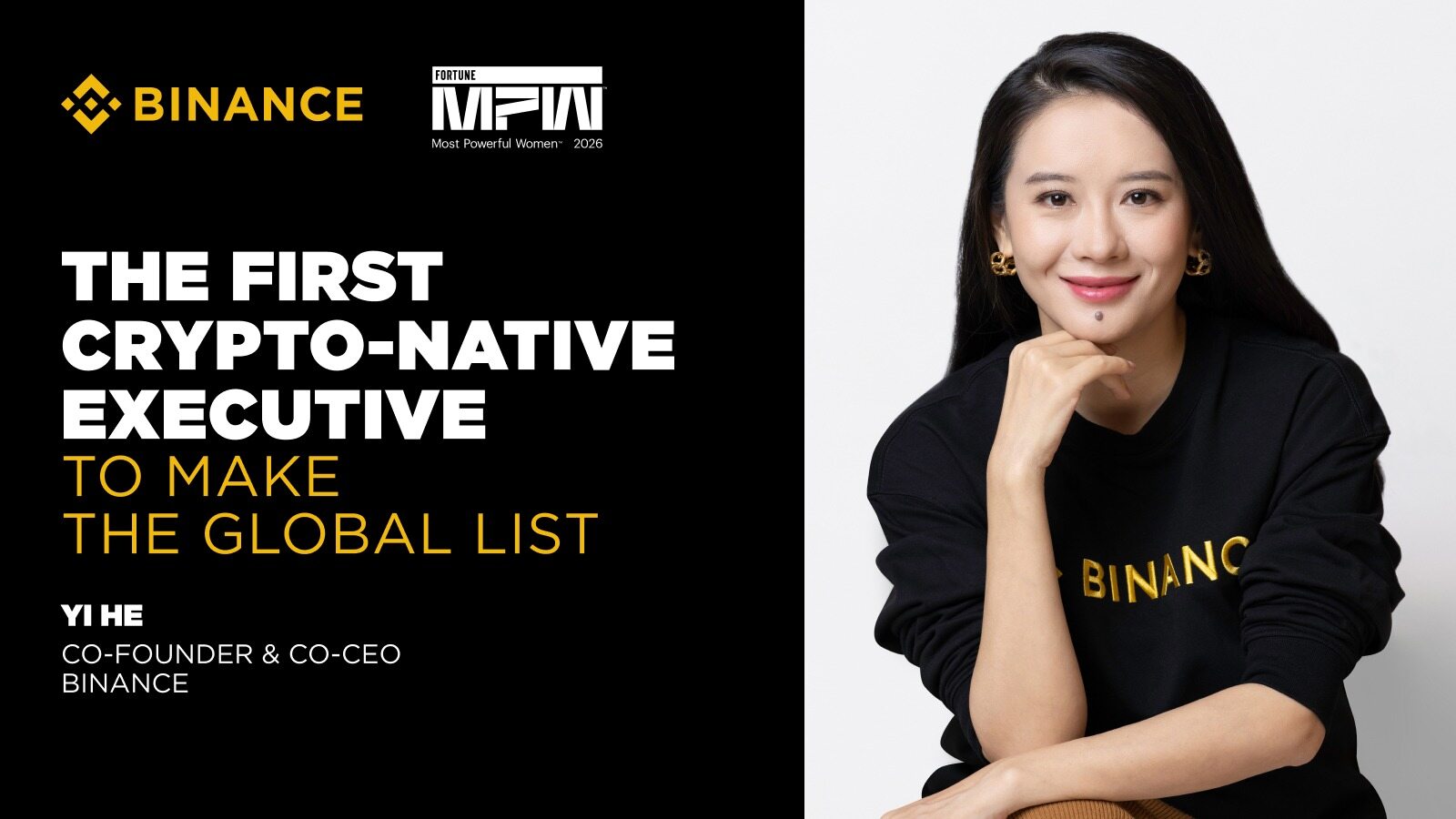
1. From the Periphery to the Spotlight
When I first learned I would be named to Fortune’s “Most Powerful Women in Business” list, my first feeling was ‘I don’t deserve this,’ and my second was a profound sense of responsibility.
This recognition bears my name, but it belongs to the Binance team, to Binance’s users, and more broadly to Satoshi Nakamoto, and to every community member who turned an idea into a global movement.
A few years ago, seeing a crypto-native entrepreneur on such a list would have been unusual. Today, however, it represents our industry’s gradual journey from the fringes of finance and technology into the spotlight. This is not my ‘achievement’ per se; I simply saw the wave coming, mustered the courage to get on the surfboard, and clumsily learned to ride it. Yet, this recognition marks another step in the blockchain industry’s long journey from a niche pursuit for geeks to a part of everyday life. The road, however, is still long. It requires persistent, incremental effort — building and polishing, step by step. That’s what we do every single day.
I often call myself the “Chief Customer Support Officer,” and I like that title. At Binance, every new manager spends their first month working front-line customer support, and we all rotate back to that role each quarter — myself included. The logic is simple: What you can’t see from your office chair, our users see for you every day.
Last year in Dubai, a young man from Kenya stopped me as the event was winding down. He uses Binance to send his paycheck home to his mother every month. He didn’t ask about blockchain architecture or tokenomics. He just wanted me to know how much faster his mom receives the money now, and how much less money disappears along the way. He didn’t need to be ‘educated’ about what cryptocurrency is; he needed a product that works.
He is not alone. Over the past five years, more than 34 million people have completed remittances through Binance Pay, totaling over $87 billion. Based on the World Bank’s global average remittance fee of 6.36%, we have helped our users save over $5 billion — money that hasn’t disappeared into intermediaries’ pockets, but has instead gone back to family meals, children’s school fees, and seed capital for small businesses.
2. We Must Dismantle That Door
I was born in a small village in Sichuan, the kind of place you’d be hard-pressed to find on a map. When I was young, the power sometimes went out, and I’d have to do my homework by the light of a kerosene lamp. Girls in the village under 16 would borrow other people’s IDs and go to work in factories.
When I was 9, my father passed away. My uncle told my mother, “Sending a girl to school for so long — you might as well save that money for your son’s bride price.” But my mother was exceptionally resilient. She worked as a substitute teacher while also farming the land, somehow managing to support the whole family on her own and putting me through teacher’s college.
Over the years, I’ve often been asked: why, when you’re already financially free, are you still working so hard? Honestly, not everyone gets a chance to change the world, but I am in the process of making history. Since I’m here, why not give it a try? There’s an old saying: “In poverty, one cultivates their own virtue; in prosperity, one brings benefit to the world.”
In tier-2 and tier-3 cities across India, there is a group of women between 36 and 50 years old. Their mothers never had a bank account in their lives. They themselves didn’t have one a year ago. But over the past year, they’ve become one of our fastest-growing user segments. Those whom no one listens to are quietly taking back their right to information and decision-making regarding their own judgment, their own money, and their families’ futures from outdated systems, stepping into a faster, more efficient, and lower-cost financial world. They are, like I was 12 years ago, beginning to think, “What is money?” This matters more than any grand narrative.
Over the years, Binance has carried out tens of thousands of small initiatives in rural South Africa, Brazil, and India: scholarships, training programs, and basic financial literacy courses. They are small, but they are happening, one after another. I don’t like the phrase “empowering women.” It sounds like someone holds the keys and decides whether to open the door for you. I’d rather dismantle that door entirely, so more people can walk through. They should decide for themselves who they want to become and what kind of life they want to live.
3. From 300 Million to 3 Billion
Back when we said Binance aimed to serve 1 billion users, people outside thought we were dreaming. Today, we have over 300 million users. 1 billion is no longer a distant dream. So this year, we changed our target to 3 billion.
Honestly, before I said this number out loud, I also wondered: Is it the right number? Do we deserve it? But one thing I am certain of: If we don’t set this goal for ourselves, no one will set it for those 3 billion people.
3 billion is roughly the number of adults in the world today who still lack access to the formal financial system. This means our mission has evolved beyond just being a cryptocurrency exchange. We must become the financial infrastructure capable of supporting the daily lives of 3 billion people.
AI is reshaping productivity. But if this productivity belongs only to a few companies, it’s not a revolution; it’s a new monopoly. Over the past year, we have been putting tools, once accessible only to professional institutions, into the hands of ordinary users: enabling a person with no coding skills to use AI to optimize decisions; allowing someone encountering crypto for the first time to ask any question they want in natural language. Finance shouldn’t be a language spoken only by the few.
Blockchain is meant to solve another issue: ensuring that everyone who uses AI can claim their fair share of the value generated by it. Only by addressing both these things can we pave the way from 300 million to 3 billion users.
Someone once said something very simple: If you don’t like the world, go change it. Having made my way step by step from that small Sichuan village, to the county town, to the provincial capital, and out into the world, I know better than anyone that the world you dream of, like Rome, isn’t built in a day.
So, let’s get back to work. Progress, one step at a time. No effort is ever in vain.


