






别再拿手续费给ETH估值了,「金库逻辑」才是未来?


- Core Thesis: Ethereum should not be valued as a company generating fee revenue, but as a "vault" protecting approximately $250 billion in crypto assets. ETH is the "lock" securing this vault, and its value directly determines the vault's security level. Currently, ETH's market cap is severely undervalued, and its fair price should be significantly higher than the market price.
- Key Elements:
- Fees are network friction, not revenue. Ethereum's average transaction fee has dropped from over $50 to $0.20, yet transaction volume has tripled. The hallmark of a successful network is driving fees toward zero.
- With the transition to Proof-of-Stake, the cost of attack is tied to ETH's value. Controlling 33% and 66% of staked ETH can respectively disrupt or alter the network. The cost of malicious action is calculated in ETH, and such action results in the destruction of that ETH.
- On-chain assets on Ethereum total approximately $250 billion, but the value of staked ETH securing these assets is only $72 billion. This security ratio (lock : safe) is severely imbalanced, akin to protecting gold bars with a broken lock.
- According to the model, to secure current on-chain assets, ETH's fair price should be $6,900 (currently around $2,070). As on-chain assets grow to trillions, ETH would need to rise to tens of thousands of dollars.
- Ethereum's security is self-contained, fundamentally different from Linux or DTCC which rely on external legal or community guarantees. ETH cannot have zero value, otherwise the chain would have no security.
Original Author: Tom Dunleavy, Varys Capital Venture Lead
Original Translation: Yuliya, PANews
Editor's Note: The current market generally views Ethereum as a traditional enterprise, calculating its P/E ratio based on the fees it generates, and concluding that it is overvalued. However, Tom Dunleavy proposes a completely different framework: fees are not revenue, but network friction; Ethereum is not a company, but a "vault" protecting hundreds of billions of dollars in assets, and ETH itself is the lock. Below is the compiled translation:
TLDR
- Stop valuing Ethereum by looking at fees. Fees are actually friction; a successful network will invariably find ways to reduce fees to zero. Now, ETH transaction fees have dropped from a high of over $50 in 2021 to around $0.20 today, yet transaction volumes have more than tripled. The collapse in fees indicates the network's success, not its decline.
- After transitioning to Proof of Stake (PoS), ETH became the lock protecting the asset vault. To attack Ethereum, you need to control the staked ETH. Controlling one-third can halt the network, controlling two-thirds can alter the ledger. In either case, the cost of wrongdoing is denominated in ETH, and upon committing an attack, these ETH are automatically slashed by the system. This inextricably ties ETH's value to the network's security. No network operated this way before staking.
- Currently, there is approximately $250 billion in assets on the Ethereum chain (including stablecoins, tokenized assets, L2 cross-chain funds, etc.), but the total value of staked ETH protecting these assets is only around $72 billion. This is like using a cheap, flimsy lock to secure a vault full of gold bars. Logically, ETH's fair price should be around $6,900 (currently at $2,070). If on-chain assets eventually grow to trillions, ETH's price needs to rise to tens of thousands of dollars to justify its security responsibility.
- Saying "Ethereum is like a free Linux system" or "like DTCC (Depository Trust & Clearing Corporation)" is incorrect. Linux and DTCC derive their security externally (e.g., open-source community goodwill, or legal guarantees from governments and banks). But Ethereum pays for its own security, using its own token, ETH. Therefore, ETH must hold value, whereas Linux does not.
- If ETH fails, Crypto will likely fail too.
Fees Are Not Revenue, They Are Friction
Last week, Bankless founder David Hoffman announced he had sold all his ETH, causing a stir in the crypto space. While I respect David's decision, I believe the way people evaluate ETH and other PoS chains is outdated. I've discussed my new framework with many people on shows, but it seems not to have stuck (perhaps due to my explanation). So today, I'll lay it all out clearly in one go.
New things require a new perspective. Let me introduce a completely new ETH valuation model.
Many people treat Ethereum as a company, viewing the fees it collects as its revenue. When they see fees drop, they conclude the "company" is failing and the token is overvalued. This is entirely backwards. Once you understand this, you will never see it the same way again.
In reality, fees are like taxes – the higher they are, the less people want to use the network. Lower fees encourage more participation, leading to more applications and capital on-chain. The data is unambiguous: transaction fees have dropped from over $50 in 2021 to around $0.20 today, yet transaction volumes are at all-time highs, more than triple 2021 levels, with L2s now handling approximately 85% of transactions. It's cheaper to use, so more people use it. A successful settlement network should aim to drive tolls down to zero.
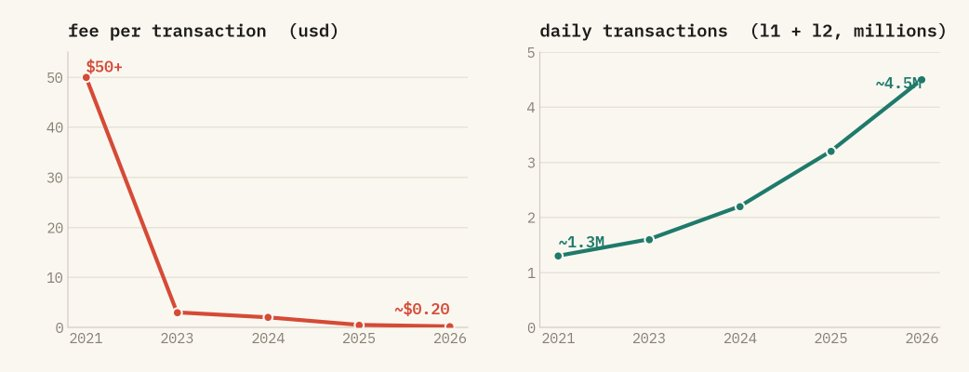
Ethereum's fees have plummeted while transaction volumes hit new highs. It became cheaper and more people used it. L2s now handle roughly 85% of the throughput.
So, if fees are the wrong metric, what is the right one?
Ethereum is a Giant Vault, ETH is the Lock
Stop thinking of Ethereum as a company. Think of it as a massive vault. This vault contains approximately $160 billion in stablecoins, $20 billion in RWAs (like U.S. Treasuries, money market funds, and private credit), $35 billion in L2 cross-chain assets (as L2s inherently inherit Ethereum's consensus), plus about $12 billion in wrapped Bitcoin, and roughly $20 billion spread across DeFi positions, NFTs, and on-chain treasuries. Total on-chain assets amount to around $250 billion and are growing every quarter.
A vault's security depends on its lock. And everyone is miscalculating the value of this lock. On Ethereum, the lock is made of ETH.
Under the old Proof of Work (PoW) system, you protected the network with mining hardware. The lock was bought externally, its cost unrelated to the token's value. But now with Proof of Stake (PoS), everything has changed. To attack Ethereum now, you must buy and control the staked ETH. The lock is made of the token itself. This means the security level of the vault and the market price of the token are one and the same. You cannot separate them.
The Lock Is Cheaper Than the Safe
This is what the market is missing. Today, the total value of all staked ETH securing Ethereum is only $72 billion. But it protects $250 billion in assets. The money inside the safe is more than double the cost of the lock protecting it.
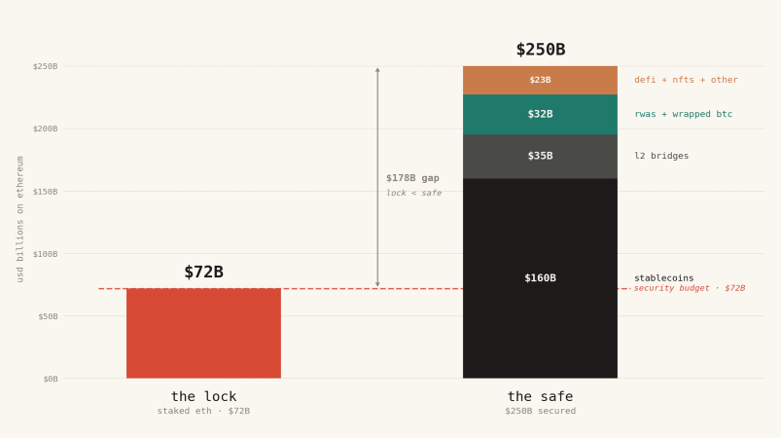
This is dangerous. If the cost to break in is less than the value of what you're protecting, your vault is poorly designed. For Ethereum to securely safeguard this $250 billion, the capital used for defense (staked capital) must exceed $250 billion, not be less than a third of it.
Currently, only about 30% of ETH is staked. So, just to make that 30% staked portion equal to on-chain assets, ETH's total market cap would need to be more than three times the on-chain assets (1 / 0.30). Right now, ETH's market cap is roughly equal to the assets it protects (around 1x). But according to my logic, it should be over 3x. Based on the current $250 billion, ETH's fair price would be around $6,900, not the current $2,070. This means that even without any new capital inflows, based solely on the assets it currently protects, ETH's price should more than triple. This aligns closely with the directional model of BitMine chairman Tom Lee.
"But Circle can freeze USDC, so it doesn't need ETH protection."
Every time I mention this, someone brings up this objection, but it's profoundly wrong. Here's why:
The argument is that if Ethereum is attacked, Circle (the issuer of USDC) can just freeze the attacker's addresses and reissue the tokens. Therefore, these hundreds of billions shouldn't count towards Ethereum's security responsibility.
But think about it: Circle's freeze mechanism operates based on smart contracts, which execute on Ethereum and rely on Ethereum's ledger. If Ethereum's consensus is broken, there is no honest chain everyone agrees on, and the freeze mechanism cannot function.
Furthermore, Circle could have chosen not to use Ethereum and built a private database instead. They chose Ethereum precisely for its neutrality, deep liquidity, and composability with other projects. Having enjoyed these benefits, the consequence is that USDC's fate is now tied to Ethereum's security. You can't have the upside without the dependency risk.
Moreover, people often assume attackers want to steal USDC. That's not the case. If Ethereum collapses, this $150+ billion isn't stolen; it's trapped on a chain with no consensus, unable to be redeemed, causing chaos for all loans and transactions built upon it. The value of these assets isn't taken by the attacker; it's destroyed. And this destroyed value is a critical factor for security considerations.
An attacker doesn't even need to steal money to profit. They could short ETH, short the entire ecosystem, or simply be a hostile entity that gains by paralyzing the network. The more value is on-chain, the greater their incentive to disrupt it. Therefore, our security budget must scale with the total assets on-chain, not just the easily stealable portion.
Once you place value on Ethereum, you consume its security, regardless of whether you have a "freeze" button. All value must be accounted for.
"Ethereum is just Linux" or "Ethereum is the DTCC."
This is another common rebuttal from smart people.
- Ethereum is like Linux. It's a foundational piece of infrastructure driving the internet, but worthless as an asset. Open-source infrastructure is a free public good; value is captured by the applications running on top, not the base protocol. Therefore, ETH will be incredibly important but worth nothing.
- Ethereum is like the DTCC (Depository Trust & Clearing Corporation), the infrastructure behind almost all U.S. securities transactions. The DTCC processed $3.7 quadrillion in transactions in 2024, generated about $2.5 billion in revenue, but made less than $500 million in profit. It's critical, regulated, but its value is a tiny fraction of the transaction flow. Infrastructure is cheap. Even if Ethereum processes a mind-boggling amount of transactions in the future, it will only deliver a sliver of utilitarian profit. That's it.
Both these arguments are wrong for the same reason.
Linux and the DTCC borrow their security from outside. Linux relies on its open-source community, reputation, and decades of code review. The DTCC relies on U.S. law, federal regulators, and the dollar and Treasury guarantees provided by the backer banks. Their security is external to the system itself. That is precisely why the DTCC can settle immense wealth while capturing almost no value. It's a member-owned utility designed to run at cost. It doesn't need a valuable token because trust is provided by governments and banks.
Ethereum has none of these external protections. No government enforces it. No member banks back it. No law can reverse a stolen settlement. The only thing standing between Ethereum and an attacker is the market value of the staked ETH used to protect it. Ethereum must buy security on the open market, using its own asset.
This is the fundamental difference. Linux is software; no one is required to own a scarce asset to run it. The DTCC provides collateral in dollars, external to itself. Ethereum's collateral is ETH, internal to itself. You cannot commoditize it to zero because security isn't a line of code; it's a quantity of value that must be locked and put at risk. Strip away ETH's value, and you don't have a leaner Linux. You have a chain with no guarantees, and no one will trust it with a dollar.
So, don't compare Ethereum to Linux or the DTCC. Compare it to the dollars and Treasury bonds backing the DTCC. No one values the dollar based on the DTCC's fee income. You separately assess the clearinghouse's fees and the collateral (dollars and Treasuries) that underpins the entire system, valued in the trillions. ETH is not the clearinghouse. ETH is the collateral that builds the clearinghouse. That is the asset you are buying.
Linux never needed a treasury. Ethereum's security budget is a treasury, and it's denominated in ETH.
Looking Ahead and Market Dynamics
Let's follow this logic further. This model doesn't look at fees or market hype. It focuses on a core question: How much value will settle on Ethereum in the future? And to protect that value, how valuable must ETH be?
Stablecoins are on track to break $1 trillion soon. RWA tokenization could reach several trillion by 2030. Combined with various on-chain applications, the assets Ethereum needs to protect will likely surge from the current $250 billion to trillions. Maintaining that "more than 3x" security ratio, you can calculate how high ETH's price must rise as more capital flows in.
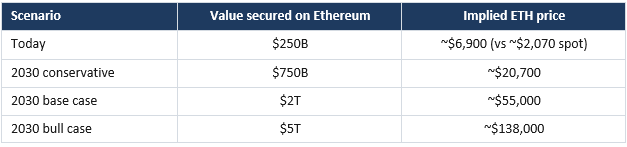
Even if you are pessimistic and lower the required security ratio, it doesn't matter. On-chain value is the variable (growing), and the security ratio is leverage. No matter how you calculate it, the trajectory is decisively upwards.
"This is blind optimism. The market will never price it this way."
This is the most reasonable rebuttal. I'm describing what ETH *should* be worth, not what the market will *immediately* price it at. There's no forced arbitrage mechanism to close the gap. And my logic that "ETH should go up" has been proven wrong by price action over the past few years. Let's address these points one by one.
- What closes the gap: Ethereum isn't an arbitrage asset; it's a demand for the system's pricing asset. As value settles on Ethereum, ETH is used as collateral, as a paired trading asset, and is staked to earn the network's base yield. This demand grows with the activity it supports. Reserve assets are not priced by their income; they are priced by how urgently the surrounding system needs to hold them. Gold is worth over $18 trillion but produces zero cash flow. ETH is the reserve asset of on-chain finance, and this framework simply measures how large that reserve must be.
- On the staking multiplier: My mental model treats the staking multiplier as a range, not a fixed target. At current staking rates, parity (staked ETH equals protected value) sits around 3.3x. A reasonable range could be from a lenient 1.7x to a strict 5x, where the cost to attack via a two-thirds staking share must equal the total protected value. Price will track protected value at some multiplier within this range. Fixing it at one specific number undermines rigor and is where reasonable people can disagree without breaking the model.
- On reflexivity: The model does have multiple equilibria, and nothing decisively picks the highest one. Today, Ethereum is secure enough below the coverage floor because acquiring a one-third staking share is illiquid, slashing penalties are brutally effective, and the social layer can fork out an attacker. These defenses are real, but they determine whether an attack *succeeds*, not whether coverage is *adequate* as risk accumulates. Thin coverage is tolerable when protecting $250 billion. When dealing with two or five trillion in regulated institutional capital, coverage is no longer an academic question. The gradient to close the gap becomes monotonically steeper as adoption increases.
Finally, the most damning point is ETH's price over the last 5 years. Logically it should have gone up, but it kept falling. I believe the main reason is: there wasn't enough value on-chain yet for people to worry about security as a major issue. When only $50 billion was on-chain, no one cared. When it grew to $175 billion, people started feeling uneasy. When it reaches $1 trillion, the first question major institutions will ask before entering will be: "Is this chain secure?" And the answer to that question rests entirely on ETH's price. My model can't predict when the price will rise, but it tells you that as on-chain value increases, the force pushing ETH's price up grows stronger, and the fact that "on-chain value is increasing" is something even the bears can't deny.
Some people point to Bitcoin, noting its security budget is negligible compared to its market cap. But Bitcoin primarily protects itself. Ethereum protects other people's dollars and various assets, which is a much heavier responsibility! And the trend is already clear: more ETH being staked, compliant products continuously buying ETH, and the burn mechanism destroying ETH as the chain remains active. These all corroborate the demand growth I describe.
Those who only look at fees and cash flow will continue to claim ETH is overvalued. They have entirely reversed cause and effect. On-chain activity comes first, then security is needed. ETH must be valuable to secure the entire ecosystem. Fees are friction you should strive to eliminate, not a leverage to value ETH.


