






2026世界杯终极观赛手册:赛程、看球、加密投资全攻略


Overview
The 2026 FIFA World Cup will be jointly hosted by the United States, Canada, and Mexico from June 11 to July 19. This edition is the largest in history: 48 teams, 104 matches, 16 cities, and a 39-day schedule – almost every metric sets a new record.
For the average fan, this means more exciting games to follow than any previous tournament. For participants in the cryptocurrency space, this World Cup represents one of the most noteworthy sports narrative catalysts in the past four years – fan tokens, prediction markets, and on-chain betting platforms are permeating the world's biggest sporting event in unprecedented ways.
This article provides a comprehensive and ready-to-use guide to the 2026 World Cup, covering everything from tournament format analysis and schedule overview to global broadcast channels and crypto investment opportunities.
Key Takeaways
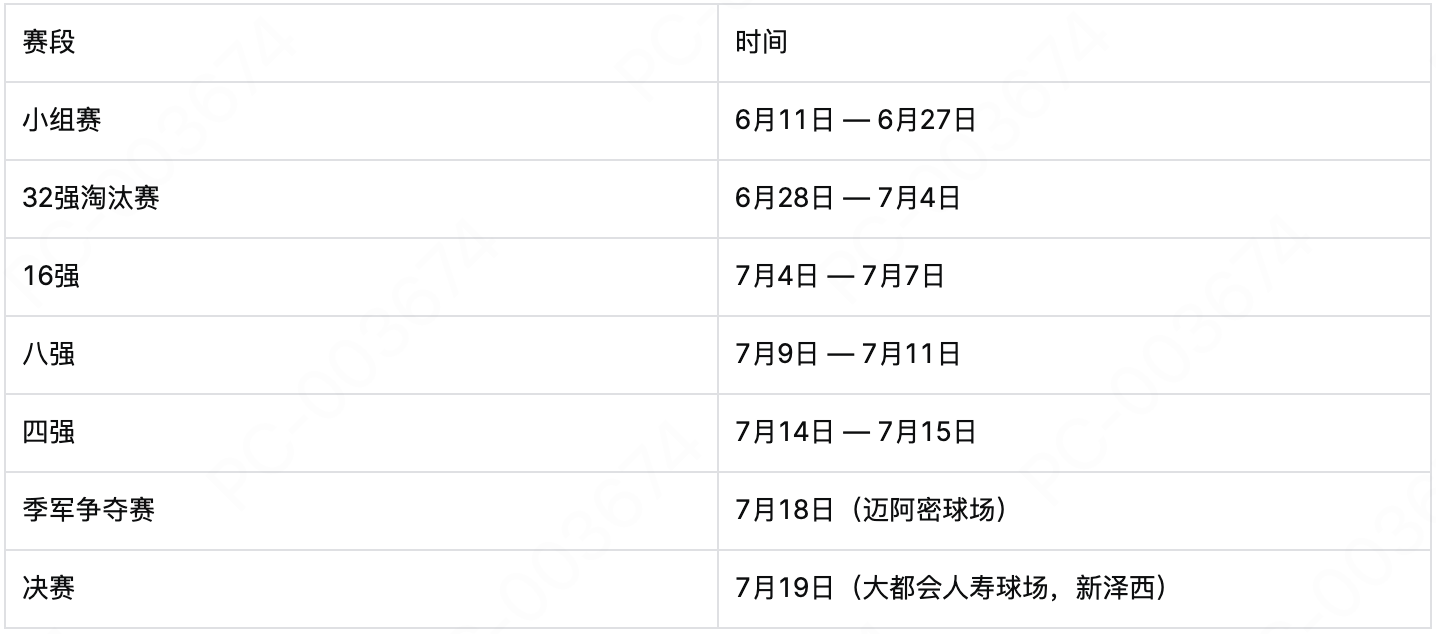
The 2026 World Cup kicks off on June 11, with the final on July 19 at MetLife Stadium in New Jersey, New York area, spanning 39 days
First-ever expansion to 48 teams, divided into 12 groups, with a new round of 32 in the knockout stage
Broadcast channels confirmed in major countries including the US, UK, Australia, and Mexico; broadcast rights for China and India are yet to be secured
Before the 2022 World Cup in Qatar, CHZ surged over 380% in five months, a classic example of sports narratives driving independent crypto asset price action
In March 2026, the SEC and CFTC jointly classified fan tokens as digital collectibles rather than securities, formally removing the regulatory barrier in the US market
Chiliz has committed $50 million to $100 million to re-enter the US market; national team tokens for Argentina, Portugal, and Italy are already listed
Historical data shows that fan token price increases are concentrated in the months leading up to the tournament, not during the event itself – timing of entry is more critical than token selection
Complete Guide to the New Format: Key Changes You Need to Know
The New Landscape: 48 Teams, 12 Groups
The 2026 World Cup expands from 32 to 48 teams, the most significant format change since 1998. The 48 teams are divided into 12 groups of four, with each team playing three group stage matches.
The top two from each group automatically advance, along with the eight best third-placed teams from across all 12 groups, totaling 32 teams entering the knockout stage.
A First in History: The Round of 32 Knockout Stage
The 2026 World Cup introduces a brand new "Round of 32" knockout round, a first in World Cup history. The knockout stage begins on June 28, progressing through the Round of 32, Round of 16, Quarter-finals, Semi-finals, culminating in the final on July 19 at MetLife Stadium.
The direct impact of this change: More countries have the opportunity to reach the knockout stage, and the number of watchable matches in a single World Cup jumps from 64 to 104.
Key Dates
Opening Match and Final: The Two Most Important Dates to Mark
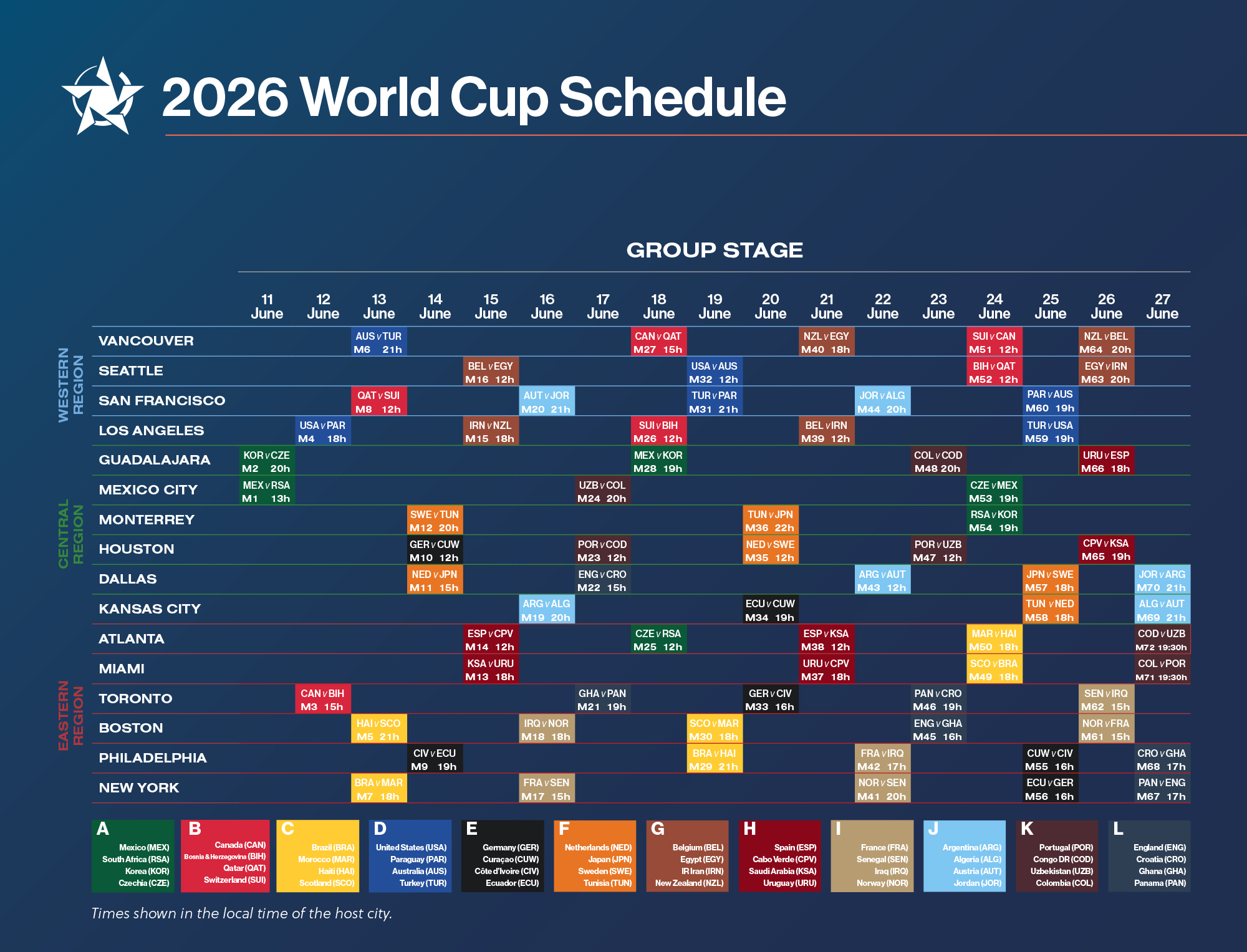
Opening Match: Mexico vs. South Africa
On June 11, the World Cup kicks off at the Estadio Azteca in Mexico City. This stadium will become the first in World Cup history to host three different men's World Cup tournaments, a significant historical milestone.
The Final: July 19, MetLife Stadium
The final venue is set for MetLife Stadium in East Rutherford, New Jersey. Kick-off is at 3:00 AM Beijing time on July 20 (3:00 PM Eastern Time). According to Sky Sports, FIFA President Gianni Infantino has confirmed the final will feature a halftime show, with Coldplay set to participate, paying homage to the NFL Super Bowl's production model.
Global Viewing Guide
United States
FOX Sports holds the English-language broadcast rights for the 2026 World Cup. 70 matches will air on FOX, and 34 on FS1. All matches will be simultaneously available on the FOX Sports App and streaming platforms like FuboTV, YouTube TV, and Hulu Live. Spanish-language broadcasts are handled by Telemundo (92 matches) and Universo (12 matches), also available on Peacock's Spanish-language version.
The opening match (Mexico vs. South Africa on June 11) and USA vs. Paraguay (June 12) will be streamed for free on Tubi.
United Kingdom
BBC and ITV each hold the rights to broadcast all 104 matches. Viewers can watch all matches completely free via BBC iPlayer and ITVX, with no subscription required.
Australia
SBS and SBS Viceland hold the exclusive broadcasting rights. All 104 matches will be aired for free, with simultaneous streaming on SBS On Demand. Important note: the 2022 World Cup in Qatar was broadcast by Optus Sport; the rights for 2026 have returned to SBS, so don't get confused.
Canada
CTV, TSN, and RDS cover English and French-language audiences in Canada. TSN also offers streaming subscriptions.
Mexico
As one of the host nations, Mexican viewers can watch all matches for free via TelevisaUnivision and TV Azteca, with free streaming available on the ViX platform.
India
Broadcast rights negotiations for India are deadlocked. FIFA initially demanded approximately $100 million (for a bundle covering both 2026 and 2030), but no major Indian broadcasters have made an offer. According to FIFA World Cup News, FIFA has lowered its asking price to around $35 million, with state broadcaster Doordarshan emerging as the most likely fallback option.
FIFA+ and Social Platforms
In regions without a local dedicated broadcaster, FIFA's official digital platform, FIFA+, will offer free live streams. Additionally, according to the World Cup Pass website's broadcasting rights guide, FIFA has signed official media partnership agreements with TikTok (signed in January) and YouTube (signed in March). Broadcasters can live stream the first 10 minutes of each match for free on their YouTube channels and select several full matches for replay.
The 2026 World Cup and Cryptocurrency: A Complete Guide to Fan Tokens and Prediction Markets
Why the World Cup is the Most Important Sports Narrative in Crypto
The 2026 World Cup is the first edition where cryptocurrency penetrates a major sporting event comprehensively in a visible way – covering four dimensions: betting, fan interaction, prediction markets, and digital collectibles. Analysis by Traders DNA points out that with 48 teams, 104 matches, and three host nations, this World Cup represents the most ideal large-scale testing scenario for blockchain products ever.
Historical Precedent: Lessons from Qatar 2022
To understand the opportunities of 2026, one must first grasp the data from 2022.
A report from CCN Analysis notes: In the five months leading up to the start of the 2022 World Cup in Qatar, CHZ climbed from approximately $0.10 to $0.44, a surge of over 380% – this occurred while Bitcoin was deeply entrenched in a bear market following the FTX collapse, losing over 70% of its value.
This was a textbook example of narrative-driven price action: while the broader crypto market declined, a single event narrative completely decoupled fan tokens from the overall market. Certain club tokens also recorded double-digit or even up to 65% gains during the same period, with daily trading volume for fan tokens briefly exceeding $300 million.
However, there is a crucial detail that cannot be overlooked: An in-depth report by Phemex documents the history of CHZ's price crashing immediately on the opening day of the World Cup – the "buy the rumor, sell the news" market logic holds true in sports events as well. Historical data clearly shows that the main price gains for fan tokens are concentrated in the months before the tournament starts, not during the event itself.
What's Different in 2026: Regulatory Breakthrough and Capital Influx
The structural differences in 2026 should not be underestimated.
In March 2026, the SEC and CFTC jointly issued guidance at the Washington D.C. Blockchain Summit, formally classifying fan tokens as digital collectibles rather than securities – this ruling removed the biggest regulatory obstacle that had prevented Chiliz from entering the U.S. market for years. Major U.S. exchanges can now list fan tokens without the risk of enforcement action, and American professional sports leagues like the NBA, NFL, and MLS can issue tokens via Socios.
Chiliz has already announced a commitment of $50 million to $100 million to re-enter the U.S. market. National team tokens for Argentina, Portugal, and Italy have been listed successively. The Chiliz ecosystem user base has also grown from 1.5 million in 2022 to over 5 million currently.
Meanwhile, analysis from BeinCrypto emphasizes that the audience advantages of the 2026 North American host locations far exceed those of Qatar in 2022 – the US is home to the world's largest cryptocurrency user base, with a local audience highly receptive to digital interactive platforms and in-app consumption, making it a market perfectly suited for fan token penetration.
Major Fan Tokens and Key Projects
CHZ (Chiliz): The foundational layer of the fan token ecosystem. Holding CHZ allows users to purchase various team tokens and interact on the Socios platform. Following the regulatory clarity, CHZ gained 36% in April alone, with its highest single-day trading volume reaching $276 million.
National Team Tokens: Tokens for Argentina (ARG), Portugal, and Italy are already live on the Chiliz ecosystem, with Argentina, as the defending champion, commanding the highest attention.
GambleFi Sector: A research report from MEXC Crypto Pulse notes that the global annual revenue for GambleFi is approximately $81 billion. RLB's deflationary buyback mechanism, WINR's infrastructure layer, and Azuro's on-chain prediction track are three noteworthy sub-projects worth exploring.
Prediction Markets: How to Participate in On-Chain World Cup Betting
Rotowire's prediction market guide indicates that the 2026 World Cup is one of the largest single sporting events by trading volume in prediction market history, with hundreds of millions of dollars in volume flowing across major prediction market platforms, including tournament winner contracts, group stage outcomes, and individual match predictions.
For users accustomed to crypto trading, the logic of these platforms is highly similar to spot/futures trading: assessing probabilities, managing positions, and waiting for settlement.
Exclusive Insights from the MEXC Crypto Pulse Research Team
The 2026 World Cup represents a structural inflection point for the convergence of sports and crypto finance, not merely a repetition of a past narrative.
From a chronological perspective, with less than three weeks until the June 11 kick-off, the historical "expectation-driven price window" for fan tokens is in its final phase. Data from 2022 showed that the largest gains were concentrated four to six months before the tournament. As the opening approaches, momentum tends to wane, and the opening day itself often sees a "sell the news" technical correction. This means that if you are only now paying attention to the fan token narrative, your entry logic needs to be fundamentally different from four months ago – it requires managing expectations for a "short window, high volatility, quick in-and-out" scenario, rather than holding for long-term upward appreciation.
From a structural difference perspective, the most essential distinctions between 2026 and 2022 are two-fold:
First, the US, home to the world's largest crypto user base, is a host nation for the first time, creating a natural alignment between the audience base and fan tokens;
Second, the regulatory clarity from the SEC and CFTC has created legal space for substantive institutional capital participation, whereas 2022 was almost entirely retail-driven. Institutional capital participation differs greatly from retail – they will not rush in on the eve of the opening; instead, they position earlier and hold more steadily, which may change the historical pattern of the "opening day crash" to some extent.
Finally, it's important to note: GambleFi and sports prediction markets are evolving from niche narratives to an infrastructure layer. If fan tokens were a speculative narrative in 2022, the real opportunity in 2026 might lie in on-chain prediction protocols that can capture actual transaction volume and user activity – a parallel narrative decoupled from the ups and downs of fan tokens, backed by real revenue, and worth evaluating independently.
Frequently Asked Questions
When does the 2026 World Cup start and where is it held?
The 2026 FIFA World Cup opens on June 11 at the Estadio Azteca in Mexico City, with the final on July 19 at MetLife Stadium in New Jersey, USA. The tournament spans three countries – the US, Canada, and Mexico – featuring 16 host cities and 16 stadiums.
How many matches are there in this World Cup?
This World Cup consists of 104 matches, significantly more than the 64 matches in the 2022 Qatar World Cup, due to the expansion of participating teams from 32 to a record 48.
What are fan tokens and does the average fan need to know about them?
Fan tokens are blockchain-based digital assets issued under license by clubs or national teams. Holders can participate in team polls, access exclusive content and event entry, etc. In March 2026, the SEC and CFTC formally classified them as digital collectibles. For crypto investors, these assets are highly dependent on tournament narratives and require understanding their characteristics of high volatility and strong time-sensitivity.
Where can I trade fan tokens?
MEXC offers trading pairs for CHZ and major fan tokens, boasting industry-leading trading pair数量和 depth, while also providing 100% reserve assurance and among the lowest withdrawal fees in the industry.
What is the difference between prediction markets and traditional sports betting?
Traditional sports betting involves a centralized platform acting as the counterparty, whereas on-chain prediction markets utilize smart contracts for peer-to-peer outcome wagering. Fund flows are transparent and verifiable on the chain. The risk structures and regulatory frameworks of the two are fundamentally different. Participants must understand the legal regulations of their respective regions before engaging.
Are there still investment opportunities in fan tokens in 2026?
Historical data indicates that the primary price gains for fan tokens are concentrated in the months leading up to the tournament opening. Momentum tends to weaken as the start approaches, and technical corrections may occur on opening day. As of this article's publication, with less than three weeks until the opening, the entry logic is vastly different from previous months. All investment decisions should be based on personal risk tolerance. See the disclaimer at the end of the article.
Disclaimer
This article is written by the MEXC Crypto Pulse team for informational purposes only and does not constitute any form of investment advice or financial recommendation. Cryptocurrency prices are highly volatile, and past performance does not guarantee future results. Investing in digital assets may result in the total loss of principal. Please conduct independent research and consult qualified professionals before making any investment


