신위 최신 인터뷰: AI 시대에는 인간의 의지가 더 중요해졌으며, 비트코인은 더 나은 금이다


- 핵심 요점: 신위와 진밍은 AI 시대에 인간 의지의 중요성, 빌더의 사명감, 투자 프레임워크, 그리고 Web3의 미래 방향에 대해 논의했다. 신위는 AI가 아이디어에서 실행까지의 비용을 대폭 낮췄으며, Web3의 다음 단계 핵심은 Agent 생태계에 있다고 본다. 이더리움 등 체인은 주로 사람이 아닌 Agent가 사용하게 될 가능성이 높으며, "독점 + 성장"을 핵심 자산 선별 프레임워크로 제시했다.
- 핵심 요소:
- 신위는 AI가 인간의 지식을 압축하고 구조화하여 극히 낮은 비용으로 개인에게 실행 능력을 부여함으로써 "인간의 의지성"이 더욱 중요해지고 방대한 가능성의 공간이 열렸다고 지적했다.
- 신위의 투자 철학은 분산 투자가 아니라 진정으로 이해하는 소수의 자산, 예를 들어 비트코인, 이더리움, 테슬라에 집중 보유하는 방식이며, "독점 + 성장"을 가장 핵심적인 자산 선별 기준으로 삼고 TAM(접근 가능한 시장)이 충분히 커야 한다고 강조한다.
- 그는 Agent가 이더리움 생태계에서 대규모 채택을 이룰 수 있을지 관찰하고 있으며, 이 시점이 도래하면 전환점이 될 것이라고 본다. 체인 상의 제품은 사용자에게 높은 수준의 전문 기술과 보안 의식을 요구하기 때문에, Agent가 중간 계층으로서 더 나은 해결책이 될 수 있기 때문이다.
- 신위는 매일 세 개의 AI Agent와 노트 시스템을 통해 정보를 얻는다. AI는 관련 관점과 도서를 선별해 읽기를 제안하므로, 그는 "거의 직접 읽지 않는다"고 말한다. 그러나 투자 프레임워크 구축에 있어서는 DeFi 물결에서 시작되어 실천에서 이론으로 이어지는 학습 과정을 겪었다고 자평한다.
- BTC에 대해 신위의 견해는 "디지털 골드"라는 점에서 10년 이상 변함이 없다: 중개자 없이 보유할 수 있다는 것이 핵심 강점이며, 그 가치는 극단적인 상황에서 드러나기 때문에 시장이 번영할 때 주목받지 못하는 것은 정상이다. 그는 "주권적 개인"을 핵심으로 보며, BTC와 AI가 각각 자산 처분 능력과 개인 역량을 강화한다고 본다.
Original Author: Da Qianzi, PANews
Recently, Cobo co-founder Godfish (Shen Yu) and Extreme Vision Technology founder Jin Ming held an in-depth conversation covering AI, entrepreneurship, investment, Bitcoin, Web3, Agents, and life purpose.
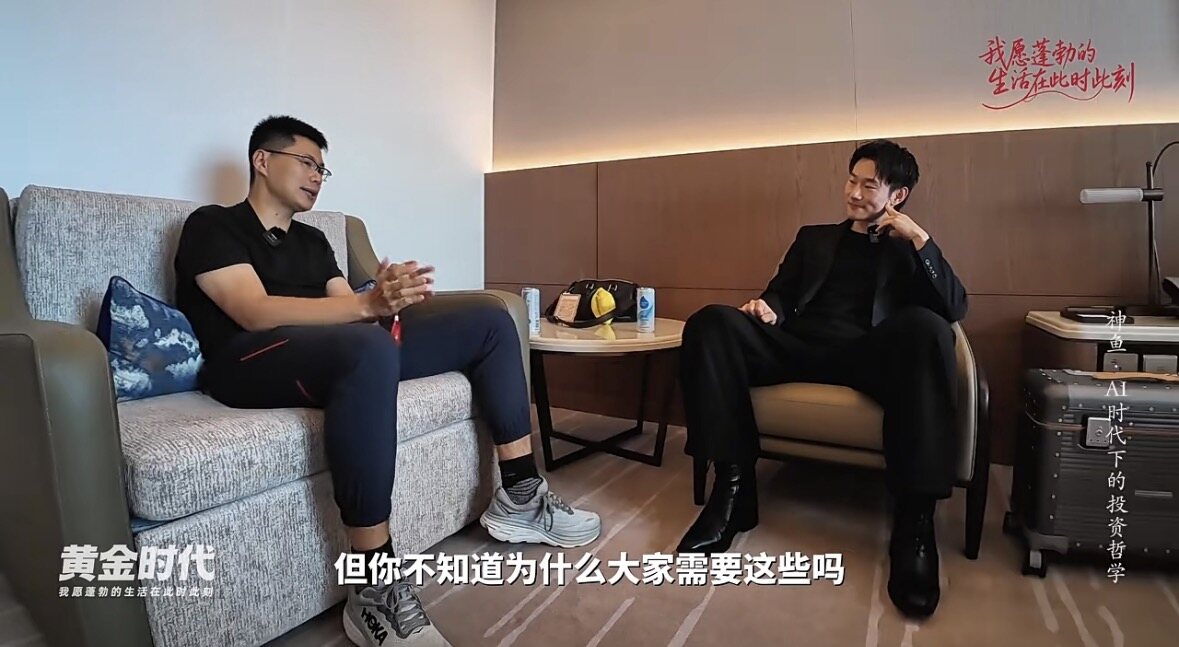
Godfish has been an early participant in the crypto industry, diving into the cryptocurrency space since 2011, making him one of the earliest Bitcoin evangelists and adopters in China. Jin Ming, meanwhile, is a member of China's national freediving team and founder of Extreme Vision Technology, with a long-term focus on video AI technology development and commercial applications. His company has received investment from institutions such as Alibaba, Yunfeng Capital, and Megvii Technology.
From an entrepreneur's sense of mission to the relationship between humans and technology in the AI era; from freediving and death anxiety to investment frameworks and asset allocation; and further to BTC, RWA, Agents, and the future of Ethereum—the two engaged in a deep discussion revolving around technology, capital, and individual life experiences.
Godfish believes that one of the most important changes brought by AI is the dramatic reduction in the cost of going from an idea to implementation. In the past, an idea might remain forever in one's mind because the execution cost was too high. Today, AI is compressing and structuring vast amounts of human knowledge while handing execution capabilities to individuals at extremely low costs. As technology develops, human will has become even more important. However, he also admitted that while AI has opened up a vast array of possibilities, he has yet to find a sufficiently large and systematic undertaking. He still defines himself as a Builder, believing that "in a sense, living means that through your existence, you've made the world's possibilities slightly greater."
This Builder mindset also runs through his investment philosophy. Godfish believes that good assets don't need to rely on continuous narratives. Compared to broad diversification, he prefers concentrating on a few assets he truly understands, because human energy is limited, and what really matters is understanding the underlying logic of an asset.
As for the next phase of Web3, the key direction Godfish is observing is Agents. He believes that ecosystems like Ethereum may not primarily serve humans in the future, but rather serve Agents.
The following is the full text of the interview, organized by PANews:
In the AI Era, Human Will Is Becoming More Important
Jin Ming: The last time you did an interview was ten years ago, in 2017. At that time, you had a classic quote: "With all this money, I suddenly don't know how to spend it."
Godfish: Now I know how to spend it. In essence, I think human will is becoming increasingly important. Since the AI era arrived, many things that used to require significant time and cost can now be done quickly as long as you have an idea. This is a huge change.
Right. You see, in essence, human will is becoming more and more important. With the AI era, a lot of execution—or things you used to think were extremely difficult—can suddenly be done as soon as you have an idea. This change is enormous. Things we couldn't even imagine ten or twenty years ago can now be delivered very easily. Things we wouldn't have dared to imagine ten or twenty years ago can now be delivered quickly, because with just an idea, the backend execution cost has dropped extremely low, and many things can be delivered rapidly.
Jin Ming: So it's about going from an idea to final implementation.
Godfish: Right. Before, you had a seed and a dream, but it might forever remain just a dream. Now, backend costs have dropped rapidly, and with AI compressing and structuring vast amounts of human knowledge, you can access these capabilities at low cost.
If you have a seed, it can take root very quickly. Before, it was like, "OK, I have a seed, I have a dream," but it could only be a dream. Now, the backend cost has dropped extremely quickly, and AI has compressed a lot of human knowledge, so you can tap into it at low cost. I feel this has opened up a huge space of possibilities. So I think AI has suddenly opened up many possibilities.
From a Sense of Mission to Uncertainty: A Builder Searching for Answers
Jin Ming: Are you satisfied with your current life? Do you feel happy and fulfilled every day?
Godfish: It's alright, but I still feel a bit lost. It's not like the early days of entrepreneurship, when my sense of mission was very strong. Now I've entered a kind of chaotic state: I see all the possibilities AI has opened up and feel this is the best of times, yet I haven't found a particularly clear path. Whether it's a sense of mission or a specific business path, I haven't fully figured it out. So for now, I'm mostly exploring and improving myself.
Jin Ming: When you first started your business, how did you define your sense of mission?
Godfish: At that time, you saw a window of opportunity and felt an incredibly strong creative impulse. You felt that if you didn't do this thing, you would definitely regret it for the rest of your life. It was as if some force was pushing you forward, and you simply couldn't step away—so you went out and built it.
Jin Ming: The huge demand you saw back then was mining?
Godfish: The earliest days were actually in 2013, and the core issue was computing power. Mining first started in the US and later began migrating to China. When China first started making ASIC miners, the machines still needed to connect to US mining pools to mine. There were two problems: first, network issues—international internet had latency and packet loss, making mining inefficient; second, the settlement method of the entire mining industry at that time was unreasonable. So what we did was solve these two problems.
In essence, you see a market gap—a niche market with unmet demand—and you happen to have the ability to fill it. That's when a very strong impulse arises to want to build this thing.
Jin Ming: After all this time, what do you think your mission is now?
Godfish: I think I still need to build things. I've always defined myself as a Builder. Since the AI era began, I've made various small tools and dashboards, both big and small, but I haven't yet found that truly large, systematic thing. I'm still observing.
When you've been on the front lines of entrepreneurship and built many things, you actually end up with a lot of confusion and doubt. So you have to go back and absorb vast amounts of human history: How did similar things happen in the past? How did philosophers think about these issues? All of these come back to influence you. Standing at this very moment, you can see many future possibilities unfolding, but you haven't yet found that specific path.
Finding a Sense of Life Purpose
Jin Ming: In my talk yesterday, I touched on purpose awareness—the sense of life purpose. I compared it to a scale.
Many people initially want to create big things and hope to leave a legacy. On the other end of the scale are experience and happiness—many young people feel that life should be about pursuing joy. If placed on this scale, where are you right now?
Godfish: I don't particularly want to leave something behind, nor do I especially pursue experiences. I've also used AI to analyze a lot of psychoanalytic material, but fundamentally, I'm someone with an intrinsic drive to build. I just want to build things. When the thing is done, I feel great. I want to present something to the world because I believe that, in a sense, living means that your existence adds slightly more possibility to the world.
Jin Ming: That's very much on the left side—very much about legacy. There's an interesting phenomenon in psychology research: many people want to become Builders. And a potential psychological trait of Builders is a tendency toward anxiety. Because your life purpose is to keep building. When you're not actively moving forward or building, you easily fall into an anxious state. Have you experienced this? And how do you usually deal with it?
Godfish: I definitely have a bit of it, but now I switch between states. I've had ways to empty my mind since I was young, like raising animals and pursuing hobbies. So basically every week, I enter that state. You have to allow yourself to let go. When you're diving, how do you confront fear?
Rediscovering Fear at the Limits
Jin Ming: When you hold your breath, your body continuously sends you signals. At that point, it's really a battle between rationality and emotion. I think the most straightforward analogy is that freediving is very much like a spiritual practice. First, you have to enter the water with a mindset of "knowing the ending." You have to keep telling yourself: you are safe.
The human brain is actually very intelligent. Humans are controlled by the autonomic nervous system. For example, when you hold your breath on land, it's very hard to actually suffocate yourself. When you reach your limit, your brain might experience a brief blackout—BO—a short state of unconsciousness. After about ten seconds, the airway reopens, and you naturally breathe in.
But why might someone die underwater? Because after losing consciousness underwater, when the airway reopens, what you inhale is not air but water. So ultimately, it might be drowning. This is why freediving training absolutely requires a buddy—a training partner.
On the other hand, it's also a great spiritual practice. You constantly give yourself complete positive psychological suggestions: what you're doing is meditation, and you're entering a flow state; you're healthy and safe; your brain is very smart.
And no one can hold their breath to the limit right away. In the beginning, over ten sessions, two months, three months, most people can only reach about 50% of their limit. With more training, they gradually approach 70%, 80%, even 90%. A lot of the time, what holds beginners back isn't their physical limit, but unfamiliarity with their own bodies. As you become more familiar with your body, you trust yourself more and get closer to your limits. So the whole process isn't as much of a struggle as you might imagine—a lot of the time, it's actually very peaceful.
Godfish: Doesn't this process help you let go of the fear of death? Or does it make you confront death more directly?
Jin Ming: That's a great question. I think after long-term freediving or breath-hold training, my fear of death has indeed decreased significantly. I haven't really thought deeply about why. At first, on my first breath-hold or the first few training sessions, I did have some fear of death, but now it's completely gone. Even in daily life, when joking with my parents, I'll say that I feel my life experiences are already very complete and abundant. Even if an accident happened tomorrow and I were gone, I'd still feel I've been very happy. Before, I definitely felt that the longer you live, the better, and that death was a terrible waste. But now I'm not so afraid of it anymore. Are you afraid?
Godfish: I think on some level, there's still anxiety. Or rather, outside observers might tell me—my Agent companions also tell me—that I actually do have death anxiety.
AI Agents Are Becoming the New Information Gateway
Jin Ming: What channels do you use to collect information every day?
Godfish: Almost all AI. The moment I open my eyes, AI tells me it has read everything I did yesterday. I currently have three AI Agents. One Agent is instrumentally rational—it tells you what to do; one is more feminine and soft, probing the deeper parts of your psyche; and another combines what you did yesterday and tells you which blind spots it has observed.
For example, it might tell you: "There's a good book in history, and a chapter in it discusses a problem that the ancients also encountered, and it's very relevant to your current state. Would you like to spend 15 minutes reading that chapter?" Then three things pop up, and you can go read them directly.
Additionally, I have a note-taking system. They use evolutionary thinking to connect things I've cared about in the past with things related to my life. In a sense, my attention is like a "God"—it determines which ideas or propositions survive. AI "cross-breeds" a batch of new things daily, then filters one and tells me: "Here's an article you might want to read." So now I rarely read things directly anymore. There are also daily briefings and long-form articles filtered by AI—AI processes them first, then sends them to me. I usually quickly compress them into a PPT format to review.
Building an Investment Framework from DeFi
Jin Ming: But this approach is still mostly about processing existing information. A lot of information happens in real time—like a conflict that breaks out one second ago—and obtaining that kind of information through AI might not be timely enough.
Godfish: I don't care. The most important information will find you on its own—you'll definitely see it. I also don't do very short-term trading. I realized early on that I have no talent for that. It's easier to make simple decisions, but for longer-term matters, I might be better suited.
I truly started investing only after playing around with DeFi. DeFi essentially helped me catch up on investment history. We went from the "underground Fed" to seeing how traditional finance was invented, covering two hundred years of development. In that process, you generate a lot of questions, then go back to fill in gaps in history and financial knowledge. It was only at that point that I started taking investing seriously.
I was just lucky on day one—somehow I picked up some decent methodologies and walked a path that wasn't too wrong. But it was only after completing the DeFi wave that I really began building my own knowledge structure and investment framework. Before that, I didn't have a complete investment framework.
Jin Ming: So during that long period of mining, you never really formed an investment framework.
Godfish: Back then, I didn't even think of it as investing. I just had a vague intuition: I should hold some Bitcoin, with a bit of position-sizing thinking.
I'm an ISTJ personality type. A lot of things are abstracted through hands-on practice. I first form frameworks, then train my intuition; in the process, new questions arise, and I abstract new frameworks again. That's how my investment framework gradually formed.
From DeFi to RWA: Reunderstanding Financial Products Themselves
Jin Ming: Very few people actually form an investment framework from DeFi, because DeFi at its core is often just "mining and dumping"—that's a completely different logic from investing.
Godfish: But what you need to look at is what these financial products themselves actually provide and how they satisfy market demand. It's essentially building a financial market from 0 to 1 on-chain. That's what I was watching—not arbitrage or yield farming within DeFi, which I think are more like muscle memory, intuitive things.
But in that process, you accumulate many experiences, which are valuable; and you also accumulate many questions, which are equally valuable. At first, you might not know why people need these things, but once you figure it out and look back at history, a lot of things start to connect.
Jin Ming: So this round of RWA on-chain, including bringing US equities on-chain, is essentially extending the financial product understanding you built in DeFi into traditional finance.
Godfish: Right, it's like US stocks are being shoved in front of you, and you have to understand the logic behind them.
Jin Ming: But ten years ago when you were mining, you never thought about holding US stocks, did you?
Godfish: Even when people borrowed money from me to trade US stocks, I didn't quite understand it at the time. I can only say I got lucky and happened to walk a path that wasn't too wrong. Back then, I was muddling through without really thinking it through. Later, I had a lot of questions, and then AI came along just in time, making the learning speed incredibly fast. I could quickly go through a large number of books and materials to understand why these things happened.
Good Assets Don't Need Constantly New Narratives
Jin Ming: You've been involved with Bitcoin for over a decade now. How has your view of BTC changed?
Godfish: It hasn't changed—it's still digital gold. In this world, of the assets you can hold without intermediaries, almost all others are wrapped in one, two, or even three layers of intermediaries.
Jin Ming: Quite a few people in our group chat are currently pessimistic.
Godfish: BTC's value precisely reveals itself in extreme situations. So when the market is booming, it's only natural that people don't care about it.
Jin Ming: Do you agree with the view that BTC, under classical liberal thought, has greatly enhanced the capabilities of the sovereign individual?
Godfish: A core aspect of the sovereign individual is the ability to dispose of assets. AI brings enhanced capabilities, while BTC is a core asset in terms of how a sovereign individual disposes of assets. Both of these things are extremely important.
Jin Ming: I have some friends around me who were very bought into BTC early on and had strong faith. But I feel that after this cycle ends, many people are starting to feel they can't see new narratives.
Godfish: Good assets don't need narratives, and the longer they exist, the more they prove something.
Jin Ming: I think there are probably only two significant narratives in this round of Web3. One is Ethena's full-asset arbitrage, and the other is RWA on-chain. But both