






从Coinbase到Upbit:一个代币如何走完28天的接盘之路


- 核心观点:2026年熊市下,CEX上币已从流量驱动转向验证驱动,形成了Coinbase/ByBit(发现)→ Binance Perps(验证)→ Binance Spot(确认)→ 韩国交易所(接盘)的结构化路径,上币事件更多是存量资金再分配而非增量催化剂,投资者可借此识别Alpha机会。
- 关键要素:
- Coinbase、ByBit和Binance Perps是首发第一梯队,分别有67%、39%和48%的代币为首发上线,承担价格发现;Binance Spot仅上线19个代币,首发率28%,注重安全验证。
- 韩国交易所(Bithumb、Upbit)系统性地处于上币路径末端,平均延迟首发约28天,跟随率高达85%和较高位次,用户常高位接盘(Upbit入场溢价高达27.4%)。
- Binance Perps上币的核心前置信号是Coinbase和ByBit的上线动态(75%和70%的转化率),且响应极快(平均4.9天),并优先筛选价格表现稳定的热门项目,规避持续走弱或过度投机的代币。
- 上币后的价格表现整体承压:所有交易所的30天平均回报均为负,跌幅逐步加深,反映流动性释放特征而非增长;首发所(如ByBit)峰值平均达+86%,但后续交易所(如OKX)仅为+25%。
- 交易所选择显著影响风险收益结构:首发所(Coinbase/ByBit)用户拥有最低入场价和最高峰值空间,而韩国所用户面临高位接盘和深度回撤(30天回报-25.7%),盈亏差距可达4.5个百分点。
Original Authors: Xinyang & Ethan @ IOSG
Every bear market quietly reshapes the listing logic of centralized exchanges (CEXs). When liquidity tightens and retail enthusiasm fades, each listing decision becomes more deliberate and, consequently, more signal-rich. We systematically tracked spot listing data from Coinbase, Binance Spot, ByBit, OKX, Bithumb, and Upbit, along with Binance Perpetual, from the start of 2026 to mid-May. This resulted in 207 listing records covering 92 unique tokens. The data clearly reveals a core fact: listing is a highly structured path of validation and liquidity transmission.
Who discovers and prices a project first? Who absorbs and amplifies liquidity in the middle phase? Who provides market coverage at the end? Different exchanges play distinctly separate roles along this chain. By the time a token is finally listed on Binance Spot, it has often passed through multiple layers of exchange validation. This report will dissect this listing path from three core dimensions:
- Landscape and Path: The role differentiation among exchanges and the flow patterns of tokens between them
- Binance Perps Screening Logic: What kind of tokens are more likely to enter Binance Perp
- Price Impact: How listing timing determines investor entry points and the actual return differences after listing on different exchanges
For project teams, understanding this path means a more precise and efficient listing strategy. For investors, recognizing the positional differences within the path could be one of the most important Alpha sources of 2026.
2026 CEX Listing Landscape and Path
Exchange Listing Overview
▲ Total Listings by Exchange
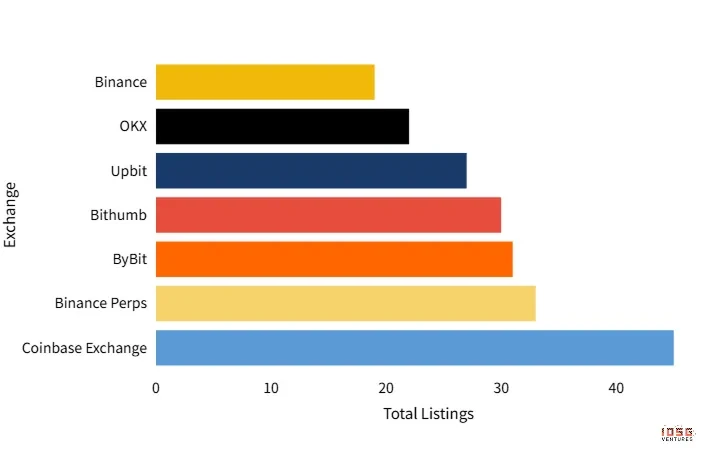
From 2026 to present, we tracked new spot listings from the six major exchanges – Coinbase, Binance Spot, ByBit, OKX, Bithumb, Upbit – along with Binance Perp, resulting in 207 listing records covering 92 unique tokens.
The number of listings per exchange shows clear stratification. Coinbase leads firmly with 45 new listings. It is closely followed by Binance Perps (33) and ByBit (31). Bithumb (30) and Upbit (27) form the second tier, OKX listed 22, while Binance Spot listed only 19, the fewest among all observed exchanges.
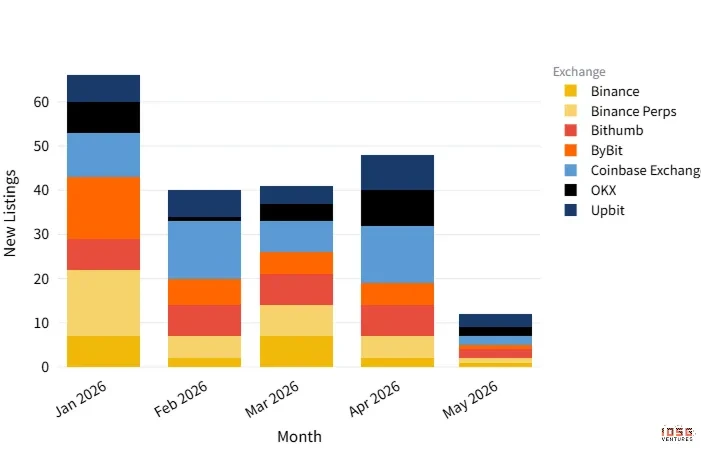
Looking at the monthly rhythm, January was the peak listing period for the year. Binance Perps listed 15 tokens in a single month, and ByBit listed 14. The overall pace slowed significantly from February onwards, with the average monthly listings per exchange dropping to 5-8, entering a more cautious and stable selection phase. Coinbase showed a listing rhythm disparate from other exchanges, with two concentrated listing peaks in February and April (13 tokens in a single month each), demonstrating its independent and rapid listing decision-making characteristics.
▲ Monthly Listings by Exchange
Simple quantitative differences only reflect surface-level activity. More important is the profound differentiation in listing sequence and roles among different exchanges, which will be further analyzed in subsequent chapters.
Role Differentiation: Discoverers, Screeners, and Confirmers
Among tokens listed on multiple exchanges, there is a significant sequential order. We define the exchange that lists a token first within our tracked scope as the "First Mover" and the rest as "Followers."
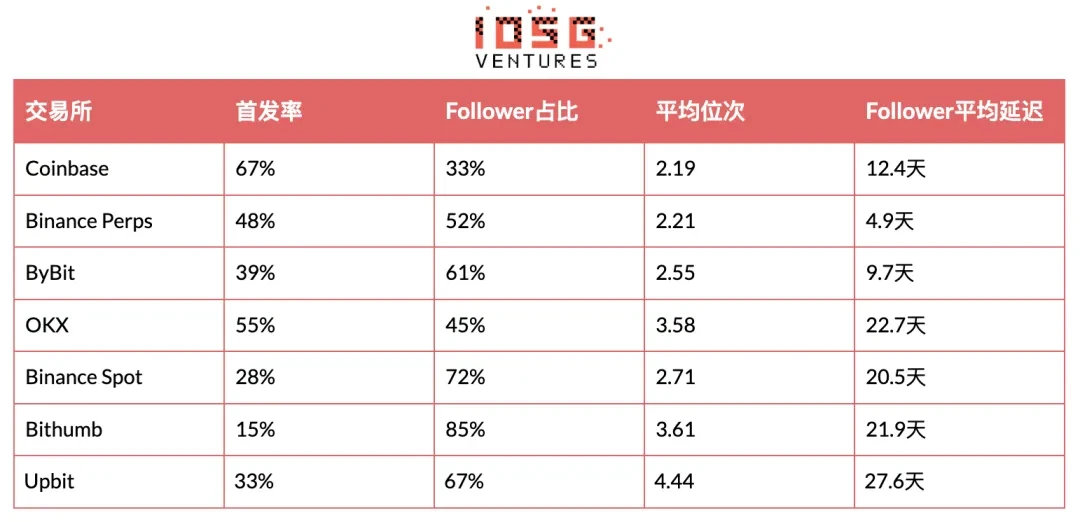
Coinbase is the most prominent first-mover listing venue in 2026, serving as the first mover for 67% of tokens listed within our tracked exchanges, undertaking the initial price discovery function for the market. ByBit (FIrst Mover Rate of 39%) and Binance Perps (First Mover Rate of 48%) also maintain high activity. These three often list the same token intensively within the same week, collectively forming the first echelon for new project listings.
The Korean exchanges (Bithumb and Upbit) are systematically at the end of the listing path. Bithumb has a Follower ratio of up to 85%. Upbit has an average ranking position of 4.44 and has a high probability of being the last among all exchanges to list a token, lagging the first-mover exchange by an average of about 28 days. This is closely related to the lengthy regulatory review process in South Korea and the preference of local exchanges to introduce projects after they have gained broad consensus.
Binance forms a clear funnel-like division of labor internally: Binance Perps is the first mover in half of the cases, and in the other half, it follows up with extreme speed after a spot listing (average delay of only 4.9 days), making it the most responsive among all exchanges. Its main role is to quickly test liquidity and market demand through the derivatives market. In contrast, Binance Spot has the fewest listings (only 19) and a first-mover rate of only 28%, clearly preferring to wait for sufficient market validation before choosing its entry timing.
OKX demonstrates a relatively strong independent coin selection capability, with a First Mover Rate of 55%. However, its overall number of listings is relatively restrained (22), with an average ranking position of 3.58, indicating a high screening threshold and more prudent strategy.
Listing Path Paradigm
Looking at the sample of tokens covered by 3 or more exchanges, the listing order shows highly stable echelon characteristics: early discoverers represented by Coinbase and ByBit list first, Binance Perps follows up quickly within days for validation, then Binance Spot selectively lists for confirmation, while OKX, Bithumb, and Upbit mainly provide supplementary coverage later in the path.
Typical Case: ROBO (Fabric Protocol)
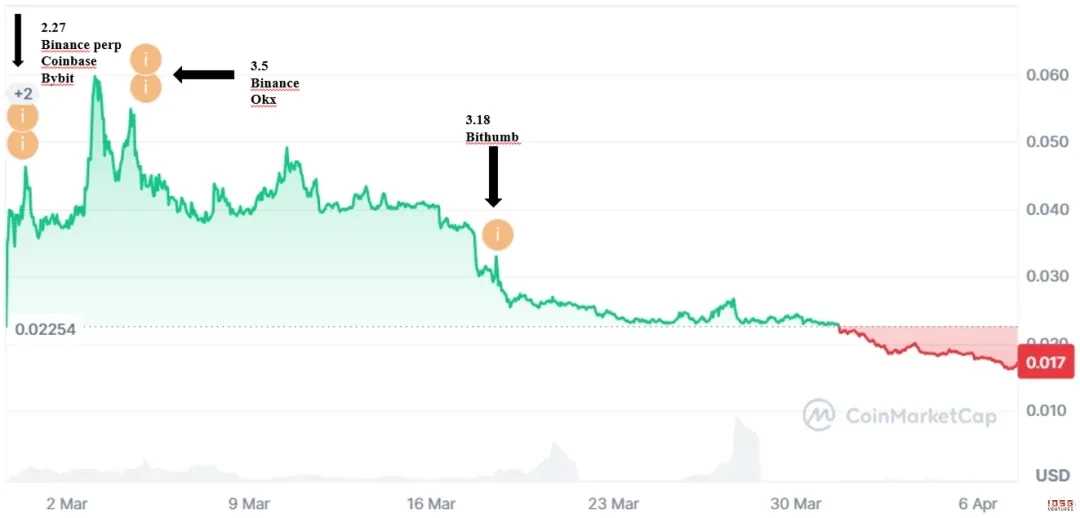
On February 27th, the DePIN project Fabric Protocol (ROBO) was first listed on Binance Perp. Coinbase and ByBit followed up on the same day. The opening price was $0.022, and it surged over 80% on its first day of listing. By the next day's opening, the price had risen to $0.0405, nearly doubling from the initial listing price. The project, leading a $20 million round backed by Pantera Capital, focuses on the intersection of blockchain and the robotics economy. Combined with Kaito public sale hype and the "AI + Robotics" narrative, it quickly garnered market attention.
On March 5th, Binance Spot officially listed ROBO, with the daily price reaching $0.0493. This also marked the price peak for ROBO during the entire cycle. By the time OKX listed, the opening price was already lower than Binance Spot's price. When Bithumb listed on March 18th, the price was $0.0303. Although it triggered a brief spike, the token price subsequently fell back and is currently below the initial listing opening price.
From the first listing to the Bithumb listing, ROBO took only about 20 days to fully traverse a typical 2026 listing path:
First Mover: Binance Perps, Coinbase, ByBit → Confirmation at Peak: OKX, Binance Spot → Terminal Absorption: Korean Exchanges.
ROBO is not an isolated case. Among the sample from the first five months of 2026, 28 tokens completed listings on 3 or more exchanges. The positional distribution of these cross-exchange cases consistently shows echelon patterns highly similar to ROBO's. Although the specific order may vary slightly based on project attributes, the overall path structure is stable and predictable.
This path clearly reflects the different risk appetites of the exchanges: Coinbase, ByBit, and Binance Perps tend to proactively seize early windows, Binance Spot focuses on post-validation safety, while Korean exchanges and OKX prefer to enter only after sufficient market consensus has formed.
Binance Perps Listing Conditions
As a crucial entry point for the derivatives market, Binance Perps' listing decisions directly influence the flow direction of significant leveraged capital. Through analysis of 33 Perps listing cases, we can clearly distill the core logic behind Binance's token selection in a bear market environment.
Leading Signal: Listings on Coinbase and ByBit
▲ Exchanges Listed Before Perps
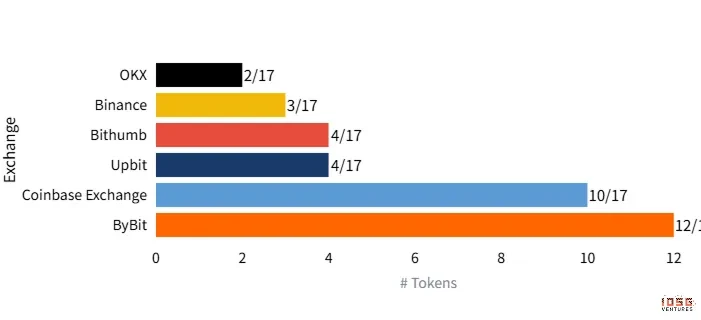
Among the 33 tokens that entered Binance Perps, 17 were listed on other spot exchanges before being included in Perps. Tracking these tokens shows that Coinbase and ByBit are the most important leading signals for Perps.
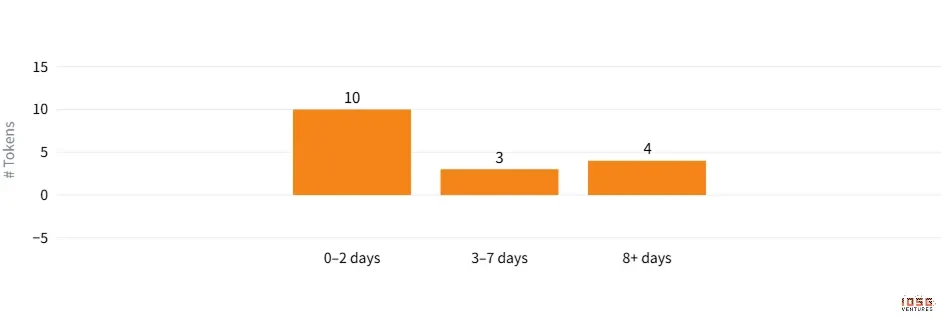
▲ Days from First Spot to Perps
Of these, ByBit listed before Perps in 71% of the cases, and Coinbase in 59%. More importantly is the response speed: in the 17 follower listing cases, 10 listed on Perps within 0-2 days of the spot listing, with an average delay of only 4.9 days. This extremely fast follow-up indicates that Binance Perps closely monitors the listing activities of Coinbase and ByBit and uses them as a significant decision-making reference.
Looking at a larger sample, 75% of tokens listed on Coinbase eventually enter Binance Perps, while the figure for ByBit is 70%. When a token receives support from both Coinbase and ByBit and shows relatively stable price performance, it will highly likely be listed on Binance Perps within a week. This is one of the strongest, directly observable leading signals currently available in the market.
Price Performance is the Most Critical Screening Criteria
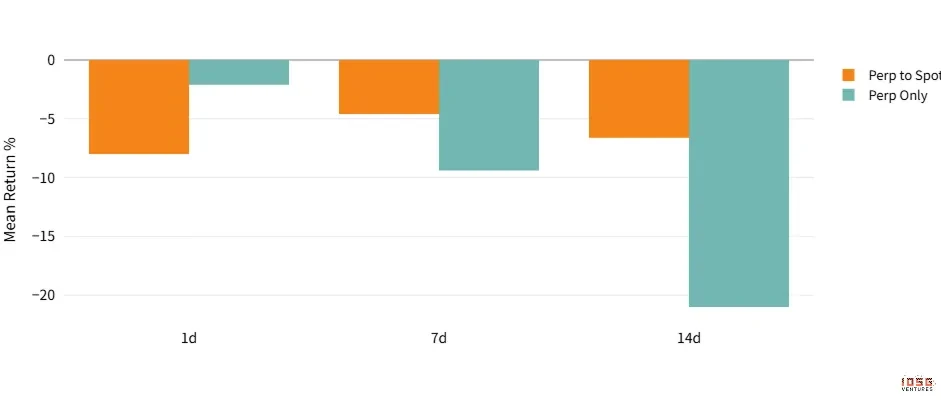
▲ Post-Listing Mean Return (Converted vs Perp Only)
Projects listed on Coinbase and ByBit generally have an opening FDV above $100M; FDV itself is not a differentiating factor. What truly determines entry into Perps is the price performance after listing.
Looking at tokens listed on Coinbase and ByBit but failing to enter Perps, three main characteristics emerge:
- Projects that weaken continuously after listing and lack market heat;
- Meme coins with overly speculative attributes (e.g., WHITEWHALE, ELON), where Binance's screening is noticeably stricter than ByBit's;
- Tokens that did not go through Binance Alpha. Alpha acts as a pre-screening channel within the Binance system and is an important prerequisite step for entering Perps.
The impact of price performance extends beyond "whether they can get on Perps" to the subsequent "Perps to Spot" transition. Data shows that tokens that successfully transitioned to Binance Spot (Converted group) had a 7-day return of -4.6% and a 14-day return of -6.6% after the Perps listing. In contrast, tokens that did not transition to Spot (Perp Only group) had a 7-day return of -9.4% and a 14-day return that dropped significantly to -21.0%. Although both groups experienced negative returns due to the bear market, the Converted group showed significantly better price maintenance ability, indicating that Binance considers "sustainability" an important factor during the Perps phase itself.
Price Impact of Listings
The actual impact of listing events on token prices is the most concerning topic for project teams, institutions, and traders. We analyze this from two core dimensions: Price Position (relative price level at listing) and Post-Listing Return (7-day, 14-day, 30-day returns after listing).
Price Discovery is Concentrated in the First-Mover Window, but Entry Prices Vary Significantly Across Exchanges
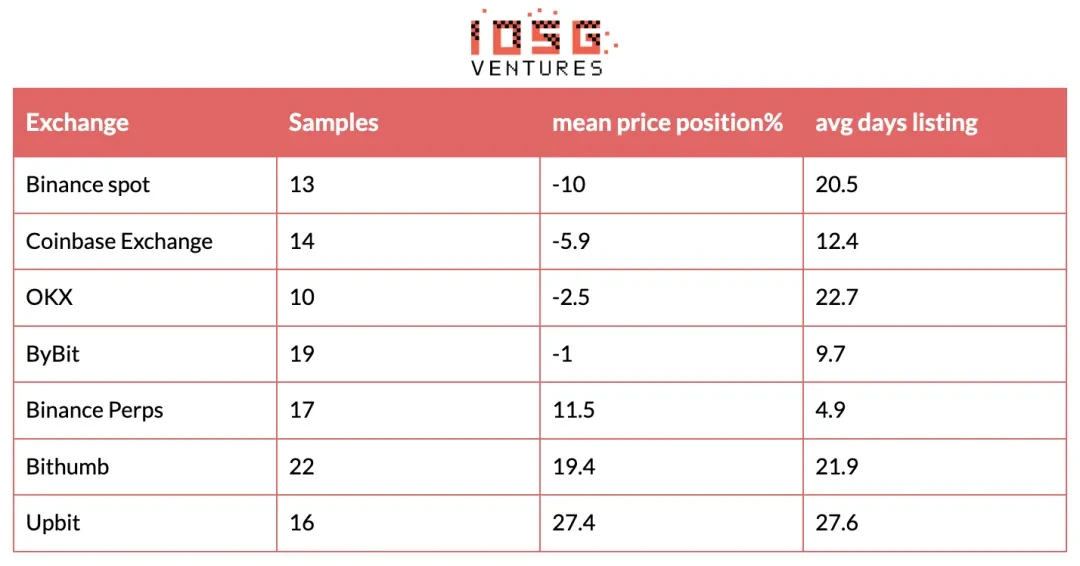
▲ Price Position at Listing
Price discovery primarily occurs within the first-mover window. When acting as followers, ByBit and Coinbase have entry prices roughly flat or slightly lower than the first-mover price, indicating rapid price convergence among first-echelon exchanges.
Binance Perps, as a follower, has an average price 11.5% higher than the first mover, but thanks to its extremely fast follow-up (only 4.9 days), it remains in a relatively early position. Binance Spot's Price Position is -10%, suggesting it tends to list after a price pullback, allowing users to potentially get a relatively better entry price.
Korean exchanges face the most unfavorable entry positions: Bithumb averages 19.4% higher, and Upbit is as high as 27.4%. Due to an average delay of over three weeks, users often buy at significantly high levels.
Overall Listings Under Pressure in 2026: Liquidity Unlocking Rather than Growth Catalyst
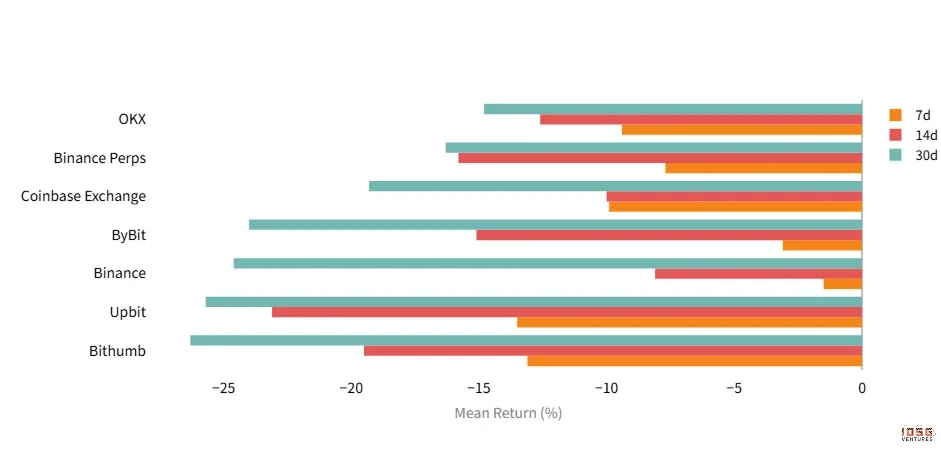
▲ Mean Return by Exchange 7d/14d/30d
In the 2026 bear market environment, the overall price performance of newly listed tokens is weak. No exchange had a positive 30-day average return.
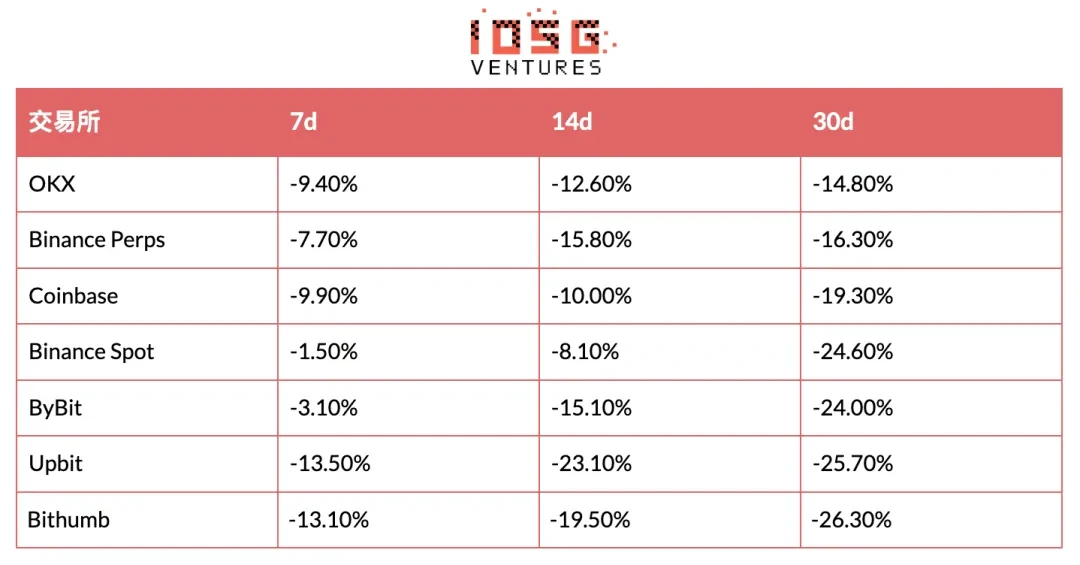
From 7d to 30d, losses deepen progressively, indicating that the price decline after listing is not short-term volatility but a sustained downward trend. In the current market environment, new listings play more of a role in unlocking liquidity – providing an exit window for early holders (including project teams, investment institutions, and early traders) – rather than attracting sustained inflows of new capital.
The performance of the two Korean exchanges is particularly noteworthy: Upbit's 7d return is already -13.5%, reaching -25.7% at 30d. Combined with its +27.4% price position, this means Upbit users not only entered at the highest price but also endured the deepest decline.
Price Peak Performance Across the Listing Path
Although final returns after 30 days are generally negative, the rebound peaks (Peak Return) in the early days after listing show a distinctly different distribution structure. Disassembling the price performance data of tokens reveals that listing sequence directly determines the upper limit of short-term speculative space.
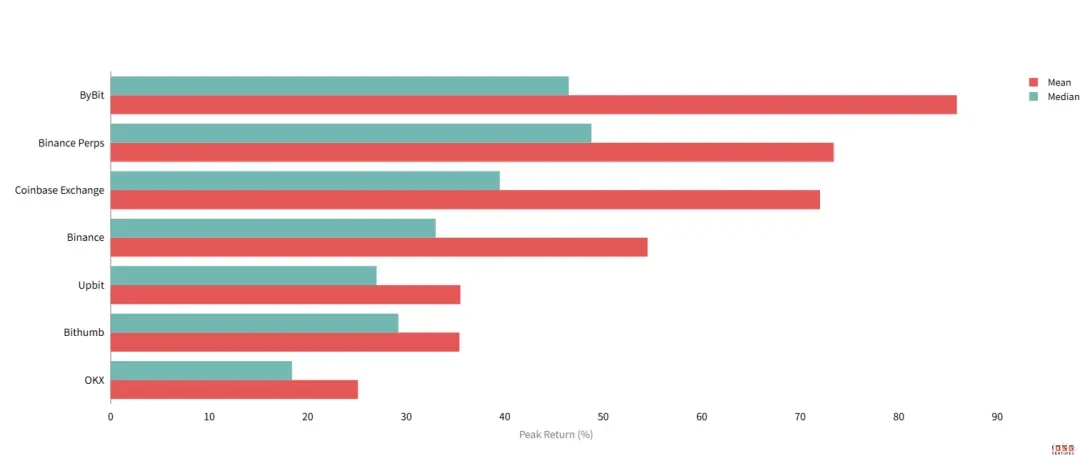
▲ Peak Return by Exchange (14d High)
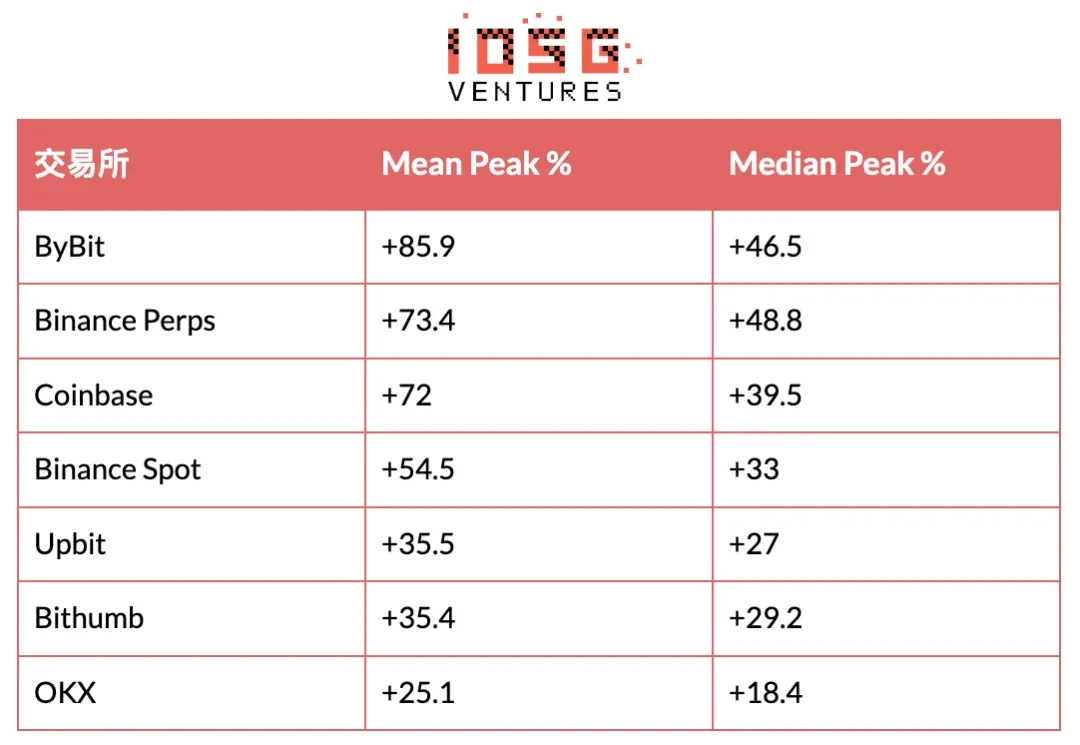
First movers hold an absolute advantage: ByBit's average peak is as high as +86%, and Binance Perps' median is the highest (+49%). The first echelon of listings (ByBit, Coinbase, Binance Perps) captures the highest price elasticity, providing early holders with a significant liquidity premium. Even if the price subsequently goes to zero, there is ample time to exit at the peak.
Late followers have limited space: Bithumb and Upbit's peaks are suppressed to around +35%, while OKX's is only +25%. Due to lagging entry timing, the buying pressure on these platforms primarily absorbs profit-taking from earlier holders rather than initiating uptrends.
This difference confirms the path of liquidity transmission: the first-mover exchange bears the primary price discovery function, providing the best exit liquidity for early holders. As time passes, the buying pressure on subsequent exchanges is more about absorbing realized gains, leading to diminishing marginal returns. For traders, this means the later they enter the listing cycle, the lower the probability of capturing excess returns.
Exchange Choice Determines the Risk-Reward Structure
Combining the three indicators – Price Position (entry point), Peak Return (ceiling space), and Mean Return (final return) – users on different exchanges face completely different risk-reward structures.
Users on first-mover exchanges (Coinbase/ByBit), while also facing negative returns, have the best risk buffer. With the lowest entry prices (-10% ~ -5.9%) and the highest peak space across the market (average +70%+), even if they fail to perfectly time the top, the absolute loss calculated from the initial listing price is relatively manageable, and they even have the opportunity to lock in profits during the rally.
In contrast, users on Korean exchanges face the classic "buy


