Meme 스킨 계약, alt.fun은 진정한 혁신인가, 아니면 가짜 수요인가?


- 핵심 의견: alt.fun은 Hyperliquid 생태계의 새로운 Meme 발행 플랫폼으로, Meme 토큰과 레버리지 토큰을 결합하여 "Meme 플레이 + 계약 개설"의 이중 경험을 제공한다. 그러나 그 메커니즘은 기초 자산의 동질화, 커뮤니티 합의 부족 등의 병목 현상에 직면하여 향후 발전이 제한적이다.
- 핵심 요소:
- alt.fun 플랫폼 메커니즘은 Pump.fun과 레버리지 토큰의 결합과 유사하다. 사용자가 Meme 토큰을 생성하거나 구매할 때, 플랫폼은 동시에 BounceTech에서 해당 레버리지 토큰(예: HYPE 3배 롱)을 발행한다. 토큰 가격은 매수·매도 심리와 기초 자산 성과라는 두 가지 요인에 의해 결정된다.
- 토큰 "졸업"(HyperSwap V2로 마이그레이션)을 위한 시가총액 임계값은 9,000달러이며, 구매 또는 기초 자산 가격 상승을 통해 달성할 수 있다. 그러나 레버리지 감쇠와 급등락(插针) 현상으로 인해 토큰 가치가 0이 될 수 있으며, 이는 단방향 시세(단일 방향 추세)에만 적합하다.
- 현재 이 플랫폼에는 단 41개의 "졸업" 토큰만 있으며, 시가총액이 100만 달러를 넘는 토큰은 ALT(HYPE 5배 롱)와 STONKS(S&P 500 5배 롱)뿐이다. 사용자 수는 약 1,000명이며, 기초 자산은 단 14종에 불과하여 토큰의 동질화 문제가 심각하다.
- 핵심 문제점은 Meme 토큰이 커뮤니티 합의를 형성하지 못한다는 것이다. 투자자들은 서사나 문화가 아닌 가격 기대치에 기반하여 매수하므로, 입소문 효과(전파 효과)를 만들기 어렵다. 또한, 사용자는 프리미엄을 피하기 위해 스스로 레버리지 토큰을 발행할 수도 있다.
Original by Odaily Planet Daily (@OdailyChina)
Author: Golem (@web3_golem)
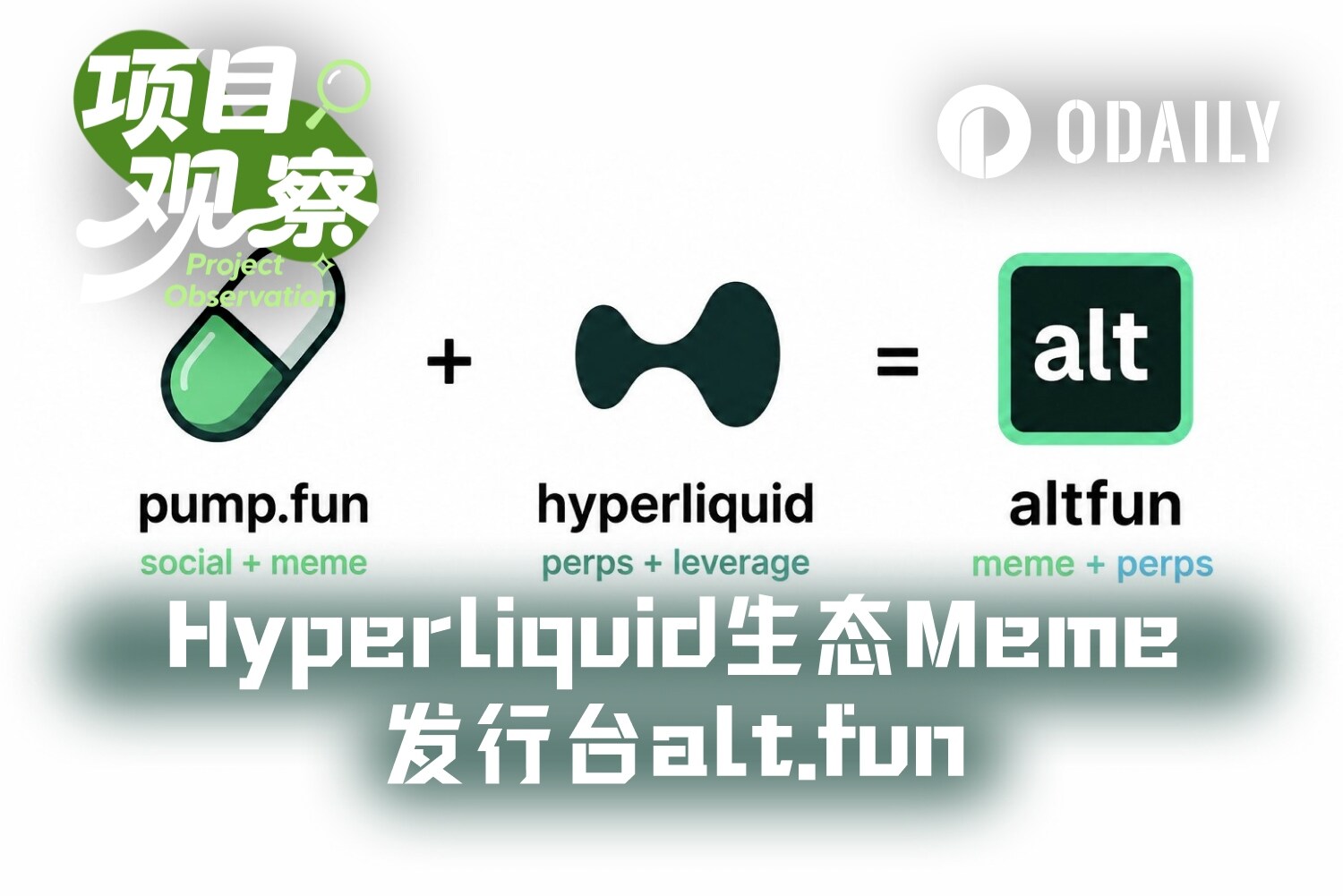
Last week, a new meme launch platform on the Hyperliquid ecosystem called alt.fun attracted significant attention from meme traders. Within just one week of its launch, its flagship token, ALT, reached a market cap of up to $8.8 million. While the price has since pulled back, the market cap remains around $6.7 million.
The novelty of alt.fun can be understood as a combination of Pump.fun and Hyperliquid, allowing users to experience the dual thrill of playing with memes and trading perpetual contracts simultaneously on the same platform.
How the alt.fun Platform Works
Specifically, every meme token launched on alt.fun has a corresponding contract position matched on Hyperliquid as its underlying asset.
Similar to Pump.fun, any user can launch a meme coin on HyperEVM via the alt.fun platform with a single click. The token price is still influenced by a bonding curve. The total supply for each created meme coin is 1 billion tokens. When 75% of the tokens are sold, the token successfully "graduates" and is migrated to the HyperSwap V2 liquidity pool.
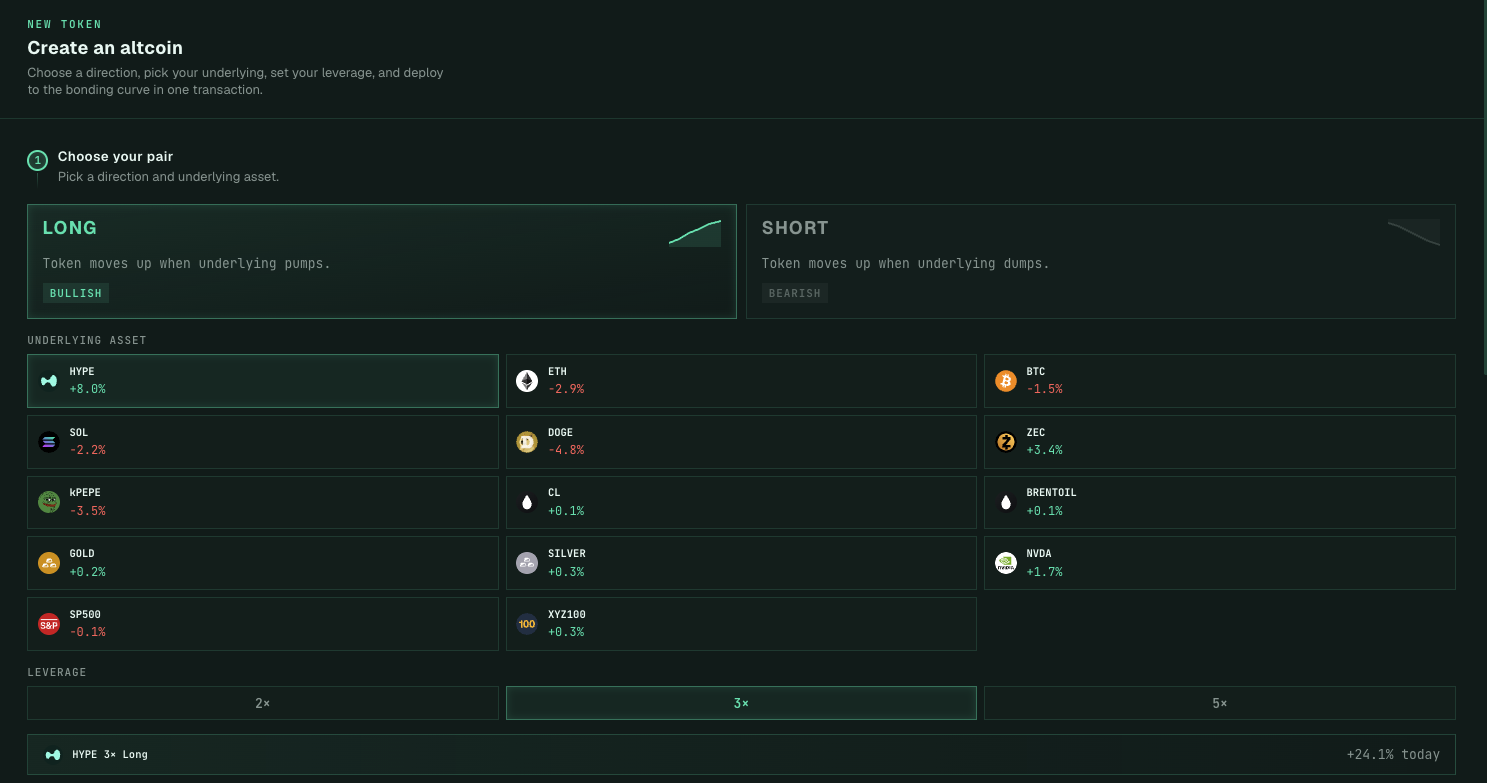
The difference from Pump.fun is that when creating a token on alt.fun, users must also select an underlying asset and choose a leverage direction (long/short) with a limited leverage multiplier (2x/3x/5x). At the moment of token creation, the platform mints a corresponding amount of leveraged tokens (LT) on BounceTech (Odaily Note: a permissionless leveraged token platform on Hyperliquid) and sends them to the user. These leveraged tokens correspond to establishing a perpetual contract position on Hyperliquid. For example, if a user creates a token based on a 3x long position on HYPE, what they essentially receive are leveraged tokens that track the returns of a 3x long position on HYPE.
As shown below, users can currently choose from 14 different assets as the underlying asset when creating a token on alt.fun. Similarly, when a player buys a meme coin on this platform, the platform mints corresponding leveraged tokens on BounceTech. If a player sells, the process is reversed: the leveraged tokens are redeemed, and the user receives the corresponding USDC.
This model of wrapping leveraged tokens as underlying assets before selling them is similar to securitizing specific risk exposures from derivatives like futures and options in traditional finance, such as 3x inverse Nasdaq ETFs or 5x inverse crude oil products. The alt.fun platform acts as an asset management company in this process, managing the long-term positions behind the leveraged tokens for its users.
The core price of this type of financial product typically follows the net asset value. However, because the tokens issued on alt.fun are also simultaneously influenced by the meme coin's bonding curve mechanism, the graduation model and price drivers for meme coins on this platform are not singular.
Dual Graduation Model and Price Drivers
This also means that the price of a token on the alt.fun platform is influenced by two factors: firstly, market sentiment driven by buying and selling, and secondly, the performance of the underlying asset. So now you might understand the alt.fun platform's slogan: "Your token pumps even when nobody's buying."
For example, if a user creates a token based on a 3x long on HYPE and invests an initial capital of $20 (the minimum buy-in set by the platform), and subsequently HYPE rises by 10%, the user's position value would increase by 30% to $26, even if no one else buys the token.
Due to this dual price driving mechanism, the token graduation model on alt.fun is not limited to just one method. Specifically, the condition for a token to graduate requires its market cap to reach $9,000. This essentially calculates the value of the leveraged tokens. Besides making a token graduate through purchases, if the token's own market cap reaches $9,000 due to an increase in the underlying asset's value, it can also graduate successfully. Therefore, whether a token reaches the graduation threshold is often the combined result of both price mechanisms.
Of course, ideally, a rise in the underlying asset drives up the leveraged token, combined with catalytic sentiment from the meme market, the token might experience a self-reinforcing upward spiral. However, if the underlying asset declines, causing the leveraged token's value to continuously shrink, the market might panic and sell off, potentially leading to an instantaneous crash in the token's price.
Therefore, while alt.fun's mechanism can effectively amplify returns through leverage, this is only effective in a trending market and requires users to accurately time the trend. If the underlying asset experiences choppy or sideways price action, users will also suffer from leverage decay losses. When the underlying asset price is volatile, the platform needs to perform "rebalancing" to manage positions and avoid liquidation. This means that even if the underlying asset price drops and then recovers, the leveraged token will incur a loss from being forced to reduce its position during the decline, gradually depreciating.
In extreme cases like flash crashes, the platform might not be able to react in time, potentially causing the leveraged token's value to go to zero.
Meme or Not Meme
The alt.fun platform currently has a total of 41 graduated tokens. Only two tokens have a market cap exceeding one million dollars: ALT, based on a 5x long position on HYPE, and STONKS, based on a 5x long position on the S&P 500. The total number of users is approximately over 1,000. Although alt.fun is still in its early stages, we can already identify some of its current development bottlenecks.
First, the platform has too few underlying assets. With the current 14 underlying assets, there can be at most 84 different combinations of leveraged tokens. Meme coins based on shorting/longing underlying assets with the same leverage multiplier have already appeared on alt.fun. For instance, the current top token by market cap, ALT, is based on a 5x long on HYPE, while another token with an All-Time High market cap named ATH is also based on a 5x long on HYPE. They are almost identical except for their token names and creation times. Given this, why wouldn't investors simply buy the lower market cap ATH?
Although alt.fun might support more underlying assets in the future, its core pain point is its inability to foster community consensus, which is the hallmark of a meme coin ecosystem.
The fundamental reason investors choose to buy leveraged tokens on the alt.fun platform instead of opening leveraged positions directly on Hyperliquid is to gain greater price leverage. Additionally, because the platform manages position rebalancing on the backend, individual users can take a hands-off approach without worrying about individual liquidation risks.
However, this is also the core issue. When investors buy an alt.fun token, they are essentially betting on the future price expectation of its underlying asset, rather than on narratives, market dynamics, or attention – the very "intangible elements" that form the core value of a meme. A meme typically rises or gains market recognition not because of any tangible value support or financial engineering behind it, but due to its community transmission properties.
As a meme trader, I find it difficult to develop the same affection for a leveraged token that I would for a specific meme community culture. If one truly has conviction in the underlying asset of a particular leveraged token, it would make more sense to launch one's own leveraged token rather than buying existing ones and incurring unnecessary premiums.
Therefore, while the mechanism of the alt.fun platform appears novel, in my view, it represents mere mechanical innovation. If alt.fun pivots its focus towards developing as a DeFi platform in the future, it might have a chance. However, if it insists on competing in the meme launch platform space, it is destined to be a fleeting phenomenon.