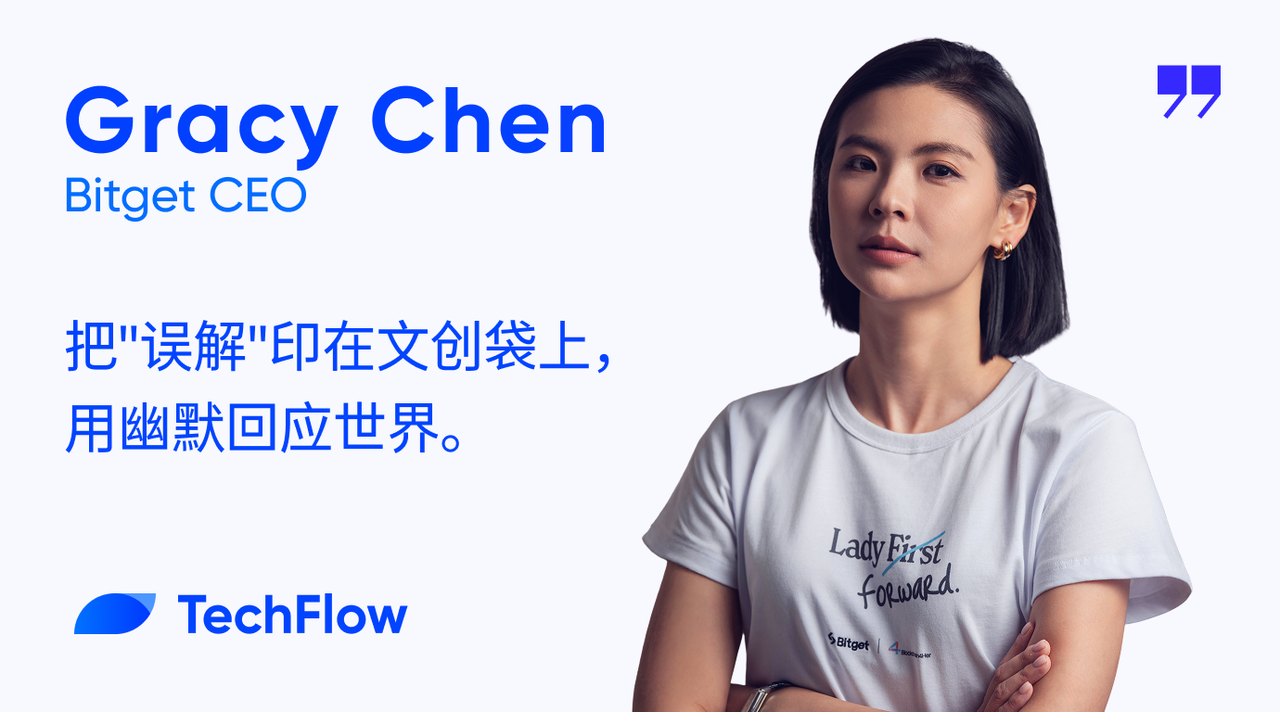
专访Bitget CEO Gracy:把“误解”印在文创袋上,用幽默回应世界


- 핵심 요점: Bitget CEO Gracy가 회사가 2년 동안 '수량 추구'에서 '질적 성장'으로 전략적 전환을 한 과정을 공유했습니다. 여기에는 UEX 전략 도입으로 전통 자산 포용, 전 직원 AI 활용으로 효율성 증대, 그리고 여성 리더로서 여론에 정면 대응하고 일과 가정의 균형을 맞추는 개인적 성장 스토리가 포함됩니다.
- 핵심 요소:
- Bitget의 Q1 비암호화폐 자산 거래량이 플랫폼 전체의 약 40%를 차지했습니다. UEX 전략의 1단계는 전통 자산 커버리지를 확보했고, 2단계는 배당 메커니즘과 유동성 최적화에 초점을 맞춥니다.
- Bitget은 Republic과 협력하여 (SpaceX와 같은) Pre-IPO 상품을 출시했습니다. 규정을 준수하는 SPV 방식과 구조화된 청약 메커니즘을 사용하여 1:1 매핑을 보장하며, 가치는 6개월 전 인수 비용을 기준으로 합니다.
- 중국어권 사용자 거래량은 전 세계의 25%-33%를 차지합니다. 지정학적 갈등(예: 1-2월)은 금 일일 거래량이 비트코인에 근접하게 만드는 촉매제가 되어 사용자들이 전통 자산을 수용하도록 이끌었습니다.
- 전 직원 대상 AI 도입을 진행 중이며, 고객 서비스, 번역, 규정 준수 감지 및 거래 도구(예: GetClaw)를涵盖합니다. AI 응용에는 거품이 없으며 효율성이 5-10배 향상될 수 있다고 봅니다.
- 전략적 조정은 순 신규 사용자 확보보다 사용자 생애 가치(LTV)에 초점을 맞추며, ETF와 월가 자본 유입에 대응하여 규정 준수와 기관 자금을 포용합니다.
- 개인적으로 Gracy는 초E 성향에서 I 성향으로 전환했습니다. 키워드는 '더 큰 무대로의 지속적인 진출', '한쪽에 치우친 평온함', '더 이상 연기하지 않음'을 포함합니다. 싱글맘으로서의 정체성은 아들에게 롤모델이 되고자 하는 의지를 강화했습니다.
Author: TechFlow (Shenchao)
Playfully dubbed someone who "can really put on a show," she simply printed that teasing remark onto a merchandise bag and carried it with her into an industry conference.
As the head of Bitget, a leading global crypto exchange, Gracy has steered this 2,000-person ship from a "quantity-focused" approach to a "quality-focused" one in the two years since she became CEO.
From deep cultivation of the Chinese-speaking market to global expansion, from pioneering the UEX strategy to embrace traditional assets, to going all-in on AI to welcome the silicon-based life era, Bitget is reshaping the trading ecosystem at an incredibly rapid pace.
During the Web3 Carnival, we had an in-depth conversation with Gracy, covering personal public perception, company strategy, and family. For the first time, Gracy shared a comprehensive view of Bitget's strategic evolution and business logic. She also recounted her own transformation from Managing Director to CEO. In this cycle filled with uncertainty, witness how this female leader uses a "calm heart in a secluded corner" to command a "larger stage." Beneath the CEO mantle lies her softness and resilience as a single mother.
Facing Criticism Head-On, Printing Misconceptions on Merchandise Bags
Q1: You frequently appear in the Chinese-speaking market. In your view, which regions are Bitget's current primary focus, and how does the Chinese-speaking market differ from other regional markets?
Gracy: The regions Bitget focuses on are exactly the most active regions in the entire crypto industry.
The user base and trading volume of the Chinese-speaking region account for 25% to 1/3 of the global market share, a proportion similar to the US market. The European English-speaking (EUEN) market is large in scale, but the region is fragmented with diverse languages and cultures, and the characteristics of Eastern and Western European markets are completely different. In the derivatives trading sector, some East Asian countries stand out; however, looking at the spot market, the aforementioned core regions are the primary markets, while Latin America, Southeast Asia, and emerging European regions represent new business growth points.
Bitget has been deeply involved in the industry for over seven years, serving more than 100 countries globally, with a global operational perspective. The core team members are predominantly Chinese, I myself grew up in a Chinese-speaking region, and Chinese is my native language. Many team members come from traditional finance and Web2 tech backgrounds. Therefore, our emphasis on the Chinese-speaking market is beyond doubt. This market is the business area we are most familiar with and is also one of the mainstream global markets.
Q2: I see many of your travel and personal growth posts on Xiaohongshu. How do you balance travel with your CEO duties? What is your favorite travel destination, and why?
Gracy: It's nice to talk about questions like this, not just work all the time.
New Zealand was my travel destination for last year's National Day holiday. During National Day, Christmas, Labor Day (May Day), and the Spring Festival – these major core holidays – many team members choose to take time off. Over the past National Day, I was invited to participate in a local innovation and entrepreneurship competition in New Zealand and give a speech, while also connecting with several local friends. This includes a good friend from my MIT days who is now a female member of the New Zealand Parliament; she accompanied me on a tour of the New Zealand Parliament. I'm accustomed to deep cross-border travel, usually staying for five to six days per trip. For New Zealand, I stayed about seven or eight days, which felt very immersive and very enjoyable.
Regarding travel, for myself and for our company, even though everyone is working extremely hard, and we are even famously intense, jokingly referred to as the 'Huawei of crypto,' I want to clarify that we accept this moniker. But it's not just about long working hours; it's more about a 'Work hard and play hard' spirit. For instance, we don't require clocking in or coming to the office every day, although we have offices in many parts of the world. We care more about results. As long as you deliver results, you have great flexibility.
Our team also needs holidays, but you can't just disappear or stop working during them; that's something we would mind. So, my travels are usually scheduled around these holidays. This Labor Day, for example, I went to Consensus in Miami because we have some business matters in the US this year.
For pure leisure travel, among the places I've been, I probably prefer exotic locations like Morocco or Turkey. But for a more laid-back vacation, I really like Italy. However, my bucket list still has some places I haven't been to, like Tanzania for the great wildebeest migration, or more adventurous trips to the Arctic and Antarctic. I'm really looking forward to those.
Q3: On Xiaohongshu, you directly address negative comments. Which criticisms do you think are the most misunderstood, and what is the actual truth?
Gracy: Haven't those bags of ours been trending recently? This year at the conference, since we didn't have a booth, our marketing team said, "We don't have a booth, so let's create a mobile booth." They asked if I minded using my photo to make a viral bag. I agreed without a second thought. I remember one slogan was, "I'm very introverted, but this bag is super social." So, one misconception is that everyone thinks I'm extremely outgoing. I'm not introverted either, but lately, I've really started to enjoy being alone.

I think deep down I'm an E person, but this job has made me more of an I. A second misconception is also reflected on that bag: "I can really put on a show." So we directly printed the misconceptions onto the bag. That's my way of responding. Given how competitive this industry is, gaining people's attention is a good thing in my book. As they say, even bad publicity is still publicity.
On the other hand, people are quite tolerant nowadays. For example, they are tolerant of female CEOs or female leaders being assertive, holding sharp opinions, acting sophisticated, or having a personal life. I also feel people are tolerant of brands choosing unconventional ways to do marketing and communication.
But there was a previous controversial incident where Bitget Wallet used a viral kissing photo from Dubai for a card. Our Wallet team got consent from the two people, but it went out without my approval. When I saw it, I thought it was a bit over the top. Many netizens criticized it, so it was taken down.
What I want to say is that, from a company perspective, we embrace innovation and tolerate mistakes. I believe that in the process of such innovation, things like this are bound to happen, and you need to find the right balance. First and foremost, we must encourage this kind of innovation. If we don't tolerate even small mistakes, people won't dare to innovate. A brand's core communication power and creativity might just manifest in these areas.
Disruption and Reinvention: The UEX Strategy, the RWA Wave, and a New Trading Paradigm for the Silicon-Based Life Era
Q4: Bitget was among the first to actively list assets related to stocks, IPOs, and precious metals. I've heard that stock trading volume accounts for a significant portion for some exchange users. Could you share how user behavior and portfolio structure have changed since Bitget listed traditional assets? From a data perspective, where would you rate the implementation of Bitget's UEX plan?
Gracy: UEX is our long-term strategy. Aggregating various assets is merely the first step. Data already shows some shifts. For instance, in Q1 of this year, the trading volume of non-crypto assets on our platform approached 40%. We also noticed significant regional characteristics in user acceptance of non-crypto assets within the UEX segment.
Taking US stock tokens as an example, user acceptance is higher in regions with asset controls, foreign exchange restrictions, and difficulty opening US stock accounts. First and foremost, we do not do business in sanctioned countries, like Iran. No matter how much money is offered, we won't earn it. But conversely, indeed, for many regions where opening US accounts is difficult, we become a natural choice for global asset allocation, as they had no other channels before. We are not an optional nice-to-have but a necessity. So, these regions exhibit this characteristic and show higher acceptance.
Secondly, over half of Bitget's users are from Asia. In January and February of this year, geopolitical conflicts caused significant volatility in precious metals and oil prices. Their trading volume would spike suddenly. On its highest day, gold trading volume on our platform nearly matched Bitcoin's trading volume.
Since launching the UEX strategy in September last year, Q4 saw the listing of a large number of US stock assets. In January this year, we laid out commodities like gold and oil, as well as forex assets via CFDs. However, users need an adaptation period for new products. Geopolitical conflicts and other unexpected events act as catalysts for user acceptance. For example, when gold prices saw significant corrections, user trading activity also increased. Combined with leverage factors, some market liquidations occurred, which is normal for high-volatility markets.
Looking at the UEX strategy now, I feel we have only completed the first stage. In my definition, the first stage is achieving relatively comprehensive coverage of these assets. The next stage involves continuously optimizing the products we have already listed.
Let me give you an example. US stock tokens are quite mainstream in the RWA world now. But protocols like Ondo and xStocks have been working on these US stock tokens for nearly a year. Although we launched ours around September or October last year, we still see many issues. A major user concern, for example, is whether dividends are paid. The mechanism for dividend distribution is quite opaque. In reality, dividends are paid, but they are not directly credited to your account. Instead, the underlying SPV buys back the asset, which is reflected in the price. So you receive the economic benefit of the dividend, but you won't see a direct dividend payout. Because of this mechanism, the price of the underlying SPV, let's say for a tokenized Meta stock hypothetically at $500, might become $510 after a dividend payment, while the underlying Meta stock remains at $500. This widening price difference can confuse users and make them uncomfortable. These issues are very hard to detect.
If you're not involved in this or aren't a trader, you might not think of this problem. But it's exactly what we need to continuously optimize in the second stage. For instance, can we find a way to distribute dividends or make them more perceptible to users? Also, extended trading hours (24/7, 24/5) sound appealing, but how do you optimize liquidity during weekends when the US markets are closed? There are many such problems we encounter when dealing with traditional assets.
Q5: I noticed Bitget recently launched IPO Prime, which I understand is a key step in the UEX strategy extending from secondary to primary markets. What was the logic behind choosing to partner with Republic for the preSPAX launch? Compared to other exchanges' on-chain, reservation, or derivative models, what do you see as the advantage of Bitget's 'compliant SPV + structured subscription' design?
Gracy: I wrote an article sharing some stories behind our collaboration with Republic. I've known the two co-CEOs of Republic Crypto for years. A little fun fact: Their co-CEO Andrew and I were both portfolio companies of Dragonfly. Dragonfly once hosted a closed-door event, and Andrew and I were in the same group completing tasks. We even won a championship. That was a very fun experience and strengthened my personal connection with Republic and Andrew.
Since last year, when we planned to launch the Pre-IPO product, knowing their deep involvement in this area, I told our team to talk to Republic. However, this wasn't decided just because Gracy and Andrew have a good personal relationship. Objectively speaking, the team conducted extensive market research across the board, and they ultimately settled on Republic. This was because Republic holds numerous licenses globally (e.g., in the US and Europe). Moreover, they have already issued Pre-IPO tokens for US stocks with other exchanges, encountering pitfalls along the way. Those experiences can inform our product design, helping us avoid issues like terminology risks. For instance, during promotion, we clarify it's a debt instrument, not equity. A third-party SPV holds the actual equity, but our external communications require careful phrasing from a compliance and risk control perspective.
Our core reasons for choosing Republic were: first, its licenses; second, its existing experience; and third, its transparent mechanism.
Republic's Pre-IPO product is even more challenging than regular US stock products because a company's IPO timeline and price are not entirely predictable. Take our latest listing, SpaceX. When will Elon Musk decide to IPO? We've been designing this product since last year, but in February or March this year, the merger between SpaceX and xAI (acquiring Grok) happened. We found that the SPV's partners who were selling secondary shares suddenly stopped selling, or prices completely changed, requiring renegotiations. There are many such intricate details you only realize when you actually build this product. We also pass these close to cost price to users; we are not looking to profit from this product but rather offer it as a benefit to our users.
Many users ask why the valuation is $1.5 trillion when Reuters estimates a $2 trillion valuation post-IPO, and some on-chain platforms show even higher trading valuations. Users wonder if Bitget's lower price implies a risk of not being 1:1 mapped. I want to explain that this is because we asked our third-party SPV to acquire and lock in a valuation in the market six months ago. The lower valuation you are getting is due to this time lag. You are benefiting from the price we locked in six months ago, delivered at today's price. So, it's a bargain, not a lack of underlying mapping. For us, 1:1 mapping is the most critical aspect when designing any RWA product. In the Pre-IPO product mechanism, we also ensure that once the IPO happens, the price of the 'presale' token will be 1:1 aligned with the token representing that asset's stock.
Q6: You previously mentioned in an interview that 'the four-year cycle rule still exists but is now smoothed by Wall Street capital represented by ETFs and DAT.' The global market is reassessing macro risks faster. What impact does this have on exchanges, and what strategic changes are needed?
Gracy: We have certainly made major strategic adjustments. This is why we conceived UEX. We realized that pure Crypto can no longer satisfy our users or our own development cycle. There are clear trends in the market that we have identified and need to capture.
The first is the growth of stablecoins. Stablecoins are attracting more and more traditional capital at an incredibly fast pace, including family offices, endowments, and especially for cross-border payments. I was talking to a friend the other day, completely unrelated to our industry. His family runs many shops in Yiwu. He told me he holds a lot of USDT. I asked why, and he said everyone in Yiwu uses USDT because it's the most convenient asset for cross-border transfers.
There are many similar scenarios. I am certain that people will hold more and more stablecoins, and the ratio of stablecoins to fiat currency will increase. We want to capture the incremental trading volume of stablecoins. Since Bitget mainly focuses on trading, and Bitget Wallet or our other sister companies handle payments more, we believe that as stablecoins are used more for payments, they will also be used more for trading. That's the first opportunity we want to capture: trading in U.
The second opportunity is RWA. The market cap of tokenized US stocks compared to US stocks is currently 0.1%. For products like money market funds and private credit, this ratio might be around 0.5% - 1%. I believe the tokenization of US stocks will accelerate dramatically with the involvement of the NYSE and Nasdaq, potentially reaching a tipping point. In our discussions with them, we found they