






누가 Trade.xyz를 사용하고 있는가?


- 핵심 요점: Trade.xyz의 온체인 분석 결과, 해당 플랫폼에 대규모 시빌 지갑(전체의 44%)이 존재하는 것은 사실이지만, 이들이 기여한 거래량은 0.77%에 불과하다. 월 5000억 달러가 넘는 거래량을 실제로 뒷받침하는 핵심 세력은 소수의 전문 마켓 메이커(Jump, Selini, Wintermute 등), Bybit 출신의 차익 거래 봇, 그리고 Polymarket과 상당 부분 겹치는 개인 투자자 그룹이다.
- 핵심 요소:
- 시빌 레이어와 거래량의 분리: 35,453개의 시빌 지갑은 동일한 Polymarket 계정 'Themino'로 추적 가능하며, 릴레이 방식의 소액 양방향 거래 전략을 사용했으나 누적 거래량은 약 4억 달러로 총량의 0.77%에 그친다.
- 고도로 집중된 마켓 메이커 세력: 363개의 마켓 메이커 지갑(0.46%)이 전체 거래량의 63%(3275억 달러)를 견인했으며, 상위 5개 지갑이 마켓 메이킹 물량의 절반을 차지했다. 여기에는 Powell, Jump Crypto, Selini 및 Wintermute가 포함된다.
- 전문 차익 거래 봇(SAT)이 공격적인 거래 주도: 522개의 HFT 봇이 거래량의 6.7%를 기여했으며, 상위 4개 봇이 해당 카테고리 점유율의 89%를 차지했다. 대부분의 자금 출처는 Bybit 거래소로 추적된다.
- 개인 투자자 그룹과 Polymarket 간 높은 중첩도: 거래량 기준 상위 400개의 개인 지갑 중 22%의 거래량(163억 달러)이 식별 가능한 Polymarket 사용자에게서 발생했으며, 이는 예측 시장 사용자가 핵심 거래 동인임을 시사한다.
- 알고리즘 거래가 실제 유동성 증가: Tread.fi와 같은 알고리즘 상품이 메이커 주문을 제출하여 포인트를 적립하는 방식으로, 전통적인 마켓 메이커가 부재한 시간대(야간, 주말 등)에 호가창 상단의 깊이를 제공하며, 이는 구조적으로 시빌 워시 트레이딩과는 다르다.
Original Title: "Who is actually trading on Trade.xyz?"
Original Author: @web3_pastel, Arrakis Finance
Compiled by: Jaleel, BlockBeats
Editor's Note:
On the landscape of Hyperliquid, one of the most unavoidable names in 2026 is Trade.xyz. It is the first truly successful product to emerge after the launch of HIP-3, the "permissionless perpetual market deployment framework," moving assets like US stocks, crude oil, and silver—previously confined to traditional financial market hours—onto a 24/7 on-chain order book.
In just a few months, it has grown from a niche experiment with only the XYZ100 index into an on-chain trading venue hosting multiple markets like Oil, Tesla, and Silver, with a monthly trading volume surpassing $50 billion.
But at the same time, its controversy has sparked significant discussion abroad: among those impressive wallet numbers, how many are real users, and how many are Sybils created in bulk, chasing the yet-to-be-issued token?
Arrakis' research provides a quite interesting result: there is indeed a Sybil layer, with over thirty thousand wallets traceable to the same Polymarket account, "Themino"; but it inflates headcount, not dollar volume. What truly drives the trading volume are several professional market-making desks, a handful of taker bots with backgrounds from Bybit, and a long tail of retail investors heavily overlapping with Polymarket.
The following is the full text:
Abstract
When we wrote the first edition of "Who's Trading on HIP-3?", our attribution method was statistical. We classified wallets based on their trading behavior over the previous three months: addresses primarily placing limit orders were categorized as market makers, those with high-frequency taker orders as arbitrageurs, and orders with low fill rates and builder tags as retail. This approach did reveal some interesting market structure characteristics, but the classification was probabilistic, and about 70% of wallets remained unclassified.
This article replaces statistical inference with mechanical classification. Every order on Hyperliquid X carries a set of deterministic tags signed and published by the exchange itself: time-in-force (ALO, GTC, IOC, FrontendMarket), builder code, fill flag, and position duration. We use these order metadata to classify each wallet into one of four categories: Retail, Market Maker, Arbitrage Bot, and Sybil/Airdrop Farmer.
The second step is identifying the entities behind these wallets, extracting identity and trading behavior data from @Arkham and HyperTracker's APIs. The top 450 wallets accounted for 78% of the total trading volume. Within this group, we identified several @Polymarket-linked accounts, @jump_, @SeliniCapital, @wintermute_t, Abraxas Capital, and others.
Using this two-step classification method, we observed several patterns. These are detailed below.
Trade.xyz Wallet Analysis
Our observation window was from March 10, 2026, to March 31, 2026 (21 days). During this period, the four markets on @tradexyz (xyz:CL Crude Oil, xyz:SILVER Silver, xyz:TSLA Tesla, xyz:XYZ100) recorded 79,622 unique participating wallets, with a total trading volume of $51.95 billion.
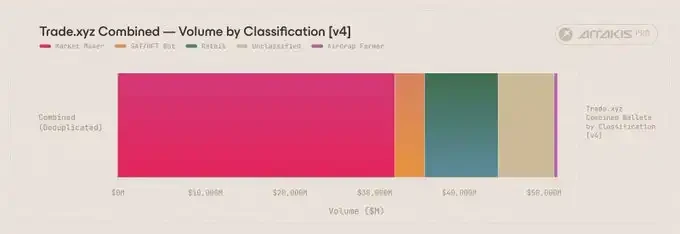
The 79,622 participating wallets broken down by trading volume. Although market makers account for less than 0.5% of total wallets, they are responsible for 63 cents of every dollar traded.
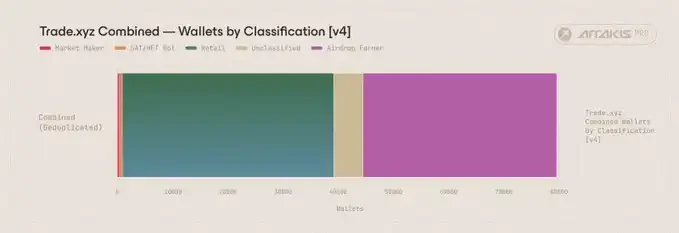
Classified by wallet count (not volume). The Airdrop Farmer category alone has 35,091 wallets, nearly half of all identified wallets.
The Airdrop Farmer category is one of the largest by wallet count but the smallest by volume share. 35,091 wallets represent 44.07% of total wallets, yet they generated only $400 million in trading volume over the entire window, a mere 0.77% of the venue's total $51.95 billion. Nearly half of Trade.xyz's active wallets contributed less than 1% of total volume.
Breaking it down by market reveals another distinct pattern.
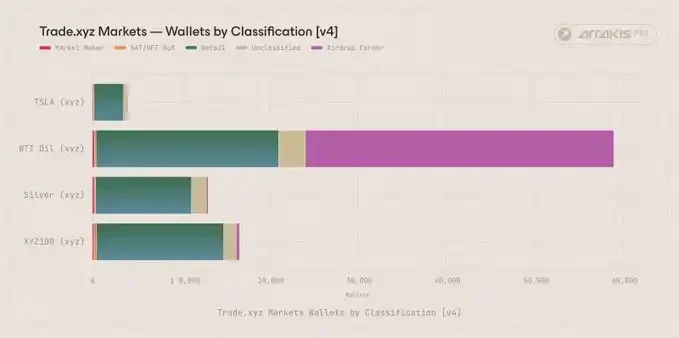
Wallet distribution by market. xyz:CL captured 99.3% of Airdrop Farmer wallets, likely due to its optimal execution cost.
Out of the 35,091 Airdrop Farmer wallets, 34,859 (99.3%) traded xyz:CL during this window, with the remaining 232 spread across xyz:SILVER, xyz:TSLA, and xyz:XYZ100. This pattern aligns with Airdrop Farmer behavior: each wallet repeatedly executes small, round-trip trades to generate volume without assuming price risk. This strategy relies on tight execution costs and is extremely sensitive to slippage. xyz:CL, having the best depth among Trade.xyz's four markets, naturally became the preferred venue for this activity.
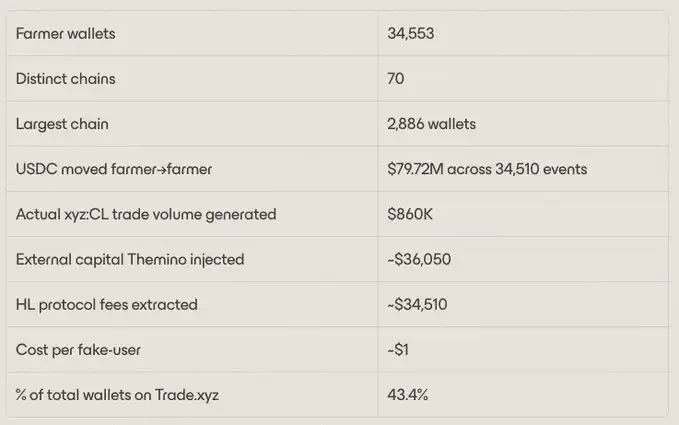
Another noteworthy point is who is behind these addresses. On-chain tracking, shown below, reveals that 34,553 Airdrop Farmer wallets are linked to the same Polymarket operator. This single entity alone accounted for 43.4% of all participating wallets on Trade.xyz during this window.
At the other end of the classification is market making. 363 wallets, or 0.46% of active addresses, drove $32.75 billion in trading volume during the window—63 cents of every dollar on Trade.xyz. The other three categories fall in between. 522 SAT/HFT bots contributed $3.5 billion (6.7%). 38,307 wallets classified as Retail contributed $8.7 billion (16.7%). 5,339 unclassified wallets contributed $6.61 billion (12.7%).
The 12.7% volume in the Unclassified category cannot be definitively attributed to a specific strategy based solely on metadata. A reasonable assumption is that a significant portion comes from retail users placing limit orders via the Hyperliquid frontend, or those placing market and limit orders through the Trade.xyz frontend. Neither channel attaches explicit builder codes or specific TIF tags to orders, making these trades invisible to a metadata-driven classification method.
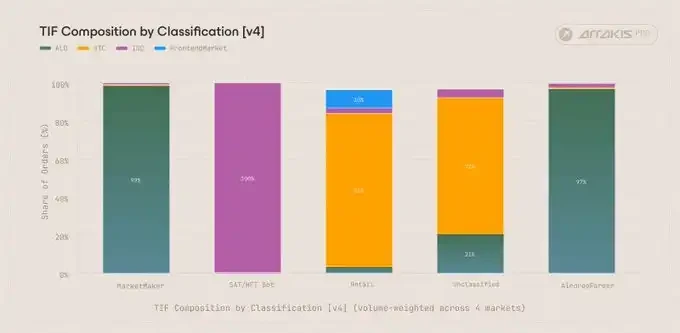
Time-in-force distribution weighted by order count for each category. Unsurprisingly, 98.5% of market maker orders are ALO, while arbitrage bots use 100% IOC. The Unclassified category shows 71.5% GTC orders, a hallmark of manual limit order placement by frontend users.
The TIF composition supports this speculation: 71.5% of orders in the Unclassified category carry a GTC (Good Till Cancel) tag, typically used when frontend users place resting limit orders.
"Themino" Leads to Over 30,000 Wallets
In recent weeks, there has been considerable debate: are Trade.xyz's impressive user numbers driven by genuine human participation, or by Sybil activity ahead of an anticipated TGE? We don't intend to comment on the broader airdrop farming landscape for this exchange, but our analysis of trade-level data across the four Trade.xyz markets in March reveals a pattern worth presenting.
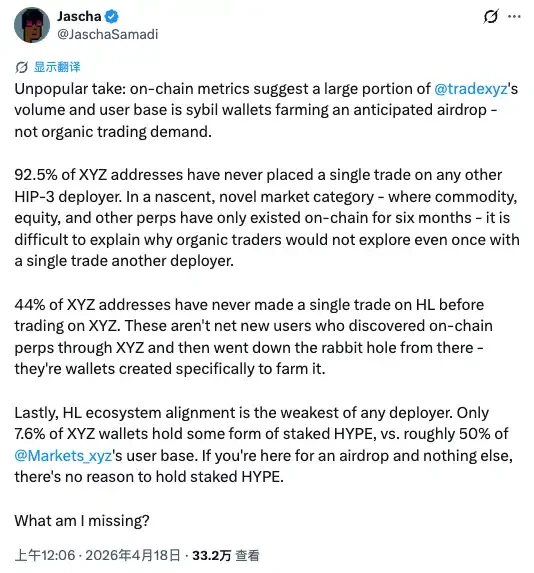
Analyst Jascha points out that 92.5% of XYZ addresses never executed a single trade on any other HIP-3 deployer.
Among the 34,602 wallets classified as Airdrop Farmers, 34,553, or 99.9%, can be traced back to a single Polymarket identity named "Themino."
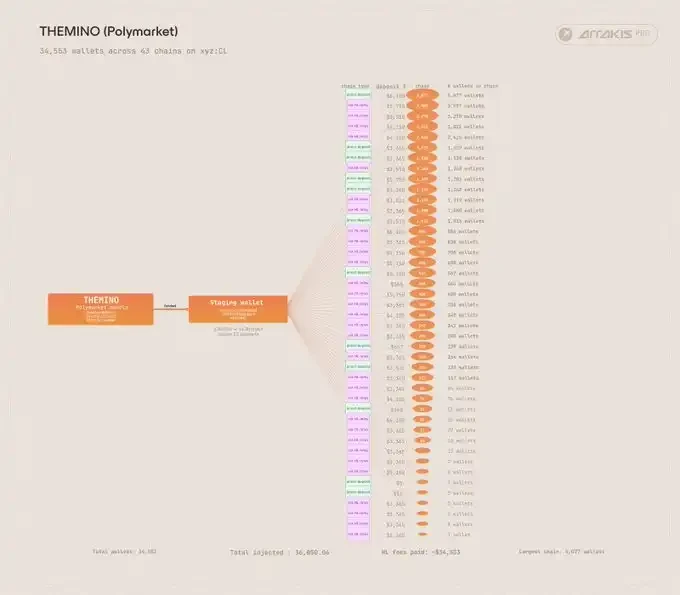
"Themino," a Polymarket identity on Arbitrum, spawned 70 independent linear chains covering 34,553 wallets.
How exactly did it work? Hyperliquid's L1 provides a primitive called `internalTransfer` that allows transferring USDC between wallets for a fixed fee of $1 regardless of the amount. The operator of Themino used this primitive to pass a seed deposit sequentially through tens of thousands of new wallets. Each wallet would execute the same five-step sequence in approximately 26 seconds:
1. Receive $X from the previous Sybil wallet via `internalTransfer`, losing $1 to the HL transfer fee.
2. Transfer $14 to the xyz sub-account.
3. Execute two IOC orders on xyz:CL (one buy, one sell), generating two fills and some trading volume.
4. Transfer approximately $13.99 back to the main account (the $0.01 difference covers execution slippage and trading fees).
5. Transfer $X minus $1 to the next Sybil wallet via `internalTransfer`.
The next wallet repeats the same sequence.
The 34,510 internal transfers in this operation cost Themino a total of $34,510 in protocol fees, a tactic consistent with his trading history on Polymarket.
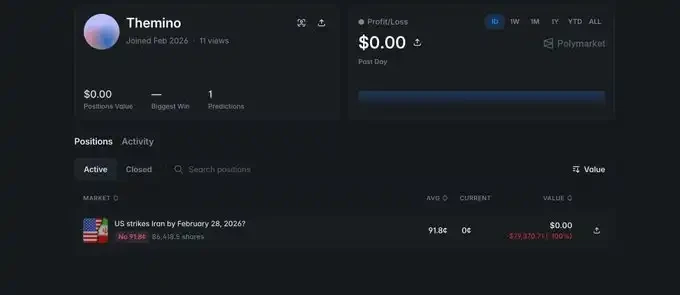
Themino also bet "No" on Polymarket for "Will the US launch a strike on Iran before February 28, 2026?", losing approximately $80,000. The strike happened on February 28.
What Types of Builders Are There?
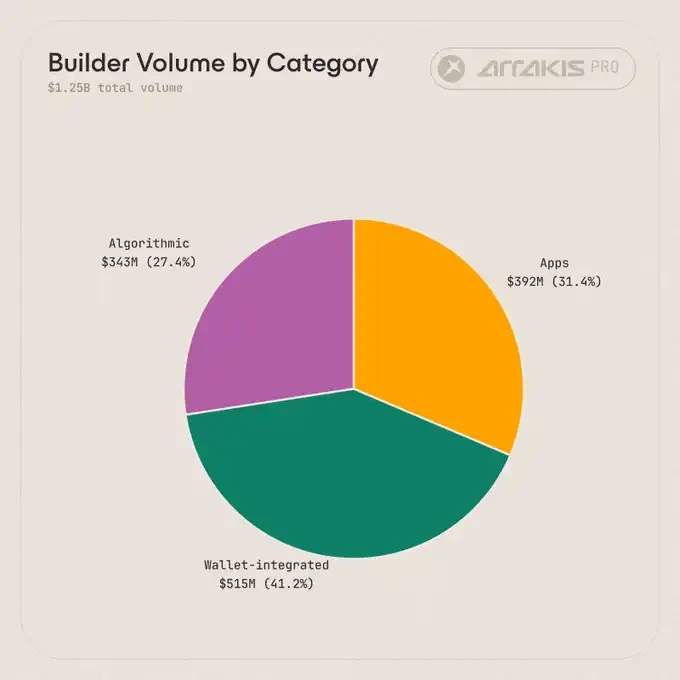
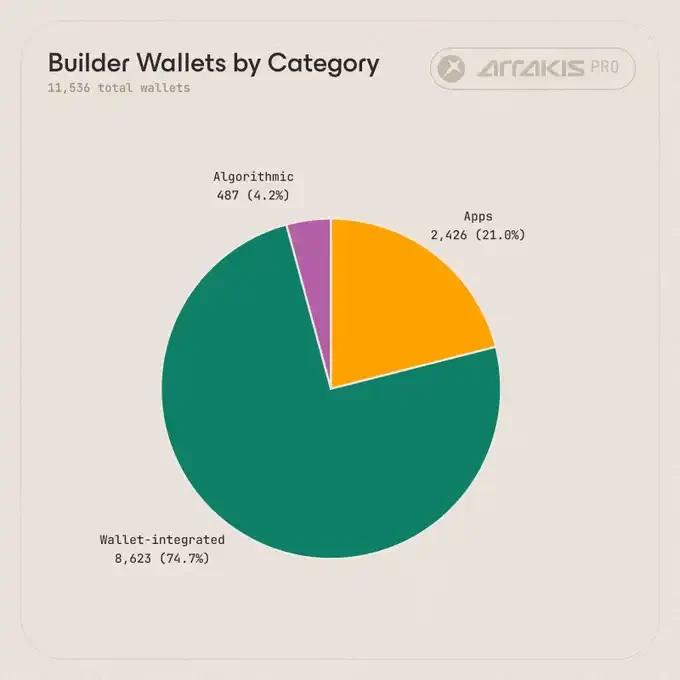
Hyperliquid attaches an identifier to orders routed through third-party frontends, allowing these applications to collect custom frontend fees. This identifier is the builder code, the most direct way to determine which interface a wallet used, if any. Among wallets that traded across the four markets, these builders can be broadly categorized into three types.
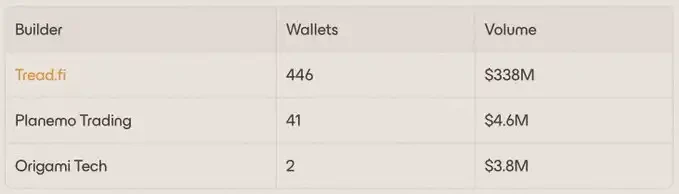
Algorithmic Builders. These are products designed for retail users to maximize trading volume on DEXs and farm points for potential airdrops. Before late 2025, farming points on a perpetual DEX meant either wash trading or running algorithmic, non-directional taker-vs-taker strategies, which was costly for participants and net negative for the exchange. Retail market-making bots like @tread_fi, @PlanemoTrading, and @origamitech_ replaced wash trading with genuinely valuable market making. Every order placed by these products is post-only, meaning the wallet adds liquidity to the order book instead of consuming it.
As @davidyjeong, CEO of @tread_fi, stated: "Before retail market-making solutions, farming points on a perpetual DEX meant wash trading, inflating volume at the cost of execution fees, slippage, and the risk of account bans. We solved this with a new farming method: the bot only places maker orders on both sides. Users farm with lower costs, often profit from captured spreads, and the byproduct is genuine top-of-book liquidity for the market—exactly what HIP-3 equity perpetuals need during nights and weekends when traditional market makers are absent. It's a better way to farm, and why HIP-3 markets have excellent execution experiences today."
The contribution of these market-making bots is most evident during periods when traditional market makers are absent. CME WTI futures close on Friday afternoon and don't open until Sunday evening; equity perpetuals face the same "night and weekend" gap. During these times, retail market-making bots support the top of the book on markets like xyz:CL and xyz:TSLA.
It's important to note: in this analysis, wallets routed through these algorithmic products are classified as Airdrop Farmers, but their trading behavior and market impact are structurally completely different from typical Sybil activity.
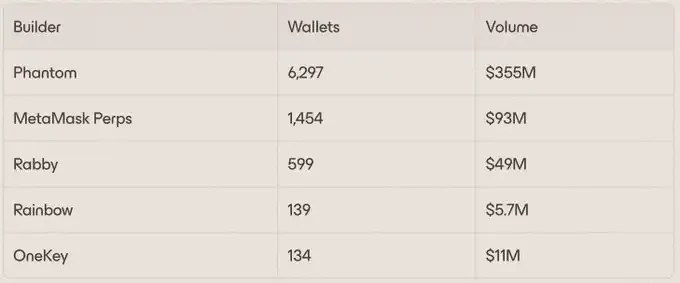
Wallet-Embedded Builders are perpetual contract interfaces embedded within consumer wallets. Since early 2026, this type of integration has become one of the largest sources of retail order flow on HIP-3. This group includes @phantom, @MetaMask, @Rabby_io, @rainbowdotme, and @OneKeyHQ. Their median trading volume per wallet ranges from $1,000 to $3,000, consistent with the order size of retail users who prioritize ease of use over marginal builder fees.
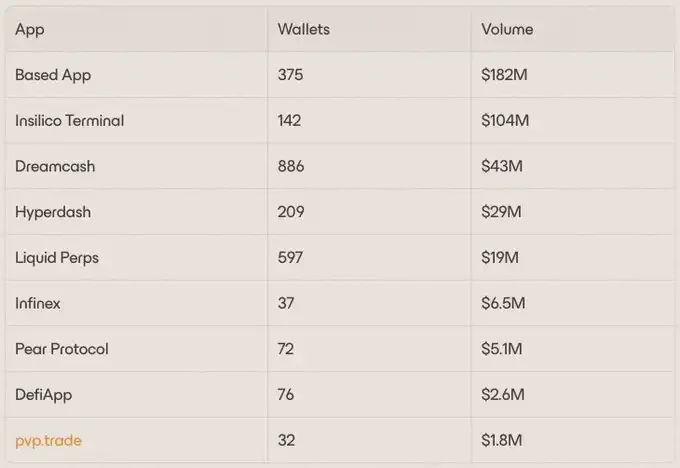
Application Builders are standalone perpetual frontends and integrated products. These are products designed for traders, offering specialized workflows that cater to users who find wallet plugins insufficient and require better order placement, charting, position management, and execution tools. This group has fewer wallets than the wallet-embedded type but higher volume per wallet, aligning with advanced users who prioritize feature depth over plug-and-play convenience. Such products include the @InsilicoTrading terminal, @liquidtrading, @hypurrdash, @BasedOneX, @Dreamcash, @infinex, @pear_protocol, @defiapp, and @pvp_dot_trade.
@0xVKTR, Head of Growth at @InsilicoTrading (the team behind the Insilico terminal), describes it: "At Insilico, we view HIP-3 markets as the next step in bringing real-world exposure natively onto crypto rails. Traders don't just want another frontend. They want fast execution, clean market access, and the ability to seamlessly move between crypto and macro assets without leaving their existing workflow. Trade.xyz is one of the clearest examples of this demand. The order flow routed through Insilico proves there is a genuine advanced user base for on-chain perpetuals when the venue has depth, the product is useful, and the trading experience is built for serious participants."
Who is Trade.xyz's Largest Market Maker?
The market-making landscape across Trade.xyz markets is highly concentrated. The top 5 market makers account for 50% of the market-making volume, the top 13 for 80%, and the top 21 for 90%. A handful of market-making desks shoulder the vast majority of the exchange's market-making book.
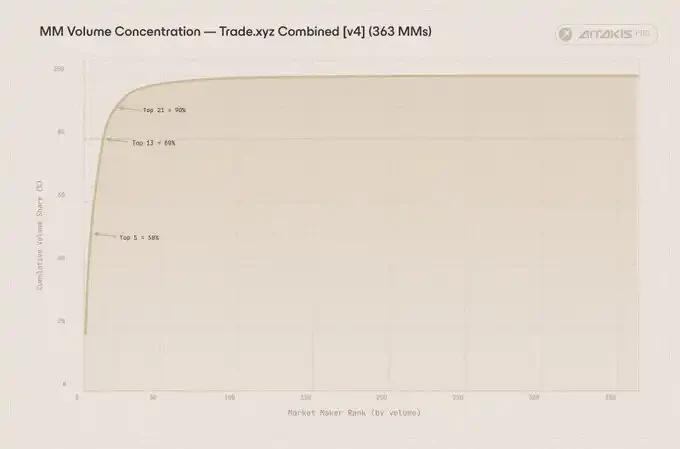
Cumulative share of market-making volume ranked by wallet. The top 5 desks account for 50% of all market-making flow, the top 13 reach 80%, and the top 21 reach 90%.
The second-largest market maker is the most interesting wallet in the entire sample. 0xc926ddba…98d3, with a trading volume of $


