






World Cup Arbitrage Bible


- Core Insight: This article systematically elaborates the scientific methodology of World Cup prediction and trading. The core lies in converting the emotions and narratives surrounding football matches into quantifiable probability models (such as Poisson distribution, Elo ratings, Bayesian updates), identifying pricing biases based on market pricing, and leveraging disciplined execution (order books, Kelly criterion, stop-loss) along with systematic post-match analysis to gain a long-term edge, rather than simply predicting the sole champion.
- Key Elements:
- Model Evolution: From basic Poisson distribution for predicting goals, to Dixon-Coles correction for low-score scenarios, Bayesian hierarchical models for handling the noise in national team small-sample data, and finally to xG/xT for quantifying match processes, progressively approaching true probability.
- Path Asset: The expansion of the 2026 World Cup to 48 teams, introducing a third-place group stage advancement mechanism, makes the championship contract a "path asset." Traders must focus on the cascading impact of group rankings and the strength of the bracket halves on advancement probability.
- Market Trading: The model provides a fair probability, but actual trading needs to combine the order book (bid/ask spread, depth) and the Kelly criterion for position management to avoid losses from slippage or overconfidence.
- Strategy Cases: The article outlines trading logic for specific scenarios such as path mispricing (group stage results altering bracket difficulty), process reversal (scoreline contradicting xG), and incentive trading (changes in team motivation during the third round of the group stage).
- Minimum Viable System: It is recommended that traders start with a minimum closed loop: focusing on 8 teams, establishing a baseline probability, recording trades, and conducting reviews. This helps gradually train probabilistic intuition and execution discipline, rather than chasing complex models.
Original author: @MrRyanChi, Founder of @insidersdotbot
Preface
It's been quite a while since my last article. During this time, I've been researching various new strategies while tirelessly polishing our trading terminal, insiders.bot. The World Cup is the ultimate "put up or shut up" moment – a chance to test whether our product can be a strategy applicable to the general public, enabling everyone to trade the tournament successfully.
So, this article will deconstruct all the historically effective trading strategies for the World Cup. These are the strategies that inspired the current version of our product.
What excites me most about the new insiders.bot isn't just fast order execution; it's that it connects many things scattered across screens: smart money signals, order books, TP/SL, second-level copy trading, filterable data, and an AI Agent that can answer questions in natural language.
The World Cup is the perfect scenario to explain this. It's universal enough that everyone has emotions; it's also low-scoring enough that a tiny variable can change the entire path. A missing forward, a red card, a deflected shot with 0.08 xG, a goal difference for a third-placed team – any of these can shift championship probabilities, qualification odds, and market prices simultaneously.
So, back to strategy – this article isn't about telling you "who will win." Honestly, no one knows for sure.
What I want to deconstruct is something else: When the World Cup becomes a price in a prediction market, how do we break emotions down into variables, compress variables into probabilities, and then subject those probabilities to the judgment of the market price?
In a nutshell: Scientifically predicting the World Cup isn't about predicting a single future; it's about putting all possible futures on the table, pricing them, and executing with discipline.
This article will take you on a journey through history, explaining the evolution of strategies from a century ago to the present, allowing you to grasp the essence of each.
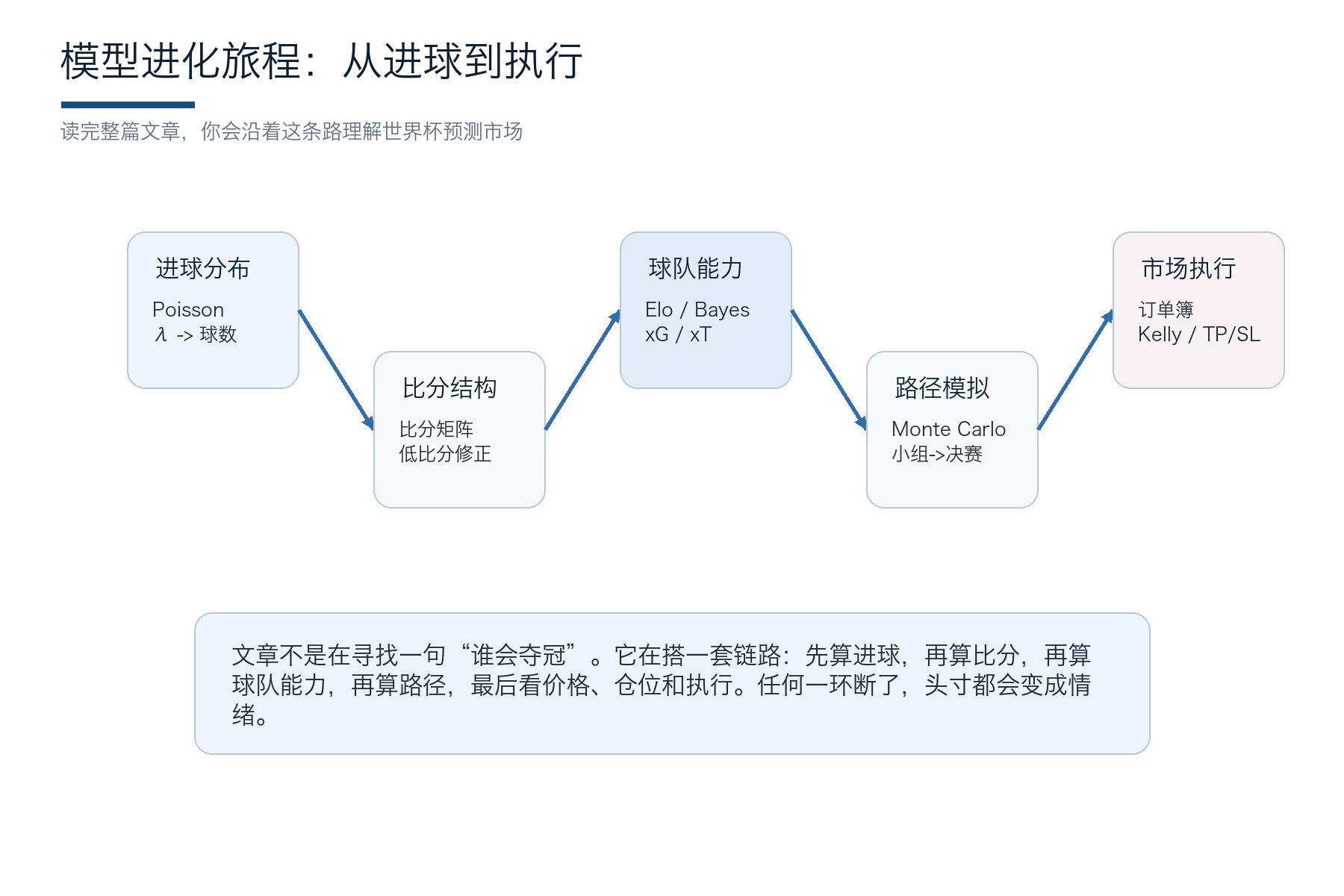
Initially, people just asked: How many goals does a team typically score? Thus, Poisson emerged, transforming the "feeling of strength" into a goal distribution.
Soon, they realized looking at averages wasn't enough; there's structure between scores. So, score matrices, Dixon-Coles, Bivariate Poisson, and Skellam continued to break down football more finely.
Later, the question shifted from "how many goals will be scored" to "how strong is this team?"
Then, Elo, Bradley-Terry, and ordered logit provided a long-term strength baseline; Bayesian hierarchical models told us that with small national team samples, we shouldn't be swayed by a single big win or upset; xG, xT, and VAEP re-examined the process behind the score, revealing chance quality, ball progression, and action value.
Finally, models must enter the market. Machine learning and ensembles fuse diverse information; Monte Carlo simulates group stages, knockouts, and bracket paths over and over; order books show if theoretical prices can be filled; and Kelly and TP/SL determine if you'll survive until the final. Read on, and you'll find this article isn't asking "who will win," but rather: Where do probabilities come from? Why do prices move? How should trades be executed and reviewed?
With this roadmap, each subsequent section won't be an isolated concept. We won't start with formulas. Instead, we first place the World Cup back into the pricing system of prediction markets, moving it from an emotional spectacle. Only by understanding what a contract price represents can we discuss goals, paths, and positions without it becoming pure technical self-indulgence.
I. First, View the World Cup as a Probabilistic Asset
Let's shift perspective first: The World Cup is full of emotion, national narratives, and legendary farewells, but prediction markets care about only one thing: whether the current price correctly expresses the probability of a future event occurring.
1.1 Why 2026 is Special: Expanded Format Turns the Championship Market into a Path Asset
The 2026 World Cup expands from 32 to 48 teams, with 12 groups of four. The top two from each group and the eight best third-placed teams advance to a 32-team knockout stage. The champion will need to play 8 matches. In FIFA's official regulations, these numbers seem like mere organizational details; from a trading perspective, they mean an expanded state space, increased path dependency, and more frequent market re-evaluations (FIFA World Cup 2026).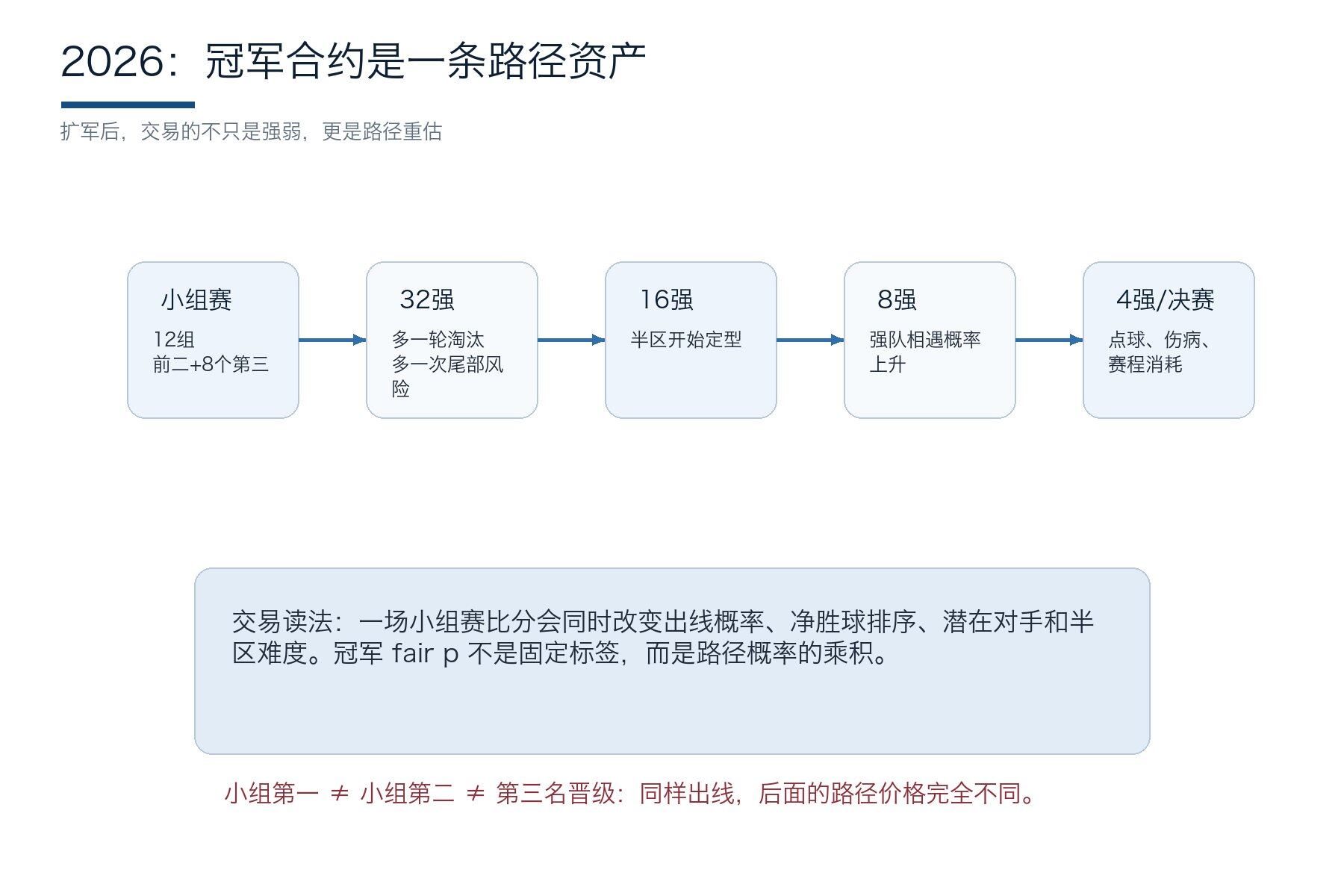
In past World Cups, strong teams could secure a relatively clear path to the knockout stages by confidently winning their group.
The third-place qualification mechanism of 2026 will turn the final round of the group stage into a complex payoff table.
- A team might not need to win, just avoid a heavy loss;
- A team might have already qualified, yet still need to fight for a better bracket position;
- A team ranked third might see its real qualification probability change rapidly based on results from other groups.
This is crucial for prediction markets. A championship contract isn't about single-match win probability; it's about path probability. The probability of winning the title can be roughly expressed as: Probability of advancing from the group × Product of probabilities of winning each subsequent round. Each extra match introduces another chance for a red card, penalty, injury, weather change, refereeing decision, or tactical mismatch. The strong team's advantages accumulate, but so do their risks.
Therefore, the correct trading objects for the 2026 World Cup aren't just "who will be champion," but the paths themselves: group advancement, bracket strength, third-place qualification, avoiding strong opponents, penalty kick risks in knockouts, and travel fatigue. The market will provide a total price before the tournament and continuously re-price paths during the games.
So, the trader's task is to identify, before the re-pricing occurs, which path's price is significantly undervalued.
1.2 Practical Reference
Let's look at a format-related example. Suppose a strong team's pre-tournament championship price is 12%. It wins its first match 1-0 against a weaker opponent. The market might just interpret this as "earning three points." However, if another favorite in the same group unexpectedly loses, this strong team's probability of winning the group, avoiding the tough bracket, and facing weaker opponents before the quarterfinals all change simultaneously.
At this point, the trader shouldn't just ask if the team played well; they should immediately re-run the paths: How much did the probability of winning the group increase? Is there a chance of squad rotation in the final group game? Did the bracket become easier?
These windows are best prepared for in advance. Before the tournament starts, list the key score scenarios for each group. During the matches, when prices move, use the order book to see the real ask and depth, not just the mid-price on the page.
If insiders.bot's 24-hour smart money screening signals suddenly show concurrent heating up in the same group's qualification market and championship market, treat it as a reminder that "someone is trading the path," then return to your own model to check if you agree.
Once the format is explained, the real modeling begins. No matter how complex the paths, they ultimately boil down to individual matches: how many goals each team is likely to score. This determines win/draw/loss probabilities and whether you should express your view through championship, qualification, over/under, correct score, or simply not trade. In other words, the first modeling approach isn't to guess the champion, but to first calculate the single-match goal distribution, and then let that determine which market your position should be in.
II. Model Foundation: From Goal Distribution to Score Matrix
This section covers the most fundamental engine. Readers don't need to write code right away, just understand that all win probabilities, over/under odds, and advancement chances ultimately stem from the probabilities of a range of specific scores.
In this chapter, we'll learn two basics. One is the Poisson distribution, used for probability calculation. The other is the matrix, the model's framework. Combining these two forms the Dixon-Coles model, used for predicting match scores.
2.1 Poisson: Bringing Football from Storytelling to Distribution
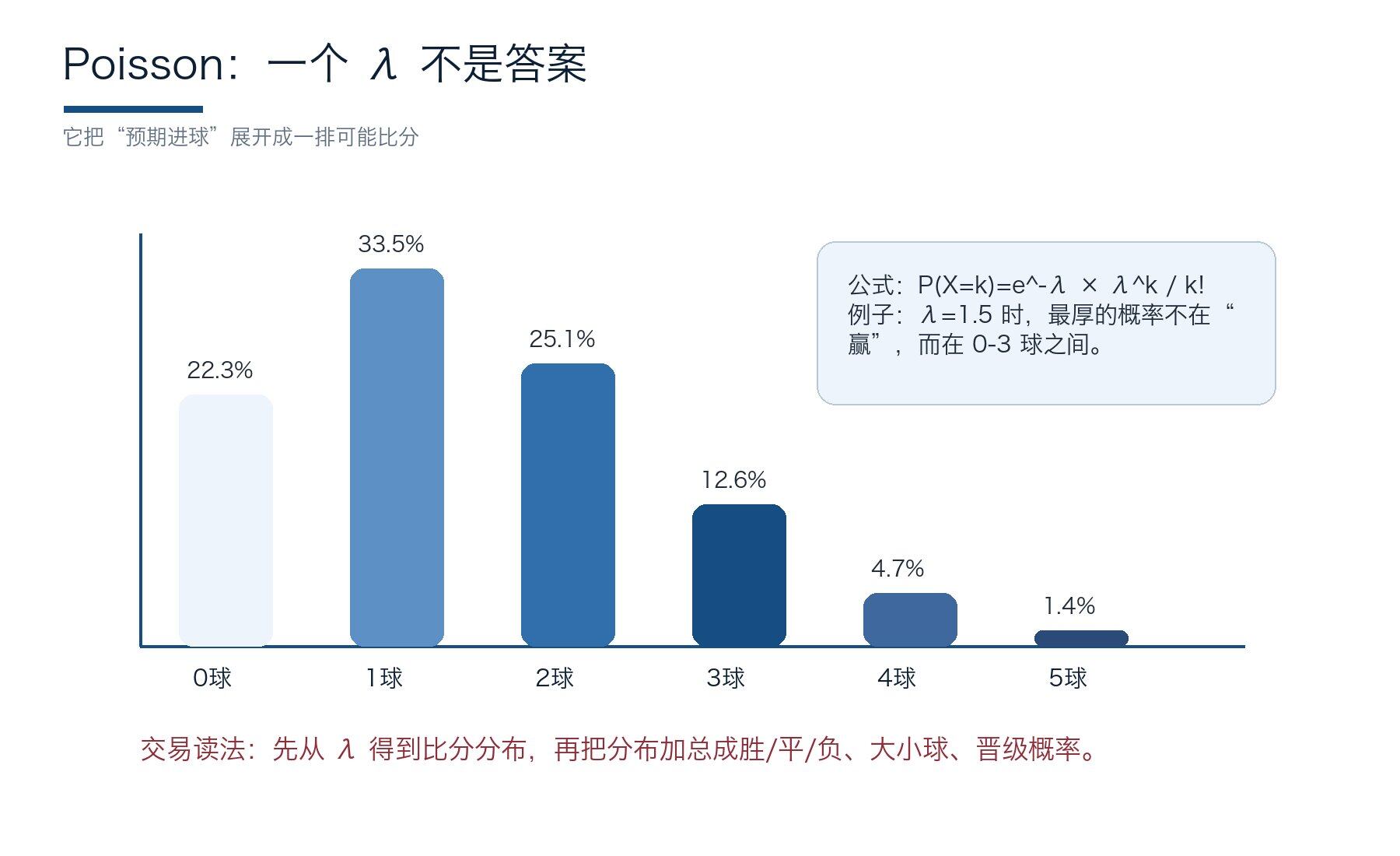 Figure 1: Poisson Distribution: A single λ is expanded into specific probabilities for 0 goals, 1 goal, 2 goals, etc.
The first bridge for football prediction is Poisson. Maher's classic 1982 paper placed a team's attacking strength, defensive strength, and goal count into a single statistical framework (Maher). This seemingly simple step defined the foundation of football prediction for the next forty years: don't guess the result directly, predict the number of goals first.
Poisson's formula is written as P(X=k)=e^-λ × λ^k/k!.
The symbols have the following meanings:
- λ is the average goals
- k is the specific number of goals
If a team has a λ=1.5 against a particular opponent, it doesn't mean they "should score 1.5 goals." Rather, it means that across many similar matches, their average goals would be around 1.5. A real match can only yield 0, 1, 2, 3 goals, etc., so the model expands the value of 1.5 into a series of probabilities.
This is what differentiates football from basketball or tennis. Football is inherently low-scoring, so the weight of a single goal is immense:
- A deflected shot with 0.08 xG can change a group's dynamics.
- A goalkeeper's spill can ruin all pre-match narratives.
The value of Poisson is reminding us not to treat a low-scoring sport like a deterministic novel.
In trading, λ is the entry point to everything. From λ, you derive the score matrix, and from the matrix, you sum up win/draw/loss, over/under, both teams to score, and correct score. The championship market seems far removed from λ, but it's really just placing the λs from many matches into a single tournament tree. If the entry point is skewed, the whole tree grows crooked.
Don't rush to memorize the formula. Just think of Poisson as a translator: it takes a vague statement – "this team can probably score a few" – and translates it into a set of probabilities that can be added, compared, and traded.
What readers should practice isn't calculating e to some power, but forming a habit: every time you see news, ask yourself which team's λ it changes and by roughly how much. Once this action is stable, all subsequent markets become clearer.
Practical Reference
A small actionable example: Team A has a pre-match λ=1.65, Team B has λ=0.82. The model doesn't predict Team A will score 1.65 goals; instead, it lays out the probabilities for 0, 1, 2, 3 goals for Team A. If the starting lineup is missing the main center-forward, you can decrease Team A's λ by 0.12-0.20; if a substitute winger is missing, perhaps only by 0.03. This action is more reviewable than "feeling their attack is weaker."
In execution, translate λ changes directly into rules: core striker absent → reduce shot quality λ; key defensive midfielder absent → increase opponent's counter-attack λ; heavy rain and poor pitch → decrease λ for both sides.
Once the rules are clear, an AI Agent is well-suited to help translate news into candidate parameters. However, the final decision on whether to adopt them must be made by your model and trading discipline.
Poisson gives us the goal distributions for two teams, but a trader can't just stare at two distributions. Before placing an order, you need to know what scores are generated when these distributions meet, which score regions have the highest density, and whether your view is best expressed by betting on Team A to win or on Under. So, the next step is to overlay the two distributions to create a score map directly linked to market choices.
2.2 Score Matrix: The True Engine of Single-Match Probability
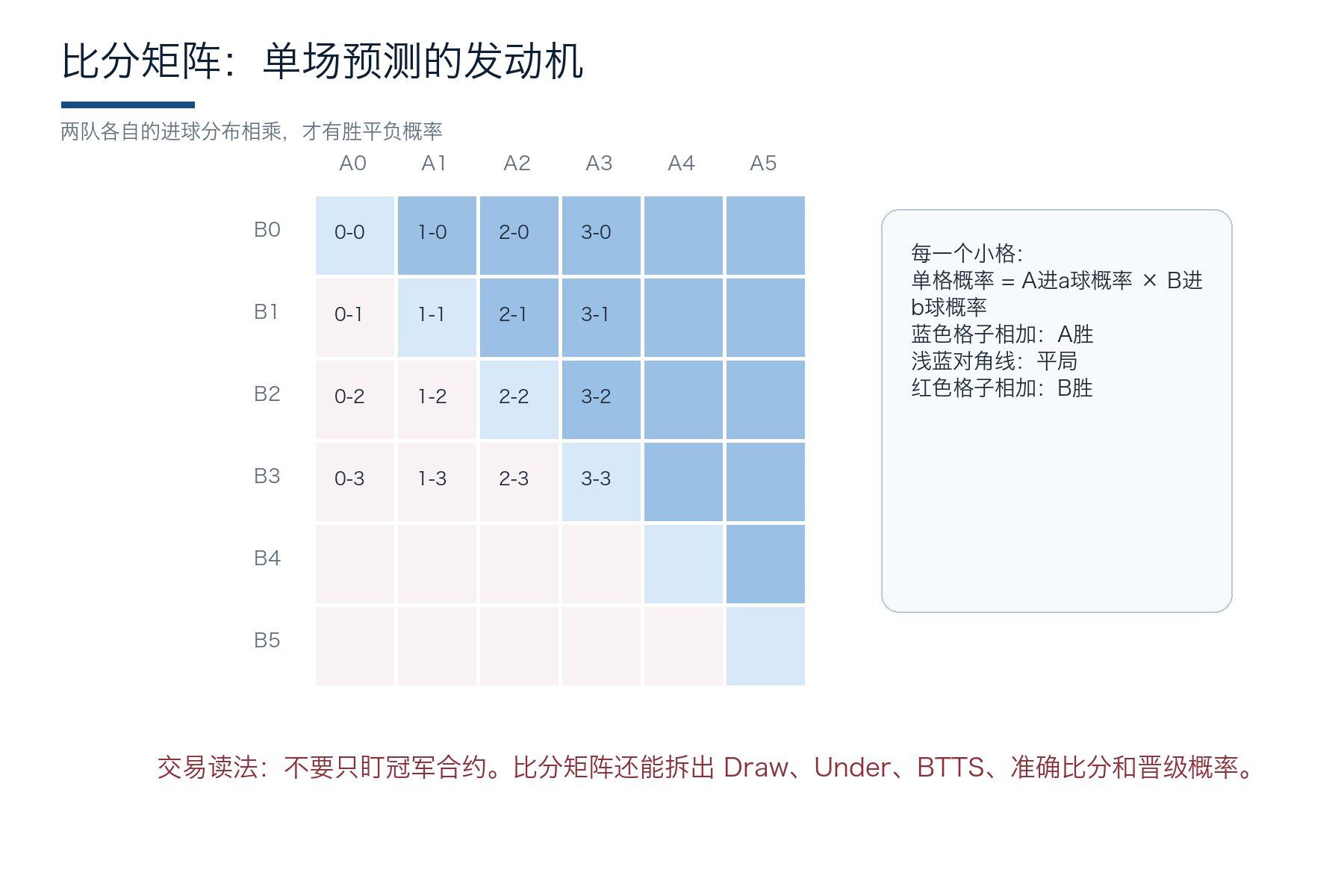
Figure 2: Score Matrix: After multiplying the goal distributions of both teams, they are summed to form win/draw/loss and derivative markets.
Many newcomers jump directly to "what's this team's win probability" when talking about predictions. A more trader-like approach is to first lay out the score matrix. Assume Team A's goal distribution and Team B's goal distribution are calculated. Multiply the probability of Team A scoring 'a' goals by the probability of Team B scoring 'b' goals to get the probability of the a-b score cell.
- The top-left of the matrix contains 0-0, 1-0, 0-1, 1-1; the bottom-right represents high-scoring tail outcomes.
- Summing all cells where A's goals are greater than B's gives A win probability (dark blue);
- Summing equal cells gives draw probability (light blue);
- Summing cells where A's goals are less gives B win probability (red).
This process is slower than directly estimating win probability, but it preserves the structure. And structure is what trading can repeatedly exploit.
Consider two matches where both give Team A a 55% win probability. The first match is a high-tempo, attacking game (2.0 vs 1.2 λ), the second a low-tempo, grinding game (0.9 vs 0.4 λ). The win probability is the same, but over/under, draw odds, red card sensitivity, substitution risks, and extra time probability in knockouts are completely different. The market sometimes compresses these into the same headline probability; the model must decompose them.
This is why, in the World Cup, Draw and Under are often "cleaner" trades than Winner. The market is full of people loving heroic narratives, and prices often favor the popular team, but the low-scoring cells quietly tell you: even strong teams can be dragged into a grind.
Practical Reference
The score matrix is best suited for deconstructing a view. For example, you favor Team A, but the matrix shows their win probability is concentrated in 1-0 and 2-0, not 3-1 or 4-1. Then a more natural expression might not be betting on Team A to win big, but rather on an A win combined with Under or a specific correct score combo. Many losses occur not because the direction was wrong, but because the wrong market was chosen.
In live trading, first check the order book. If the Team A win market has deep liquidity and the price seems fairly reflected, but the ask on Under is still low, the trade should pivot to the market that better expresses your view.
The order book analysis in insiders.bot isn't just for show here. It solves a very practical problem: can your marginal model's edge still be bought at an acceptable price?
The score matrix can answer many questions, but it has an inherent weakness: it's too much like a static mathematical table, easily underestimating the most sensitive low-scoring states in football. 0-0, 1-0, 0-1, 1-1 aren't just four cells; they correspond to a team's risk appetite, match time, and group situation.
To make the model closer to real trading, we must specifically look after these low-scoring regions.
Combining Poisson (2.1) and the score matrix (2.2), we finally arrive at the full picture of this football strategy, which is the earliest and most commonly used World Cup prediction model – Dixon-Coles.
2.3 Dixon-Coles: Low-Scoring Regions Need Special Attention


