Tiger Research: What Does South Korea's Draft "Digital Asset Basic Act" Mean for Four Market Groups?


- Core Viewpoint: South Korea's draft "Digital Asset Basic Act" elevates the unwritten rules of the crypto market into statutory provisions, imposing strict regulation on four major entities—CEXs, financial institutions, overseas stablecoin issuers, and Web3 foundations—driving the industry toward an irreversible evolution of institutionalization, transparency, and compliance.
- Key Elements:
- CEX token listing review reports are upgraded to a statutory obligation, with false statements incurring civil liability; single-entity shareholding caps for systemically important exchanges are set at 20%, putting the control of leading exchanges at risk of being reshuffled.
- Korean won stablecoin issuance is opened only to consortia in which banks collectively hold no less than 60%, with minimum paid-in capital of 5 billion Korean won and a requirement to 100% segregate highly liquid reserve assets.
- Licenses are subdivided into four categories—trading intermediation, custody, brokerage, and advisory—allowing securities firms and trust companies to enter the new custody and brokerage tracks without building their own exchanges.
- Overseas stablecoin issuers must establish registered branches in South Korea, meet a minimum capital requirement of 5 billion Korean won and segregate equivalent reserves, or face mandatory delisting.
- The domestic ICO ban is effectively lifted, but the 24% corporate tax burden and stringent disclosure obligations make large-scale return of overseas foundations unlikely; the dual-track structure of offshore issuance plus local R&D remains the mainstream choice.
This article was written by Tiger Research and provides an in-depth analysis of the far-reaching impact of the bill on four core entities: centralized exchanges, traditional financial institutions, overseas stablecoin issuers, and Web3 foundations—from liability for false statements in token listings and the 20% shareholding cap for major exchange shareholders, to bank-dominated stablecoin consortia and the trade-offs of offshore tax avoidance, comprehensively deconstructing the pains of breaking through as the Korean crypto market enters an era of strict regulation.
Key Takeaways at a Glance
- Bill Panoramic Framework: The bill clearly defines four types of digital asset business forms and establishes hard compliance frameworks for KRW stablecoin issuance, domestic token initial coin offerings (ICOs), and centralized exchanges.
- Centralized Exchanges (CEX): Listing disclosure reports are formally upgraded to statutory obligations, and exchanges will bear strict legal liability for compensation for material misstatements, while major shareholders' shareholding ratios are硬性 capped at a 20% ceiling.
- Korean Domestic Financial Institutions: KRW stablecoin issuance is initially open only to consortia in which "banks hold an absolute majority stake," but the segmentation of licenses also opens up new blue oceans in custody and brokerage for securities firms and trust companies.
- Overseas Stablecoin Issuers: Foreign issuers that already hold compliant licenses in their home countries must establish registered branches in Korea and meet the statutory minimum capital requirement of 5 billion KRW and the equivalent reserve segregation requirement.
- Web3 Foundations and Project Teams: The domestic ICO ban in Korea is substantially lifted, but given the significant tax advantages of overseas crypto hubs such as Singapore and Dubai, the likelihood of project teams returning en masse to Korea remains low, and they face extremely stringent information disclosure thresholds.
Elevating Unwritten Market Rules to National Law
About two years after the first phase of the Virtual Asset User Protection Act officially took effect in July 2024, Kim Jae-sup, a lawmaker of Korea's ruling People Power Party, formally led the proposal of the Digital Asset Basic Act draft (i.e., the second phase of digital asset legislation) in February 2026. The bill still needs to go through lengthy and fierce legislative debate and clause bargaining before it is formally passed by the National Assembly.
Even so, the core significance of the draft lies in comprehensively elevating the "unwritten rules" that previously relied on administrative guidance to statutory provisions, clearly delineating the legal boundaries of various market activities, and filling the long-standing legal gaps in the stablecoin system and domestic issuance mechanisms.
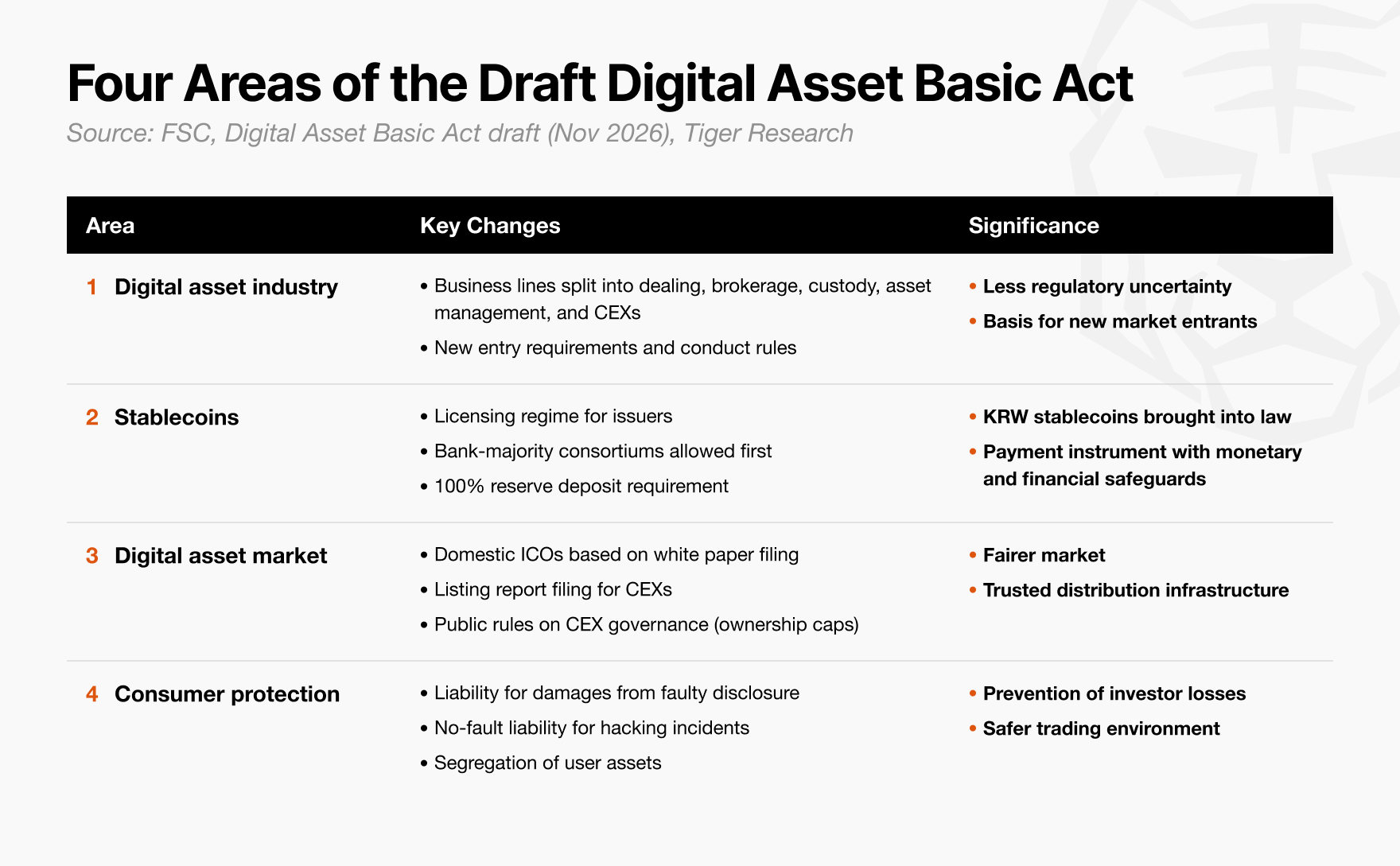
Under the impact of this bill, four core categories of participants in the Korean digital asset market will need to disruptively restructure their long-term strategies: 1) centralized exchanges (CEX), 2) domestic financial institutions, 3) overseas stablecoin issuers, and 4) Web3 foundations and project teams. This article aims to move beyond a tedious clause-by-clause legal dissection and deeply deduce the game dynamics and industrial reshaping of the four major market players under the new regulatory landscape.
Centralized Exchanges (CEX): Listing Liability Codified and 20% Equity Ceiling
Under the new regulatory framework, centralized exchanges must not only submit official listing review reports to the Financial Services Commission (FSC) for each listed token and mandatorily disclose them to the public, but must also bear joint and several civil liability for any false statements or material omissions in the reports. The legal risks of listing reviews have sharply increased, directly triggering a sharp tightening of exchange listing strategies.
The bill's core reforms for centralized exchanges focus on two dimensions: asset listing admission mechanisms and the exchanges' own equity governance structures. Among these two reshapings, the listing review rules will take effect immediately one year after the bill's promulgation, thus constituting the exchanges' urgent compliance deadline; while the rectification of the shareholding cap for major shareholders provides designated exchanges with a three-year grace transition period from the date of designation.
1. Mandatory Disclosure of Listing Review Reports
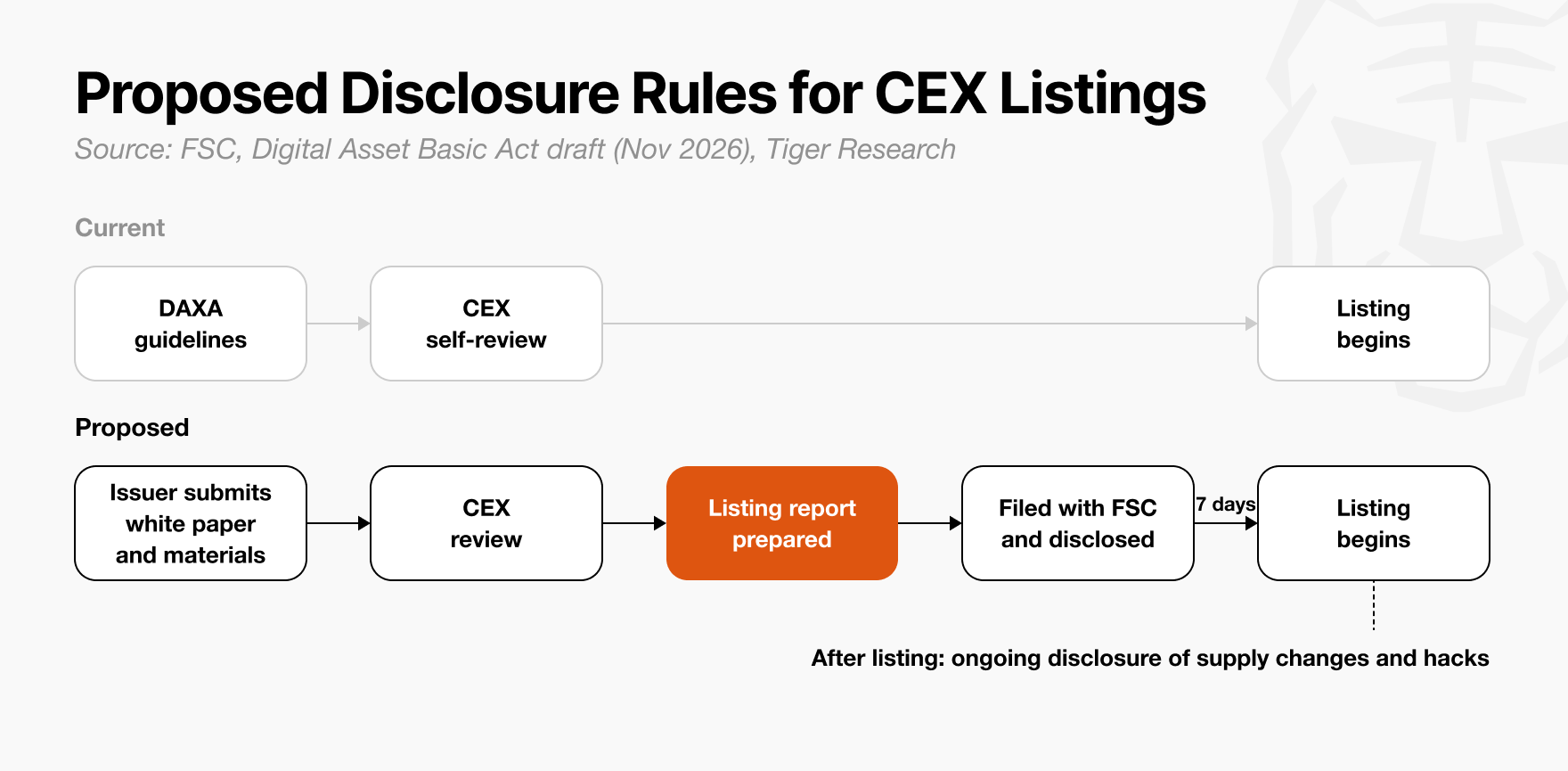
Article 11 of the draft explicitly stipulates that digital asset exchanges (i.e., "digital asset trading intermediary business entities" as defined by the bill) must, when deciding to list any asset, submit to the regulatory authorities a listing review report covering the issuing entity, technical whitepaper, tokenomics allocation, and potential conflicts of interest, and publicly release it to society at large.
Even more fatal is that Article 15, Paragraph 1 establishes an extremely severe civil liability mechanism: once a listing report contains false records, material misstatements, or omissions of important facts that cause ordinary investors to suffer economic losses, the exchange that issued the report must bear civil damages liability to the injured investors.
However, the vast majority of mainstream blockchain protocol development entities are established in overseas offshore jurisdictions, and Korean domestic exchanges have extremely limited cross-border penetrating verification capabilities over their off-chain finances and codebases. Once overseas project teams engage in malicious fraud, Korean exchanges will directly become potential flashpoints for class-action lawsuits brought by injured investors, and exchange legal compliance departments will have to conduct protracted due diligence, forcing them to retreat to more robust, battle-tested mainstream assets.
2. Designated Exchange System and 20% Shareholding Cap
Article 42, Paragraph 1 of the draft introduces a highly lethal "Designated Exchanges" system: for top platforms whose trading scale and market influence reach specific thresholds, the Financial Services Commission may directly designate them as systemically important exchanges and impose public governance requirements as stringent as those for traditional stock exchanges.
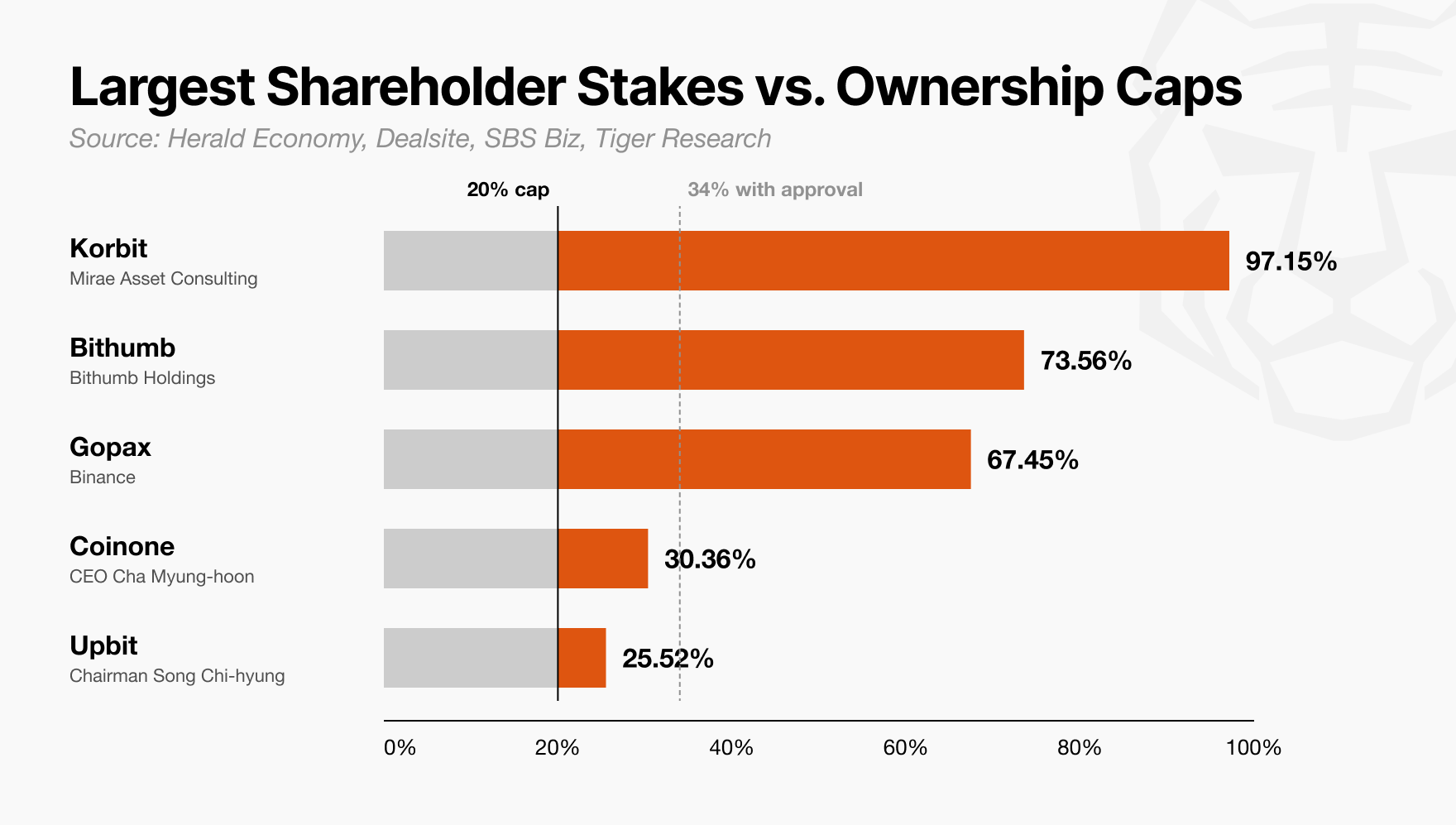
Among them, the clause that most shocks the industry is Article 42, Paragraph 2: no single entity and its affiliates may directly or indirectly hold shares in a designated systemically important exchange exceeding 20%.
This clause directly targets the two Korean exchange overlords, Upbit (Dunamu) and Bithumb. Currently, founder-core figures such as Song Chi-hyung firmly control more than 20% of Dunamu through concerted action parties; in the Bithumb system, Lee Jung-hoon and his affiliates are likewise deeply in control. If the bill formally takes effect, although existing designated exchanges enjoy a three-year rectification grace period, the three major controlling shareholders will be forced to list and sell massive excess equity on the secondary market, or dilute their holdings by introducing institutional consortia, and the actual control and capital landscape of the entire Korean exchange sector will undergo an irreversible historic reshuffle.
Korean Domestic Financial Institutions: A Diversified Expansion Blueprint Beyond the Stablecoin Framework
Traditional commercial banks, securities brokers, and trust companies that have long been firmly barred from the digital asset door will welcome a historic institutional icebreaking in this bill.
1. KRW Stablecoins: Bank-Led Consortia and Fintech Access
Article 21, Paragraph 1 of the draft formally establishes the issuance admission license for fiat-collateralized stablecoins (especially KRW stablecoins). To prevent systemic financial risks similar to the Terra-Luna algorithmic collapse, regulators have set nearly苛刻 capital and governance red lines:
Issuing entities must have at least 5 billion KRW (approximately USD 3.7 million) in paid-in capital and deposit 100% of highly liquid reserve assets equivalent to the stablecoin's circulating scale in segregated custody at safe institutions such as banks. More substantively binding is that the Financial Services Commission has set a stringent shareholder structure threshold: commercial banks must hold a combined stake of no less than 60% in the issuing entity (for example, four major banks each holding 15% to form a consortium, a fintech company holding 30%, and other strategic partners holding 10%).
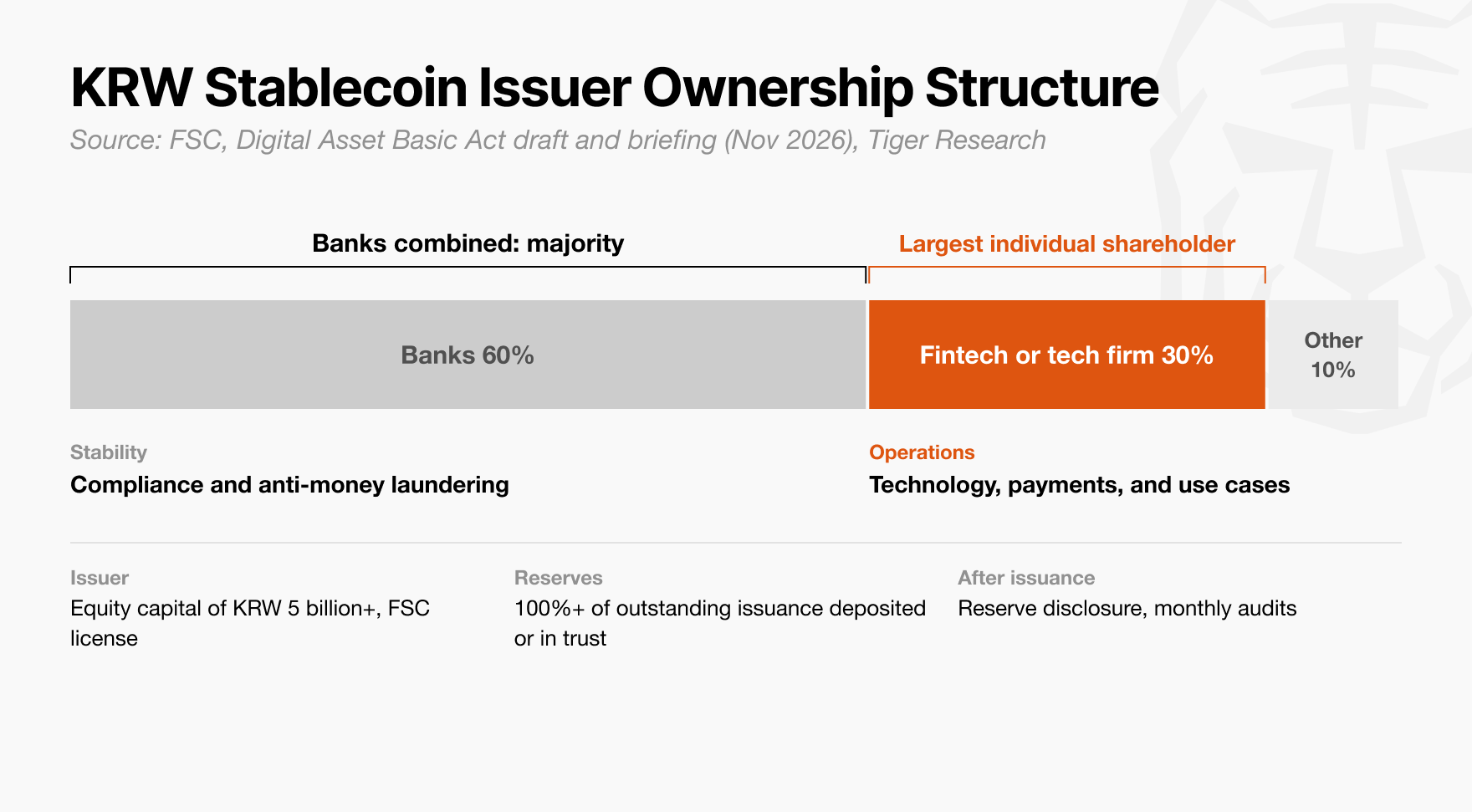
The 15% shareholder cap stipulated by the Banking Act is the key variable here. Under the current Banking Act, a single bank's equity contribution to a non-financial enterprise is in principle limited to 15%, which is also the legal basis for the FSC's deduction in official policy soundings of "four banks each holding 15% to make up 60% controlling stake." However, the draft provisions do not explicitly exempt bank consortium structures from the current Banking Act restrictions. In the absence of clear operational guidelines, any enterprise attempting to enter the KRW stablecoin space must, as its first strategic step, form an interest community by partnering with multiple mainstream banks.
This also means that pure fintech companies or Web3-native teams are almost impossible to independently monopolize the issuance rights of KRW stablecoins. The future will inevitably evolve into a co-opetition norm of "commercial bank controlling shareholders providing licenses and reserve credit + fintech giants taking equity stakes to provide front-end scenarios and circulation networks."
2. Diverse New Tracks Created by the Separation of Four Business Licenses
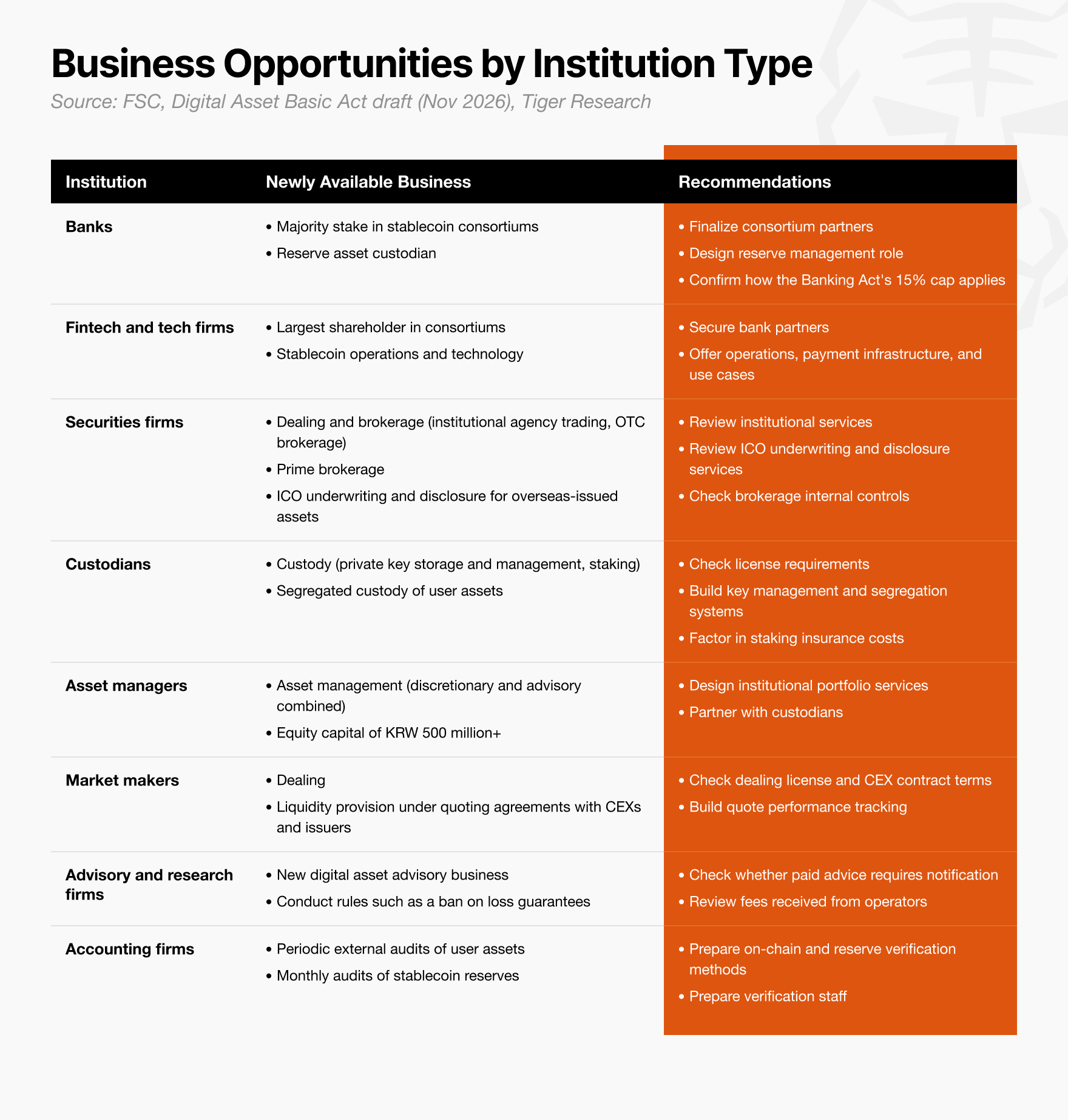
The draft completely abandons the previously broad and crude single concept of "Virtual Asset Service Provider (VASP)" and instead draws on traditional capital market legislation to finely segment the digital asset industry into four independent licensed business types:
- Digital Asset Trading Intermediary Business: Responsible for matching and order book matching (i.e., pure order book exchanges);
- Digital Asset Custody Business: Independently and securely safekeeping client assets;
- Digital Asset Brokerage Business: Executing trading instructions on behalf of clients;
- Digital Asset Advisory Business: Providing investment analysis and asset allocation recommendations.
This refined segmentation of licenses enables traditional securities firms to directly integrate crypto asset trading modules into their existing securities apps by applying for independent brokerage and advisory licenses, without spending huge sums to build their own exchanges; while large trust companies and commercial banks can leverage their extremely high sovereign credit endorsement to rapidly seize institutional-grade custody dominance in the independent custody license track.
3. Remaining Issues Not Yet Clarified in the Draft
Although the framework has taken initial shape, the bill still leaves huge gaps on many key operational details: Are commercial banks allowed to allocate spot digital assets directly on their balance sheets with their own capital? Can traditional financial institutions directly use KRW stablecoins in cross-border payments and clearing settlement? These pending red lines still await final determination through the Enforcement Decrees subsequently issued by the Financial Services Commission.
Overseas Stablecoin Issuers: Subject to Korea's Localized Admission and Registration Procedures
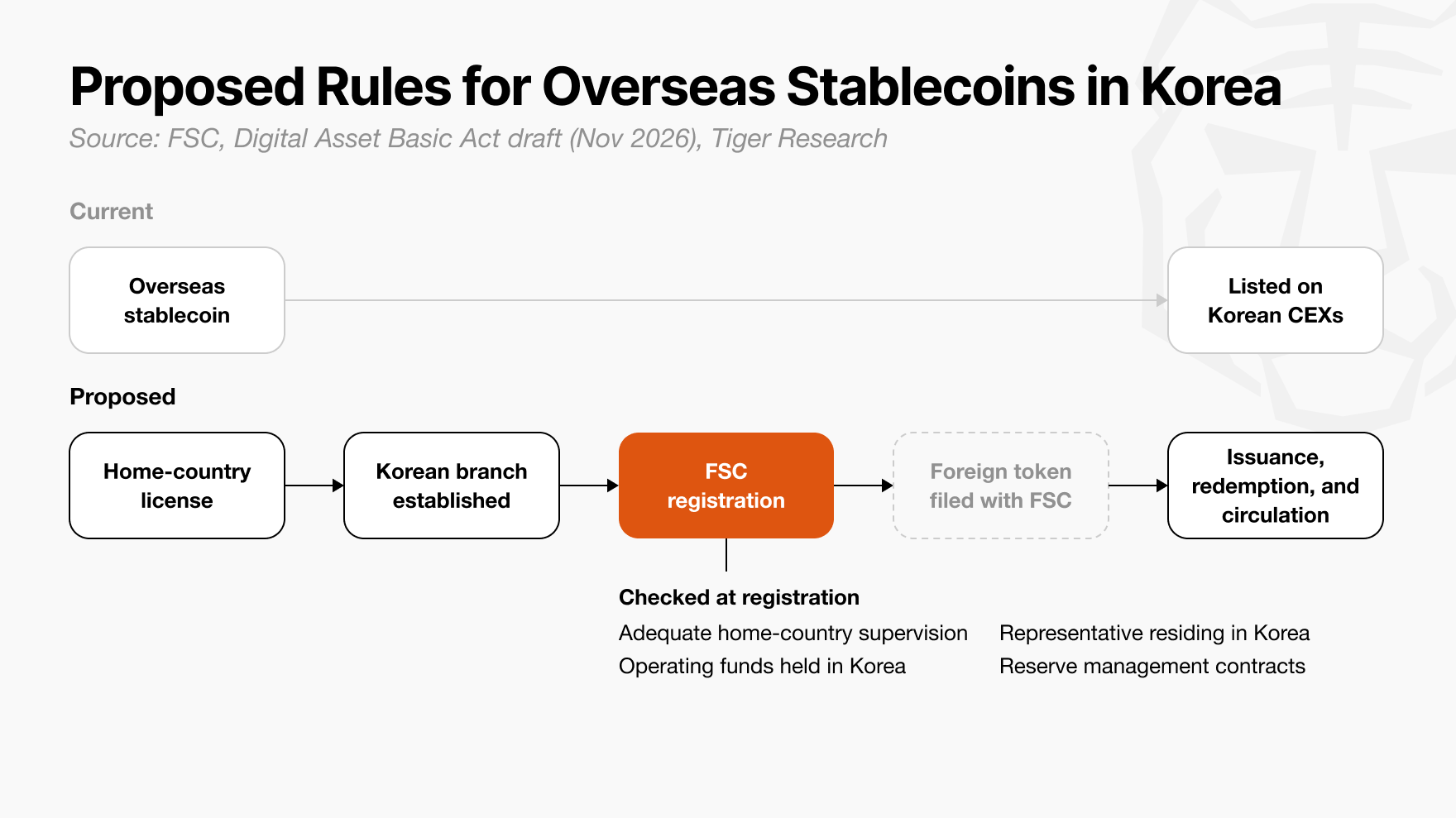
Regarding the overseas USD stablecoins that currently hold monopoly dominance in Korea's trading market (such as USDT issued by Tether and USDC issued by Circle), Article 28 of the draft establishes a highly targeted cross-border long-arm regulatory mechanism:
If overseas issuing institutions want their stablecoins to maintain compliant trading on major Korean CEXs and circulate legally to Korean residents, they must establish a formal registered branch or designate a statutory local agent in Korea. At the same time, issuers must have already obtained equivalent compliant licenses in their home jurisdictions and regularly submit reserve asset adequacy ratios and audit reports to the Korean Financial Supervisory Service (FSS).
The introduction of this provision means that overseas giants will have to accelerate the construction of their localized legal entities in Seoul and the docking of bank settlement networks. If certain offshore unregulated stablecoins refuse to meet the above localization compliance requirements, Korean regulators will have the authority to directly order major exchanges to enforce mandatory delisting and isolation.
Web3 Foundations and Project Teams: Domestic ICO Ban Lifted but Tax Havens Hard to Shake
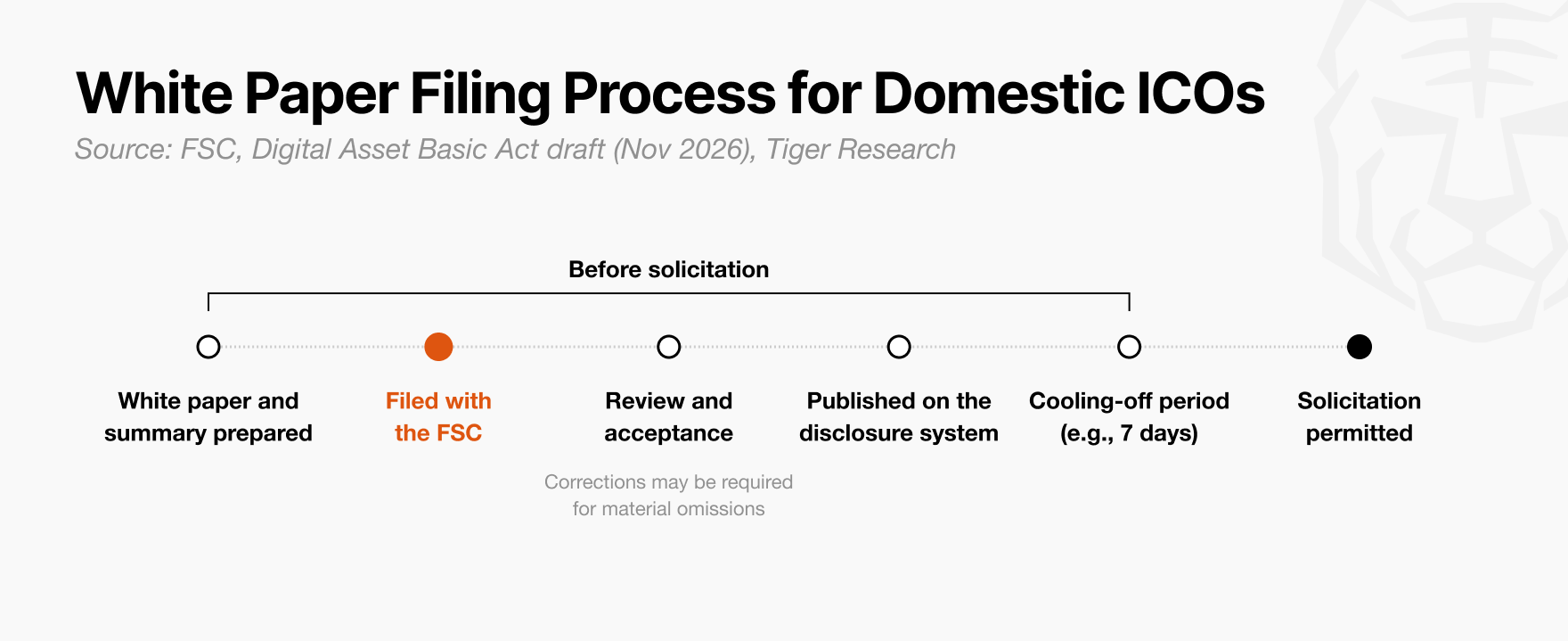
Since the Korean Financial Services Commission issued a blanket ban on domestic ICOs in September 2017, for nearly a decade, the vast majority of excellent Korean startup teams have been forced to go overseas, establishing offshore foundations in Singapore, Switzerland, the UAE (Dubai/Abu Dhabi), or the Cayman Islands to issue tokens indirectly. Article 7 of the draft finally formally unseals domestic compliant ICOs at the legal level.
However, Tiger Research's investigation believes that this policy relaxation is unlikely to trigger a large-scale return of overseas foundations in the short term. The core constraints lie in the heavy tax costs and stringent disclosure responsibilities:
- Significant Tax Haven Gap: In Dubai, UAE, or the Cayman Islands, foundations can enjoy offshore tax advantages with near-zero tax rates; once the token issuance entity is moved back to Seoul, Korea, the foundation will immediately be incorporated into Korea's standard corporate income tax regime of up to 24%.
- High Statutory Whitepaper Disclosure Burden: The draft requires domestic issuing entities to submit to regulators detailed technical code audits, token unlock schedules, treasury fund flows, and executive holdings details, and to bear comprehensive joint legal liability for the authenticity of disclosures.
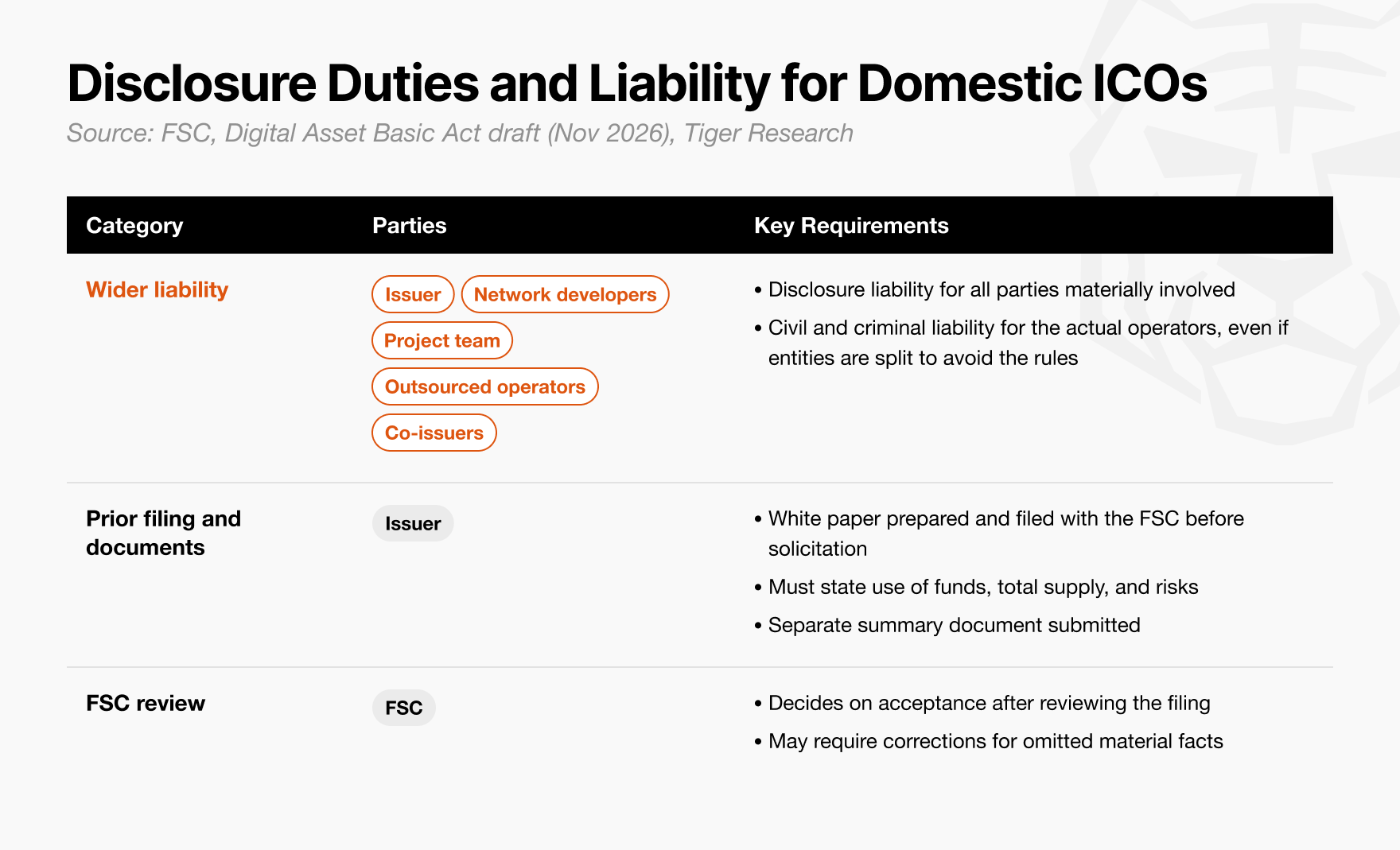
Therefore, for the vast majority of leading Web3 teams with a global vision, maintaining the dual-track structure of "offshore foundation issuance + Korean local technology subsidiary R&D" remains the most rational and pragmatic optimal solution at present.
The bill further substantially extends the scope of joint liability for information disclosure from purely issuing entities to underlying network developers, core project teams, and token sales promotion agencies. Any natural person involved in writing whitepapers or promoting and selling tokens may be drawn into the vortex of civil compensation in the event of false statements by the project. To cope with this high-risk environment, overseas foundations will in the future have to establish permanent compliance liaison offices in Korea or hire local professional law firms to assume statutory information disclosure agency responsibilities.
Digital Assets: A Key Step into the Compliant Traditional Financial System
The proposal of the Digital Asset Basic Act draft marks that the Korean crypto market has finally bid farewell to years of barbaric extensive development and gray-area wandering, and formally entered a modern rule-of-law era rigorously aligned with traditional capital markets. Although controversies over property rights surrounding the 20% shareholding cap, the bank monopoly tendency of KRW stablecoins, and the crowding-out effect of high taxes on domestic innovation will still trigger fierce clashes in the National Assembly, the overarching trend of the entire industry's irreversible evolution toward institutionalization, transparency, and compliance has been thoroughly established.