Nvidia's Market Cap Surges $950 Billion Overnight — Who Knew About Jensen Huang's Return in Advance?


- Key Points: Nvidia CEO Jensen Huang returned to his post after a brief 11-day absence, triggering a dramatic market reversal, while multiple suspicious accounts in prediction and options markets positioned themselves ahead of the news, in what appears to be insider trading for profit.
- Key Details:
- Nvidia plunged 14% on November 20, marking its longest weekly losing streak since 2008. After the return announcement on November 23, the stock soared 31.48% in a single day, adding $950 billion in market cap overnight.
- Nvidia drove the S&P 500 and Nasdaq 100 to close up 4.73% and 6.86% respectively. Nasdaq futures were briefly halted after rising over 7%, and Bitcoin briefly broke through $64,000.
- On Polymarket, 5,381 addresses bet on Jensen Huang's return, collectively earning $3.87 million. Among them, 16 suspicious addresses invested only about $20,000 and profited $350,000 — some accounts were funded and placed bets just hours before the announcement.
- Nvidia options volume exceeded 11 million contracts on November 23, a historic high and more than five times the 30-day average. On November 20, a trader actively bought call options worth approximately $19.9 million across 7 transactions, including a long-dated contract expiring in 2029 with a strike price of $240 worth about $11.04 million.
- Economist Peter Schiff publicly questioned whether people close to Trump may have had advance knowledge of the news and bought Nvidia and related AI stocks before Friday's close to profit.
- Cathie Wood's firm reduced its Nvidia holdings by approximately 679,000 shares — about $102 million — before the rally, missing out on this rebound.
Original | Odaily (@OdailyChina)
Author | Golem (@web3_golem)
The surreal nature of financial markets continues to intensify. Last week, global assets fell across the board, with the market still mired in pessimism over the bursting of the AI bubble and the collapse of the global economy; but after Jensen Huang announced last night that the king has returned and would rejoin Nvidia as CEO, the market instantly entered a bull-run frenzy.
It took only 11 days for Jensen Huang to go from announcing his departure to being reinstated, and at the market level, the true swing from extreme pessimism to a reversal occurred over just 2 trading days (November 20 and November 23). Nvidia plunged 14% on November 20, logging its longest streak of weekly declines since 2008; after the reinstatement announcement on November 23, the stock surged 31.48% in a single day, marking its largest intraday gain since May 2003 and adding $950 billion in market cap overnight.
At the same time, Nvidia also lifted other assets, with the S&P 500 and Nasdaq 100 closing up 4.73% and 6.86% respectively. Nasdaq 100 futures were even briefly halted after gaining more than 7%, and Bitcoin briefly broke above $64,000.
Even for professional traders, such a market is hellishly difficult. Cathie Wood's investment firm trimmed a total of about 679,000 Nvidia shares, worth roughly $102 million, before Nvidia's stock surged; but for "insider players" in prediction markets and futures markets, such a market is their "ATM."
16 Insider Addresses in Prediction Markets Rake In $350,000
Before Jensen Huang formally announced his return as Nvidia CEO, the probability on Polymarket of Huang continuing as Nvidia's next CEO was 18%, with Arm CEO Rene Haas — at nearly 20% — having a higher probability than Huang. But only after Huang announced last night that he would serve as vice chairman of SoftBank Group did his probability become the highest. Then, after the official reinstatement announcement, the probability quickly rose above 90%.
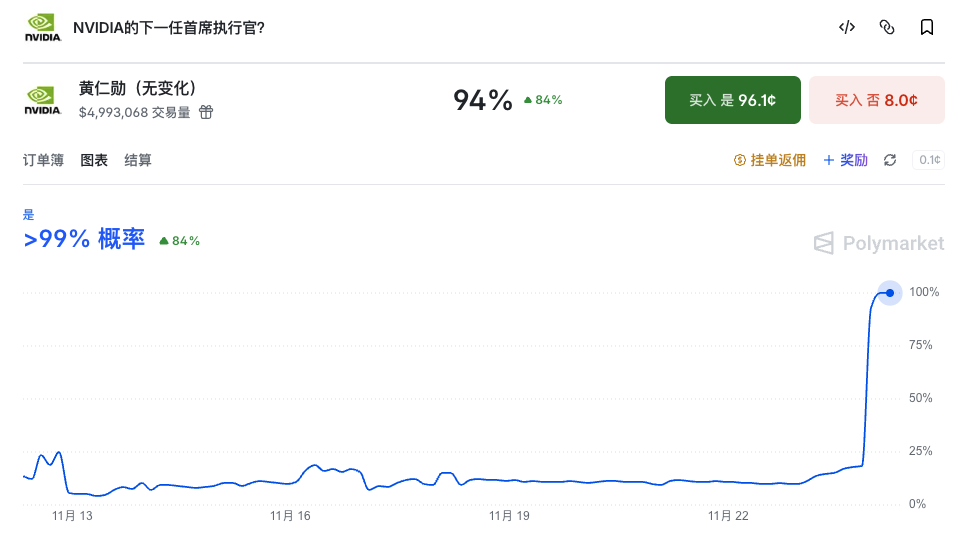
There weren't many traces of insider addresses in that event contract, but in the separate event contract trading the date of Huang's return to Nvidia, multiple addresses showed suspicious characteristics.
According to Polymarket's public trading data, overall, 5,381 addresses in that market bet on Huang's return, earning a total of $3.87 million after fees, while 1,419 addresses bet against his return. The top-ranked account (username not displayed) earned $275,536, having made its first purchases on November 14 and November 17 at average prices of 5.5 to 13 cents per purchase.
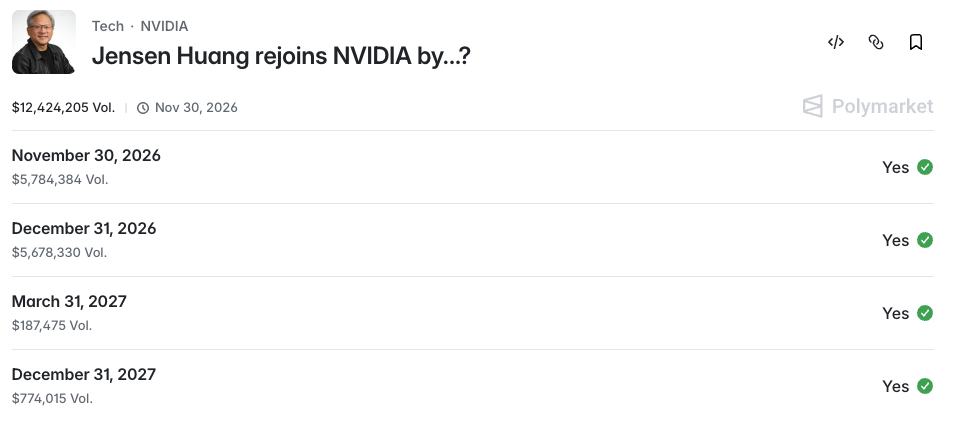
Judging by position-building timing, the top-ranked address's "insider flavor" isn't particularly strong, but two other groups of suspicious accounts placed bets before news of Huang's reinstatement emerged, earning a combined $350,000. These addresses only bet on markets related to Huang and Nvidia.
Among them, the first group of 11 accounts only funded between 3:49 and 10:44 UTC on November 23 (hours before the announcement) and placed bets immediately after funding; the other group of 5 accounts received funds on November 16 (last Monday), but these accounts only bet on Huang-related markets, with no involvement in sports, politics, or crypto — a very high concentration of insider flavor. If true, it can reasonably be inferred that Nvidia's board had already reached some kind of implicit consensus on Huang's reinstatement as early as last week.
But these 16 addresses collectively invested only about $20,000 betting on Huang's return to Nvidia, ultimately earning $350,000. The four highest-earning addresses are shown in the image below.
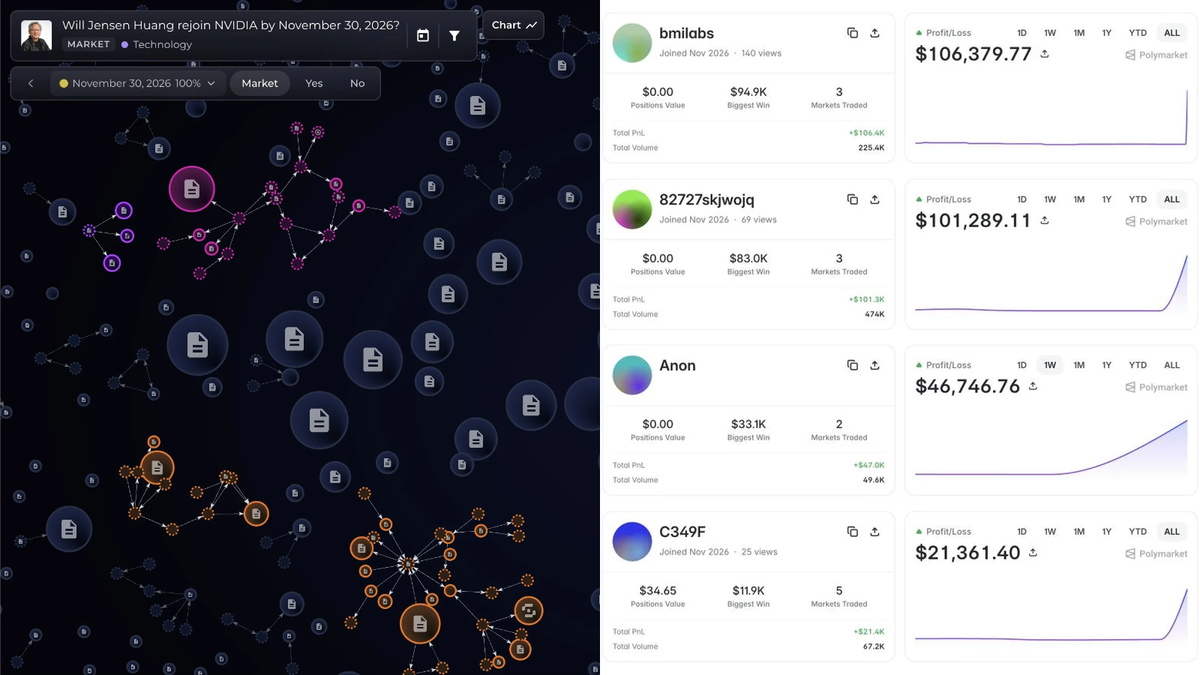
Source: Bubblemaps
Suspicious Trades in the Options Market
Constrained by market liquidity and depth, the real "top insider players" may not even bother profiting from prediction markets — the futures market is the bigger stage.
On November 23, Nvidia stock options volume exceeded 11 million contracts, setting a record for single-day options volume in the stock and more than five times the 30-day average. But overall it was not an abnormally one-sided bullish stance; among the top 10 trades there were two large Put sells, with no obvious "direct large Call buying" dominance, and a large volume of trades concentrated around the 160-170 strike (about 4 million contracts, nearly $2 billion notional).
Therefore, November 23 was more about repricing and rolling positions after a decline in volatility rather than pure speculative bullish bets. But according to options data platform CapitalFlow, a trader made a large purchase of Nvidia call options on November 20 (last Friday).
The trade most viewed by the market as suspicious was an investor buying Nvidia call options in 7 tranches over 151 minutes on that day, when Nvidia's stock price was around 135, with total premiums of about $19.9 million, all executed at the active seller's Ask.
Three of these were long-dated calls expiring January 19, 2029, with a $240 strike, totaling about $11.04 million, with the largest single trade at about $6.61 million; the other four were calls expiring February 2027 with a $145 strike at about $5.45 million, two calls expiring January 2028 with a $140 strike totaling about $2.31 million, and calls expiring March 2027 with a $200 strike at about $1.13 million.
Economist and gold advocate Peter Schiff also publicly questioned on X that people close to Trump may have learned in advance about Huang's return to Nvidia and bought Nvidia and other AI-related stocks before the US market close last Friday to profit from the subsequent rally.
Of course, these trades are not yet enough to prove that insider trading actually occurred, and the final outcome awaits follow-up from regulators. But Nvidia's "short-drama-style" CEO reinstatement saga is finally over — from the initial Huang "pants problem," it escalated to issues of racial discrimination and political factions in Silicon Valley startups, and ultimately ended with the wallets of most ordinary investors being harvested.
Perhaps some people had already seen the cards in this play in advance. Jensen Huang is now receiving cheers at Nvidia headquarters, the winners in the market have already left the table, and the rest are only just beginning to understand what happened.