With licenses in one hand and security in the other, how is Gate positioning itself for the second half of the exchange race?


- Core Viewpoint: Competition among crypto exchanges has shifted from incremental growth to existing market share, with compliance becoming a core moat. Gate began laying out global compliance as early as 2018 and has now formed a license network covering markets such as Europe, the Americas, the Middle East, and Japan. Compliance investment is translating into new momentum for user growth and business expansion.
- Key Elements:
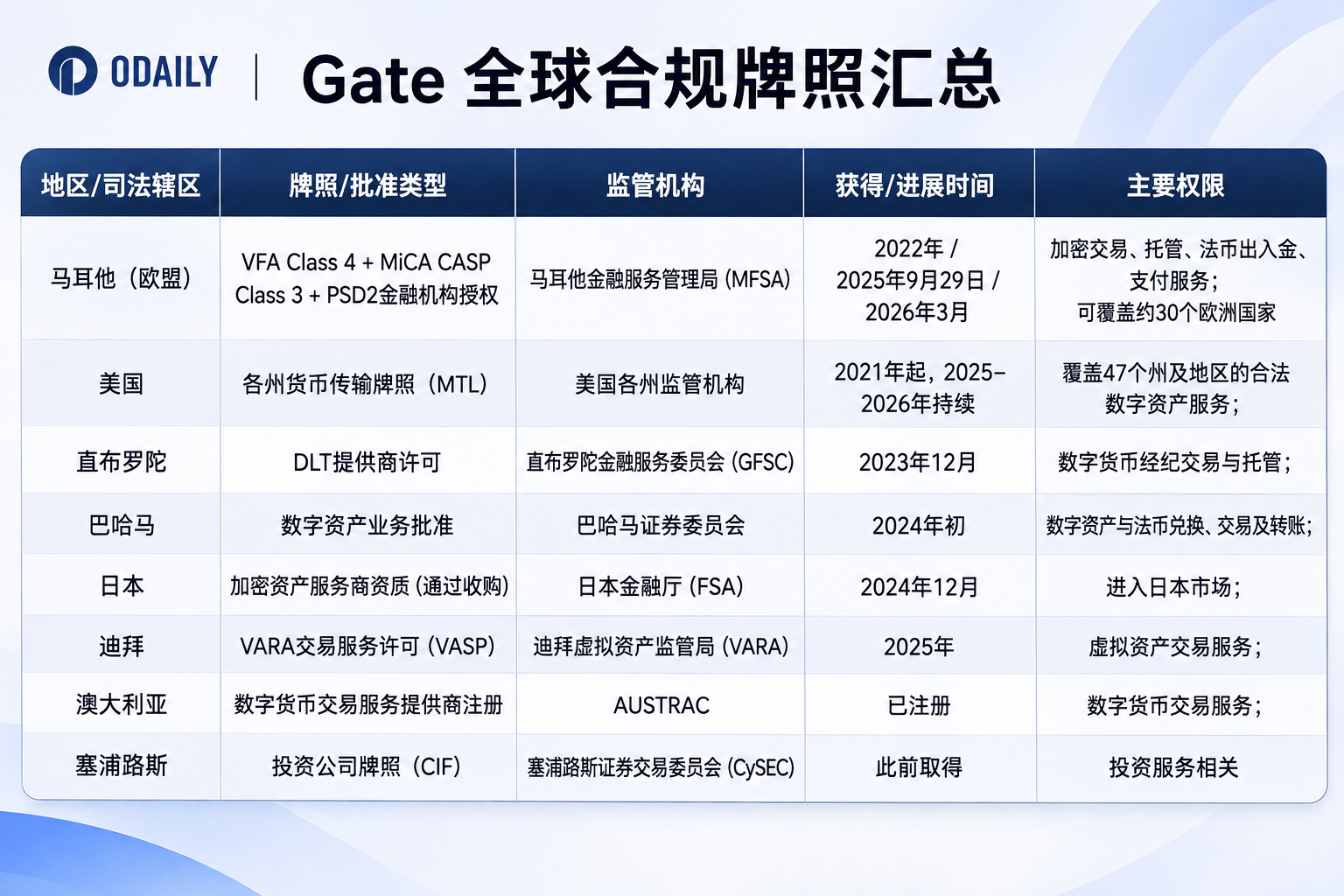
- Gate initiated its license application in Malta in 2018, four years before the FTX collapse, and obtained the Malta VFA Class 4 license in 2022.
- In 2025, it obtained the Dubai VARA trading license, Gate US covers 47 U.S. states and territories, and in September of the same year it obtained EU MiCA CASP authorization (Class 3, the highest capital tier), enabling passporting across more than 30 European countries.
- Among the world's top 100 exchanges, only 17 have obtained MiCA licenses, and among the top 10, only 6 are licensed, highlighting the scarcity of compliance.
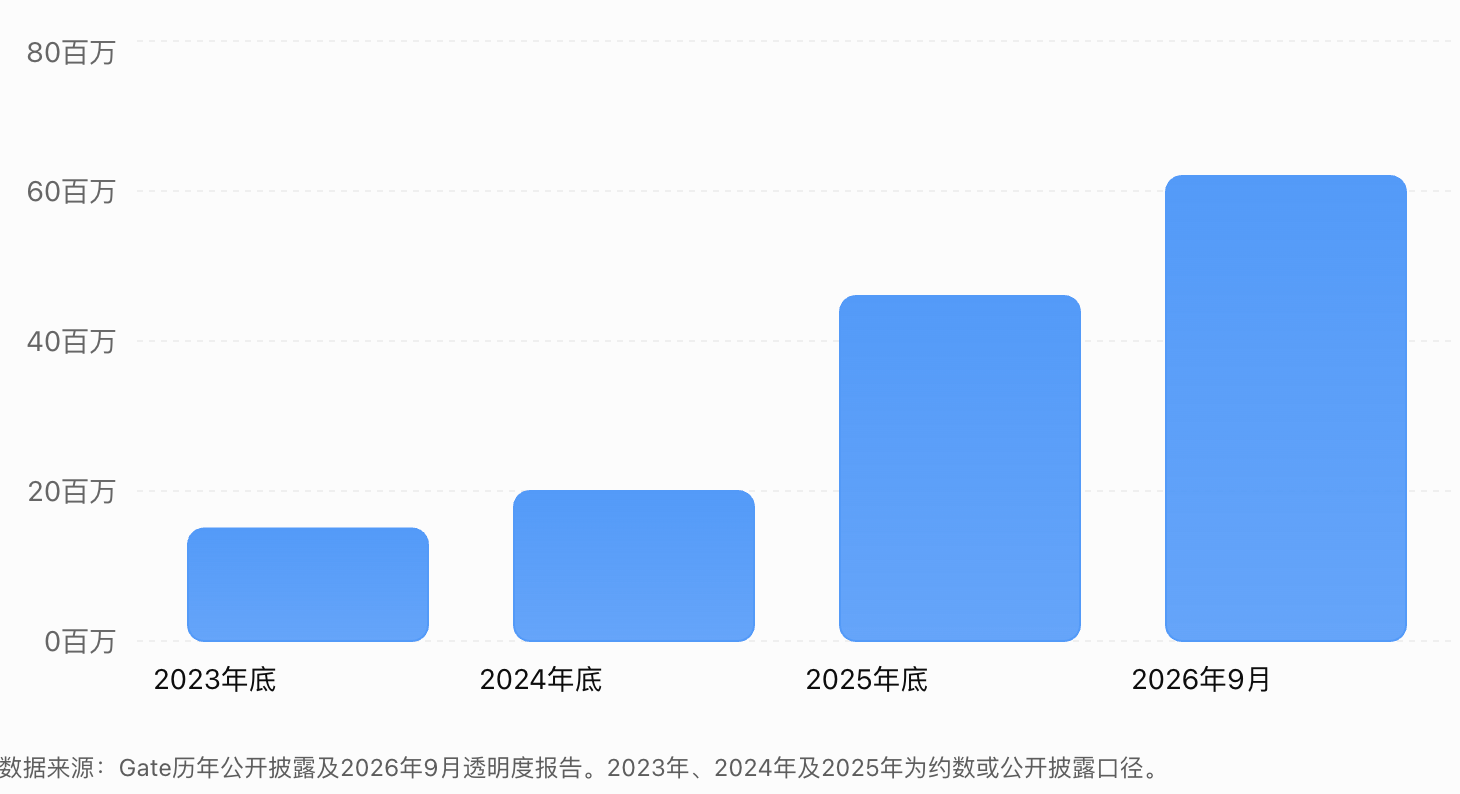
- User scale grew from about 15 million at the end of 2023 to over 46 million by the end of 2025, and surpassed 63 million in November 2026; derivatives trading volume reached $396 billion in Q3 2026, up 38.2% quarter-over-quarter, ranking third globally.
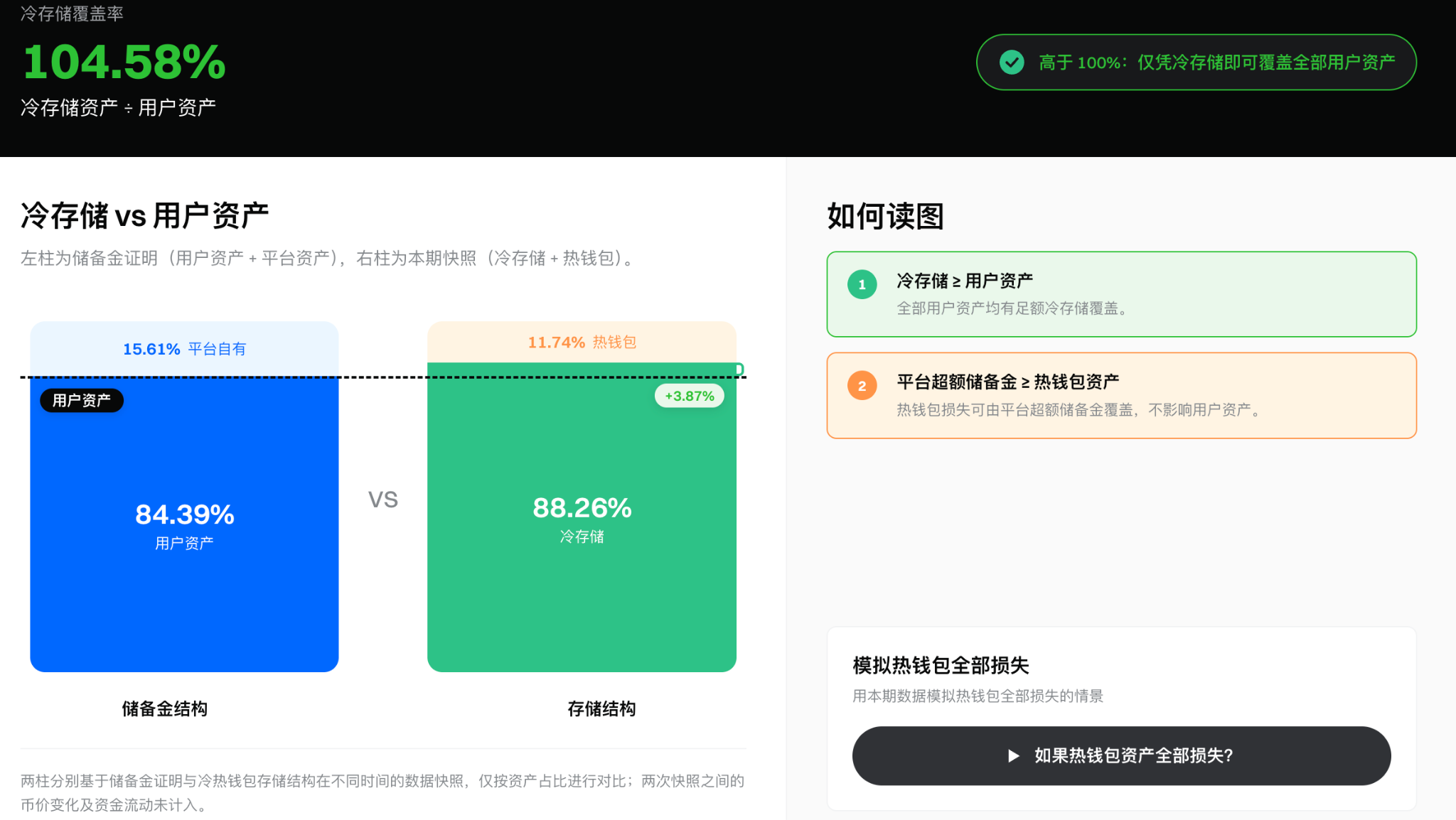
- It launched PoSEC proof of fund security, with cold storage coverage reaching 104.58%, and cold and hot wallets accounting for 88.26% and 11.74% respectively.
- Gate Security Guardian provides compensation for account theft, with a cap of $200,000 per incident, productizing security capabilities.
Original | Odaily@OdailyChina)
Author | Golem (@web3_golem)
Competition among crypto exchanges is entering a new phase.
For more than a decade, the industry was in a period of rapid expansion, and exchanges competed only on listing speed and trading depth. But today, as the crypto market gradually matures, the growth of global users and trading demand is beginning to rationalize, and competition among exchanges has shifted from an incremental market to a stock market.
When new users become increasingly difficult to acquire, and when trading products and fees gradually converge, what should exchanges rely on to build their own competitive moats? The answer is compliance.
In this round of change in the industry's competitive logic, Gate is a case worth observing. As early as 2018, Gate had already begun applying for overseas licenses, and today its compliance footprint has extended to markets including Europe, the United States, Japan, and Dubai, and it has successively launched PoSEC proof of fund security and Gate Guard. As the industry's competitive rules begin to change, Gate's years of investment are also ushering in new value.
Compliance Layout Four Years Before the FTX Collapse
The FTX collapse in 2022 was an important turning point in the compliance process of crypto exchanges.
This crisis ultimately caused enormous industry chain reactions. Some affected trading platforms suspended user withdrawals, and the entire crypto market began to re-examine the operating models of centralized exchanges, which also prompted global regulators to step up compliance supervision of crypto exchanges.
However, Gate did not begin building compliance only after this crisis occurred. Gate's compliance construction was four years earlier than this crisis.
"In 2018 we submitted an application in Malta, and in 2022 Gate obtained Malta's compliant custody license and trading license, and since then we have begun to advance the compliance process globally." At the beginning of this year, Gate founder and CEO Dr. Han, in an interview with Odailyinterview, once reviewed the platform's compliance construction journey.
What did the crypto market look like in 2018?
At that time, the industry had just experienced the 2017 ICO frenzy, and the entire market was still in a stage where the regulatory framework was incomplete and trading platforms grew wildly. For most exchanges, how to expand user scale, increase trading pairs, and compete for market share was far more urgent than how to build a compliance system that could adapt to the regulatory requirements of different countries.
Gate's choice to begin applying for overseas licenses at this stage meant that it needed to allocate legal, operational, and technical resources for compliance construction during the industry's rapid expansion period. These efforts not only brought little direct revenue at the time, but also required Gate to continue investing.
With the outbreak of the industry trust crisis in 2022, the compliance construction that Gate had invested in for years also began to demonstrate new value.
Of course, submitting an application in 2018 still left a long road before having global compliant operating capability. But from the timeline, Gate regarded compliance as part of long-term operations very early on, staying ahead of the crisis.
Gate's continuously expanding global license map in the following years is also the most intuitive embodiment of this long-term strategic value.
Gate's Global Compliance Map
Obtaining compliant operating permission globally is not an easy task. Regulatory systems differ greatly across countries and regions, and each time an exchange enters a new market, it needs to understand local laws and regulations, establish corresponding business entities, and apply for different regulatory qualifications according to business types.
Judging from Gate's progress over the past few years, its global compliance layout did not begin only in the last year or two, but is work that has continued for many years.
As early as 2021, Gate US had already begun applying for relevant licenses in the United States one after another.
In February 2022, Gate's Maltese entity Gate Technology Ltd obtained the Class 4 Virtual Financial Assets Service Provider License (VFA Class 4) issued by the Malta Financial Services Authority (MFSA), allowing it to provide crypto asset trading, fiat on-ramp and off-ramp, and custody services.
In December 2023, the group's Hippo Capital Co. Limited obtained a Distributed Ledger Technology (DLT) provider license issued by the Gibraltar Financial Services Commission (GFSC), allowing it to provide brokerage trading and custody services related to digital currencies within the authorized scope.
In 2024, Gate's overseas compliance layout continued to expand. At the beginning of the year, entities related to Gate Group received approval from the Securities Commission of the Bahamas to conduct businesses including digital asset and fiat exchange, digital asset trading, and transfers. In December of the same year, Gate Group announced the acquisition of Japanese crypto asset service provider Coin Master, further paving the way for entering the Japanese market.
But if the previous years were about establishing compliance footholds one by one in different markets around the world, then 2025 was an important year for the expansion of Gate's compliance map.
According to information disclosed by Dr. Han in an interview with Odaily, 2025 was the year in which Gate obtained the most compliance licenses. First came progress in the Middle East, where Gate Technology FZE obtained a trading service license issued by the Dubai Virtual Assets Regulatory Authority (VARA), allowing it to provide virtual asset trading services to different types of investors within the authorized scope.
Second, compliance construction in the US market made major progress. In 2025, Gate US obtained compliance licenses in 35 US states, with compliant business covering 46 US jurisdictions, allowing it to provide legal services in most of the United States. In 2026, Gate US obtained two additional state-level Money Transmitter Licenses (MTL), expanding its service coverage to 47 US states and territories.
Obtaining Europe's MiCA Compliance License
The US state-level license system is a protracted battle requiring long-term investment, while in Europe, Gate secured a license with broader regional value.
On September 29, 2025, Gate obtained authorization as a Crypto Asset Service Provider (CASP) issued by the Malta Financial Services Authority (MFSA) under the EU's Markets in Crypto-Assets Regulation (MiCA), becoming a Class 3 licensed service provider, with Class 3 being the tier with the highest capital requirements under MiCA.
The significance of this license goes far beyond Gate obtaining an operating permit in Malta.
Unlike the relatively fragmented license systems of US states, MiCA established a unified crypto asset regulatory framework for EU member states. A CASP authorized by a regulator in one member state, after meeting requirements such as cross-border notification, can conduct corresponding business in other EU member states through the license passporting mechanism, without needing to reapply for a separate MiCA license in each country.
Therefore, Gate is eligible to provide crypto trading services in major European markets such as Germany, France, Spain, and the Netherlands, with overall coverage exceeding 30 countries in Europe.
The value of this license can also be seen from how it has been obtained across the industry.
According to MiCA license statistics as of November 2026, among the top 100 crypto exchanges by global trading volume, only 17 had obtained CASP authorization, accounting for about 17%; and among the top 10 exchanges, only 6 had obtained MiCA licenses.
In addition to MiCA, Gate further expanded its payment service capabilities in Europe.
On March 20, 2026, Gate officially announced that its Maltese entity Gate Technology Ltd obtained financial institution authorization from the MFSA under the framework related to the EU's second Payment Services Directive (PSD2), allowing it to provide payment services within the approved scope.
If the MiCA license mainly addresses the trading, exchange, and custody of crypto assets, then the payment service authorization provides a further regulatory foundation for stablecoin payments and broader fund usage scenarios.
Combined with the previously obtained Cyprus investment firm license, Gate's compliance layout in Europe is no longer limited to crypto asset trading, but is gradually extending to financial businesses such as investment services and payments.
From Malta and Gibraltar to the Bahamas, Japan, the United States, and Dubai, plus Australia's digital currency exchange service provider registration, the regulatory licenses, registrations, and approvals obtained by different business entities under Gate have gradually formed a compliance network covering multiple important financial markets.
Long-Term Compliance Investment Begins to Translate into Gate's New Growth Driver
Gate's years of compliance investment have been more like building infrastructure for future business expansion. During periods of rapid industry growth, these investments may not have seemed impressive, but as exchange competition gradually shifts from land-grabbing to licensed operations, the infrastructure accumulated in the past begins to show different value.
In particular, when an exchange hopes to expand its business from单纯的 cryptocurrency trading to broader financial services such as stocks, ETFs, precious metals, and payments, compliance capability is no longer an optional bonus, but an important prerequisite for whether the business can be implemented.
Over the past few years, Gate has entered a new growth stage in terms of user scale, trading volume, and market share.
Gate's user growth data in recent years
At the end of 2023, Gate's global user count was close to 15 million. In 2024, this number grew to more than 20 million, with about 4.7 million new registered users for the year, a year-on-year increase of 234%. At the same time, the platform's total trading volume for the year reached $3.8 trillion, a year-on-year increase of 120%, and its market share rose to about 10.42%, firmly ranking among the top four in the industry.
By the end of 2025, Gate's global registered user scale had further grown to more than 46 million. From 15 million to 46 million, Gate took about two years, with its user scale growing to more than three times the original.
Of course, compliance cannot be the only factor behind this; product innovation, market operations, liquidity building, and brand influence are equally important. But when an exchange's business scale continues to expand, the regulatory requirements it faces will also increase accordingly. Being able to continue operating in multiple markets itself requires a corresponding compliance foundation as support.
Entering 2026, this growth momentum has extended to more business areas. According to Gate's published Q3 2026 report, the platform's derivatives trading volume in September reached $396 billion, up 38.2% quarter on quarter, ranking third globally in CoinDesk Data's statistics. At the same time, Gate's global registered user scale exceeded 63 million in November 2026, and the platform's overall business scale continued to expand.
Along with the growth in trading scale, Gate's business scope is also constantly expanding. From spot and contract trading to stocks, ETFs, precious metals, and other traditional finance-related assets, and further to payment and daily fund usage scenarios represented by Gate Money, Gate is trying to extend its business, originally centered on crypto trading, into broader financial services.
This is precisely where the value of Gate's years of continuous compliance system building lies. In an interview at the beginning of this year, Gate founder and CEO Dr. Han revealed to Odaily that Gate is exploring new areas and, in addition to blockchain custody and trading licenses, will also strive to obtain more compliance licenses in payments and derivatives.
PoSEC + Gate Guard: Dual Protection for User Fund Security
If licenses determine which markets an exchange can enter, then security capability affects whether users are willing to keep their assets on the platform for the long term.
Exchange fund security mainly involves two levels: first, whether the platform itself has sufficient asset reserves and whether these assets are properly safeguarded; second, whether the platform can provide corresponding protection and safeguards when users' personal accounts are attacked.
On November 5, Gate officially launched the PoSEC (Proof of Security) fund security proof system, becoming the first exchange in the industry to extend fund security verification from traditional asset reserve adequacy to asset storage structure and extreme risk coverage capability.
Unlike PoR, which mainly verifies whether asset reserves are sufficient to cover user liabilities, PoSEC introduces cold storage coverage as a core indicator. Cold storage refers to assets that the platform does not use for daily deposits and withdrawals, are offline or independently custodied, and require multi-party authorization for transfers, including cold wallet digital assets and custodied traditional assets.
According to data published by Gate, the platform's cold storage coverage reached 104.58%, with cold storage and hot wallet assets accounting for 88.26% and 11.74%, respectively. This means that even if all hot wallet assets were lost under extreme circumstances, cold storage alone could still cover all user funds.
In addition to platform-level fund security proof, Gate is also trying to further extend security protection to user accounts.
To this end, Gate launched the Gate Guard account security protection plan. Eligible users, after completing relevant security settings and activating the plan, with a security score maintained at 80 or above for 30 consecutive days and meeting other plan requirements, can have the protection take effect.
During the effective period of protection, if account assets are transferred out by others without authorization due to hacker attacks, phishing, malware, or other reasons, users can apply for direct asset loss compensation according to relevant rules, with a maximum compensation of $200,000 per incident. It should be noted that this plan is not an insurance product, and losses caused by users' own authorized transfers, operational errors, or market fluctuations are not covered.
From PoR to PoSEC, and then to Gate Guard, Gate is transforming security technologies and risk control capabilities that previously existed mostly in the background into security products that users can view, verify, and use.
In today's increasingly homogenized trading products, these protection capabilities directly related to user assets are also expected to become a new competitive moat for exchanges.
The Era Belongs to Gate
Returning to the original question: when competition among crypto exchanges shifts from an incremental market to a stock market, what is the competitive moat that a platform can truly rely on for the long term?
Over the past decade and more, the answer given by the industry has often been speed. Whoever can list popular assets faster, launch new products faster, and acquire users faster has the opportunity to gain an advantage in the next bull market. Gate once also believed in this value.
But at the same time, Gate also realized that speed cannot solve all problems. As the crypto market gradually matures, regulatory requirements, customer trust, and long-term operating capability will begin to occupy a more important position. Therefore, there must also be the patience of "slow work produces fine results."
Today's Gate is going through a stage in which market scale expansion, product system expansion, and compliance capability accumulation intersect. The costs Gate invested in compliance over the past nearly decade were once not valued by the market, but now that compliance is becoming an industry competitive threshold, these investments have finally begun to pay off.
When the industry was still rewarding speed, Gate began accumulating compliance capability for the future; when more and more exchanges realized the importance of compliance, Gate's past investment began to translate into market access advantages; when crypto finance and traditional finance further integrate, these pre-established compliance networks provide Gate with more possibilities and first-mover advantages for expanding businesses such as stocks, ETFs, and payments.
The time and cost Gate has spent on compliance capability over the past nearly decade are becoming what is hardest for competitors to replicate today.