Gate Research: Vaults Drive On-Chain Asset Management Professionalization, Gate's Multi-Asset Wealth Management Ecosystem Continues to Expand


- Core Viewpoint: On-chain Vaults have developed into a multi-asset management ecosystem covering lending, RWA, professional strategies, and index funds, with scale exceeding $27 billion. Industry value is differentiating across segments including asset supply, professional management, infrastructure, and capital distribution.
- Key Elements:
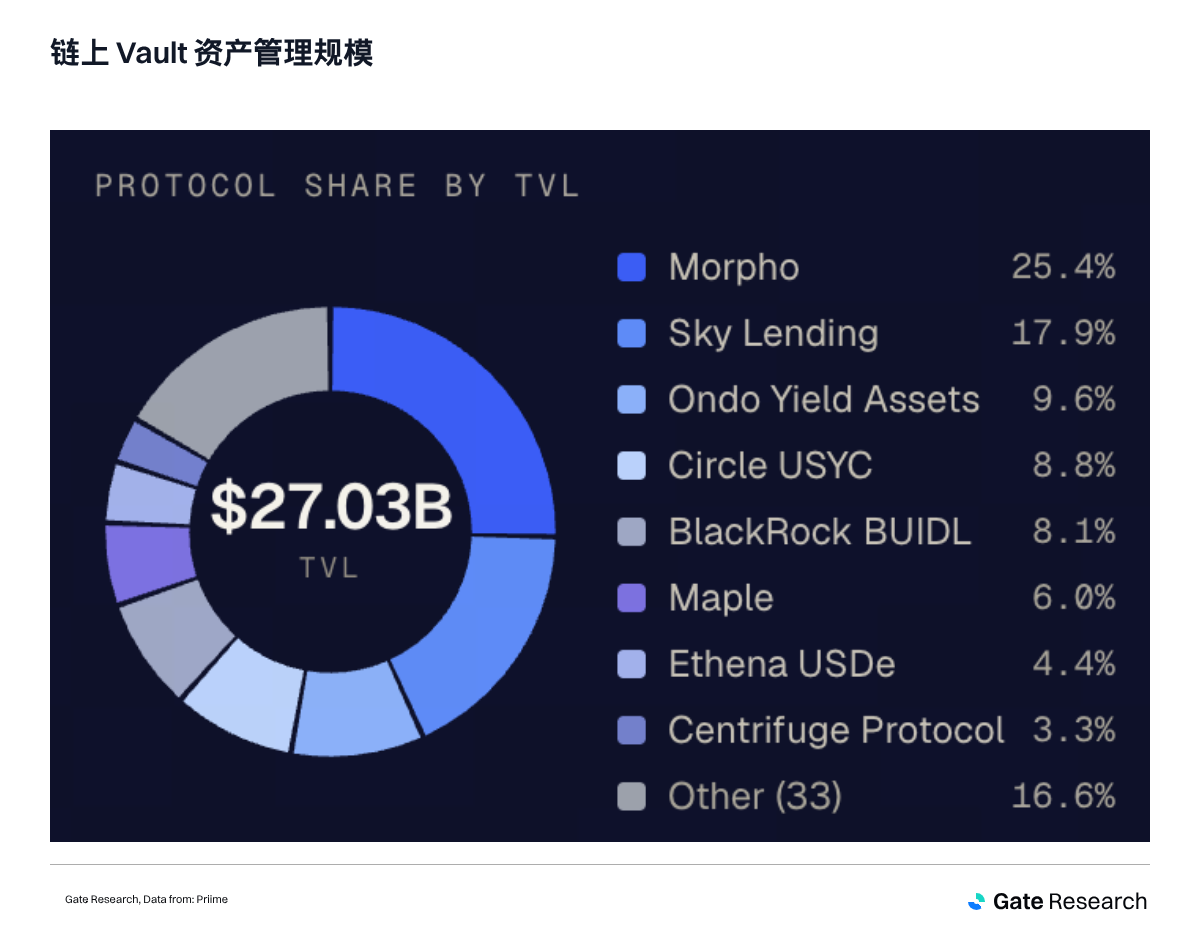
- As of the end of October 2026, on-chain Vaults managed over $27 billion in assets, covering 41 protocols, 28 public chains, 549 Vaults, and 83 Curators; Morpho accounted for 25.1%, and Sky Lending accounted for 18.4%.
- RWA and institutional asset protocols collectively managed approximately $9.698 billion, accounting for about 35.5% of the total scale. Treasuries, money market funds, and institutional credit have become important sources of yield.
- Morpho's approximately 40 Curators managed about $7.286 billion, with annualized Curation Fees of approximately $20.46 million; the top three Curators collectively accounted for approximately 63.8%, showing a trend of concentration at the top.
- Janus Henderson and Centrifuge launched JQQQ, an on-chain fund tracking the Nasdaq 100; The Index on Robinhood Chain uses trading fees to purchase and distribute tokenized stocks, exploring a new path for indexed products.
- Gate Simple Earn AUM exceeded $1.85 billion (up over 24% quarter-over-quarter), Staking quarterly peak exceeded $1.27 billion, Idle Earn holdings exceeded $300 million, and gStocks August trading volume exceeded 2.5 billion USDT.
- The industry faces constraints including yield capacity, strategy crowding, underlying asset liquidity, and on-chain/off-chain pricing discrepancies. Product competitiveness depends on asset quality, management capability, and liquidity efficiency.
Summary
• As of the end of October 2026, onchain Vault assets under management exceeded $27 billion, spanning 41 protocols and 28 public chains, with RWA yield products now forming a significant component.
• Vaults have expanded from stablecoin yield aggregation to specialized strategies, RWA, and tokenized index funds, further broadening onchain portfolio construction and financial product issuance models.
• Underlying protocols, Vault infrastructure, professional managers, and capital distribution platforms are gradually forming specialized divisions of labor, with yield quality, management capability, and liquidity efficiency becoming key competitive factors.
• Gate Simple Earn AUM exceeded $1.85 billion, Staking quarterly peak AUM exceeded $1.27 billion, and Idle Earn holdings surpassed $300 million, further enriching multi-asset trading and yield management scenarios.
Introduction
Onchain asset management is extending from early auto-compounding, liquidity mining, and single-protocol yield aggregation toward professional asset allocation, multi-strategy management, and financial product tokenization. As infrastructure for asset custody, strategy execution, portfolio management, and share issuance, Vaults have progressively covered diverse asset classes including stablecoin lending, Treasury and money market funds, institutional credit, derivatives strategies, and equity index funds. With the entry of professional Curators, traditional asset management institutions, and onchain distribution platforms, the organizational structure of DeFi liquidity and value distribution are beginning to exhibit new characteristics.
According to Priime data, as of the end of October 2026, covering 41 protocols, 28 public chains, 549 Vaults, and 83 Curators, and after eliminating duplicate holdings, onchain Vault assets under management exceeded $27 billion, with Morpho accounting for 25.1%, Sky Lending 18.4%, and Ondo Yield Assets, Circle USYC, BlackRock BUIDL, and Maple constituting important components. RWA yield products represented by Treasuries, money market funds, and credit assets have become an important source of assets for onchain asset management.
Asset management models within the industry have already shown clear differentiation. One category of products optimizes stablecoin capital allocation through lending markets and professional Curators; another category deploys market-neutral, market-making, and multi-protocol yield strategies through strategy managers; emerging tokenized index products package equities, ETFs, and other financial assets into onchain shares that can be subscribed, transferred, and combined.
Additionally, Janus Henderson and Centrifuge launched the JQQQ onchain fund tracking the Nasdaq 100 index at the end of October, demonstrating a viable path for traditional asset management institutions to issue index investment products using onchain infrastructure. Meanwhile, The Index on Robinhood Chain uses trading fees to purchase and distribute tokenized stocks, and its Blend module supports users in creating stock asset baskets, providing another experimental pathway for onchain portfolio issuance.
From an industry development perspective, the expansion of Vaults is creating three types of business opportunities: professional managers earn management income through risk allocation and strategy execution; underlying protocols attract capital through financial assets and real capital demand; and trading platforms participate in the asset management ecosystem through product coverage, capital distribution, and account services. Competition among different product types will increasingly manifest in fund capacity, yield sources, risk management, and liquidity experience.
Gate's multi-asset financial ecosystem also reflects a similar product development direction. According to its Q3 2026 report, Gate Simple Earn AUM exceeded $1.85 billion, up over 24% quarter-over-quarter; Staking AUM reached a quarterly peak exceeding $1.27 billion, and Idle Earn holdings surpassed $300 million. Meanwhile, Gate's global stock and ETF products cover over 12,800 instruments, with gStocks, wealth management, and onchain yield businesses continuously broadening asset allocation scenarios.
The next phase of the onchain asset management market will revolve around expansion of yield assets, competition among professional managers, onchain issuance of stocks and index funds, and capital efficiency of multi-asset portfolios. The standardized, composable, and programmable characteristics of Vaults provide an important technical foundation for the integration of different asset classes and institutional capital participation.
1. Market Landscape: Onchain Vaults Have Formed a Multi-Asset Management Ecosystem
1.1 Lending Yields and RWA Products Form the Scale Foundation
Vault asset distribution has already exceeded traditional DeFi lending protocols. In addition to Morpho and Sky Lending, institutional assets and RWA protocols including Ondo Yield Assets, Circle USYC, BlackRock BUIDL, Maple, and Centrifuge collectively manage approximately $9.698 billion, accounting for about 35.5% of the total sample size.
The yield sources of these products cover U.S. Treasuries, money market funds, institutional credit, and other financial assets, complementing the native DeFi lending market.
Capital demand in the traditional crypto yield market primarily comes from leveraged trading, asset-collateralized financing, and onchain trading activity. Yield levels are strongly correlated with market risk appetite, financing demand, and speculative activity. When market leverage contracts, lending yields may decline, and liquidity providers may also reduce exposure to risk assets.
The introduction of RWA assets has broadened Vault yield sources. Treasury yields are correlated with traditional interest rate markets, while institutional credit yields depend on borrowers' credit conditions, loan tenors, and related risk premiums. This enables onchain asset management to cover a broader range of yield demand and form economic drivers distinct from crypto market trading activity.
However, capital allocation relationships among different assets remain constrained by risk and duration. Treasury funds, onchain lending markets, and private credit products differ in redemption mechanisms, valuation, and liquidity, and cannot be considered to have identical asset attributes simply because they all use Tokens or Vault shares.
In this market structure, Vault competitiveness is reflected in the ability to organize multiple yield assets. Users holding stablecoins can access different asset classes through standardized products, while professional managers allocate capital based on yield, duration, and risk budgets. The expanded scope of asset allocation also allows onchain asset management to serve more types of capital, rather than being limited to traditional DeFi liquidity providers.
1.2 Professional Curators and Active Strategy Management Are Gradually Differentiating
Vault management models can be divided into two categories along management authority.
The first category is Curated Vaults centered on risk parameter configuration. Managers select lending markets, collateral, LTV, risk caps, and other parameters, with asset execution primarily constrained by smart contracts, suitable for relatively standardized lending and collateral asset management.
The second category is actively managed strategy Vaults. Managers can adjust allocations across different protocols, assets, or trading strategies within established investment mandates, possessing greater investment decision-making space.
Research by vaults.fyi in 2026 shows that among EVM Curated Vaults, risk parameter management products account for 61%, while actively allocated products account for 39%. The difference between the two product types stems from the scope of asset allocation that managers can determine and the manner in which smart contracts impose constraints.
Morpho's Curator ecosystem provides a representative case of specialized onchain asset management. As of the end of October 2026, Morpho had approximately 40 Curators managing approximately $7.286 billion in assets, with annualized Curation Fees calculated at current fee levels of approximately $20.46 million. Professional managers organize dispersed stablecoin liquidity into Vault products with different risk-return characteristics by selecting underlying lending markets, setting capital allocation caps and risk parameters, and gradually establishing independent asset management businesses.
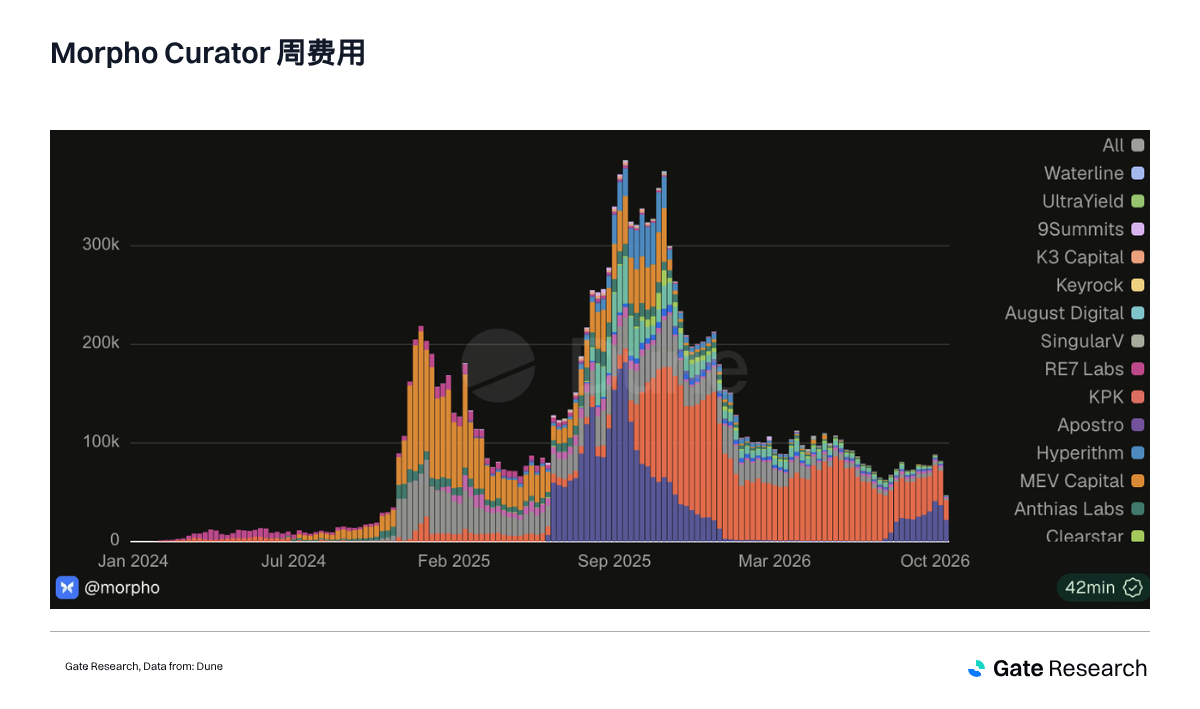
From a competitive landscape perspective, Morpho's managed assets show a clear trend of concentration at the top. Steakhouse Financial ranks first with approximately $2.515 billion in managed assets, accounting for about 34.5%; Sentora and Gauntlet manage approximately $1.162 billion and $968 million respectively. The top three Curators collectively manage approximately $4.645 billion, accounting for about 63.8% of total scale. Leading institutions are gradually forming scale advantages in capital acquisition, risk management, and market coverage, and competition in onchain asset management is beginning to exhibit concentration characteristics similar to the traditional asset management industry.
This structure also changes DeFi's liquidity competition dynamics. As large amounts of user capital enter underlying lending markets through professional managers, Curators gradually control capital allocation decisions, while underlying protocols need to attract manager allocation through yield levels, risk parameters, market depth, and fund capacity. Meanwhile, professional Curators can reuse risk models and management systems across multiple Vaults, generating sustained management fee income while expanding AUM. However, capital concentration among leading institutions may also intensify underlying market overlap across different Vaults, bringing both asset allocation efficiency and risk concentration issues to market attention.
The advantage of risk-parameter Vaults lies in management behavior being subject to relatively clear onchain constraints, which helps control exposure to specific markets; actively managed Vaults have greater strategic flexibility and can cover more complex portfolio trading and multi-market assets.
This differentiation may create different competitive landscapes for managers. Lending-focused Curators rely more on risk models, collateral assessment, and fund management scale; active strategy managers need to demonstrate their trading capabilities, portfolio management experience, and ability to consistently generate risk-adjusted returns.
Institutional investors can choose different management approaches based on investment objectives. Capital with higher liquidity requirements and lower risk budgets may favor standardized management products, while capital seeking differentiated returns may choose active strategies, but must bear corresponding manager and execution risks.
1.3 Vault Infrastructure Is Forming a Relatively Independent Industry Chain
The development of Veda, Lagoon, Mellow, Enzyme, and other asset management frameworks means that onchain strategy issuance no longer needs to rely entirely on individual protocols developing their own solutions.
In this structure, asset managers are responsible for strategy research and risk control, Vault infrastructure provides share issuance, asset management, and settlement tools, underlying protocols provide trading and yield markets, and distribution platforms connect end capital.
The long-term value of such infrastructure is related to the number of products, but the number of individual Vaults created is insufficient to measure economic scale. What truly affects commercial revenue is actual capital retention, active strategy scale, management fees, and other sustainable service income.
When professional management teams can launch multiple strategies based on the same infrastructure, product issuance efficiency improves, but competition also increases. Asset management capability, capital distribution, and brand reputation gradually become factors that differentiate strategy providers.
2. Product Innovation: Vaults Extend from Yield Tools to Indexed Asset Management
2.1 Stablecoin Vaults: Cash Management and Yield Aggregation
Stablecoins remain an important entry point for Vault asset management. Many users want to earn yield while maintaining USD asset exposure, and Vaults can complete capital allocation through different lending markets, Treasury yield products, and other strategies.
Stablecoin Vaults currently on the market have formed multiple tiers. Protocols such as Morpho, Euler, and Kamino focus on connecting lending markets; Sky, Spark, and certain RWA yield products support different forms of stablecoin yield management; infrastructure providers like Veda and Mellow can host multi-protocol strategies.
For large capital, there is a continuous trade-off between yield and liquidity. Scaled capital allocation requires markets with sufficient capacity and controllable risk, but new capital may also compress yields on certain lending strategies. Therefore, the asset management capability of professional Vaults is reflected in cross-market allocation, capital duration management, and the efficiency of adjusting underlying asset portfolios based on yield conditions.
Gate's Idle Earn provides a product case combining a trading platform with capital management. According to its Q3 report, Idle Earn supports USDT, USDC, and USD1, with holdings exceeding $300 million. When enabled by users, eligible idle stablecoins in spot and futures accounts automatically accrue interest, with funds remaining in the original account and available for trading. Its yield sources cover Treasuries, money market funds, onchain Staking, and RWA asset classes.
This product design embeds capital yield management into daily trading scenarios, improving capital efficiency of idle assets and demonstrating a practical application of combining exchange wealth management with multi-asset yield infrastructure.
2.2 Professional Strategy Vaults: Trading Capability Can Become an Onchain Asset Management Product
Professional strategy Vaults integrate market-making, arbitrage, derivatives hedging, and multi-market yield allocation into investable products.
Compared to lending products, these Vaults have greater strategy differentiation. Market-neutral strategies may hedge directional risk through spot and perpetual contracts and capture funding rate or basis yields; market-making strategies provide liquidity through order books to capture trading-related yields; active trading strategies adjust positions based on market signals.
Therefore, the development of professional strategy Vaults is closely related to the maturity of onchain derivatives markets. Trading instruments, order book depth, execution systems, and margin efficiency all affect strategy capacity and profitability.
For institutions with mature quantitative research and trading systems, Vaults provide a technical pathway to productize strategy capabilities. Strategy managers can attract external capital through standardized shares and earn income through agreed management and performance fees.
However, the growth of strategy Vaults must be built on real strategy capacity. When multiple Vaults adopt similar trading strategies, concentrated capital entering the same market may compress arbitrage opportunities, causing incremental AUM to negatively impact yields. Institutional asset management needs to control both scale and strategy capacity, avoiding maintaining yield performance through excessive leverage.
2.3 Tokenized Equity Indexes: Vaults Become the Product Foundation for Programmable ETFs
This is the most research-worthy extension area of the new generation of onchain asset management. Stock tokenization solves the problem of representing and trading traditional financial assets onchain, while index products further organize multiple assets into unified investment portfolios.
In traditional financial markets, ETFs are typically managed by fund managers responsible for index replication, portfolio construction, and share management, with investors gaining multi-asset exposure through a single fund product. Onchain index products can implement share issuance, asset allocation, rebalancing, and redemption through smart contracts, but the legal attributes, pricing, and custody structures of underlying assets still depend on specific product design.
Onchain native stock portfolios, such as The Index / Blend, Robindex, and Index Coop-type infrastructure, organize assets through stock Tokens, index baskets, automated allocation, and trading revenue mechanisms; traditional asset managers' onchain funds, such as Janus Henderson JQQQ, SPXA, and Centrifuge, are managed by professional asset management institutions, connecting to digital asset markets through onchain fund share issuance.
2.3.1 The Index: Converting Trading Revenue into Stock Asset Distribution
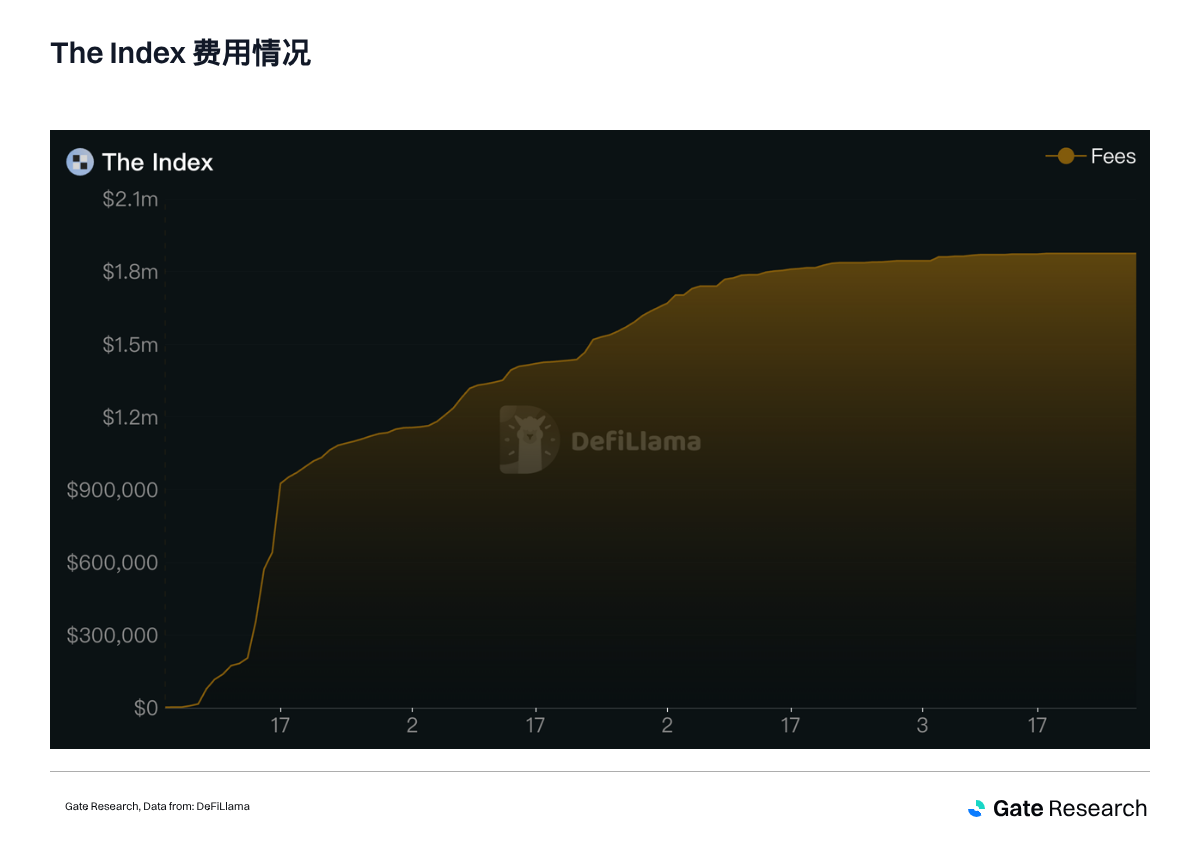
The Index on Robinhood Chain proposes a revenue distribution model different from traditional index funds. Its INDEX trading mechanism charges a 3% trading fee through a Uniswap v4 Hook, uses the proceeds to purchase tokenized stocks, and distributes them to eligible INDEX holders according to rules.
According to DeFiLlama data, The Index has accumulated approximately $1.87 million in fees. However, the protocol's revenue comes from its Token trading fees, which cannot be directly regarded as investment returns from the fund's underlying stocks.
The Index's Blend module further supports the creation of tokenized stock baskets with fixed asset quantities and enables portfolio subscription and redemption through Uniswap v4-related mechanisms. As of October, HoodScan data recorded 91 baskets created, 66 creating wallets, and cumulative trading volume of approximately $31,000.
Trading volume at this stage remains small, but the project demonstrates two new onchain asset management pathways: one automatically converts fees generated from trading activity into financial asset distribution; the other allows users to create their own stock baskets and issue them as tradeable portfolio products.
The growth of the former is highly dependent on trading activity, while the latter needs to address underlying stock liquidity, basket valuation, portfolio rebalancing, and subscription/redemption costs.
2.3.2 Janus Henderson × Centrifuge: Traditional Index Fund Onchain Issuance
JQQQ, launched on October 27, represents the institutional issuance model. The fund tracks the Nasdaq 100 index, with professional management services provided by a Janus Henderson-related investment management entity, issued through Centrifuge's onchain fund infrastructure, and initially deployed on Stellar.
Its significance comes from the combination of traditional index investment strategies with onchain share infrastructure. Investors can hold fund shares through onchain channels that meet product requirements, while asset management, fund valuation, and investor rights are executed in accordance with the fund structure and applicable rules.
SPXA in the same ecosystem provides onchain fund exposure tracking the S&P 500 index, targeting eligible professional investors.
For the onchain asset management industry, these products expand the investable asset universe to major stock market indexes. Index funds can become foundational assets for onchain portfolios and provide potential asset sources for further structured products, collateralized financing, and other financial applications, though related functions are subject to actual product rules and third-party integration.
2.4 Lowering Barriers to Index Issuance and Strategy Management
Onchain assets have composable and programmable characteristics, further reducing the technical cost of creating index investment portfolios. Some protocols allow users to specify stocks and weights, then package the portfolio into tradeable Tokens, or record investor rights through Vault shares.
This may drive an increase in thematic investment products, such as AI infrastructure, semiconductors, energy, defense, stable dividends, and stock portfolios from different regions.
However, as portfolio issuance barriers decline, product quality differentiation may also intensify. Index construction methodology, asset rebalancing, management fees, liquidity, and issuer reputation will all affect product performance.
From an asset management perspective, the long-term growth of onchain index products requires three conditions simultaneously: