Trading Volume Exceeds $500 Million, Sky Caught in "North Korean Hacker Money Laundering" Controversy


- Key Takeaways: Sky (formerly MakerDAO) has found itself in a public opinion storm after its PSM module was accused of providing North Korean hackers with a USDC conversion channel. Combined with the founder's borrowing controversy, this triggered a near-40% plunge in USDS market cap, though the protocol remains overcollateralized and operational.
- Key Elements:
- An Inca Digital investigation shows that 422 associated wallets cumulatively converted approximately $518 million through the PSM, of which about $101.9 million was attributed to North Korean hacker-related addresses.
- About 95% of the related transactions reached the PSM through third-party aggregators such as 1inch, ParaSwap, and MetaMask Swaps, rather than through Sky's official frontend.
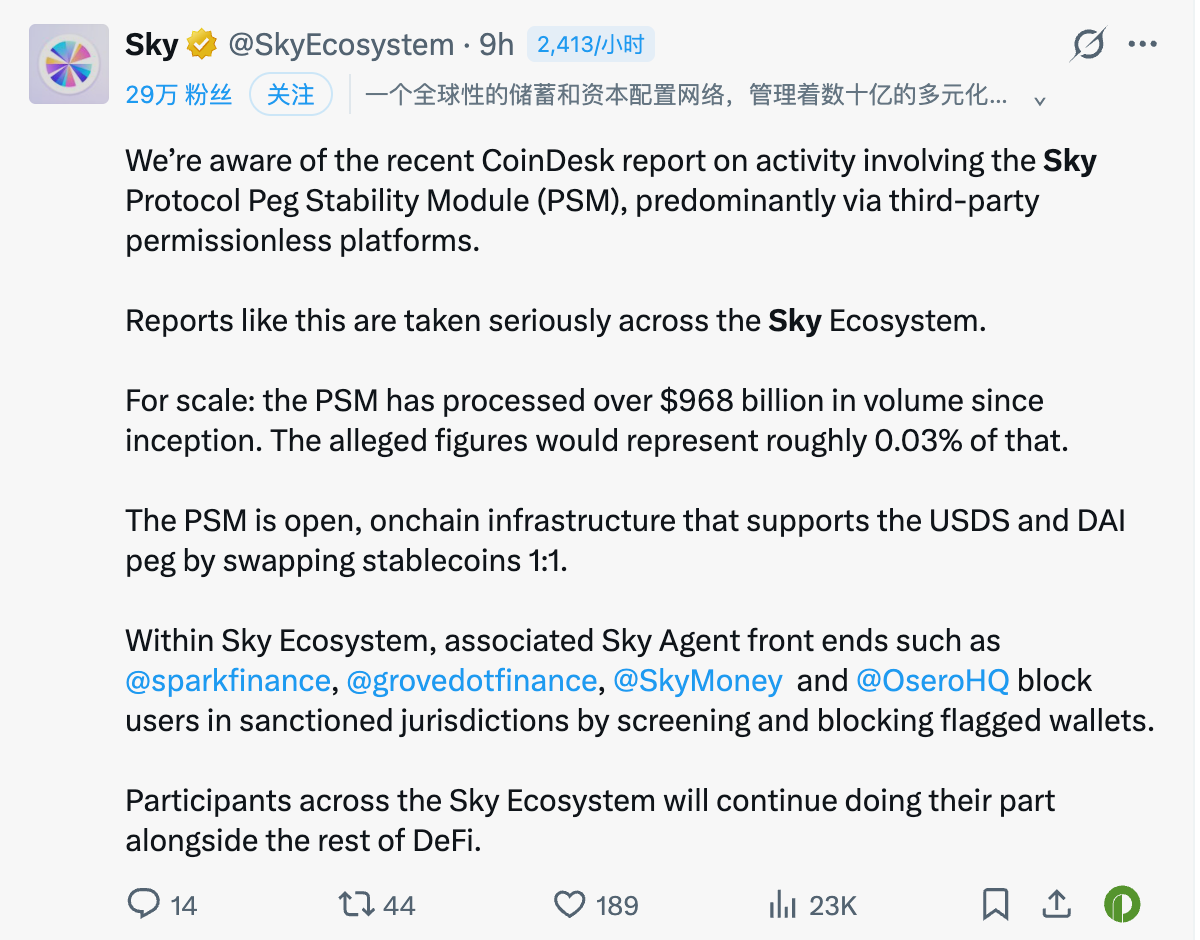
- The PSM has cumulatively processed over $968 billion in trading volume, with the transactions in question accounting for only about 0.03%.
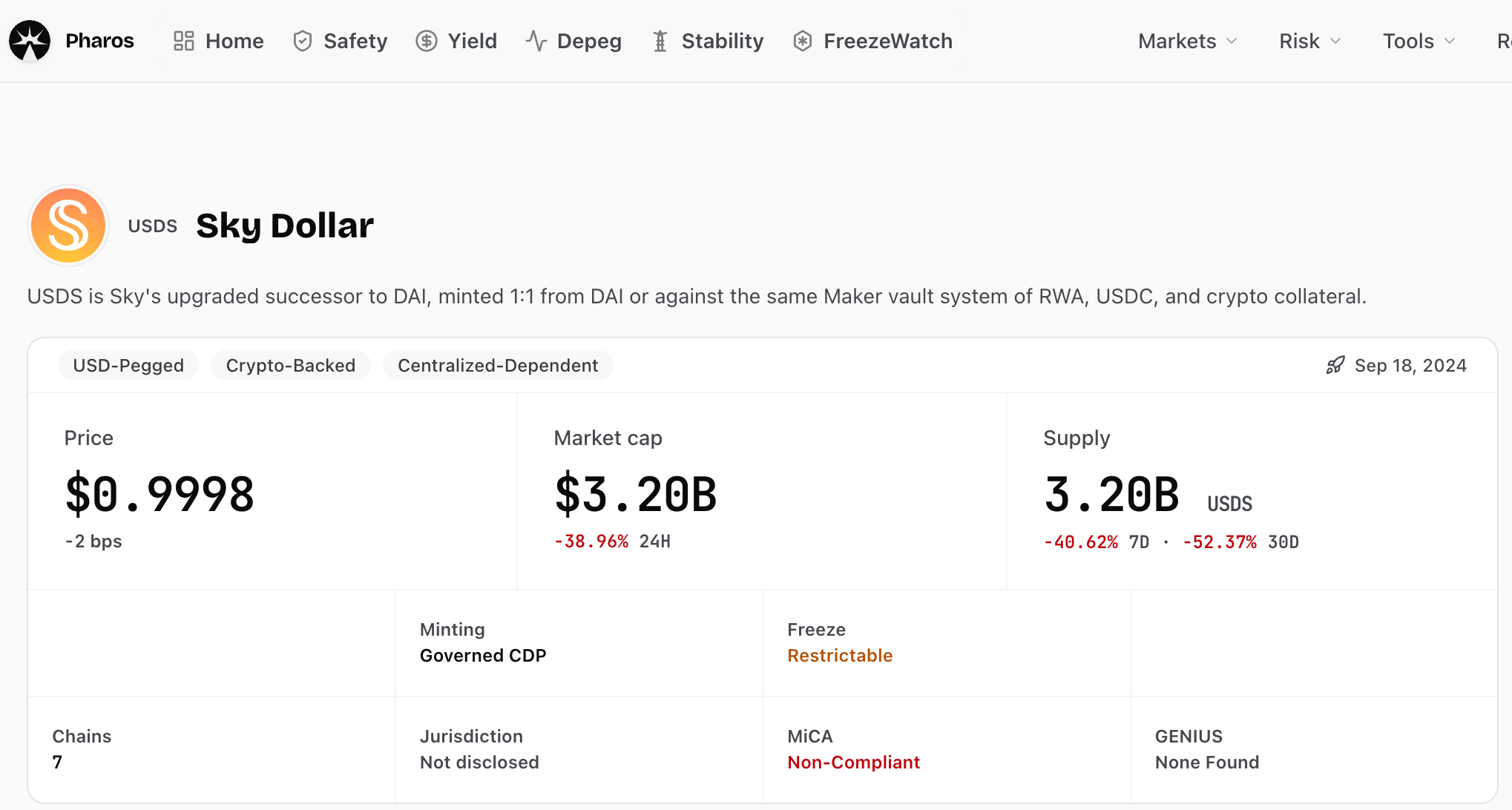
- USDS market cap currently stands at $3.2 billion, down 38.96% in 24 hours and 52.37% over 30 days.
- Founder Rune Christensen borrowed $77 million in USDS against $185 million in SKY tokens, sparking cash-out controversy.
- Sky stated that USDS remains overcollateralized, with asset backing of approximately $10 billion and revenue of about $400 million over the past year.
- The project has launched a 5.25 million USDS SKY buyback program, committing 750,000 USDS daily for seven consecutive days.
Original | Odaily@OdailyChina)
Author | Wenser (@wenser 2010)
The crypto market has taken another sharp dive, and the veteran DeFi platform Sky (formerly MakerDAO) has been caught in the fallout.
On one hand, the decline in the SKY token price has dragged out a "lending controversy": founder Rune Christensen had previously deposited $185 million worth of SKY tokens to borrow $77 million in USDS stablecoins, sparking market debate over "the founder cashing out from the liquidity pool." Sky's Peg Stability Module (PSM) has also been accused of "effectively providing North Korean hackers with an escape channel for USDC," drawing an in-depth investigation from risk-control firm Inca Digital and follow-up media coverage.
For a time, Sky was mired in a public opinion storm. But as things stand, the protocol is operating normally, the USDS stablecoin remains overcollateralized, and the team plans to launch a $5.25 million SKY token buyback; the PSM's share of illicit activity volume is only 0.03%, so the market need not be overly alarmed. That said, vigilance is still necessary—after all, if anything goes wrong with Sky as a veteran DeFi platform, the potential damage should not be underestimated.
Sky Protocol Caught in "North Korean Hacker Money Laundering Storm": 422 Linked Addresses, Cumulative Trading Volume of About $518 Million
According to an investigation by risk-control firm Inca Digital, 422 wallets linked to hackers, phishing attacks, sanctioned entities, or addresses blacklisted by Circle and Tether have completed approximately $518 million in swaps through Sky's (formerly MakerDAO) Peg Stability Module (PSM). As a key component of the Sky protocol, the PSM allows users to swap Circle-issued USDC stablecoins for DAI or USDS stablecoins at roughly a 1:1 ratio, and vice versa, helping keep both stablecoins pegged near $1. Inca described this feature as "an escape hatch for USDC that can be frozen."
It is worth noting that the $518 million is the total historical transaction volume completed by the 422 linked wallets, of which about $101.9 million was classified by the firm as tied to North Korean hacker addresses. Specifically, the related swaps are as follows:
- During the FTX collapse in November 2022, swaps related to the FTX Accounts Drainer amounted to about $26.1 million.
- In February 2025, on the day Infini suffered a hack, the attacker swapped $49.5 million in USDC for DAI.
- In February 2025, within 10 days of the roughly $1.5 billion Bybit theft, wallets funded with the stolen proceeds swapped out $91.5 million through the PSM, with nearly $30 million of those transactions occurring after February 26, when the U.S. FBI publicly identified the attacker as involving TraderTraitor under the Lazarus Group. (Odaily note: this hacker group is also linked to last month's $6.3 billion Binance theft.)
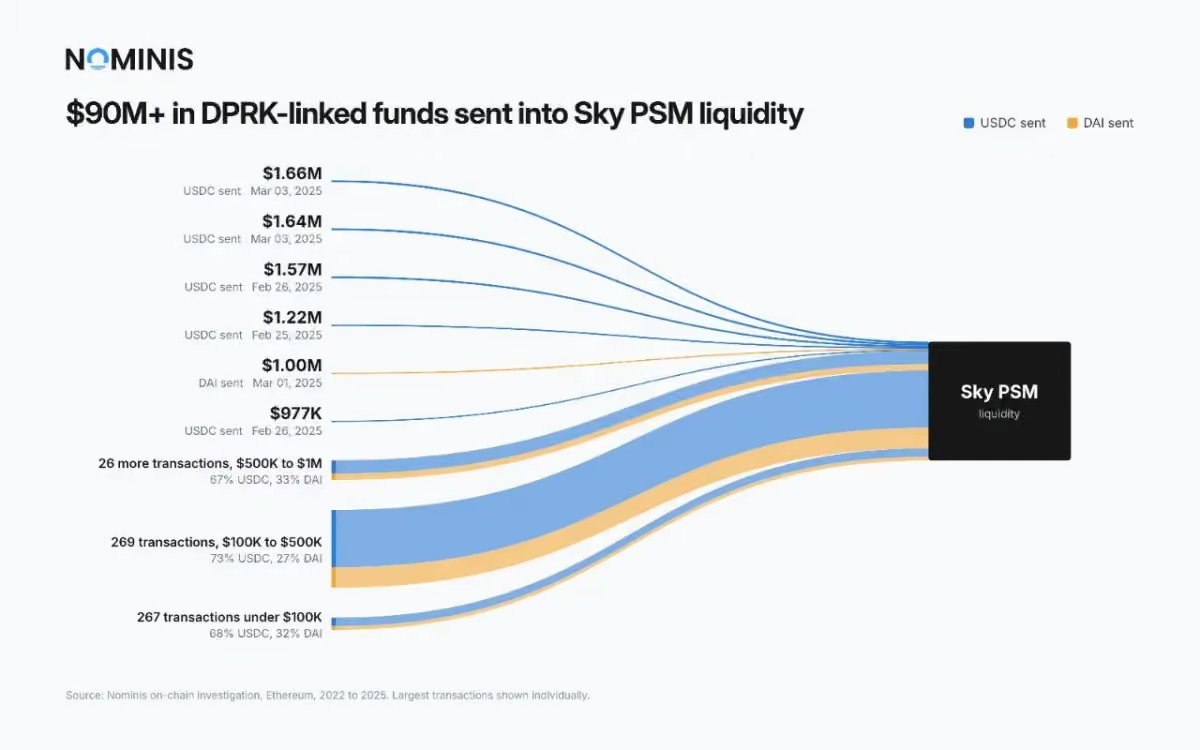
However, as Sky officially clarified, "The related activity was primarily conducted through third-party permissionless platforms. Since its launch, the PSM has processed a cumulative trading volume of more than $968 billion, and the related transactions covered in the report account for about 0.03% of that cumulative volume. The PSM is open on-chain infrastructure that supports USDS and DAI in maintaining their peg through a 1:1 stablecoin swap mechanism. Frontends within its ecosystem, including Spark, Grove, SkyMoney, and Osero, screen and block flagged wallets to prevent users from sanctioned regions from accessing related services."
Inca also provided evidence for this point: about 95% of the related transactions reached the PSM contract via third-party aggregators such as 1inch, ParaSwap, and MetaMask Swaps, rather than through Sky's official frontend. In addition, Inca's statistics reflect on-chain activity of linked wallets and do not equate to stolen funds definitively traced to specific theft cases.
Aftermath: USDS Market Cap Plunges $1.5 Billion, Down Nearly 40% in 24 Hours
The direct impact of this "money laundering channel" controversy has been the sharp drop in the market cap of the USDS stablecoin.
According to Pharos data, USDS currently has a market cap of $3.2 billion, down 38.96% in 24 hours, 40.62% over 7 days, and 52.37% over 30 days.
Combined with the earlier "SKY tokens for USDS stablecoins" episode involving Sky Protocol founder Rune Christensen, the crypto market's confidence in Sky Protocol has been somewhat shaken.
In response, Sky Protocol founder Rune Christensen responded, "The protocol is currently operating normally, USDS remains overcollateralized with about $10 billion in asset backing, and all mechanisms are functioning as designed. Over the past 24 hours, Sky processed more than $2 billion in outflows, and the liquidity supporting the stablecoin's peg never fell below $2 billion and has now recovered to above $2.25 billion. In addition, Sky generated about $400 million in revenue over the past year and remains financially sound. In response to recent market conditions, the Sky Core Council has announced a one-time SKY buyback program, which will invest 750,000 USDS per day for 7 consecutive days in accordance with the process set out in the Sky Atlas, for a total of 5.25 million USDS."
Based on the available information, the operation of Sky Protocol and the USDS stablecoin remains stable, and the protocol's own ability to generate revenue can be verified.
Looking ahead, the areas Sky Protocol can optimize are mainly concentrated in USDS's own governance upgrade. In this regard, it can only depend on improvements such as those mentioned in Sky's official whitepaper—"USDS uses an upgradeable proxy contract, and a freeze function could be added through governance in the future."