Revenue Doubles, Rubin Sells Out: Stripping Away the "Jensen Huang Premium," How High a Valuation Can Nvidia Sustain?


- Core View: Nvidia's record-breaking earnings disprove the pessimistic narrative that AI compute demand has peaked, but the governance shock and leadership-transition uncertainty triggered by founder Jensen Huang's permanent departure have become a new variable weighing on the valuation.
- Key Elements:
- Fiscal 2027 Q3 revenue reached $115.84 billion, up 103% year-over-year, with the data center business contributing $107.6 billion, accounting for over 92%.
- Vera Rubin contributed nearly $20 billion in revenue in its first quarter of mass production, setting a new record for the ramp-up of a new architecture; Q4 guidance is $130 billion, excluding China data center revenue.
- Board Chairman Harvey Jones explicitly stated there is no intention to rehire Jensen Huang and has commissioned headhunters to search globally for a successor, closing the door on his return entirely.
- Accounts receivable rose from $63.1 billion last quarter to $81 billion, with the collection cycle extended from 60 days to 64 days, drawing attention to the cash flow risk of emerging AI cloud customers "buying chips on credit."
- Q4 adjusted gross margin is expected to fall back to 71%–72%, a decline of about 3 percentage points from this quarter's 74.9%, which management describes as a阶段性 low point.
- The growth logic of the AI industry chain is diverging: chip competition is shifting to a combined contest of performance and cost, Neoclouds rely on external financing, and optical communications and power infrastructure stand to benefit but with differing timelines for realization.
Judging solely by the earnings report Nvidia just delivered, it was enough to let a tense Wall Street breathe a temporary sigh of relief.
Revenue of $115.8 billion, up 103% year-over-year, with profits also beating expectations and next quarter's guidance equally explosive. More importantly, Vera Rubin has already begun ramping rapidly, and management even further raised its growth forecast for the next fiscal year.
After the earnings release, NVDA shares initially rose nearly 5% in after-hours trading, but the market's frenzy quickly cooled and the after-hours gain narrowed noticeably.
The reason is simple: over the past six weeks, Nvidia's stock has retreated roughly 35% cumulatively, and in the four trading days after Jensen Huang announced his resignation on November 12, the stock plunged 10.5%. Just on the eve of the earnings release, Huang had publicly signaled his "willingness to return as CEO," reigniting hopes among many investors.
However, during the subsequent earnings call, newly appointed Board Chairman Harvey Jones slammed that door shut on the spot.
This means that on one side, AI compute demand remains strong and results keep hitting new highs, while on the other, the founder who led Nvidia for more than thirty years has formally exited.
So what exactly is Nvidia worth in the "post-Huang era"?
1. A Hundred-Billion-Dollar Giant Doubles, AI Demand Is Not as Bad as Feared
Let's start with the core financial data.
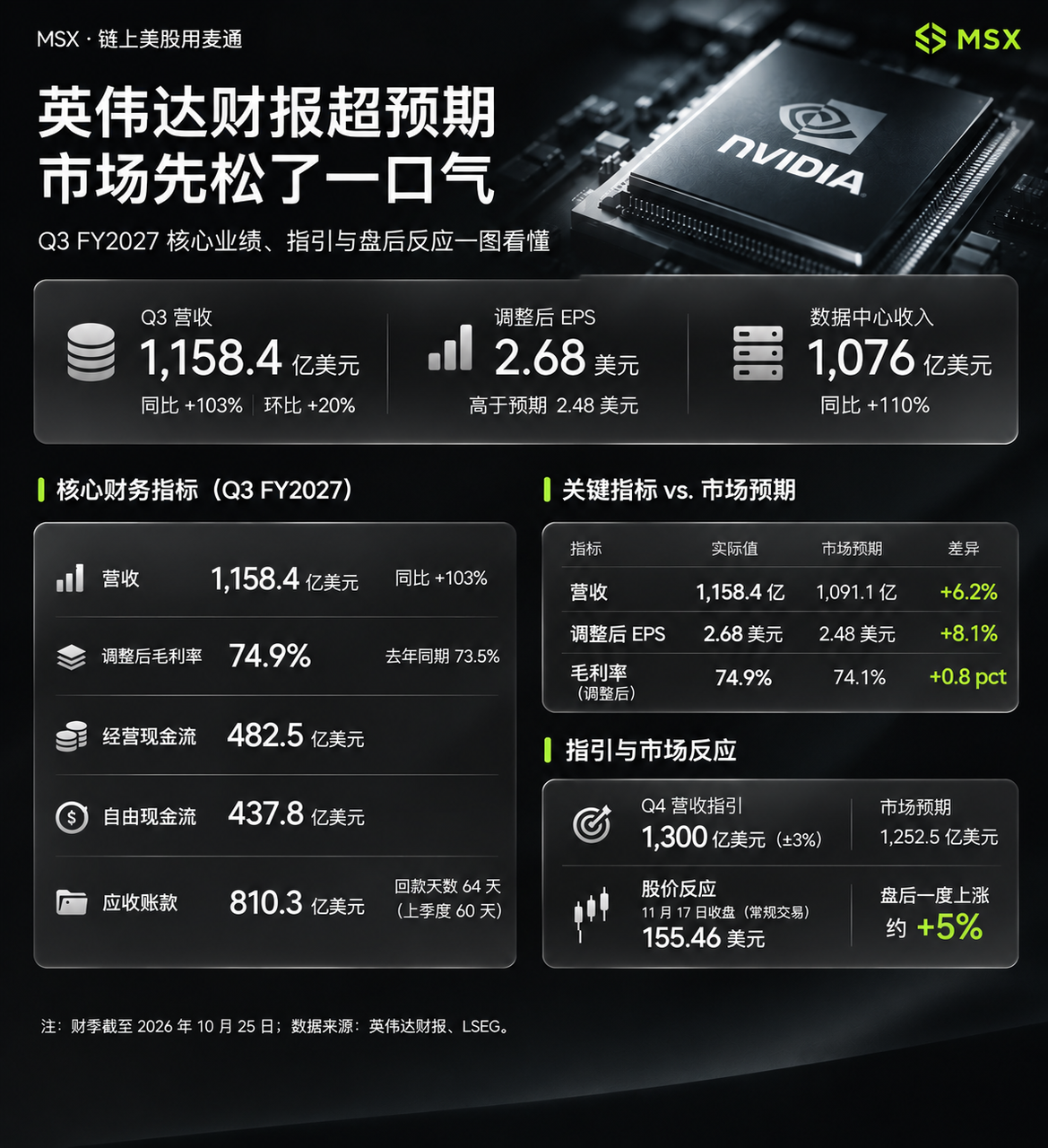
In the third quarter of fiscal 2027, Nvidia reported revenue of $115.84 billion, up 103% year-over-year and 20% quarter-over-quarter, beating Wall Street's $109.11 billion estimate by roughly $6.7 billion.
As the absolute core, the data center business contributed $107.6 billion in quarterly revenue, up 110% year-over-year and accounting for over 92% of total revenue. Behind this is not only continued spending by hyperscale cloud providers such as Microsoft, Google, and Amazon (contributing $60.1 billion, up 23% quarter-over-quarter), but also broad-based compute procurement by AI clouds, sovereign AI, and enterprise customers (contributing $47.5 billion, up 18% quarter-over-quarter).
For a giant whose quarterly revenue has surpassed $100 billion to still maintain double-digit growth, it at least proves that the global AI compute arms race is far from hitting the brakes.
Profitability and shareholder returns were equally impressive. Net income for the quarter reached $65.3 billion (up 105% year-over-year), with adjusted earnings per share of $2.68, significantly beating the market's $2.48 expectation; adjusted gross margin was 74.9%, up further from 73.5% a year earlier.
To hedge against recent stock volatility, Nvidia returned $28.1 billion to shareholders through buybacks and dividends in Q3, and still holds as much as $227.3 billion in remaining buyback authorization, serving as an important "ballast" to stabilize the share price.
What reassured the market even more was the strong debut of the new-generation platform Vera Rubin. Management revealed that Rubin contributed nearly $20 billion in revenue in its first quarter of mass production, setting a record for the ramp of a new architecture in Nvidia's history and completely dispelling earlier concerns about "product transition delays and customers sitting on the sidelines."
Based on strong order visibility, Nvidia expects fourth-quarter revenue of $130 billion (±3%), above Wall Street's roughly $125.25 billion estimate — and this figure completely excludes data center compute revenue from China (the company delivered about $2.4 billion of Hopper products to China in Q3). Management also raised its full-year revenue growth forecast for fiscal 2028 from 70% to 75%.
Yet beneath the stellar report card, two lurking concerns in the balance sheet and profit guidance are making Wall Street pay closer attention:
- Rising accounts receivable and lengthening collection periods: In Q3, operating cash flow reached $48.253 billion and free cash flow $43.777 billion, leaving no doubt about its cash-generating ability; but at the same time, accounts receivable jumped from $63.1 billion last quarter to $81 billion, and the average customer collection period extended from 60 days to 64 days. Many emerging AI cloud providers are highly dependent on external financing for expansion, and whether these "buying chips on credit" customers can pay on time has become a risk point institutions are watching closely;
- Near-term gross margin pressure and calendar effects: Nvidia expects fourth-quarter adjusted gross margin to fall back to 71%–72%, down about 3 percentage points from 74.9% this quarter, mainly due to initial ramp-up costs for new products, supply chain premiums, and earlier pricing agreements (management expects Q4 to be a temporary low, with fiscal 2028 recovering to 72%–73%). In addition, because the fourth quarter has one more week than a regular quarter (14 weeks), investors need to exclude this calendar effect when assessing quarter-over-quarter growth;
2. The Door to Return Is Firmly Shut, the "Post-Huang Era" Faces a Major Test
What stirs nerves more than the earnings figures is the dramatic upheaval in Nvidia's power structure.
Looking back over the past week: on November 12, Jensen Huang resigned as CEO, President, and Director due to personal conduct that violated the company's code of conduct; on November 17, he publicly stated for the first time that he was "willing to return as CEO" if the board believed it was in the interests of shareholders and the company.
But just hours later, on the earnings call, Harvey Jones — who had just become the first independent board chairman in Nvidia's history — ended the suspense with a statement that left no room for ambiguity: "The board unanimously accepted his resignation and has no intention of rehiring Jensen Huang as CEO." The board has also commissioned a renowned international executive search firm to find a permanent successor globally.
The capital market's sensitivity to Huang's departure stems from the fact that, over the past three decades, he long ago transcended the conventional role of a professional manager.
From the forward-looking bet on the CUDA ecosystem and aggressive chip architecture iteration to direct dealings with top executives at cloud giants and extreme supply chain scheduling, every key leap at Nvidia has been deeply imprinted with his personal will.
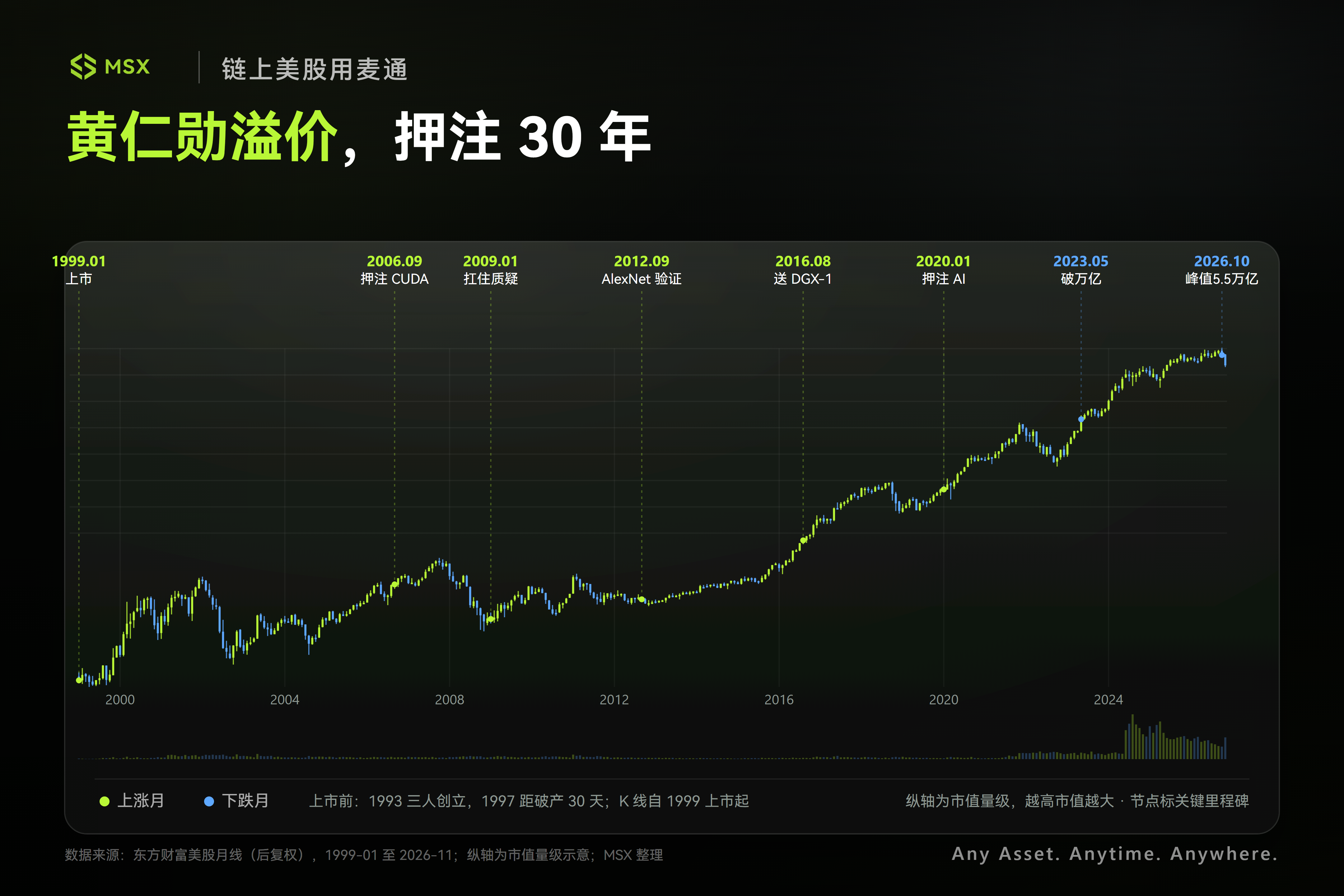
Admittedly, the company still has a world-class engineering team and a product roadmap laid out for years to come, and the newly established National Security and Export Control Oversight Committee is also trying to strengthen compliance firewalls (the related investigations and allegations have so far not resulted in any finding of wrongdoing). But after losing its soul at the helm, whether this $4 trillion tech juggernaut can maintain its past pace of innovation and execution still needs time to verify.
Against this backdrop, interim CEO Colette Kress, who presided over this earnings call in Huang's place, is under intense scrutiny for her every move. As a veteran CFO who has overseen Nvidia's finances for over a decade, she knows the customers' cards and supply chain inside out, but whether she can steady Wall Street's morale during the vacuum left by the loss of its spiritual leader remains the biggest open question on the table.
3. If Nvidia Stabilizes, Can the Entire AI Sector Launch a Full Counteroffensive?
After the earnings landed, market sentiment clearly warmed, and bull-bear debates on the overseas investment community Reddit instantly heated up.
Optimists argue that hundred-billion-dollar quarterly revenue, combined with a 75% growth forecast for the next fiscal year, is enough to prove that AI compute demand is far from peaking; others worry that Huang's issues remain unresolved and that even a beautiful earnings report may not be enough to push the stock back to previous highs.
Both judgments have merit, but more importantly, Nvidia's strong results do not mean the entire AI supply chain will benefit in sync. As the industry enters a new phase of development, the growth logic and risks across different segments are diverging markedly.
First, core chips and compute competition.
Nvidia's results provide positive demand validation for peers like AMD and Broadcom, at least showing that compute spending by large cloud providers and AI companies continues; but on the other hand, competition from Google TPU and various custom ASIC chips has not stopped, and cloud providers always have incentives to reduce computing costs and dependence on a single supplier through in-house chips.
Therefore, while the AI compute market is still expanding, future competition will gradually shift from pure supply shortage to a comprehensive contest of performance, cost, and market share.
Second, downstream AI clouds and Neoclouds.
For companies like CoreWeave (CRWV) and Nebius (NBIS), Nvidia's strong results are undoubtedly a positive, meaning GPU rental demand remains robust. But the business models of such companies are highly dependent on capital expenditure and external financing. As Nvidia begins to more prudently evaluate investments, commitments, and guarantees, the market will also scrutinize their own financing capabilities more strictly.
Whether they can continue to obtain low-cost funding, complete data center construction on schedule, improve GPU utilization, and ultimately convert compute demand into stable free cash flow will determine whether they can truly realize profits from the AI boom.
Finally, optical communications and data center infrastructure.
Lumentum (LITE), Coherent (COHR), and Ciena (CIEN), operating in optical communications and networking equipment, will benefit from the expansion of AI clusters and growing demand for high-speed interconnect; Vertiv (VRT) and Eaton (ETN) benefit respectively from data center power, distribution, and cooling infrastructure buildout.
Long-term demand in these segments remains supported, but order conversion speed, capacity expansion, margins, and valuation levels vary, making it hard for them to simply rise and fall in lockstep with Nvidia in the future.
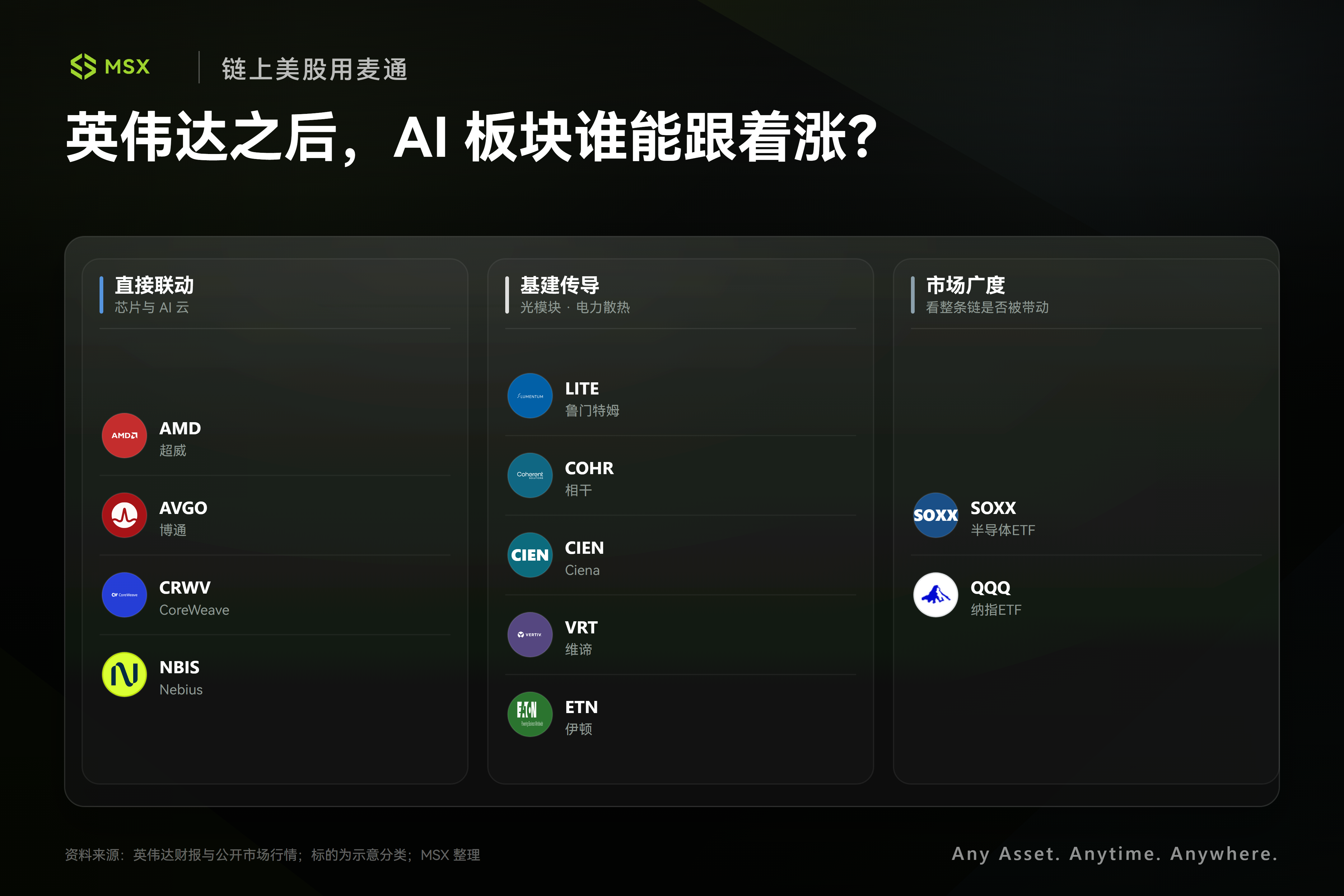
In addition, going forward, the performance of the Nasdaq 100 ETF (QQQ) and the Philadelphia Semiconductor ETF (SOXX) is also worth close observation.
If Nvidia's rebound can further drive AMD, Broadcom, and other semiconductor and AI hardware stocks higher, it would indicate the market is rebuilding confidence in the AI theme; if only Nvidia rises while other tech stocks remain weak, then this rally is more likely just an earnings-driven single-stock recovery, and whether the entire AI sector can sustain a rebound remains to be verified.
After all, Nvidia proves that AI compute demand is still there, but whether the entire AI supply chain can keep rising depends on how much of that demand ultimately converts into revenue, profit, and cash flow.
Final Thoughts
To be pragmatic, a record third-quarter report is enough to disprove the pessimistic narrative that "AI compute demand has peaked," but it is not yet enough to soothe the governance shock brought by the founder's permanent departure.
The capital market never pays just for the past.
The power transition after Jensen Huang's permanent farewell, continuously escalating geopolitical restrictions, and the cash flow risks behind customers "borrowing to buy chips" remain the three mountains weighing on the stock price.
In the short term, the market's observation anchors will focus on whether the post-earnings rebound can hold its ground and whether the rally can spread to the entire semiconductor and AI hardware sector; in the medium term, the bottoming pace of fourth-quarter gross margin, the collection quality of the $81 billion in accounts receivable, and the final selection of a permanent CEO are the decisive factors determining whether the valuation center can move higher.
Good companies never lack opportunities. Rather than blindly rushing in amid post-earnings sentiment swings, it is better to wait for the "Huang premium" valuation discount to fully clear before calmly positioning oneself based on the margin of safety in fundamentals.