


Breaking the Dilemma of Chinese LLM Going Global: Growing Usage Without Growing Revenue — B.AI Builds a Value-Return Super Hub with "Direct Original-Developer Connection + Global Aggregated Payments"


- Core Viewpoint: As Chinese LLMs go global, while call volumes on aggregation platforms grow, third-party hosting diversion and platforms' "automatic routing" mechanisms dilute the original developers' Token share and revenue, trapping them in a "growing usage without growing revenue" dilemma. B.AI seeks to return commercial value to original developers through user-selected official direct-connection channels, Token ecosystem subsidies, and a global settlement system.
- Key Elements:
- An Epoch AI report shows that overall call volumes of Chinese LLMs on OpenRouter are growing exponentially, yet original developers' revenue share accounts for only a tiny fraction of total spending.
- Zhipu's GLM-5.3 Flash open weights saw 12 third-party hosting providers within one day and 26 after 20 days; overall usage grew 17%, while Zhipu's own daily average Token volume dropped 70%, with its share falling from 88% to 22%.
- The causes of the dilemma include three structural factors: homogeneous supply, aggregation platforms routing by default based on price or latency, and cross-border payment and access barriers.
- B.AI establishes the official API as an independent, transparent, user-selected dedicated line, and has built ecosystem partnerships with Zhipu, MiniMax, Kimi, Xiaomi Mimo, Qwen, DeepSeek, and others, using subsidies to achieve "lower prices without lower intelligence."
- B.AI's payment engine supports Visa, Apple Pay, Alipay, WeChat Pay, and 7 major blockchain networks, with traditional fiat channels already accounting for over 50% of payments.
- B.AI's daily throughput exceeds 1 trillion Tokens, its user base approaches 3 million, it supports 70+ mainstream LLMs, and within about 100 days of launch it has reached a scale comparable to OpenRouter's roughly two years.
- The platform is positioning itself in the Agent economy, having deployed Agent Wallet and the Skills toolchain, and integrated the x402 payment protocol and the 8004 identity authentication protocol.
In 2026, Chinese large models entered their "first year of going global." Leveraging open weights and strong cost-effectiveness, they frequently topped the call-volume charts on major aggregation platforms. Chinese large models that are "good to use and affordable" are becoming a realistic option for overseas developers and enterprises.
Yet beneath the buzz of the leaderboards, a more noteworthy issue is emerging for the industry. Survey data shows that while the overall call volume of Chinese large models on the overseas aggregation platform OpenRouter is growing, the original developers' own Token share is declining markedly. The reason: when the same model is simultaneously hosted by numerous third-party providers, calls are diverted across many layers, diluting the original developer's call volume and revenue. The "automatic routing" mechanism that such platforms enable by default further amplifies this effect: if users don't configure anything, requests flow to the cheaper service provider based on the lowest price or latency. "Growth without revenue" has thus become the most practical challenge for Chinese large models going global.
When traffic no longer equals revenue, what Chinese large models truly need is a channel that returns value to the original developers.
As a new generation of global AI infrastructure, B.AI offers a different answer. Unlike the traditional "automatic routing" mechanism, B.AI turns the official API into an independent, transparent dedicated line that users choose for themselves, so the original developers' Token share is no longer quietly diluted. It also leverages deep ecosystem partnerships with large model developers to release Token subsidies, keeping official channel pricing highly competitive. Combined with a multi-currency aggregated payment engine, cross-border transaction friction is eliminated. More profoundly, backed by solid user accumulation, B.AI has successfully captured a massive user base and officially entered the era of trillion-level daily throughput. B.AI is no longer merely a distribution channel for going global, but a super hub connecting global enterprise demand with the agent era.
Behind the Top Call-Volume Rankings: The "Growth Without Revenue" Dilemma of Chinese Large Models
The commercial monetization dilemma of Chinese large models going global—"growth without revenue"—has been intuitively confirmed by recent industry survey data.
According to a tracking report released by the well-known AI think tank Epoch AI, the overall call volume of Chinese large models on the overseas API aggregation platform OpenRouter is growing exponentially, but this enormous "increment" has not translated proportionally into "revenue" for the original model developers. This is not an isolated case, but a common phenomenon facing leading Chinese large models as they go global.
Take Zhipu's GLM-5.3 Flash as an example: the diversion caused by same-source competition is extremely brutal. The report notes that just one day after the model's weights were released, the number of third-party hosting providers had grown to 12, and after 20 days it reached 26, of which 8 quoted prices lower than Zhipu. During this period, GLM-5.3 Flash's overall usage on OpenRouter grew 17%, yet Zhipu's own daily average Token volume fell 70%, and its share of the model's processed Tokens dropped from 88% to 22%. GLM's total call volume is growing, but more of those calls are being handled by other service providers.
Epoch AI's macro estimates further validate this structural pain point. Referring to the provided data chart, after tallying the estimated customer spending on OpenRouter (annualized) between August 27 and September 19, 2026, it was found that the vast majority of spending on Chinese large models flowed to third-party hosting providers rather than the model developers (original developers), with the original developers actually capturing only a very small share of total spending.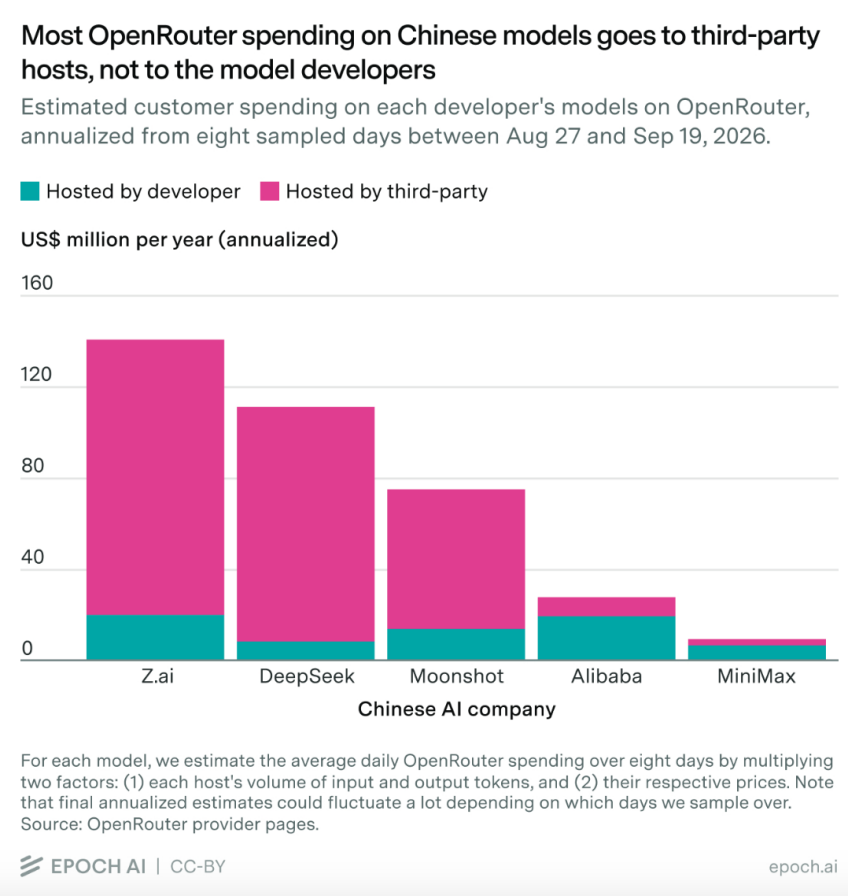
This means that Chinese large model companies bear the core costs of model training and compute iteration, yet in the commercialization chain they fail to fully capture the commercial returns commensurate with their technological contributions. Behind this are several overlapping structural factors.
The first is supply homogenization: when model weights are open and the same model can be deployed by multiple service providers, inference services themselves are highly homogeneous, and competition naturally centers on price and latency. Epoch AI's research also found that the higher the original developer's pricing premium for an open-weight model, the smaller the share of its own Tokens handled on OpenRouter.
The second is the further catalysis of the "default routing" mechanism: aggregation platforms typically distribute requests based on the lowest price or lowest latency, so if users don't make additional settings, traffic flows to the lowest-bidding hosting provider rather than the original model developer.
The third is access and payment barriers: facing friction from cross-border payments, currencies, and account systems, overseas users tend to choose more convenient aggregation channels, making it difficult for original developers' direct connection entry points to achieve scale.
For large model vendors, the key to breaking through is not to stop models from being widely distributed across multiple channels—because openness and sharing are themselves the "booster" for Chinese large models going global. What can truly return value to the original developers is establishing a clear, transparent, low-priced official channel that users can actively choose, while lowering the barriers to use and payment for global users. In other words, what the industry needs is not another "cheaper relay station," but a set of infrastructure that respects user choice while allowing value to flow back to the original developers.
Returning Choice to Users: B.AI Makes "Official Direct Connection" a Visible Channel
To crack the industry dilemma of "growth without revenue," reshaping the way users connect with models is the first step to rebuilding commercial order. To make commercial value clearly visible, B.AI's solution starts from the very bottom of the product architecture, fully returning "the ultimate choice of routing" to users.
In B.AI's system, "official direct connection" is an independent, transparent channel left to users' own choice. For scenarios with clear requirements on model performance and stability, users can directly choose the original developer's API for direct connection, ensuring extremely low latency under high concurrency while meeting stringent data security and compliance requirements. For scenarios more sensitive to cost and elasticity, users can also choose other channels as needed. This "user-defined" transparent mechanism brings direct two-way commercial value to the entire ecosystem.
For original developers, this effectively prevents the diversion of core Token share. When enterprise customers' high-concurrency and high-reliability requests reach the original developers directly through the dedicated channel, the Token share and profit margin they deserve are effectively safeguarded. For developers, this means ultimate business certainty. Choosing the official channel means bidding farewell to performance fluctuations and "dumbed-down" blind boxes, and stably obtaining model capabilities in "full-blooded" condition.
More notably, this transparent direct-connection mechanism has already gained broad recognition from the leading camp of Chinese large models. Currently, B.AI has established deep ecosystem partnerships with many leading Chinese large models, including Zhipu, MiniMax, Kimi, Xiaomi Mimo, Qwen, and DeepSeek, jointly bringing these high-quality "original developer dedicated lines" to global developers. This not only confirms the commercial viability of B.AI's model, but also marks the evolution of large models going global from "pursuing low prices" toward a healthy ecosystem that "values quality and commercial sovereignty."
However, giving choice back to users also requires answering a practical question: won't the official channel be more expensive? On this point, relying on the platform's enormous economies of scale, B.AI has continuously rolled out a series of limited-time promotional campaigns together with deeply partnered large models, consistently releasing ecosystem benefits. In these campaigns, the largest subsidies have even reached complete free use. Through genuine ecosystem concessions, B.AI has successfully played the trump card of "lower prices without lowering intelligence." Developers can obtain 100% native, full-blooded official model capabilities without bearing high premiums, at a comprehensive cost even lower than third-party hosting. Users bid farewell entirely to the dilemma of compromising between "price and performance."
More importantly, the commercial value of this deep cooperation model of "direct connection + subsidies" goes far beyond short-term customer acquisition. In the past, some models going global were often simply regarded by overseas markets as "cheap compute substitutes." Now, B.AI is leveraging its strong ecosystem synergy to help domestic large models build genuine brand loyalty overseas. By binding the official developers' high-quality services with ultimate cost-effectiveness, B.AI is helping Chinese models shed the stereotypical label of a "cheap compute pool" and significantly elevating their strategic position in the global AI industry chain.
More Than a Channel: Global Settlement, Trillion-Level Throughput, and Forward-Looking Positioning for the Agent Era
For overseas developers, whether a channel can be used smoothly also depends on payment. In its overall architecture, B.AI not only provides connectivity for compute and models, but also positions itself as an "intelligent global settlement layer," using this as the core to extend its ecosystem capacity outward.
As an intelligent global settlement layer, B.AI's payment engine achieves a high degree of compatibility within a compliant framework. It not only horizontally integrates localized settlement methods such as Visa, Apple Pay, Alipay, and WeChat Pay, but also vertically connects to 7 mainstream blockchain networks, supporting multiple digital assets. This dual-track design allows traditional Web2 enterprise customers and Web3 native developers alike to complete top-ups, subscriptions, and calls within the same platform with minimal access friction. Currently, more than 50% of payments on the B.AI platform are completed through traditional fiat channels such as Stripe.
This global settlement foundation, combining breadth and depth, marks that B.AI has completely broken through the limitations of the traditional "technology relay station" and risen to become a super hub reshaping the commercial landscape of large models. It not only allows top-tier AI compute to truly integrate seamlessly into the global commercial cycle, but also, with strong ecosystem attraction, condenses scattered global enterprise demand into a value network with tremendous commercial explosive power.
Supporting the efficient operation of this vast settlement network is the platform's deep scale foundation. Currently, B.AI's daily throughput has exceeded 1 trillion Tokens, with a user base approaching 3 million. Notably, it reached in about 100 days after launch the scale magnitude that the early aggregation platform OpenRouter took about two years to achieve. Through deep cooperation with large model vendors, the B.AI platform fully supports 70+ mainstream large models and has built an advanced multimodal ecosystem matrix. This enormous business volume and well-developed ecosystem network mean that B.AI has substantively established its position as the core hub of a new generation of global AI infrastructure.
When "official direct connection" safeguards original developers' compute share, "Token ecosystem subsidies" build an ultimate customer acquisition advantage, and a trillion-level underlying throughput network and global settlement system are layered on top, B.AI has woven a complete ecosystem loop for Chinese large models from "demand reach" to "commercial monetization." Through this mechanism, Chinese large model vendors can overcome the war of attrition of "growth without revenue" and maximize the value of going global in a stable, transparent, and highly explosive commercial soil.
Finally, on top of the foundation of payment settlement and large-scale throughput, B.AI is also casting its vision toward the more cutting-edge agent economy. The platform's long-term vision is not to remain at the model routing layer, but to deeply integrate compute routing, decentralized settlement, and full-stack Agent infrastructure. Currently, B.AI has deployed toolchains such as Agent Wallet and Skills to fully empower Agents to autonomously handle complex tasks across environments. At the protocol layer, the platform has integrated the x402 payment protocol and the 8004 identity authentication protocol, providing standardized trust and settlement support for high-frequency, micro-payment automatic calls between machines in the future. As the primary actors of API calls gradually evolve from human developers to automated Agents, this intelligent settlement layer and execution hub that B.AI has laid out in advance will become the key node connecting foundation models with the future trillion-level agent ecosystem.
In this new era driven jointly by large models and agents, B.AI will become the most certain "super router" in the global journey of Chinese large models. It not only escorts Chinese models to maximize commercial value, but will also connect global demand, compute, and agents, driving the global AI industry toward its next cycle of prosperity with a transparent, efficient, and win-win commercial loop.





