TRON Industry Weekly Report: Tech Stocks Sold Off, Crypto ETF Outflows, and a Detailed Look at the Scalable Layer 1 DAC for the Quantum Era


- Key Takeaways: This week, global macro and crypto markets came under simultaneous pressure. The U.S. tech sector saw concentrated selling over concerns about AI capital expenditure returns and regulation, while the crypto market rallied then pulled back amid tightening liquidity, institutional fund outflows, and deleveraging of high leverage. The market is shifting from valuation expansion to a phase of repricing based on earnings and interest rates.
- Key Elements:
- The S&P 500 fell 2.7% for the week and the Nasdaq dropped 3.4%. U.S. October ISM Manufacturing PMI rose to 55.5, nonfarm payrolls added 165,000, and the unemployment rate fell to 4.1%, reinforcing expectations of a Fed rate hike in December.
- Global crypto market capitalization stood at approximately $2.56 trillion, down 2.6% over 7 days; Bitcoin broke above $80,000 before falling back to around $75,000, while SOL and XRP fell 7.0% and 7.2%, respectively.
- U.S. spot crypto ETFs continued to see net outflows, and around November 5, leveraged liquidations in the derivatives market exceeded $1 billion, with capital concentrating into mainstream assets.
- Primary market financing focused on RWA tokenization and institutional infrastructure. Of the 13 deals this week, 6 disclosed amounts totaling approximately $43.5 million, with Uranium Digital leading with a $16.5 million Series A.
- Regulation advanced on multiple fronts: Hong Kong plans to submit a comprehensive virtual asset licensing bill before the end of 2026 and is reviewing the CARF tax framework; South Korea is requiring platforms to increase cold wallet ratios following security incidents; Brazil will restrict transactions with unlicensed service providers starting November 6; Russia plans to pilot crypto trading through the Moscow Exchange starting in December.
- Potential project DAC proposes a three-layer sharding architecture, protected transaction flows, and a DACT/DACC dual-asset model, but core mechanisms such as PoQW are left to the yellow paper, and performance metrics and security audit verification are lacking.
I. Outlook
1. Macro-Level Summary and Future Forecast
Macro and U.S. Stock Market Review (November 2 – November 8, 2026):
This week, global macro markets continued to revolve around the resilience of the U.S. economy, sticky inflation, and expectations for Federal Reserve monetary policy, with U.S. equities broadly under pressure and the technology sector becoming the main area of adjustment. As of November 6, the S&P 500 was down 2.7% for the week, the Nasdaq down 3.4%, and the Dow Jones down 0.9%. Following the U.S. midterm elections, the market briefly rebounded, but AI technology and semiconductor stocks subsequently faced concentrated selling, reflecting growing concerns over massive AI capital expenditures, earnings realization capability, and potential regulatory risks. Meanwhile, the U.S. labor market remained resilient and inflationary pressure had yet to ease noticeably, reinforcing expectations that the Federal Reserve will maintain a relatively tight monetary policy. Overall, U.S. equities are gradually transitioning from a valuation expansion phase driven by the AI investment boom toward a repricing of corporate earnings, capital expenditure returns, and the interest rate environment. Valuation pressure on technology growth stocks is particularly pronounced, and market risk appetite has declined.
Macro and U.S. Stock Market Forecast for the Coming Week (November 9 – November 15, 2026):
Next week, market focus will shift to U.S. October CPI and PPI inflation data as well as expectations for the Federal Reserve's December rate decision. U.S. equities are expected to remain in a high-volatility, structurally differentiated pattern. If inflation data comes in above expectations, it could further reinforce expectations of tighter monetary policy, driving up Treasury yields and the dollar, and continuing to weigh on the Nasdaq and high-valuation technology stocks. Conversely, if inflation cools somewhat, it could ease market concerns about tightening and drive a phased rebound in the technology sector and risk assets. Given the relatively large adjustments in semiconductor and AI-related stocks this week, there is short-term demand for a technical recovery; however, market concerns over AI investment returns, capital expenditures by technology giants, and regulatory policy have not been dispelled, and the sustainability of any rebound remains to be observed. Overall, U.S. equities are expected to be dominated by range-bound consolidation next week, with the technology sector potentially seeing an oversold rebound; however, before inflation and interest rate uncertainty subsides, the market still faces the risk of further valuation adjustments.
2. Crypto Industry Market Movements and Warnings
Crypto Industry Market Movements (November 2 – November 8, 2026):
This week, the crypto market overall showed a pattern of rallying then pulling back, trending downward in a volatile manner. Driven by the U.S. midterm election results, rising inflation and rate hike expectations, technology stock sell-offs, and continued institutional capital outflows, market risk appetite declined noticeably. As of November 8, the total global cryptocurrency market capitalization stood at approximately $2.56 trillion, down about 2.6% over the past 7 days; Bitcoin briefly broke through $80,000 on November 4 before quickly falling back to around $75,000, down about 2.7% for the week; Ethereum fell back to around $2,230, down about 1.6% for the week; SOL and XRP fell about 7.0% and 7.2% respectively, with altcoins broadly under pressure. On the capital flow front, U.S. spot crypto ETFs continued to experience redemptions, and institutional capital withdrawal further weakened market liquidity. Meanwhile, the sharp adjustment in technology stocks triggered cross-market risk contagion, and around November 5, the crypto derivatives market saw over $1 billion in leveraged liquidations, heightening market panic. Overall, this week's market was primarily driven by expectations of tightening macro liquidity, institutional capital outflows, and high-leverage deleveraging. Capital further concentrated into mainstream assets, altcoin divergence intensified, and the market had yet to form a clear signal of a trend reversal.
Market Forecast for the Coming Week (November 9 – November 15, 2026):
The crypto market is expected to remain in a volatile, slightly weak pattern next week, with short-term movements mainly depending on U.S. inflation data, changes in Federal Reserve policy expectations, and spot ETF capital flows. Key focus will be on U.S. October CPI data to be released on November 10 and PPI data on November 13. If inflation continues to come in above expectations, the market may further raise the probability of a Federal Reserve rate hike, driving up the dollar and Treasury yields, thereby suppressing the performance of risk assets such as Bitcoin and Ethereum. Conversely, if inflation comes in below expectations, combined with a slowdown in ETF outflows, it could drive a technical rebound in the market. On the technical level, Bitcoin should focus on the short-term support zone of $74,000–$75,000; if it effectively breaks below, it could decline further. On the upside, focus on the resistance range of $77,000–$80,000; only by regaining footing with sustained capital inflows can market sentiment improve noticeably. Ethereum and mainstream altcoins are expected to continue tracking Bitcoin's movements. Structural opportunities may continue to emerge in RWA, stablecoins, on-chain derivatives, and privacy sectors, but the sustainability of overall capital rotation remains to be observed. In summary, the market next week is more likely to be in a high-volatility adjustment phase driven by macro data, with key vigilance needed against the risk of a second decline triggered by inflation exceeding expectations, continued net ETF outflows, and leveraged liquidations.
3. Industry and Sector Hotspots
From November 2 to November 8, 2026, primary market financing hotspots in the crypto industry were mainly concentrated in RWA asset tokenization, institutional-grade trading infrastructure, stablecoin payments, and prediction markets. According to disclosed financing statistics for this week, there were 13 investment transactions from November 1 to 7, of which 6 disclosed financing amounts totaling approximately $43.5 million. Among key projects, physical uranium asset tokenization trading platform Uranium Digital completed a $16.5 million Series A round led by Blockchain Capital; institutional-grade liquidity and trading service provider LO:TECH completed a $12 million Series A round; stablecoin payment platform Takenos secured $7 million in additional seed funding; tokenized asset collateral financing platform Lombard Systems completed a $4 million round; and live-streaming prediction market CRSHMARKET completed a $3.5 million seed round.
II. Market Hotspot Sectors and Projects with Potential This Week
1. Overview of Projects with Potential
1.1. Analysis of DAC — a Scalable EVM Layer 1 for the Quantum Era, Built on a Three-Layer Sharded Architecture, Protected Transaction Flow, and Dual-Asset Economic Model, with $1 Million in Total Funding Led by Unicorn Crypto Ventures
Introduction
DAC is an EVM-compatible sharded Layer 1 public chain designed for smart contracts, asset tokenization, decentralized applications, and enterprise-grade digital workflows. The project's core differentiation lies not only in performance but in combining sharded execution, multi-layer coordination, protected transaction propagation, a dual-asset economic structure, and a quantum-era security direction into a unified architecture.
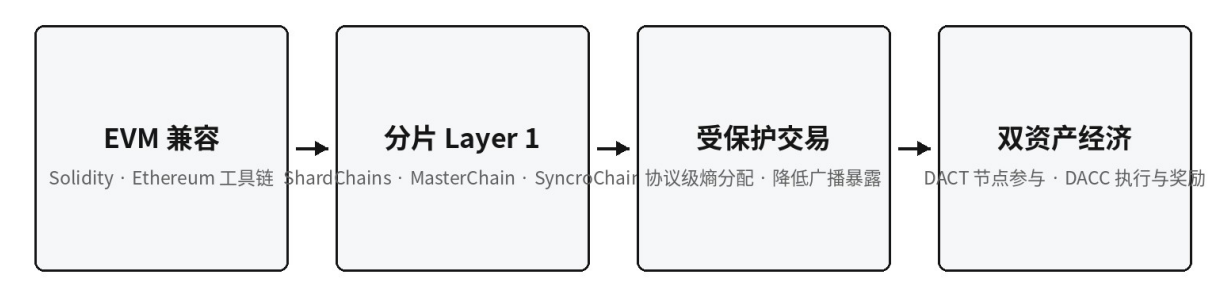
DAC aims to solve three types of problems: first, the scalability and coordination pressure of single-layer execution models as transaction volume and application complexity increase; second, the information exposure brought by public mempools during the transaction broadcast phase; and third, the structural challenges that public-key cryptography and traditional mining models — on which current blockchains have long relied — may face as quantum computing develops. At the economic layer, the project adopts dual assets DACT and DACC: DACT is used for node role activation and network participation; DACC serves as the chain's native operational coin, bearing transaction fees, smart contract execution, and node rewards. Through functional separation, DAC attempts to have "network access rights" and "on-chain execution demand" carried by different assets respectively.
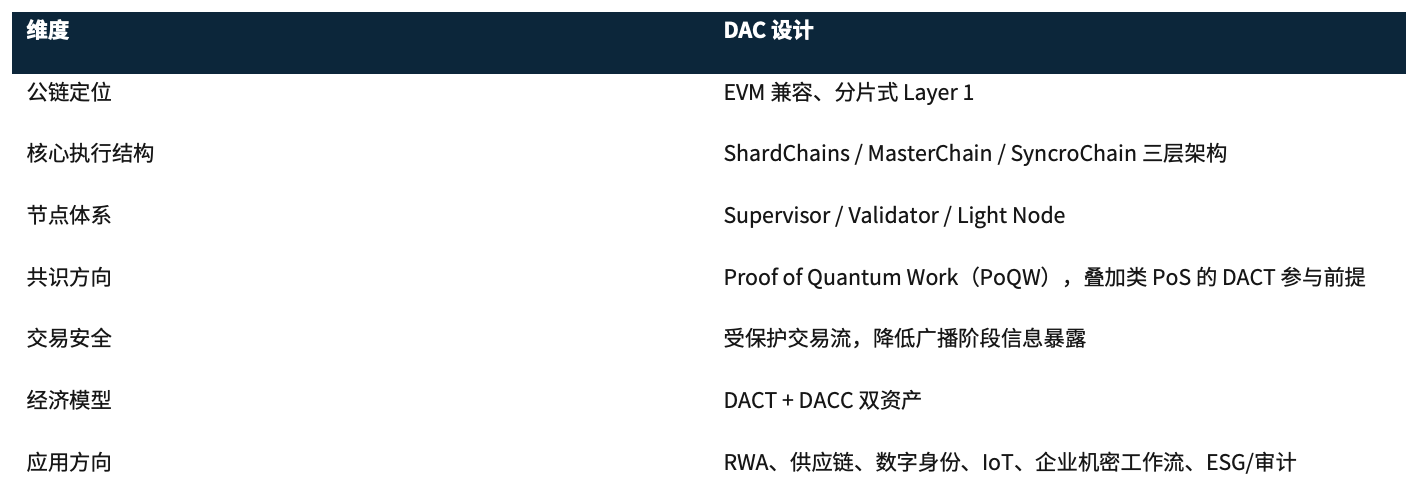
Protocol Mechanism Overview
DAC's mission is to provide secure, scalable, and forward-looking blockchain infrastructure that carries decentralized applications, asset tokenization ecosystems, and enterprise-grade digital processes within a single Layer 1 environment. The white paper emphasizes three principles: operational clarity, infrastructure readiness, and long-term resilience. Project goals include driving real business adoption, enhancing scalability through layering and sharding, strengthening confidentiality during the transaction broadcast phase, maintaining open participation, and preparing for long-term security in the face of quantum computing developments.
Technical Architecture: The Core Body of DAC
DAC's technical core is a Layer 1 architecture with clear layers, shards, and role division. Developers continue to use Solidity and the mature Ethereum toolchain, so application migration and development experience remain EVM-compatible; however, in terms of underlying execution, coordination, finality, and transaction propagation, DAC adopts a design different from traditional single-layer chains.
1. Three-Layer Network Structure: ShardChains, MasterChain, and SyncroChain
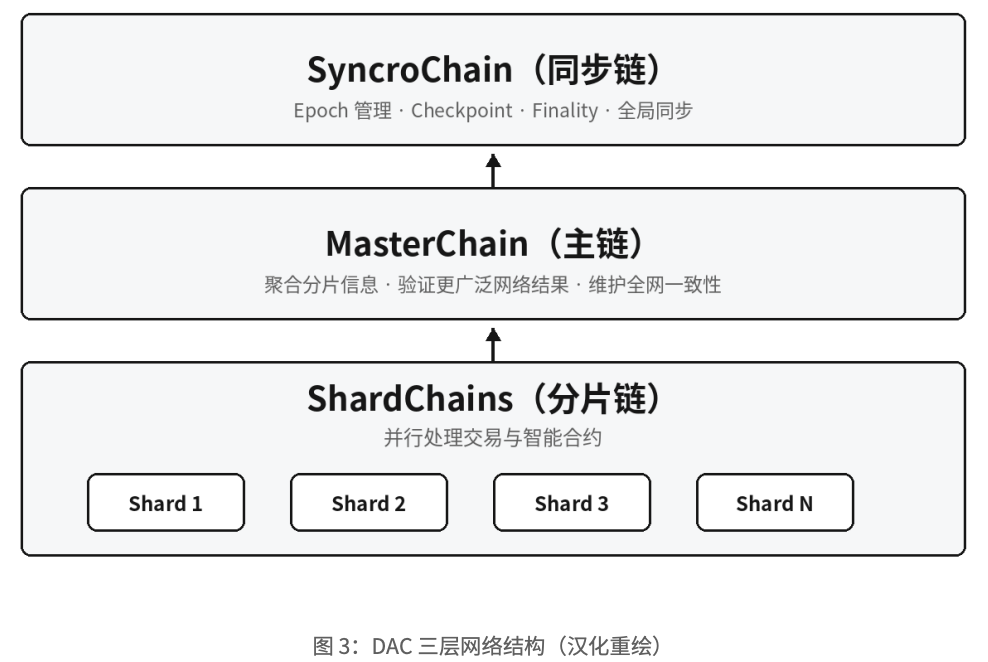
ShardChains are responsible for transaction execution and smart contract processing. The network distributes activity load across multiple parallel execution environments, so that throughput capacity does not need to be concentrated at a single execution point. Its essence is to horizontally scale "execution" across multiple Shards, thereby providing a capacity foundation for higher transaction volumes and more complex application logic. MasterChain sits above sharded execution and assumes aggregation and coordination responsibilities. It collects information from each shard layer, verifies network results over a broader scope, and maintains overall system consistency. In other words, ShardChains handle parallel processing, while MasterChain is responsible for reorganizing parallel results into a unified network state.
SyncroChain is the highest coordination layer, responsible for Epoch management, Checkpoints, and Finality. It maintains global network integrity and drives the structured synchronization on which the multi-layer architecture depends. The three-layer relationship forms a clear responsibility chain of "execution – aggregation – finality."
2. Node Roles and Responsibility Boundaries
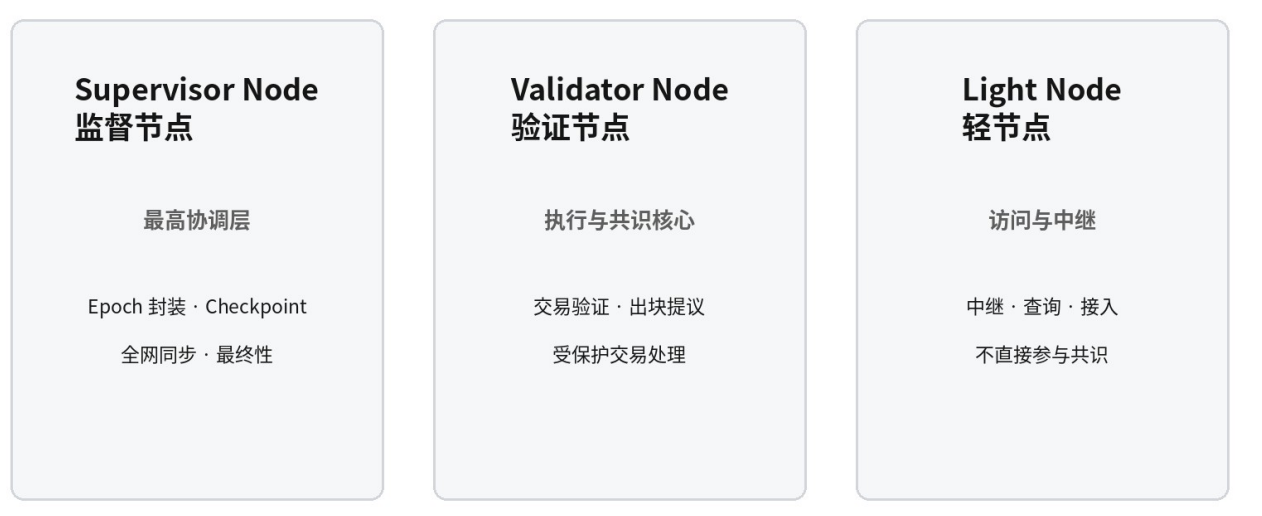
Supervisor Nodes sit at the highest coordination layer of the protocol and participate in Epoch sealing, Checkpoints, and network-wide synchronization, playing a key role in finality and structural integrity. Running a Supervisor Node requires a relatively high DACT commitment to match the network responsibilities it bears.
Validator Nodes are responsible for transaction validation, block proposal, and network execution, and are also key participants in the protected transaction flow. Validators gain participation eligibility through DACT staking and dedicated node software. Light Nodes provide relay, access, and query functions and do not directly participate in consensus, but they help lower the resource threshold for access and enhance network reachability.
3. Multi-Layer Consensus and Proof of Quantum Work (PoQW)
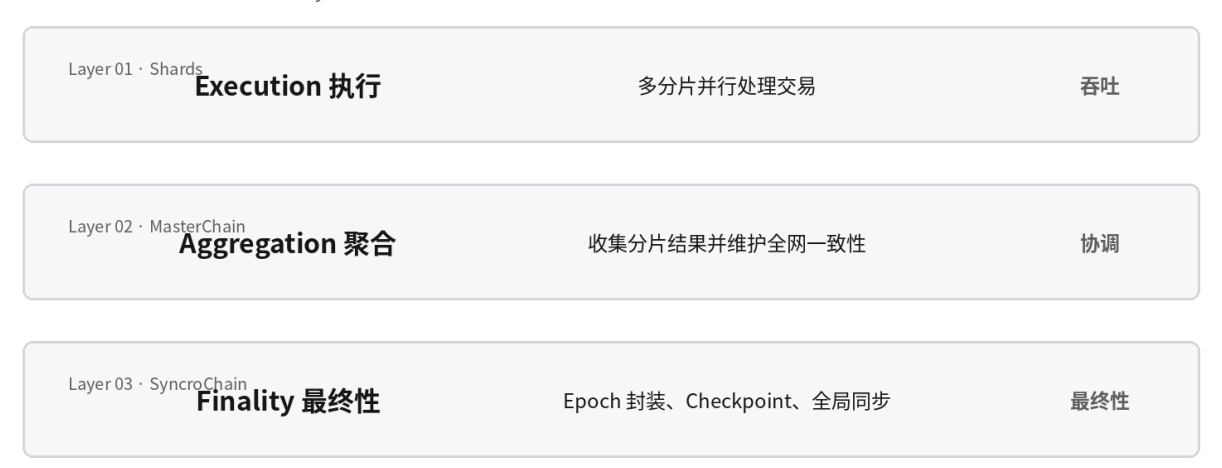
DAC's consensus architecture separates three functions: shard-layer execution, MasterChain aggregation, and SyncroChain final confirmation. This allows execution load to be distributed without sacrificing network-wide consistency, and creates a structured relationship among throughput, validation, and global coordination.
At the block production layer, the white paper states that DAC adopts Proof of Quantum Work (PoQW) and incorporates some features of Proof-of-Stake protocols. DACT commitment is a technical prerequisite for the activation and operation of Validator Nodes and Supervisor Nodes, and therefore is also one of the foundations for the network's ability to form consensus. The white paper emphasizes that this model goes beyond traditional hash-competition-based consensus and aligns with the direction in which quantum computing may reshape blockchain security.
4. Protected Transaction Flow: Embedding Broadcast-Phase Privacy into Protocol Design
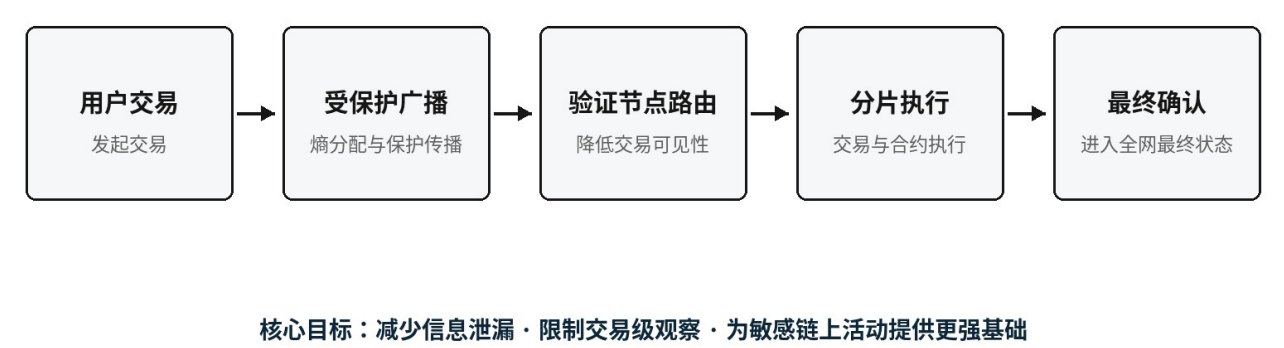
Traditional public blockchains expose transaction details during the transaction broadcast and mempool propagation phase. DAC treats this phase as a structural security weakness and proposes a transaction flow based on protocol-level entropy assignment and protected broadcast to reduce information visibility during propagation.
According to the white paper, the goal of this mechanism is to reduce information leakage, limit transaction-level observation, and provide a stronger foundation for on-chain activities involving sensitive operational data, transaction timing, or internal workflow logic, while maintaining EVM environment compatibility. The specific entropy generation, propagation routing, validation methods, and attack models are also placed in the Yellow Paper, so this research report does not make additional inferences about undisclosed mechanisms.
5. Quantum-Ready Security: The Security Roadmap for the Quantum Era
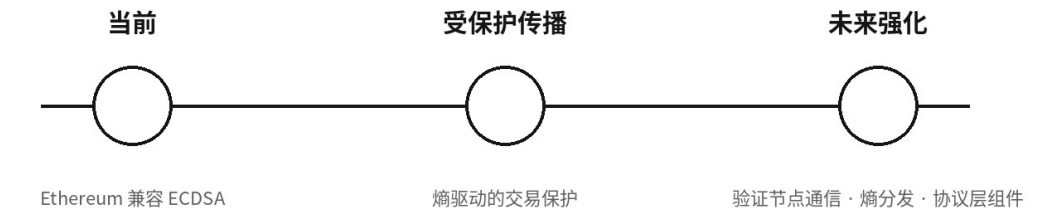
DAC views quantum computing as a long-term structural challenge to blockchain infrastructure, focusing on the potential pressure on public-key cryptography, transaction broadcast visibility, and assumptions of traditional mining models. Current user transactions still maintain Ethereum-compatible ECDSA signatures to preserve continuity with existing wallets, developer tools, and application standards.
Therefore, the precise meaning of "Quantum-Ready" in this white paper is closer to preparing in advance for quantum-era risks through protocol architecture, protected propagation, and subsequent hardening roadmaps, rather than claiming that the current user signature system has fully migrated to post-quantum cryptography. The white paper further outlines the hardening of validator node communication, entropy distribution, and other protocol-layer components.
6. Mainnet and Testnet: Progressive Deployment Model

DAC provides both Testnet and Mainnet. The testnet is used by developers, partners, and node operators for application testing, behavior evaluation, and execution parameter calibration; the mainnet is used for real production execution, DACC/DACT economic activity, and full protocol operations. This phased path is designed to reduce integration friction from experimentation to real-world use.
7. Smart Contracts and Asset Tokenization
DAC provides a Smart Contract Library, encouraging the use of verified and reusable smart contract components to reduce redundant application development and improve code reliability and operational consistency. Smart contracts are deployed through dedicated on-chain transactions, with DACC as the native execution resource.
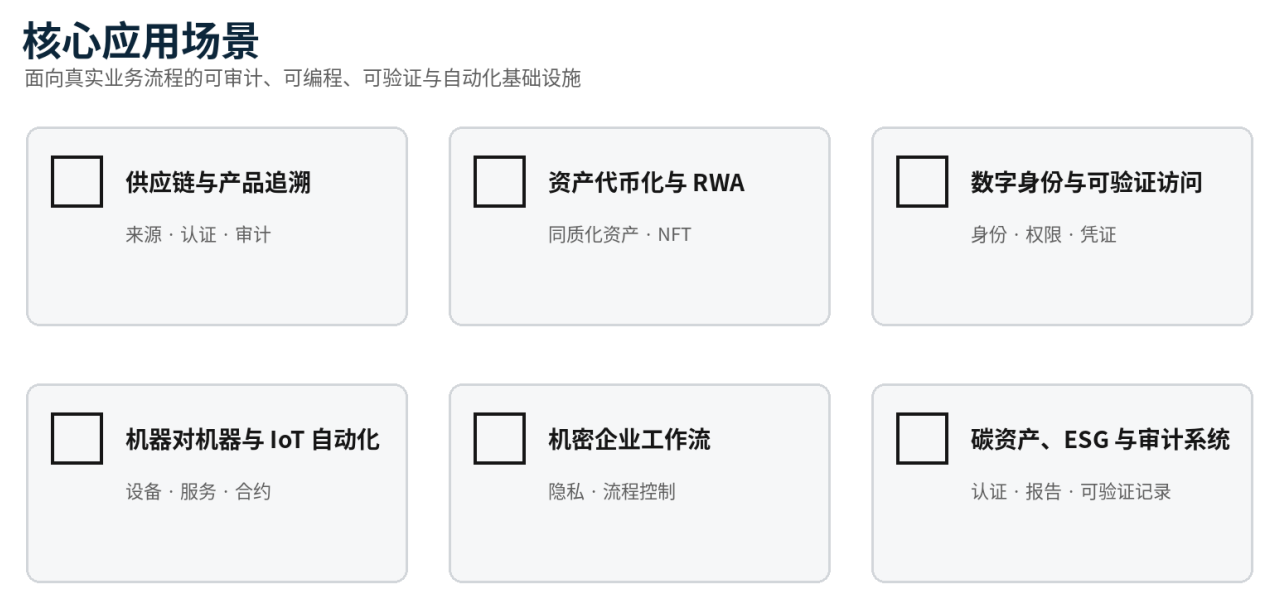
Due to full compatibility with Ethereum standards and Solidity, DAC can use existing smart contract frameworks to issue fungible and non-fungible assets. The tokenization directions listed in the white paper include financial instruments, real estate-related structures, digital certificates, access permission models, and industry-specific asset representations.
8. Digital Identity, Signatures, and Data Security
DAC builds identity and address models for different participants, including individuals, enterprises, IoT devices, and automated services. User transactions retain Ethereum-compatible ECDSA signatures, emphasizing continuous compatibility with existing wallets and toolchains; at the protocol layer, transaction processing security is enhanced through node structure, execution models, and protected broadcast logic.
Data security is defined in DAC as a protocol-level principle: the multi-layer architecture distributes responsibility, and the Validator structure and execution model jointly support scalability and stronger processing control, with the goal of making key actions verifiable, execution structured, and results auditable.
Dual-Asset Economic Model
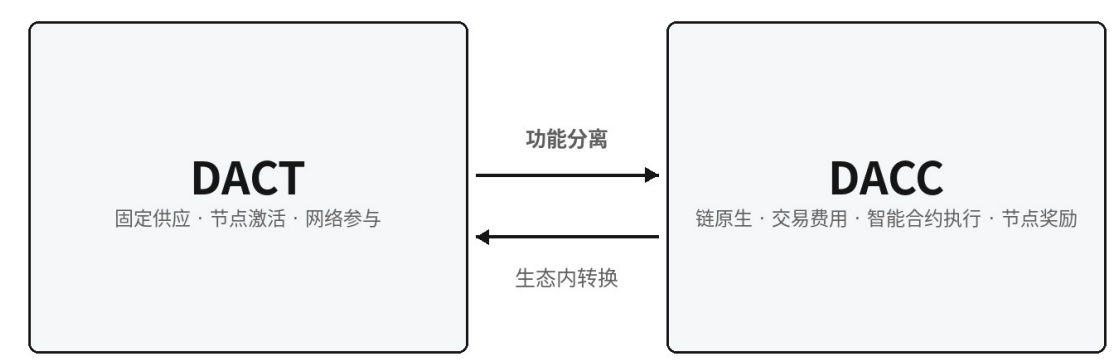
DACT is the utility token of the DAC ecosystem, with a fixed supply of 1 billion tokens. Its sole function is to enable holders to obtain DAC blockchain node attributes, namely activating Validator Nodes and Supervisor Nodes. DACT is issued on Ethereum and does not represent any claim, revenue right, asset right, governance right, or voting right with respect to DAC Labs Sagl.
DACC