「蓝潮」已至:美股谁受益,谁承压?


On November 3, the U.S. midterm elections came to a close.
The Democratic Party swept control of both the House and the Senate, and achieved key upsets in traditionally red or swing states such as Texas, Iowa, Kansas, and Ohio.
This "blue wave" completely reshaped the governing environment for Trump's final two years in office.
Trump also quickly made his stance clear, stating that he would use presidential veto power to counter when necessary—and this was not an empty threat: although Democrats control both chambers of Congress, overturning a presidential veto would still require crossing the high wall of a two-thirds absolute majority in both the House and Senate.
Therefore, what the "blue wave" truly changes is actually Congress's investigative oversight of the executive branch, the prioritization of regulatory agendas, and the boundaries of legislative battles over the next two years.
Mapped onto the U.S. stock market, this also means that policy expectations for some industries may improve, while the regulatory leniency expectations that some companies previously relied on may once again come under challenge.
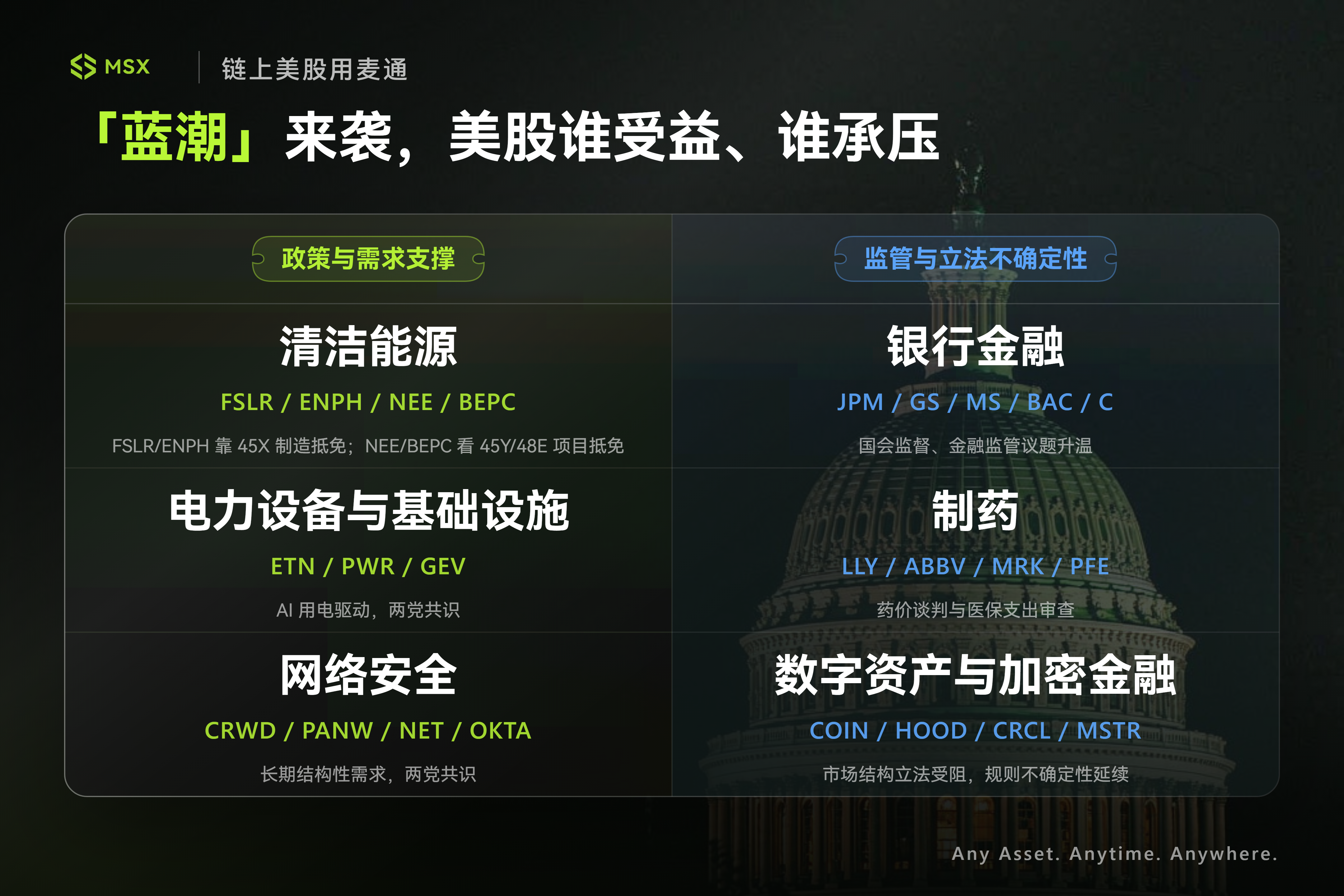
1. Marginal Improvement in Policy Expectations: Clean Energy, Power Equipment, and Cybersecurity
The premise that must be emphasized first is that Democrats regaining control of Congress does not mean that clean energy subsidies cut by the Trump administration will automatically return.
The "One Big Beautiful Bill Act" passed in 2025 has already substantially modified or prematurely terminated multiple clean energy tax credits, and any new legislation to restore subsidies would struggle to overcome the dual thresholds of "60 votes in the Senate + presidential veto power."
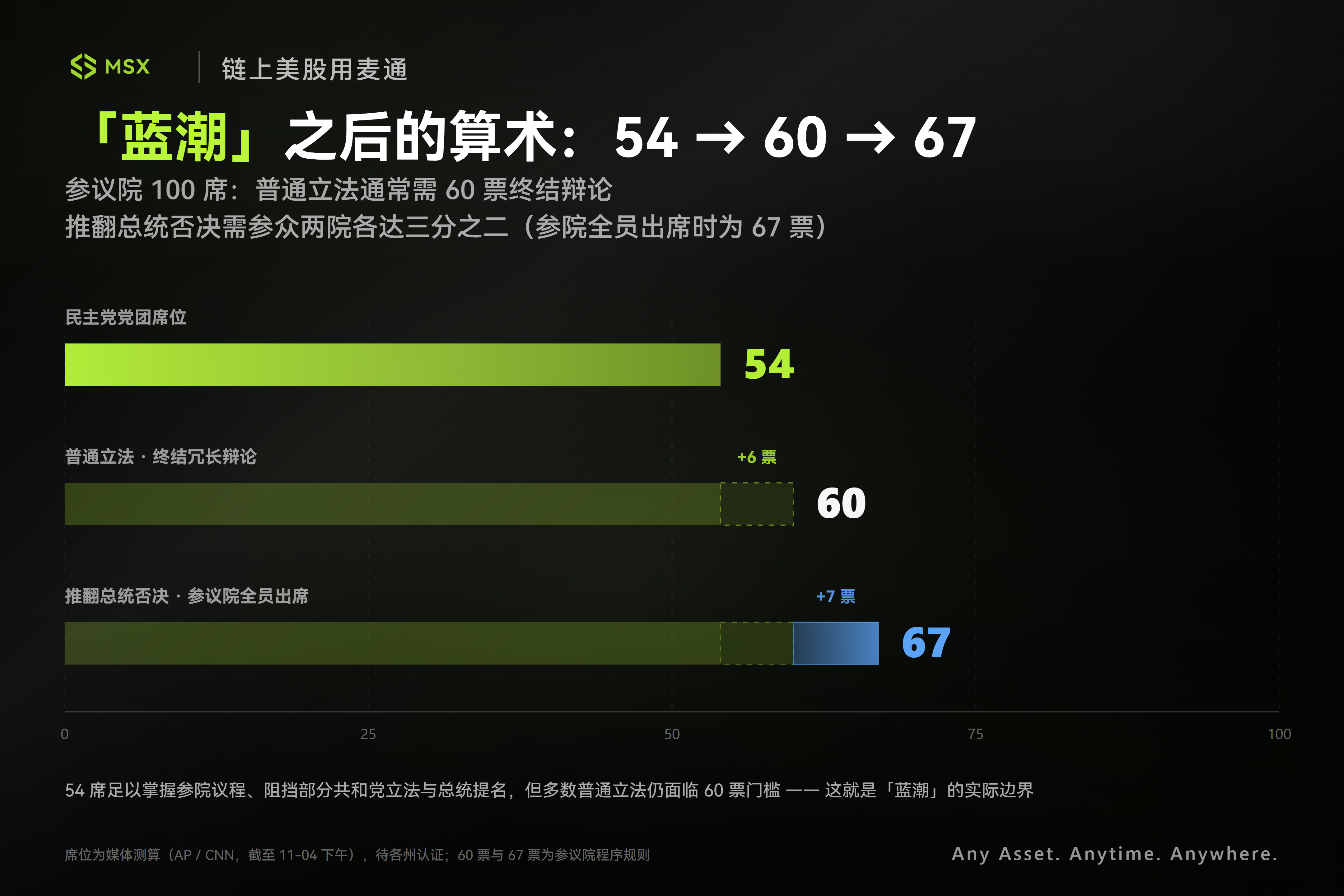
The first is clean energy, including FSLR / ENPH / NEE / BEPC. For this sector, the blue wave means more of a marginal improvement in policy expectations rather than a full return of subsidies.
Among them, First Solar (FSLR) and Enphase Energy (ENPH) mainly involve solar modules, inverters, and the U.S. domestic manufacturing supply chain, with key focus on the 45X manufacturing tax credit, tariffs, and supply chain policy; NextEra Energy (NEE) owns both regulated utility businesses and renewable energy generation operations; Brookfield Renewable (BEPC) primarily generates long-term returns through global renewable energy assets.
Next is power equipment and infrastructure, including ETN / PWR / GEV. This group of names actually has little direct relationship with partisan changes, but the industrial logic is quite clear.
Eaton (ETN) provides power management and electrical equipment, Quanta Services (PWR) participates in grid, transmission and distribution, and energy infrastructure construction, while GE Vernova (GEV) covers power generation equipment and grid technology. Regardless of whether Republicans or Democrats are in power, the AI race and energy security will not easily exit the U.S. policy agenda.
The continued expansion of AI data centers means the United States must address issues such as power supply, substation construction, grid upgrades, and insufficient generation capacity, making this a bipartisan industrial investment theme.
Finally, cybersecurity, including CRWD / PANW / NET / OKTA.
CrowdStrike (CRWD), Palo Alto Networks (PANW), Cloudflare (NET), and Okta (OKTA) respectively cover endpoint security, network security platforms, cloud security, and identity authentication. The proliferation of AI is expanding the cyberattack surface for enterprises and governments, and investment in cloud infrastructure, identity permissions, and critical system security will continue to increase.
The core drivers of this sector remain the security demands of the AI era and long-term cyber defense spending by governments and enterprises. Democratic strengthening of government cybersecurity oversight may provide additional policy attention, but it does not mean these companies will immediately receive new orders as a result (Further reading: "As AI Agents Accelerate Their Penetration into Internal Networks: The Main Battlefield of "Cybersecurity" Has Changed").
2. Rising Regulatory and Legislative Uncertainty: Banks, Pharmaceuticals, and Crypto Finance
Compared with the industrial demand logic on the left side, the banking, pharmaceutical, and crypto finance sectors are far more sensitive to congressional hearings, regulatory personnel changes, and legislative tug-of-war.
The first is banking and financials, including JPM / GS / MS / BAC / C.
JPMorgan (JPM), Goldman Sachs (GS), Morgan Stanley (MS), Bank of America (BAC), and Citigroup (C) are all important representatives of large U.S. financial institutions. After Democrats retake Congress, issues such as consumer protection, regulation of large financial institutions, capital requirements, and financial market competition may heat up again.
Particularly noteworthy is the competition between traditional banks and stablecoins. The banking industry has long worried that stablecoin reward mechanisms could divert traditional deposits, thereby affecting banks' funding costs and deposit bases.
However, since core regulators such as the Federal Reserve and the Treasury Department remain under executive branch leadership, congressional pressure will manifest more as hearing inquiries and legislative constraints rather than an instantaneous reversal of regulatory rules.
Next is pharmaceuticals, including LLY / ABBV / MRK / PFE.
Eli Lilly (LLY), AbbVie (ABBV), Merck (MRK), and Pfizer (PFE) all need to watch for policy changes in U.S. drug pricing, healthcare spending, and the pharmaceutical supply system.
Democrats have long advocated reducing residents' healthcare costs. Eli Lilly, AbbVie, Merck, and Pfizer will need to confront this long-standing obsession directly, and the focus of congressional oversight will inevitably shift back toward Medicare drug price negotiations, PBM (pharmacy benefit manager) reform, and the pricing power of large pharmaceutical companies.
But the market also need not panic excessively. The Medicare negotiation mechanism granted by the Inflation Reduction Act has long existed. Over the next two years, what is more likely is strict oversight and expansion battles over existing provisions, rather than a sudden new round of aggressive price controls under a divided government.
Finally, digital assets and crypto finance, covering COIN / HOOD / CRCL / MSTR.
The policy sensitivity of this sector deserves particular attention, but the business attributes of the four companies are not the same. Coinbase (COIN) is a crypto trading and financial infrastructure platform, Robinhood (HOOD) is a comprehensive retail financial platform, Circle (CRCL) is the issuer of the USDC stablecoin, and Strategy (MSTR) is a public company centered on a Bitcoin treasury.
In September of this year, the Senate's push for the CLARITY Act was temporarily shelved. This involves not only Democratic questions about conflicts of interest in the Trump family's crypto business, but also interest disagreements between banks and crypto companies over stablecoin reward mechanisms.
After the blue wave, this political game may become further complicated. For COIN and CRCL, prolonged uncertainty over rules will affect business expansion and market expectations; HOOD is also affected by its traditional brokerage business; MSTR depends more on Bitcoin prices and its own financing capacity.
3. The Truly Underestimated Variable: Where Will AI Data Centers Move?
There is another intersection worth studying in this election: some states where Democrats achieved breakthroughs happen to also be important markets for U.S. data center construction and AI infrastructure investment.
For example, states such as Ohio, Kansas, and Maine not only appear on this round's key congressional upset list, but also involve local votes related to data center construction.
According to Ballotpedia statistics, on November 3, a total of 41 local measures related to data center construction went to the ballot across ten U.S. states, of which 28 were oriented toward restricting development, involving construction bans, moratoriums on approvals, and increased local review.
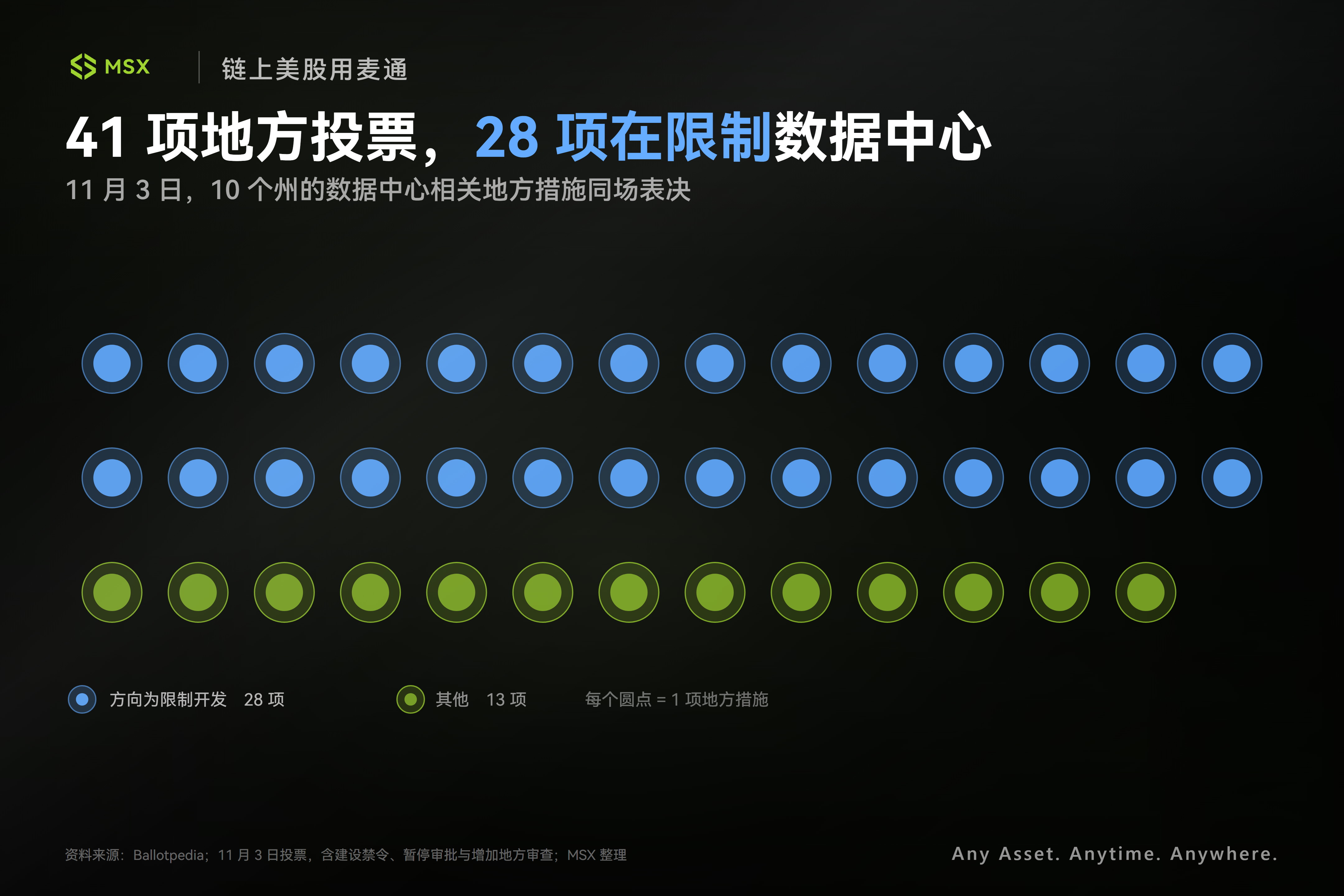
This reveals the increasingly acute underlying contradiction in U.S. AI infrastructure: the United States does not lack the willingness to build AI, but the electricity, water, and land consumed by data centers are triggering backlash among local voters.
Over the past year, the Trump administration has opened the green light for computing expansion by opening federal land and accelerating environmental reviews and energy supporting facilities; but under the dual pressure of the blue wave and local public opinion, the implicit institutional costs of adding new large-scale computing facilities in the United States are rising.
This has also brought two breakthrough paths to the surface:
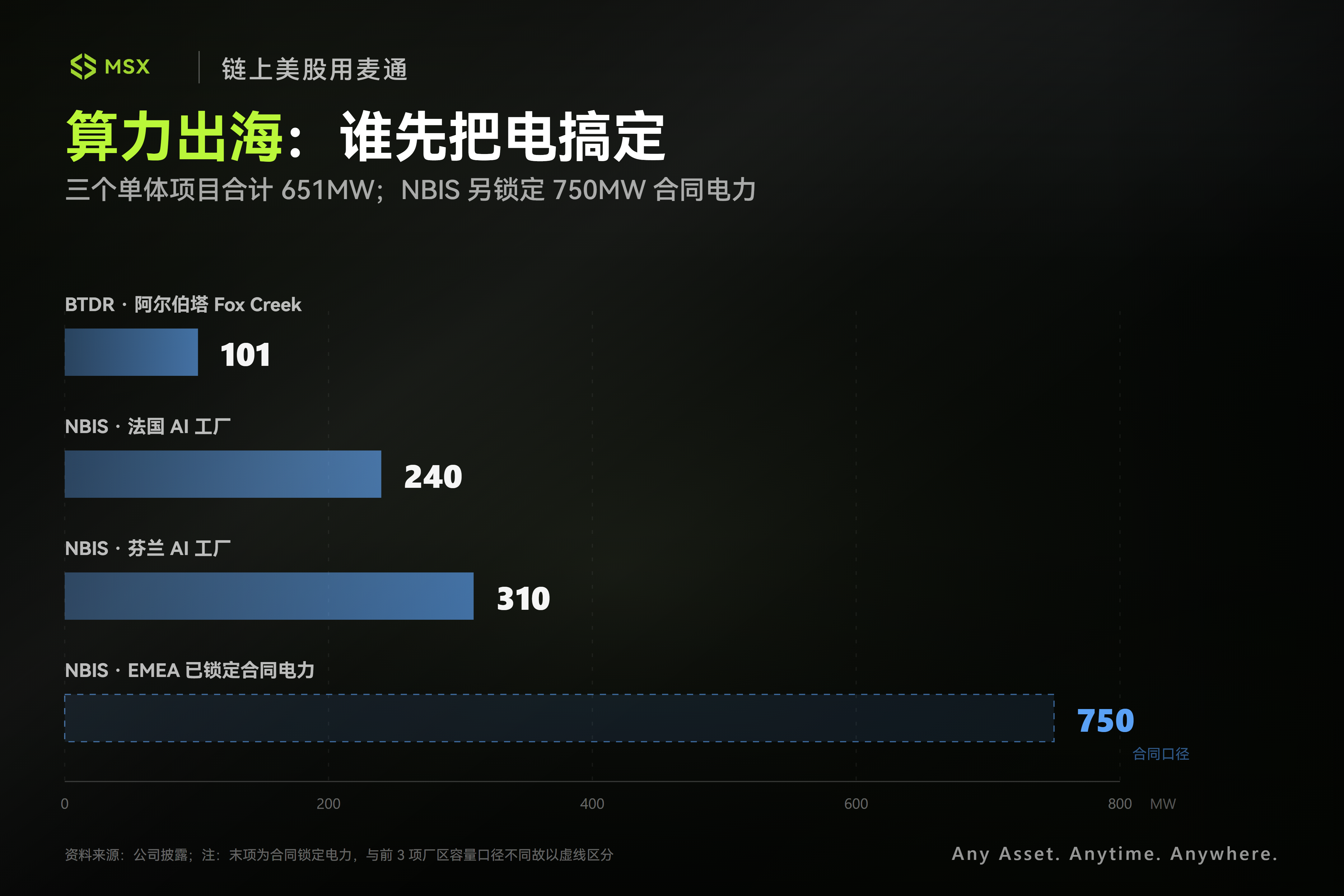
- Integrated "going overseas" of computing power and energy: Represented by BTDR and NBIS, cross-regional locking in low-cost power to avoid U.S. domestic grid queues and community resistance has become a new logic for computing infrastructure. For example, Bitdeer (BTDR) is advancing a vertically integrated project in Fox Creek, Alberta, Canada, building a 101MW natural gas power plant paired with approximately 100MW of computing facilities, initially serving Bitcoin mining while reserving switchable capacity for AI/HPC; Nebius (NBIS) adopts a dual-line layout in Europe and the United States, building AI factories of up to 310MW and 240MW in Finland and France respectively, with over 750MW of contracted power already secured in the EMEA region, while its gigawatt-scale AI factory in Independence, Missouri, has broken ground, hedging approval and power bottlenecks in a single market through global asset allocation;
- Nuclear energy, as one of the few baseload power sources with a bipartisan moat, may be revalued: In June 2024, the U.S. Senate passed the ADVANCE Act by an overwhelming vote of 88 to 2, establishing bipartisan consensus on nuclear energy development. Facing the 24-hour uninterrupted power demand of high-density computing, life extensions, capacity upgrades, long-term power purchase agreements (PPAs), and small modular reactors (SMRs) for existing nuclear plants will continue to attract capital premiums—however, constrained by long approval and construction cycles, nuclear energy is better suited as a long-cycle core holding;
Finally, there is one more variable that cannot be ignored: traditional oil and gas.
In this election round, inflation and the cost of living were important backdrops to Republican losses. High energy prices directly affect residents' cost of living and in turn constrain the government's energy policy space.
Overall, this round of the "blue wave" mainly affects the pricing shift in the market over the next two years from "one-sided policy tailwinds" to "normalized institutional friction."
For U.S. stock investors, rather than over-trading policy noise amid the verbal battles on Capitol Hill, it is better to leave chips with the grid and security infrastructure that neither party can refuse, as well as computing players that can cross national borders and solve power bottlenecks on their own.