


From payment circulation to yield appreciation, and further to value capture, unlocking diverse application pathways for assets within the TRON ecosystem


As the crypto industry evolves, Web3 has moved beyond the early, rough-and-tumble phase of narrative hype, performance-parameter contests, and a pile-up of applications, and entered a period of value return centered on "real-world application adoption" and "intrinsic value capture." In this round of industry paradigm shift, TRON, with its absolute advantage in stablecoin payments, massive real user base, consistently leading on-chain activity, sustainable ecosystem value-capture mechanisms, and efficient asset circulation capabilities, has become a benchmark representative of public chain development that combines both user foundation and practical value.
In the stablecoin payment sector, according to CoinDesk's Q3 report, TRON carries nearly 73% of global on-chain stablecoin transfer activity. In terms of on-chain activity, DeFiLlama data shows that its 24-hour active user count has long ranked first among global public chains and continues to lead top public chains such as Solana. At the ecosystem level, the four core projects JUST, SUN.io, BitTorrent, and WINkLink have successively advanced native governance token buyback-and-burn mechanisms, using real business revenue to feed back into the tokens, accumulating protocol operating results into long-term value, and further deepening the ecosystem's intrinsic value-capture capability.
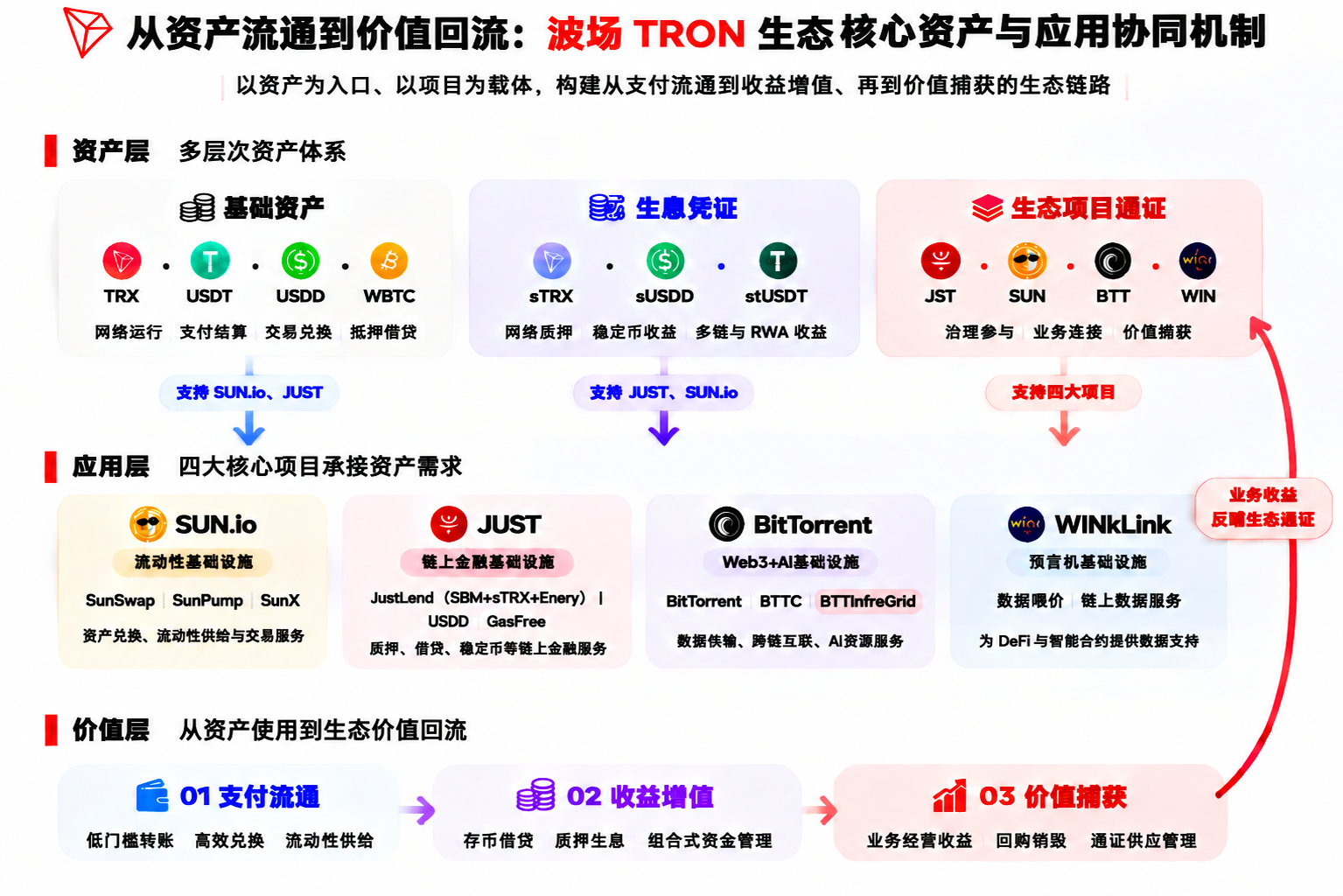
For users, the core anchor of attention has always focused on the application-scenario viability of TRON ecosystem assets, the sustainability of yield mechanisms, and how to participate in ecosystem building with a low barrier to entry so as to truly enjoy the dividends of positive ecosystem development. In the TRON ecosystem, this demand is jointly undertaken by the asset layer and the application layer: the asset layer provides the carrier foundation for circulation and yield generation, while the application layer undertakes specific scenarios such as transfer and payment, trading and swapping, lending and yield generation, and liquidity provision.
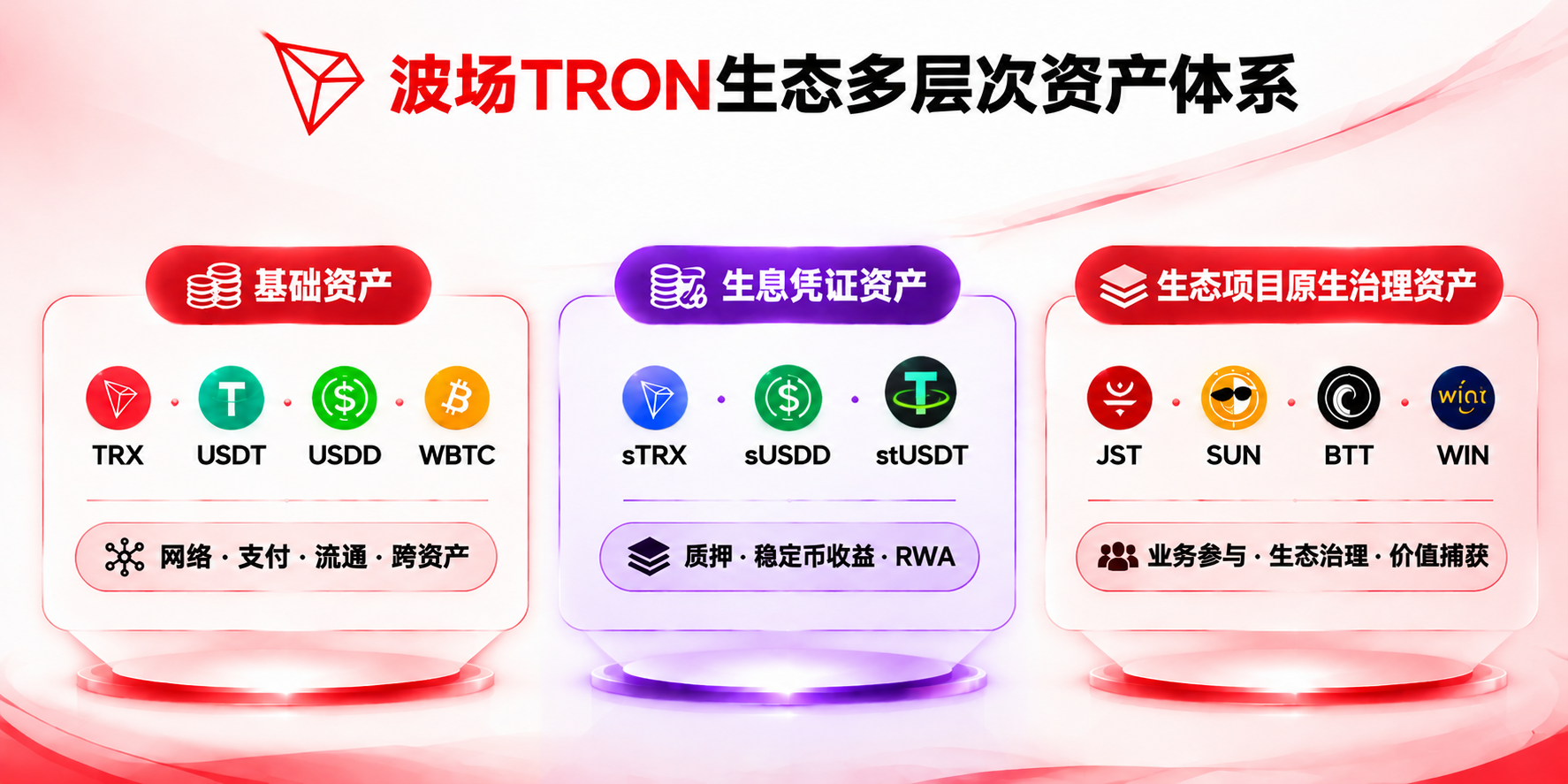
At the asset layer, TRON has formed a multi-tier asset system composed of base assets such as TRX, USDT, USDD, and WBTC; yield-bearing certificate assets such as sTRX, sUSDD, and stUSDT; and governance tokens of ecosystem projects such as JST, SUN, BTT, and WIN. At the application layer, SUN.io, JUST, BitTorrent, and WINkLink respectively undertake liquidity services, on-chain finance, decentralized infrastructure, and oracle data services. The continued combination of assets and application scenarios jointly drives assets from payment circulation toward yield appreciation and value capture.
Assets Carry Value, Applications Open Channels: TRON Solidifies the Foundation for Efficient Payment Settlement and Asset Circulation
Assets are both the value carrier for users participating in the TRON ecosystem and an important link connecting the underlying network infrastructure with upper-layer on-chain applications. At present, TRON has formed a multi-tier asset system composed of base assets, yield-bearing certificate assets, and native governance assets of ecosystem projects. Among them, base assets such as TRX, USDT, USDD, and WBTC respectively serve network operation, payment settlement, value circulation, and cross-asset applications; yield-bearing certificate assets such as sTRX, sUSDD, and stUSDT further connect network staking, stablecoin yield, and RWA yield scenarios; and native governance assets of ecosystem projects such as JST, SUN, BTT, and WIN carry functions such as business participation, ecosystem governance, and value capture. Different types of assets each perform their own roles, jointly forming the value-circulation foundation of the TRON ecosystem and further expanding use scenarios through ecosystem applications such as JUST and SUN.io.
From a functional positioning perspective, TRX, as the native token of the TRON network, mainly undertakes functions such as network operation, resource acquisition, Gas payment, and ecosystem participation. As the ecosystem continues to improve, TRX's application boundaries have further extended to asset allocation, trading and swapping, and ecosystem financial services, and it has gradually grown into an allocative crypto asset bridging traditional financial markets and the Web3 ecosystem, becoming the core hub connecting TRON's underlying infrastructure with full-scenario on-chain applications. In September 2026, Canary Capital launched a TRX spot staking ETF (ticker: TRXS), providing traditional institutional investors with a standardized channel for compliant participation in TRX asset allocation and on-chain staking yield. At the same time, TRON Inc., a U.S.-listed company in the TRON ecosystem, continued to increase its TRX holdings in the open market. As of November 5, the total amount of TRX held in its treasury had exceeded 720 million, reflecting institutional-level attention to TRX's long-term allocation value.
Stablecoin assets such as USDT and USDD constitute the core pillar of value transfer and payment settlement in the TRON ecosystem. While carrying the basic stablecoin circulation function, they can also serve as underlying assets for ecosystem financial products such as lending and yield management, providing support for various on-chain financial applications. As of November 5, the on-chain USDT circulation scale on TRON had exceeded $94.1 billion, far exceeding Ethereum over the same period and firmly securing its position as the global leader in USDT circulation. USDD is TRON's native decentralized overcollateralized stablecoin, supporting minting through collateralization with assets such as TRX, USDT, WBTC, and sTRX. Its current circulation scale is nearly $1.5 billion, making it the second-largest stablecoin on the TRON network and firmly among the global top ten stablecoins.
WBTC further expands the boundary of top blue-chip assets in the TRON ecosystem. As a mapped asset fully backed 1:1 by Bitcoin, WBTC provides a standardized path for Bitcoin assets to efficiently access blockchain and DeFi application ecosystems, with a full-chain 1:1 full reserve mechanism. Its current total network circulation is approximately 116,500. In November 2025, JustLend officially launched the WBTC fund pool, supporting users to supply and borrow the asset; in April 2026, USDD launched the WBTC Vault feature, allowing WBTC to be used as full collateral to mint USDD, further opening up the full-scenario application link for Bitcoin assets within the TRON ecosystem.
From this perspective, TRX, USDT, USDD, and WBTC together constitute important base assets for asset circulation and financial applications in the TRON ecosystem. They can be directly used for transfer and payment and trading and swapping, and can also participate in financial activities such as staking yield, collateralized lending, and liquidity management with the support of corresponding protocols. However, for these assets to truly achieve large-scale adoption in daily payment settlement and high-frequency trading circulation scenarios, they cannot do without the undertaking and support of TRON's application-layer infrastructure. Among them, applications such as GasFree under JUST, JustLend's Energy service, and SunSwap under SUN.io respectively provide solutions for transfer barriers, on-chain interaction costs, and asset swap efficiency.
In transfer and payment scenarios, the TRON ecosystem not only provides efficient native basic transfer functionality but also continuously optimizes the experience around real user pain points. The GasFree service under the JUST ecosystem, which enables "Gas"-free transfers, supports deducting the corresponding network Gas fee directly from the target token of the transfer, without the need to additionally hold native TRX to pay fees, breaking the traditional limitation that transfers require holding the native token. At present, GasFree already supports "Gas"-free transfers for the two major stablecoins USDT and USDD, greatly lowering the barrier for users accessing the TRON network for the first time.
In terms of on-chain interaction costs, JustLend's Energy service allows users to lease or purchase network energy resources on demand according to operation frequency, thereby reducing the comprehensive usage costs incurred by direct on-chain interaction.
In the asset swap and trading circulation segment, SunSwap supports decentralized swapping between core assets such as TRX and USDT and other supported assets within the ecosystem; its built-in PSM stablecoin swap tool supports 1:1 zero-slippage swaps between USDD and USDT, further reducing slippage losses in stablecoin transactions.
As a result, the underlying asset system and the upper-layer application matrix form two-way support. For example, GasFree and JustLend's Energy service continuously optimize payment settlement efficiency, while SunSwap ensures smooth asset trading circulation. Together they enhance the payment settlement and asset circulation experience and provide foundational support for ecosystem value circulation and scenario adoption.
From DeFi Participation to Holding Yield-Bearing Assets: Exploring Diversified Yield Appreciation Paths for TRON Ecosystem Assets
Once assets smoothly complete payment settlement and trading circulation, how to further improve the use efficiency of idle funds and continue to participate in yield appreciation management becomes the next core demand of ecosystem financial applications. Around this demand, the TRON ECO has formed a multi-tier path from direct DeFi participation to holding yield-bearing certificates and then to cross-protocol portfolio management: users can directly put base assets such as TRX, USDT, USDD, and WBTC into protocols such as SunSwap and JustLend to participate in liquidity provision, deposit-for-yield, and collateralized lending; they can also further connect to network staking, stablecoin yield, and real-world asset yield through yield products such as sTRX, sUSDD, and stUSDT.
At the level of basic DeFi participation, SunSwap and JustLend together form important entry points. SunSwap supports users to form trading pairs with assets such as TRX, USDT, and USDD according to fund pool rules and provide LP liquidity, thereby participating in trading fee distribution and related incentives. JustLend, through the SBM lending market, provides asset deposit and collateralized lending services, supporting assets such as TRX, USDT, USDD, WBTC, sTRX, wstUSDT, as well as JST, SUN, BTT, and WIN. Users can earn deposit interest according to market supply and demand and protocol rules, or borrow other tokens by collateralizing assets, meeting fund management needs across different durations and liquidity requirements.
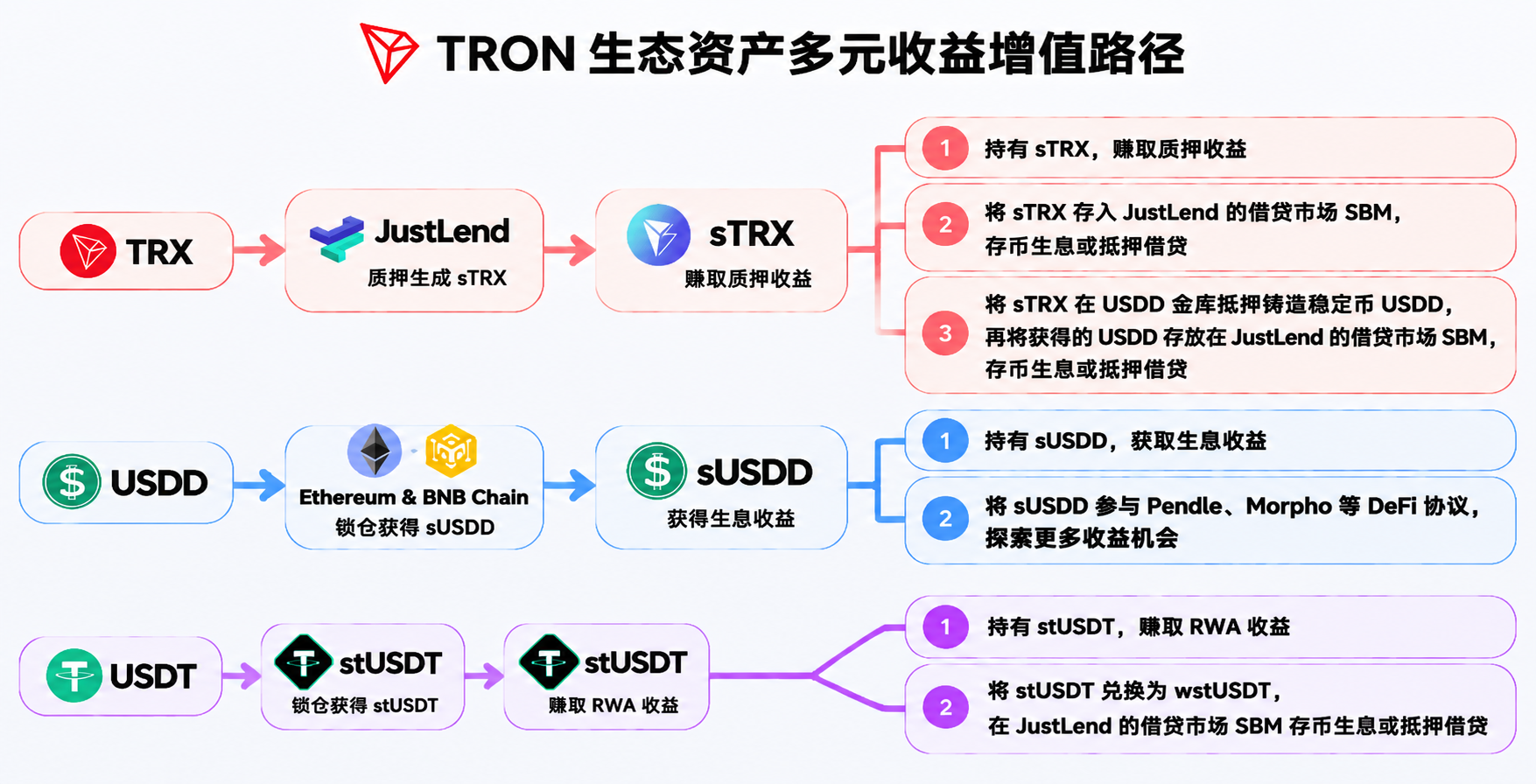
On top of basic DeFi participation, yield-bearing certificate assets further extend the yield path from active operations to certificate-based asset management. sTRX, sUSDD, and stUSDT are respectively built around TRX network staking, the USDD yield mechanism, and RWA asset yield. Users only need to stake, deposit, or lock the corresponding assets according to product rules to obtain the corresponding certificates and earn related yields. More importantly, these certificates are not limited to the underlying yield itself; they can further participate in DeFi application activities, allowing the same asset to continuously release value in different scenarios.
sTRX connects to TRX network staking yield. As a TRX liquid staking product launched by JustLend under JUST, it supports obtaining sTRX by staking TRX to earn TRON network staking yield, and the corresponding staked TRX scale has exceeded 9.8 billion. On this basis, the application boundary of sTRX can be further extended to multiple financial scenarios: sTRX can also be used in markets supported by JustLend SBM for deposit-for-yield or collateralized lending; in USDD vaults that support sTRX collateral, it can be used as collateral to participate in USDD minting, and the obtained USDD can then be deposited into corresponding markets; where supported by SunSwap, it can also form trading pairs with assets such as TRX and provide LP liquidity. As a result, the staking rights of TRX can connect to richer on-chain financial scenarios, linking lending, stablecoins, and liquidity management, unlocking multi-tier yield capture from a single asset.
If sTRX mainly opens up the in-chain "staking—yield—lending" path, then sUSDD extends yield management to cross-chain scenarios. As a yield-type asset certificate built around USDD, users can lock USDD on supported networks such as Ethereum and BNB Chain according to relevant product rules and obtain sUSDD to participate in the corresponding underlying yield mechanism. In addition, sUSDD can also connect to multi-chain DeFi applications such as Pendle and Morpho, further expanding yield management methods.
stUSDT extends the yield path of USDT stablecoin assets to real-world assets (RWA). As an RWA yield-type asset related to USDT, stUSDT provides users with a channel to participate in the yield of assets related to traditional financial markets through an underlying asset allocation mechanism, and the value of its locked assets has exceeded $56 million. After users deposit USDT according to product rules and obtain stUSDT, they can participate in its underlying yield mechanism, and can also convert it into TRC-20 form wstUSDT through the platform's official Wrapper tool, further accessing DeFi applications in the TRON ecosystem—for example, with JustLend support, depositing into corresponding markets to participate in deposit-for-yield or collateral lending, thereby further integrating RWA yield-type assets into the on-chain financial system.
From staking TRX to obtain sTRX, to expanding USDD cross-chain yield through sUSDD, and then to connecting RWA yield with stUSDT, the TRON ecosystem has formed an interlocking diversified yield path: network staking, stablecoin yield, RWA yield, and cross-chain yield management unfold in parallel. At the same time, through DeFi applications such as JustLend and SunSwap, various yield certificates can be freely combined across different protocols, allowing the same asset to continuously circulate and release value across staking, lending, and stablecoin scenarios.
Value Capture of Ecosystem Governance Assets Continues to Upgrade, Buyback-and-Burn Connects Ecosystem Growth Dividends
While the circulation of base assets gradually becomes smoother and yield appreciation channels become increasingly abundant, the value-capture mechanisms of core projects in the TRON ecosystem are also continuously upgrading, further connecting business development with ecosystem asset value. At present, the four core ecosystem projects JUST, SUN.io, BitTorrent, and WINkLink have all implemented buyback-and-burn mechanisms for their native tokens JST, SUN, BTT, and WIN, further linking real project business revenue with the token economy, allowing users to share in ecosystem development results while also potentially benefiting from the deflationary effects brought by buyback-and-burn.
From the perspective of mechanism logic, buyback-and-burn establishes a link between ecosystem tokens and actual project business development: on the one hand, projects use business operating income for open-market buybacks, bringing real buy-side demand from the operating level to the tokens; on the other hand, burning directly reduces the circulating supply on the market, creating a continuous deflationary effect on the supply side. This means that the better the project's business development, the larger the scale of tokens available for buyback-and-burn, the more obvious the contraction in circulation, and the deflationary effect continues to amplify accordingly. When demand remains relatively stable, supply contraction may support token value.
At present, the buyback-and-burn mechanisms of JST, SUN, BTT, and WIN have achieved phased results. Among them, the buyback-and-burn scale of JST in the JUST ecosystem is relatively prominent: as of now, JST has completed five rounds of buyback-and-burn, with cumulative buyback-and-burn exceeding 1.881 billion tokens, a cumulative deflation rate exceeding 19%, and real buyback funds invested exceeding $118 million, mainly from JustLend's operating income. SUN.io has executed 52 consecutive rounds of SUN buyback-and-burn, with cumulative burned amount exceeding 685 million tokens, accounting for 3.44% of total supply. Buyback funds come from protocol revenue across product lines such as SunSwap, SunX, and SunPump. BTT and WIN have also completed their first rounds of buyback-and-burn: BTT's first burn reached 21.62 trillion tokens, worth about $7.6 million, accounting for about 2.18% of total supply; WIN's first burn reached 67.357 billion tokens, worth about $3.59 million, accounting for about 6.74% of total supply.
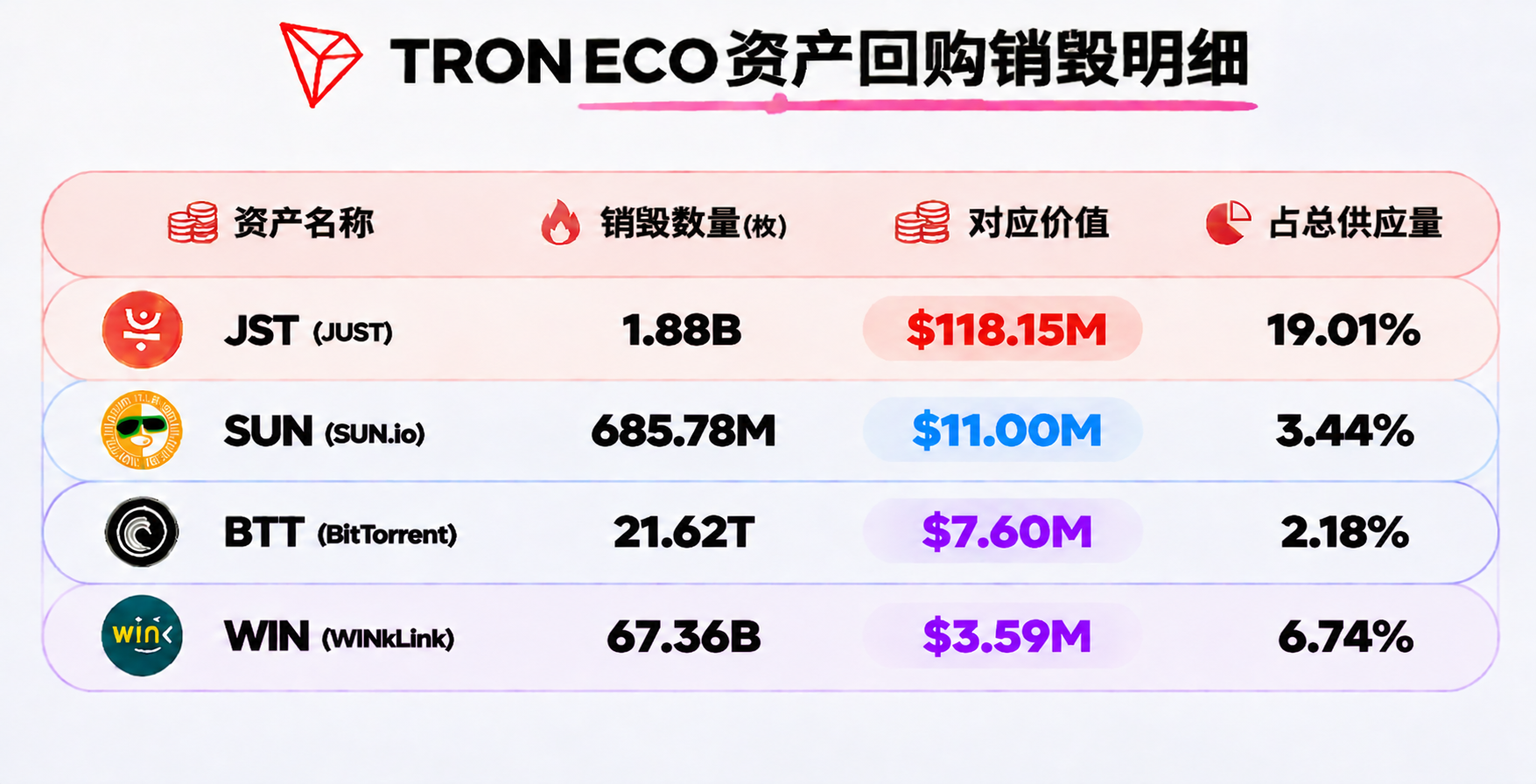
From the continuous regular buybacks of JST and SUN to the concentrated implementation of the first buyback-and-burn plans for BTT and WIN, all four core governance tokens in the TRON ecosystem have completed the closed loop of deflationary mechanisms. Real business revenue has become the core support for token value capture, directly driving a revaluation of core ecosystem asset value. From secondary market feedback, the continued implementation of buyback-and-burn mechanisms has directly driven a significant enhancement in asset price resilience: since the buyback plan launched in October 2025, JST has cumulatively risen more than 300% for the year; within three months after the buyback plan launched in July 2026, BTT and WIN rose more than 23% and 100%, respectively, and the deflationary value effect is continuing to be released.
For users, ecosystem governance assets such as JST, SUN, BTT, and WIN have dual value: they are both rights certificates for participating in the governance and ecosystem building of core projects such as JUST, SUN.io, BitTorrent, and WINkLink, and important carriers connecting ecosystem development results. Relying on normalized buyback-and-burn mechanisms driven by real project business revenue, deflationary value will continue to rise with ecosystem revenue growth, and users can automatically share in ecosystem business growth dividends without additional operations. At the same time, these governance assets can also access various DeFi applications within the ecosystem, further revitalizing assets and improving use efficiency.
From Asset Usage to Value Return, TRON Ecosystem Assets Launch a New Growth Flywheel
From the efficient payment circulation of base assets, to yield-bearing





