Sherrod Brown Returns to the Senate: What It Means for Crypto Regulation and Fairshake in 2026


- Key Takeaway: Sherrod Brown won Ohio's Senate special election, but the real impact is not about which party holds the majority—it's that the CLARITY Act requires a bipartisan coalition to reach the 60-vote cloture threshold, and Brown's return directly makes mustering those votes more difficult.
- Key Elements:
- The election was a special general election for an unexpired Class III seat; Brown defeated Republican incumbent Husted to serve the remainder of the term.
- Industry spending falls into three tiers of accounting: Fairshake's $30 million commitment, $46.67 million disclosed to the FEC by affiliated committees, and over $68 million across the industry per AdImpact.
- This cycle's spending was 3.89x to 5.67x the roughly $12 million spent in the same state in 2024, yet the outcome was the opposite, showing no stable linear relationship between spending and results.
- The CLARITY Act's cloture vote in the Senate failed 49-50 on September 15, 2026; Republicans already held the majority but were still 11 votes short, with three Republican senators among the opposition.
- During his tenure as Banking Committee chairman, Brown repeatedly blocked stablecoin legislation from advancing; committee chairmen hold procedural control, giving them more influence than simply voting against a bill.
- No committee assignments have been confirmed; the Democratic ranking member seat on the Banking Committee is still expected to go to Warren, and the Senate Agriculture Committee assignment is the key indicator to watch for crypto legislation.
Overview
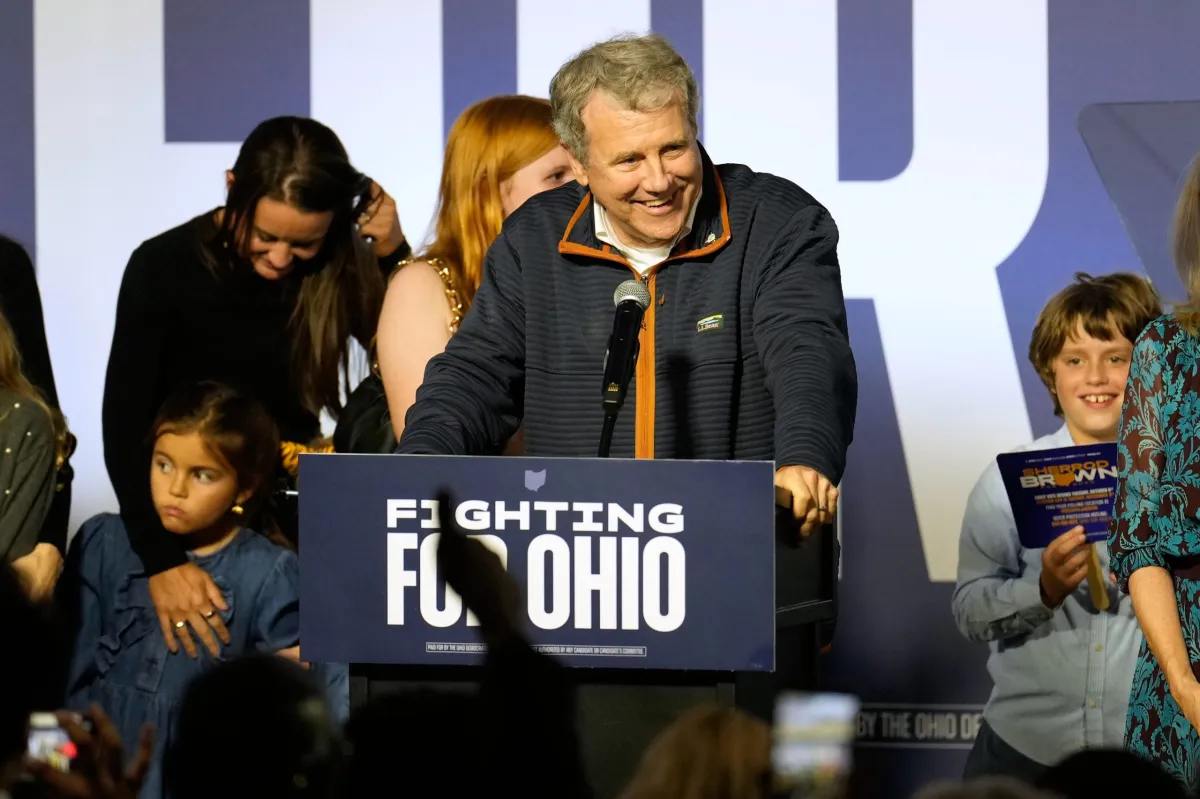
The substantive impact of this result lies not in which party holds the Senate majority, but in the fact that the CLARITY Act needs 60 votes to advance—a threshold that must be met through bipartisan support regardless of which party holds the majority. The Associated Press has called the Ohio Senate race; The Block reports that former Democratic Senator Sherrod Brown defeated incumbent Republican Senator Jon Husted on November 3. This election was a special general election for an unexpired term in the state's Class III seat. During his tenure as Chairman of the Senate Banking Committee, Brown drove the crypto agenda and repeatedly blocked the advancement of stablecoin legislation, so his return directly changes the difficulty of rounding up those 11 votes.
The industry's spending in this race needs to be viewed at three distinct levels; otherwise, the figures reported by different outlets will appear contradictory. Fairshake itself pledged $30 million on September 21; its Republican-affiliated committee Defend American Jobs disclosed cumulative Ohio expenditures of $46.67 million according to Federal Election Commission filings, 55.6% higher than that pledge; and by AdImpact's measure, total industry spending in this election exceeded $68 million.
Key Takeaways
The Associated Press has called the race; Election Day was November 3, 2026, and specific vote counts and percentages are subject to the results released by the Associated Press. The three levels of industry spending are: $30 million in public pledges from a single super PAC, $46.67 million disclosed to the Federal Election Commission by affiliated committees, and over $68 million on a whole-industry basis. In 2024, industry spending in the same state was approximately $12 million to support Bernie Moreno, who won; this time, spending calculated under different measures is 3.89x to 5.67x that amount, with the opposite result. During the 2026 cycle, total industry spending across more than 100 congressional races was approximately $176 million, of which Fairshake and its affiliates accounted for approximately $150.8 million, or 85.7%. Committee assignments are all currently unconfirmed; the Democratic ranking member seat on the Senate Banking Committee is still expected to remain with Elizabeth Warren under seniority rules.
Nature of the Ohio Election
This election was not a regular six-year cycle race, but a special general election for an unexpired term in a Class III seat. The reason is that the seat originally belonged to JD Vance; after he became Vice President, the seat became vacant and was filled by Governor-appointed Husted, so the 2026 election was needed to determine who would hold the remainder of the term. Understanding this is useful for assessing the subsequent timeline: the winner assumes the remainder of the term, not a fresh six-year term.
The Associated Press has called the race; Election Day was November 3, 2026. Specific candidate vote counts, percentages, and margins are subject to the results released by the Associated Press; this article does not restate those figures. Regarding the overall landscape of this midterm cycle and the distribution of state-level issues, MEXC previously provided a complete overview in its 2026 midterm elections crypto agenda breakdown; this article addresses only the results of this race and its aftermath.
How Much Did the Industry Spend: Three Levels Must Be Counted Separately
This is the most error-prone aspect of coverage on this topic. The figures cited for the same election range from $30 million to $68 million; the discrepancy is not because any party got it wrong, but because they cover different scopes of entities. Break the levels apart, and the apparent contradictions between the numbers disappear.
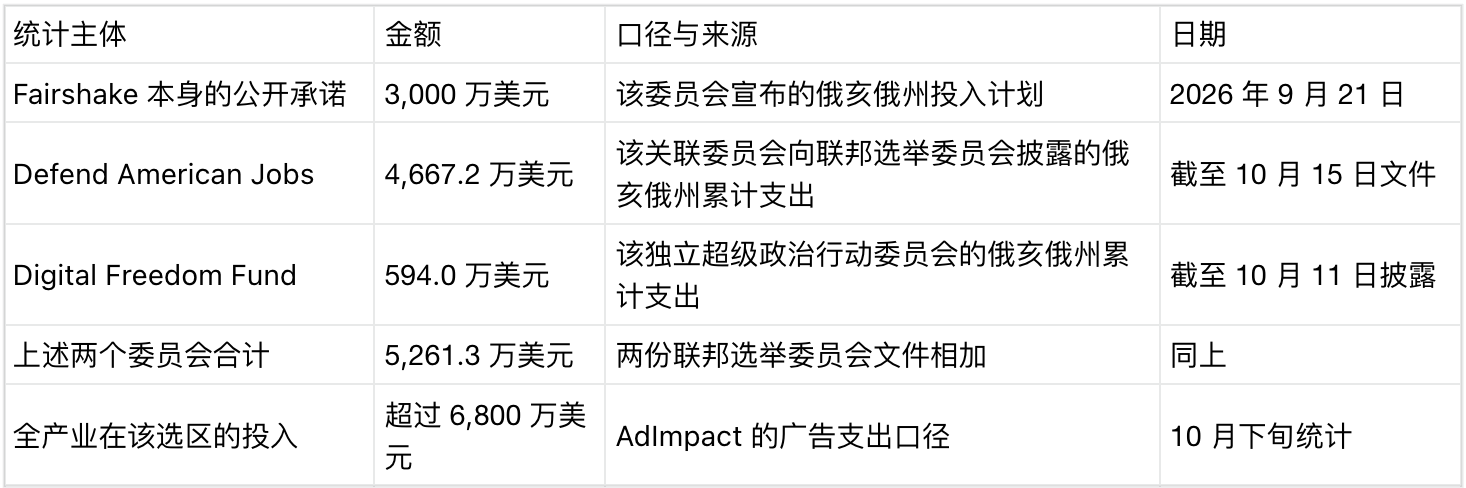
According to crypto.news's compilation of Federal Election Commission filings, Defend American Jobs is Fairshake's affiliated committee oriented toward Republican candidates, not Fairshake itself; its cumulative Ohio expenditures were $46,672,296.18, including nearly $11 million in media purchases through Main Street Media Group. This figure is $16.67 million, or 55.6%, higher than Fairshake's $30 million pledge, which itself demonstrates that "how much a committee pledges to spend" and "how much was actually spent in that district" are two different things. Digital Freedom Fund is another super PAC founded by the Winklevoss brothers; of its cumulative expenditures of $5,940,397.25, the most recently disclosed $2,970,198.58 is divided by purpose into $990,066.19 supporting Husted and $1,980,132.39 opposing Brown, with opposition spending accounting for 66.7% of that amount.
Looking at the entire cycle, the tiered structure is equally clear. According to an October 27 tally based on campaign finance filings through October 20, the digital asset industry spent approximately $176 million across more than 100 congressional races, of which Fairshake and its affiliates accounted for approximately $150.8 million, or 85.7%, and other industry-related organizations approximately $25 million, or 14.2%. Fairshake's filings with the Federal Election Commission for the 2025–2026 cycle show approximately $138.2 million in receipts and approximately $169.5 million in expenditures as of October 14, of which $139 million was transfers to affiliated committees, accounting for 82.0% of expenditures, with approximately $33 million in cash on hand. In other words, the structure is designed for the parent committee to raise funds and then transfer them to party-affiliated committees for execution, so counting only expenditures under the parent committee's name systematically underestimates actual spending.
The concentration in the Ohio race deserves separate mention. The $68 million AdImpact figure equals 38.6% of the entire industry's $176 million in spending and is 6.2x the approximately $11 million spent in Nebraska, the next-highest district. This was not an ordinary battleground race, but the single most resource-concentrated battlefield of the entire cycle.
Brown's Policy Record
To assess the impact of this result, what matters is not labels but his actual actions at specific legislative junctures.
Brown served as Chairman of the Senate Banking Committee, where he set the crypto-related agenda and called for cracking down on the use of crypto assets to finance terrorism and evade sanctions. More specifically at the legislative level: according to Bloomberg Law, an executive at a crypto trading firm said Brown repeatedly blocked attempts to advance stablecoin legislation. A committee chairman has procedural control over whether a bill can enter the agenda, whether hearings can be scheduled, and whether it can receive a committee vote; this is what "blocking" actually means, and it represents a different level of influence from voting against a bill on the floor.
The 2024 comparison provides another clue. That year, the industry spent approximately $12 million in Ohio to support Republican candidate Bernie Moreno, and Brown lost. This time, spending calculated under different measures is 3.89x to 5.67x that amount, with the opposite result. What this comparison shows is not that "money doesn't work"—election outcomes are determined by a multitude of factors—but that there is no stable linear relationship between industry spending and election results; inferring outcomes from spending levels would lead to wrong conclusions in this case.
Committee Assignments: All Currently Conditional
This section must use conditional language because no arrangement has been confirmed, and different arrangements carry very different implications for crypto legislation.
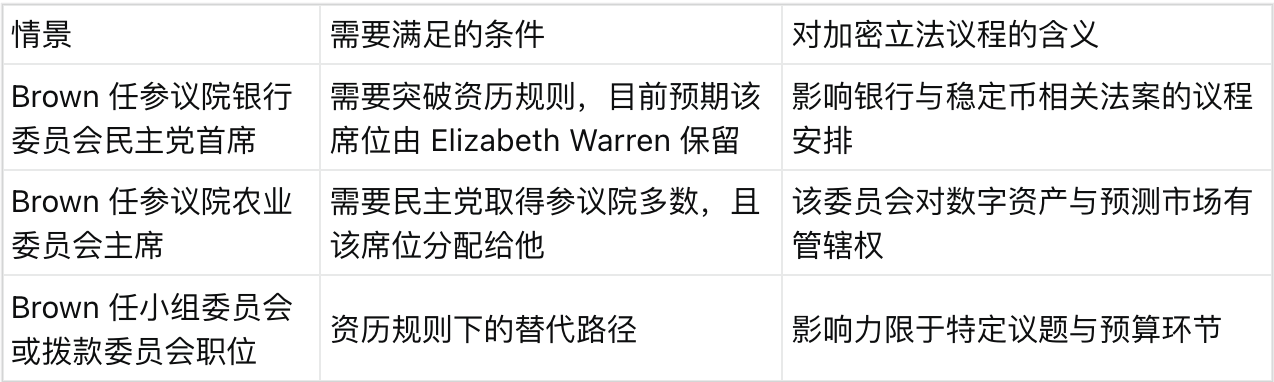
The Block's report notes that if Democrats win the Senate majority, Brown could become Chairman of the Senate Agriculture Committee, which has jurisdiction over digital assets and prediction markets, and according to its sources, he would be unlikely to proactively introduce crypto legislation as chairman. Separately, Bloomberg Law's October 27 report mentioned that under party seniority rules, the Democratic ranking member seat on the Senate Banking Committee is expected to remain with Warren, and Brown's alternative paths could be subcommittees related to agriculture or finance, or a seat on the Appropriations Committee. On the House side, the Democratic ranking member seat on the Financial Services Committee is expected to remain with Maxine Waters, with Sean Casten seeking it and Bill Foster also considering.
It should be noted that none of these are confirmed arrangements. Senate majority control, committee seat allocations, and subcommittee setups will not be finalized until around January 2027, when the 120th Congress convenes. Until then, any analysis treating a specific position as a fait accompli exceeds the available information.
The Real Constraint Is the 60-Vote Threshold, Not Majority Control
This is the most underappreciated implication of this result. Markets habitually translate congressional election outcomes directly into majority control, then infer legislative prospects from majority control, but on the matter of crypto market structure legislation, the intermediate link in this chain is wrong.
The actual trajectory of the CLARITY Act, H.R. 3633, has already proven this. The bill passed the House on July 17, 2025, by a vote of 294 to 134, then stalled in the Senate. On September 15, 2026, the cloture vote on the motion to proceed failed 49 to 50, 11 votes short of the required 60. Crucially, Republicans already held the Senate majority at the time of the vote, and the bill still failed to advance, because the Senate cloture threshold is 60 votes rather than a simple majority. The opposition votes included Republican Senators Collins, Hawley, and Moran, and Senator Tillis voted against in order to preserve the procedural right to re-file the motion.
Under U.S. legislative procedure, a bill that does not pass in the 119th Congress must be reintroduced and go through the entire process again in the 120th Congress, which convenes in January 2027. This means two things. First, regardless of which party holds the majority in the new Congress, market structure legislation will need bipartisan support to reach 60 votes—and this is precisely where the influence of lawmakers like Brown lies: his vote and his weight within the party directly affect the difficulty of assembling those 11 votes. Second, the bill must start from scratch; the House's 294-vote passage will not automatically carry over, and the entire process must be repeated.
The accurate way to assess this is therefore: this result increases the difficulty of assembling bipartisan votes, rather than making the prospects of any particular legislation dependent on who holds the majority. Focusing on majority seat arithmetic misses the mechanism that actually matters.
Implications for the Market and Key Points to Watch
From an asset price perspective, the impact of this kind of legislative process is slow and indirect and should not be equated with macroeconomic data or liquidity events. The reason lies in the time scale: the 120th Congress does not convene until January 2027, and the bill's re-run through the process will take months to years, while Bitcoin's pricing cycle is far shorter than that.
The current environment itself is also a reminder of this secondary importance. The Federal Reserve's target range is 3.75% to 4.00%, with a 25 basis point hike in September, a hold at 10 to 2 in October with both dissents favoring further hikes, and the probability of a December hike ranging from 75% to 87.5% across various estimates. In an environment where the 10-year yield is near 5%, Bitcoin and similar non-cash-flow-generating assets are far more sensitive to real interest rates in the short term than to the legislative calendar. For a detailed breakdown of why the statistical relationship between election cycles and Bitcoin prices is highly dependent on the choice of start date, see the analysis of the midterm elections and Bitcoin's fall-first-then-rise pattern; the conclusion is that the sample size of such seasonal statistics is insufficient to support inferences about any single cycle.
There are three specific milestones worth tracking going forward. The first is the formal allocation of committee seats, expected to be finalized around the convening of the 120th Congress, with particular attention to the Senate Agriculture Committee, given its jurisdiction over digital assets and prediction markets. The second is the reintroduction of market structure legislation in the new Congress—what matters is not the introduction itself but whether 60 votes can be assembled, and whether the re-filing pathway preserved by Senator Tillis is used. The third is the actions of regulators during the legislative vacuum, because with the bill stalled, transitional rules established by the Securities and Exchange Commission and the Commodity Futures Trading Commission under existing authority will play a practical role, and administrative rules are easier to challenge and revoke than legislation. Readers who want to compare actual market reactions around these milestones can mark the timing of policy events on the intraday chart on the BTC price and market data page; tracking over time will reveal that the price impact of such events is typically smaller than that of contemporaneous macroeconomic data. MEXC's spot and futures markets typically see brief changes in liquidity and spreads during major policy announcement periods.
Exclusive View from the MEXC Editorial Team
What truly matters about this result is that it has validated once again a conclusion that has been repeatedly verified: in the Ohio race, industry spending was 3.89x to 5.67x that of the same state in 2024, yet the result was the opposite. This does not mean political spending is ineffective—election outcomes are always determined by a multitude of factors—but it does mean that using spending levels to predict election outcomes is methodologically untenable. The same logic applies to reverse inference: one cannot assume that because the industry spent heavily in a district, the policy direction there is settled, nor can one assume that because of a single election loss, the entire legislative pathway is closed.
The most likely misinterpretation by the market is to translate this result into majority seats and then infer the bill's fate from those seats. The actual experience of the CLARITY Act has already disproven this chain: when the cloture vote failed on September 15, Republicans already held the Senate majority, yet the bill still stalled 49 to 50, 11 votes short of the 60-vote threshold, with three Republican senators among the opposition. In other words, what has always constrained market structure legislation is not majority control but the 60-vote bipartisan threshold. Under this mechanism, the return of a senior senator with a record of blocking stablecoin legislation manifests in the difficulty of assembling votes, not in seat arithmetic.
The most important thing to watch going forward is the Senate Agriculture Committee assignment, not the Banking Committee. Under seniority rules, the Democratic ranking member seat on the Banking Committee is expected to remain with Warren, while the Agriculture Committee has jurisdiction over digital assets and prediction markets—and the existence of this jurisdiction means its weight in crypto legislation is widely underestimated. If the committee ultimately ends up led by a lawmaker uninterested in advancing crypto legislation, then even if the market structure bill is reintroduced in the new Congress, its pace through the committee stage will be materially affected. This milestone will not become clear until around January 2027; until then, all judgments should remain conditional.
The takeaway for cross-asset investors is about matching time scales. The legislative process advances on quarterly and annual timeframes, while crypto assets price in daily and weekly reactions; directly linking the two will produce persistent expectation gaps. In the current environment, with the December rate hike probability near 85% and the 10-year yield near 5%, what determines short-term prices is the discount rate, not the legislative calendar. The value of the legislative variable is that it changes medium-term institutional certainty, and such changes are typically not priced the day after an election—nor should they be traded the day after an election.
Frequently Asked Questions
What was the result of the Ohio Senate election?
The Associated Press has called the race; Election Day was November 3, 2026, and The Block reports that former Democratic Senator Sherrod Brown defeated incumbent Republican Senator Jon Husted. Specific vote counts, percentages, and margins are subject to the results released by the Associated Press. This election was a special general election for an unexpired term in a Class III seat; the seat originally belonged to JD Vance, and after he became Vice President, it was filled by Governor-appointed Husted.
How much did the crypto industry spend in this election