


财报、利率与中期选举交织,BIT 助力把握美股关键节点


Entering November, US equities have entered one of the densest event windows of the year. The Federal Reserve's interest rate decision has landed, earnings reports from several tech giants have been released in succession, and midterm election voting is about to conclude; next up, nonfarm payrolls, CPI, and heavyweight earnings from the likes of Nvidia will take the stage one after another. With several variables stacking up, the question the market must answer remains unchanged: at higher funding costs, can AI investment deliver sufficient profit growth?
1. US Equity Valuations Are Elevated, More Sensitive to Earnings and Rates
S&P 500 valuations are at a year-to-date high, and US Treasury yields remain elevated as well. Based on the forward P/E ratio of 18.7x as of October 23, the S&P 500's earnings yield is about 5.35%, while the 10-year Treasury yield on the same day was 5.00%, leaving an equity risk premium over Treasuries of only about 35 basis points. At this level, a slowdown in earnings growth or a rise in long-end rates could directly pressure valuations. The margin of error for buy-and-hold has been compressed, and the importance of timing and position management has accordingly increased.

Chart: Key event milestones over the next month. Source: BIT
2. Earnings Side: Can AI Investment Convert into Revenue?
This quarter's earnings data looks strong on the surface, but concentration is high. FactSet data as of October 23 shows S&P 500 earnings for the latest quarter grew 29.5% year-over-year, with revenue growth of 12.7%; according to its October 16 estimates, excluding Micron and Nvidia, earnings growth drops from 29.0% to 20.0%. Among companies that have reported, 83% beat EPS expectations, above the five-year average of 78%, but the aggregate beat margin was only 2.1%, well below the five-year average of 7.5% and the ten-year average of 8.0%.
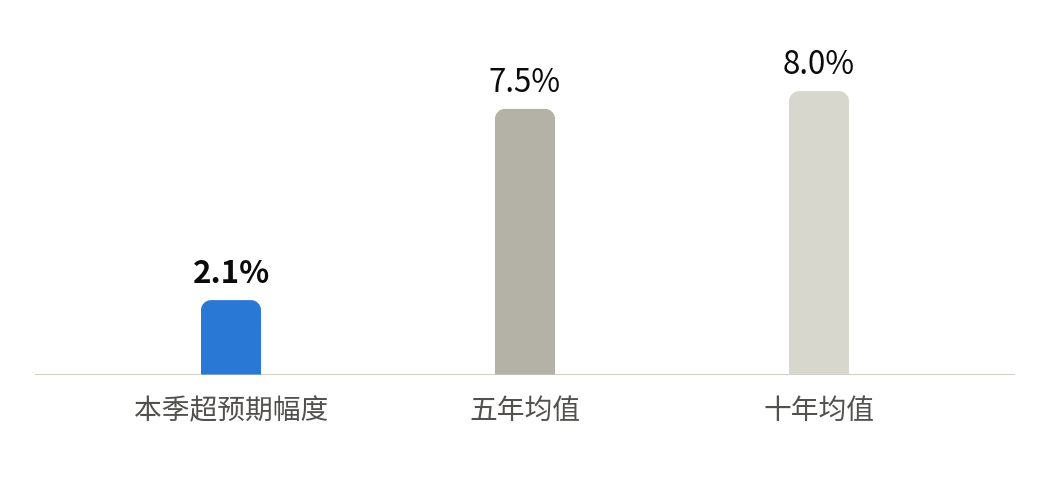
Chart: This quarter's earnings beat margin is below five- and ten-year averages | Source: FactSet
Therefore, the key to upcoming earnings lies in whether guidance can demonstrate that AI investment is converting into revenue. Meta has already provided an early reference: third-quarter revenue of about $64.6 billion, up 26% year-over-year, above market expectations of about $63.3 billion; SpaceX revenue grew 161% year-over-year, with capital expenditure reaching $19.6 billion for the quarter, while profit and cash flow remain to be seen. From October 28 to 29, Google, Microsoft, and Amazon released earnings in succession, with the focus on whether cloud revenue can keep pace with capital expenditure; Nvidia's earnings, expected around November 18, will test whether chip demand can continue. Nvidia's revenue in the previous fiscal quarter was $96.2 billion, up 106% year-over-year, with guidance for the current fiscal quarter at $108 billion, above the market expectation of $104.2 billion at the time.
3. Cost Side: Rate-Hike Pricing and Election Variables
The Federal Reserve has shifted from rate cuts to rate hikes. After three consecutive cuts from September to December 2025, the policy rate range fell to 3.50%–3.75%; on September 16, 2026, the Fed raised rates by 25 basis points to 3.75%–4.00%, and the dot plot shows median rates of 4.125% for both end-2026 and end-2027. However, this round of inflation pressure comes more from the supply side, such as oil prices, while core CPI continues to decline year-over-year, unlike the sharp tightening of 2022.
On October 28, the Federal Open Market Committee held rates steady with 10 votes in favor and 2 against, with Governors Lisa D. Cook and Beth M. Hammack advocating a 25 basis point hike. Chair Kevin Warsh gave no clear guidance on the December meeting. According to CME FedWatch, the market-implied probability of a 25 basis point hike in December has risen to about 86%. Nonfarm payrolls on November 6 and CPI on November 10 will continue to shape market pricing for the December 9 rate decision.
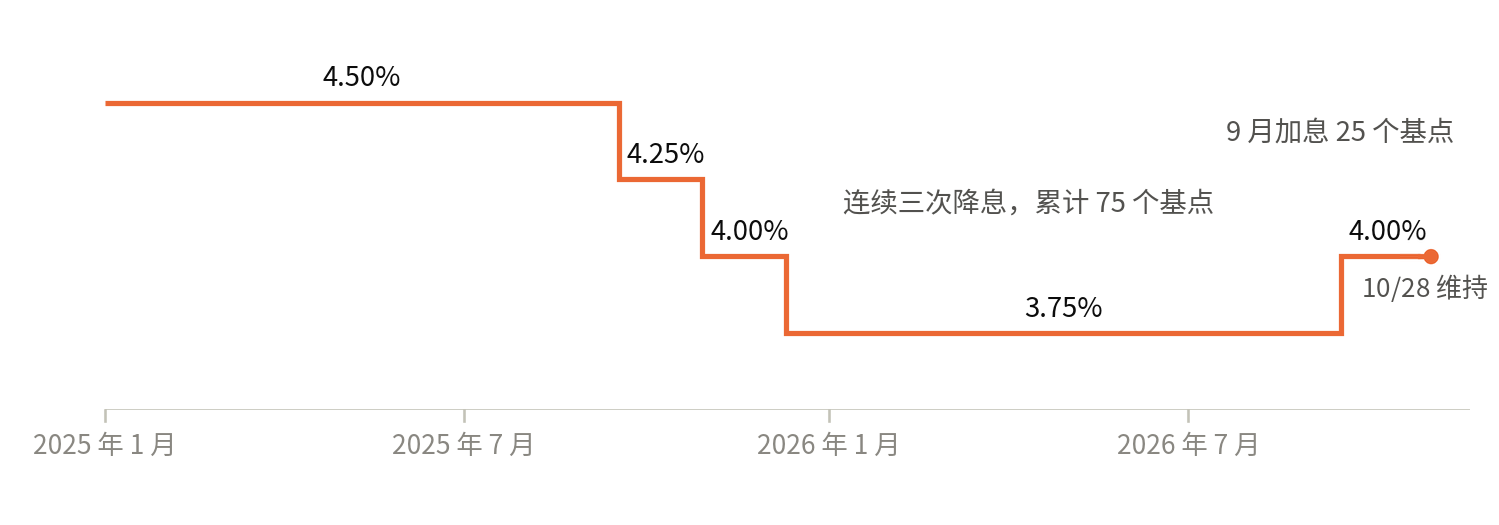
Chart: Changes in the upper bound of the federal funds rate target range since 2025 | Source: Federal Reserve, MUFG Research
The election's impact is more evident at the sector level. BlackRock statistics show that in historical midterm election years, the S&P 500 rose an average of 7.5%, below the 12.4% in non-midterm years; however, the average return in the six months after the election was 14.1%, significantly higher than the 5.7% in the same period of non-election years. A Citi report dated September 23 argued that the semiconductor and AI sectors are particularly sensitive to subsidies, export controls, and AI regulation. Data center power consumption has also become a local issue, with a ballot measure in Ohio to pause data center construction and related audits in Texas, which could affect the pace of cloud providers' capital expenditure deployment. The crypto market structure bill (the CLARITY Act) has passed the House, but a Senate procedural vote in mid-September failed, leaving the direction of stablecoin regulation uncertain.
4. Continuous Cross-Market Pricing Requires Trading Approaches That Keep Pace with Milestones
Another feature of this round of events is that price reactions are no longer confined to regular US equity trading hours. Major tech earnings are mostly released after the US market close, with the first reaction appearing in after-hours trading and crypto asset prices, then transmitting to Hong Kong stocks the next day; nonfarm payrolls and CPI are released one hour before the US market open, first reflected in pre-market and crypto markets. Market holiday schedules further alter the reaction path: if Alibaba releases earnings before the US market open around November 24, Hong Kong stocks will absorb it on the 25th, while the US market is closed on the 26th for Thanksgiving, leaving only Hong Kong stocks and crypto markets to continue digesting the earnings that day.
For investors who need to track multiple markets simultaneously, whether an account can cover these markets directly affects the efficiency of responding to milestones. Take BIT Securities as an example: the platform started with crypto asset services, launched US stock trading in February 2026, and opened Hong Kong stock trading in October, allowing users to trade US stocks, Hong Kong stocks, and crypto assets within the same account, and to trade stocks directly using stablecoins, adjusting positions around milestones without transferring funds across platforms. For dual-listed companies like Alibaba, investors can also compare prices across the two markets within the same account. Around this event window, BIT Securities has launched a limited-time earnings season themed campaign to help users start from specific earnings and data milestones and participate in the linked moves across US stocks, Hong Kong stocks, and crypto markets.
Conclusion
Over the next month, the answer on the earnings side will center on tech giant earnings, while the answer on the funding cost side will depend on nonfarm payrolls and CPI (Consumer Price Index) data in early November, with the election mainly affecting sector divergence. Against the backdrop of a thin equity-bond yield premium, for earnings to outpace funding costs, AI investment returns need to be confirmed by guidance, while inflation and employment data must stop pushing rate-hike expectations higher. If either falls short of expectations, valuations could come under pressure, and the impact will gradually transmit to US stocks, Hong Kong stocks, and crypto asset prices.





