WEEX Continues to Advance Security Infrastructure: Asset Protection, Third-Party Verification, and Account Safeguards


- Key Takeaways: Security for crypto trading platforms has expanded from single private key protection to a multi-dimensional system encompassing system architecture, permission management, third-party services, and daily operations. A continuously operating security mechanism must be built through the coordination of asset transparency, external verification, account protection, and underlying system defense.
- Key Elements:
- WEEX provides 1:1 Proof of Reserves for users to verify independently, and has established a 1,000 BTC protection fund with publicly verifiable on-chain addresses. This serves as a supplementary safeguard mechanism rather than unconditional compensation.
- The platform has obtained ISO/IEC 27001:2022 certification (audited by Swiss Approval) and partnered with HackenProof on a bug bounty program, engaging external institutions for annual security audits over multiple consecutive years.
- Account security covers Passkey public key verification, anti-phishing codes, 2FA, withdrawal whitelists, and API permission and IP binding, forming multi-layered protection.
- The platform's underlying defenses include 24/7 security operations, a Secure Development Lifecycle (SDL), multi-layer validation for deposits and withdrawals, anti-fraud monitoring, and arrangements for MPC hot wallets and offline multi-signature cold wallets.
- Data security covers the full lifecycle including encrypted transmission, key management, backup and recovery, DLP, isolation and least privilege, and monitoring and auditing.
- Third-party assessments show high security scores from CORE3 and CER.live, a historical peak of No. 15 in CoinGecko spot rankings, and a security rating of 4.8/5 from Coin Bureau.
Recently, discussions about platform security in the crypto industry have noticeably intensified. From asset custody and wallet management to internal permission controls and abnormal transaction monitoring, security has once again become a focal point for the industry. As the scale of digital asset trading and the complexity of platform operations continue to grow, security risks are no longer limited to private key protection in the traditional sense, but are gradually extending to system architecture, personnel permissions, third-party services, and various aspects of daily operations.
This also raises a question worth considering: for a crypto asset trading platform, what kind of security system must be established to cope with an ever-changing risk environment?
In fact, security construction is difficult to accomplish through any single technology or safeguard measure alone. Proof of Reserves addresses the issue of asset transparency; account protection focuses on risks during user operations; and wallet management, system security, and data protection involve deeper infrastructure development of the platform. Only when different components work together can a continuously operating security mechanism be formed.

Around these aspects, WEEX has gradually established a multi-layered security system covering asset protection, third-party security verification, account protection, and underlying platform defenses. From publicly verifiable Proof of Reserves and a 1,000 BTC Protection Fund, to ISO/IEC 27001:2022 Information Security Management System certification and the HackenProof bug bounty program, and further to internal security measures covering wallets, trading, and data management, WEEX's security construction presents multiple dimensions ranging from externally verifiable information to internal system protection.
Asset and Fund Protection: Making Reserve Information Verifiable
When users deposit assets into a trading platform, the first thing they need to understand is whether the platform holds corresponding asset reserves and whether that information can be verified.
In terms of asset transparency, WEEX provides 1:1 Proof of Reserves. Users can check relevant reserve information through the official PoR page and use the verification methods provided on the page to independently verify whether their personal balances are included within the corresponding Proof of Reserves scope. Compared with relying solely on reserve data published by the platform, enabling users to access relevant information through a public verification entry point is an important part of building reserve transparency.
WEEX does not proactively use a single reserve ratio figure as a promotional focus; specific reserve information is subject to what is displayed on the official PoR page, and users can check and verify it themselves.
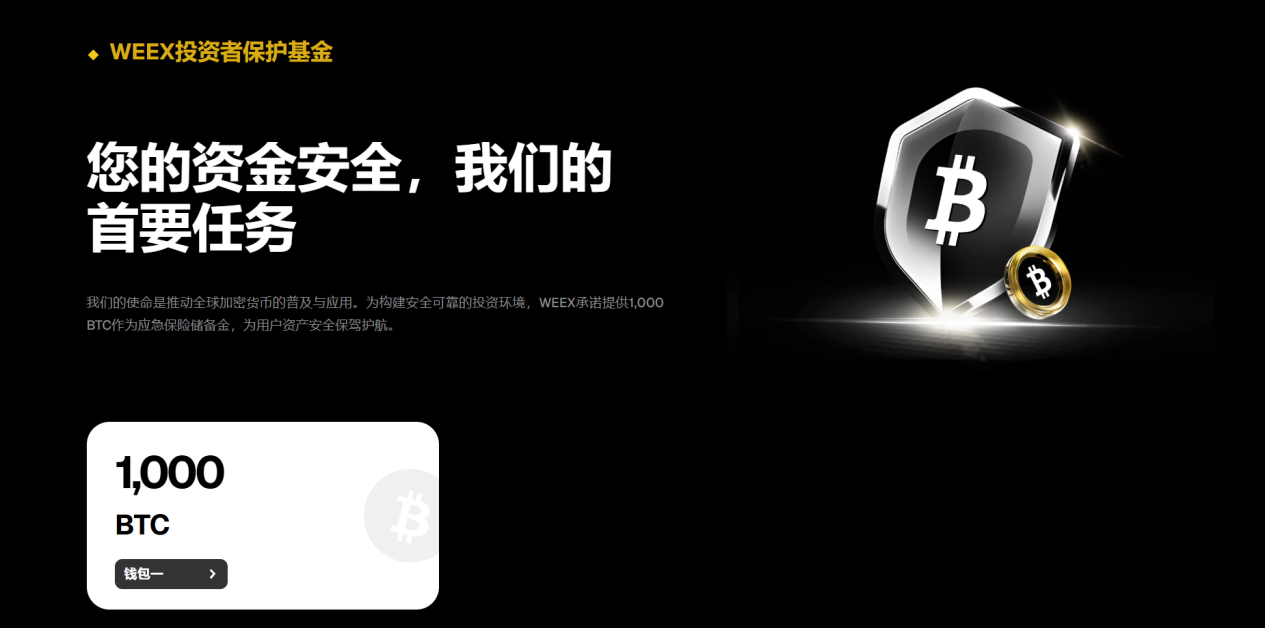
In addition to Proof of Reserves, WEEX also maintains a 1,000 BTC Protection Fund, with the relevant on-chain address made public. Anyone can check the address balance through a blockchain explorer. This provides users with an independently verifiable channel to learn about the public asset information of the Protection Fund.
It should be noted that the Protection Fund is a supplementary safeguard mechanism within the platform's security system and does not equate to unconditional compensation for all trading losses or asset losses. If an event that may qualify for protection occurs, users need to submit an application in accordance with official rules, and the platform will review each case individually. Under current rules, relevant applications should be sent to support@weex.com within 30 days after the event occurs, and the final outcome is subject to the specific rules and review results.
To make it easier for users to access relevant information, WEEX has also established a Trust Center that consolidates Proof of Reserves, the Protection Fund, security information, and official contact details. Through this entry point, users can learn about the platform's publicly disclosed security information and reduce the cost of searching across different pages.
Related Links:
• WEEX Proof of Reserves: https://www.weex.com/zh-CN/proof-of-reserves
• WEEX Protection Fund: https://www.weex.com/zh-CN/protectfund
• WEEX Trust Center: https://www.weex.com/zh-CN/trust-center
Certification and Third-Party Verification: Subjecting Security Construction to External Scrutiny
Whether a security system is comprehensive cannot rely solely on the platform's own descriptions. Third-party certifications, security assessments, and the participation of external security researchers are also important components of a platform's ongoing efforts to identify and improve security issues.
In terms of information security management, WEEX has officially obtained ISO/IEC 27001:2022 Information Security Management System certification, independently audited by Swiss Approval, with certification number 260826/1.
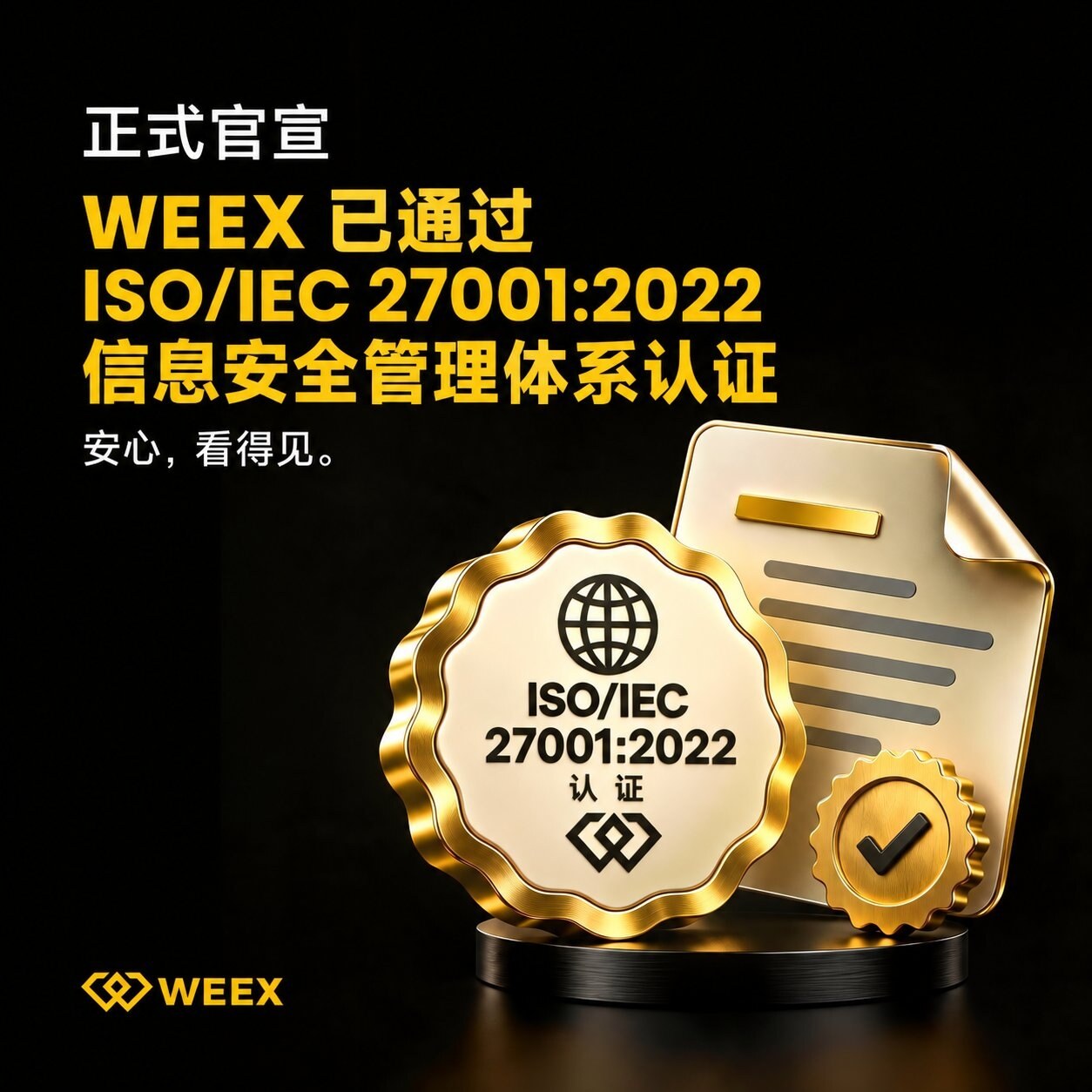
ISO/IEC 27001:2022 focuses on an organization's information security management system, covering aspects such as information security risk identification, information asset protection, access control, and continuous improvement of the management system. For trading platforms, the value of such certification lies not only in obtaining a qualification but also in incorporating information security management requirements into daily operations and management processes.
In terms of external security evaluations, WEEX also continuously monitors relevant assessment information provided by third-party platforms such as CoinGecko, CORE3, and CER.live. Among existing security assessment materials, CORE3 Security, CER.live Server Security, and User Security have all received extremely high scores, and CoinGecko also provides exchange-related security evaluation information. Relevant scores are subject to the influence of assessment systems, data updates, and page adjustments; specific metrics and scores are subject to what each platform actually displays.
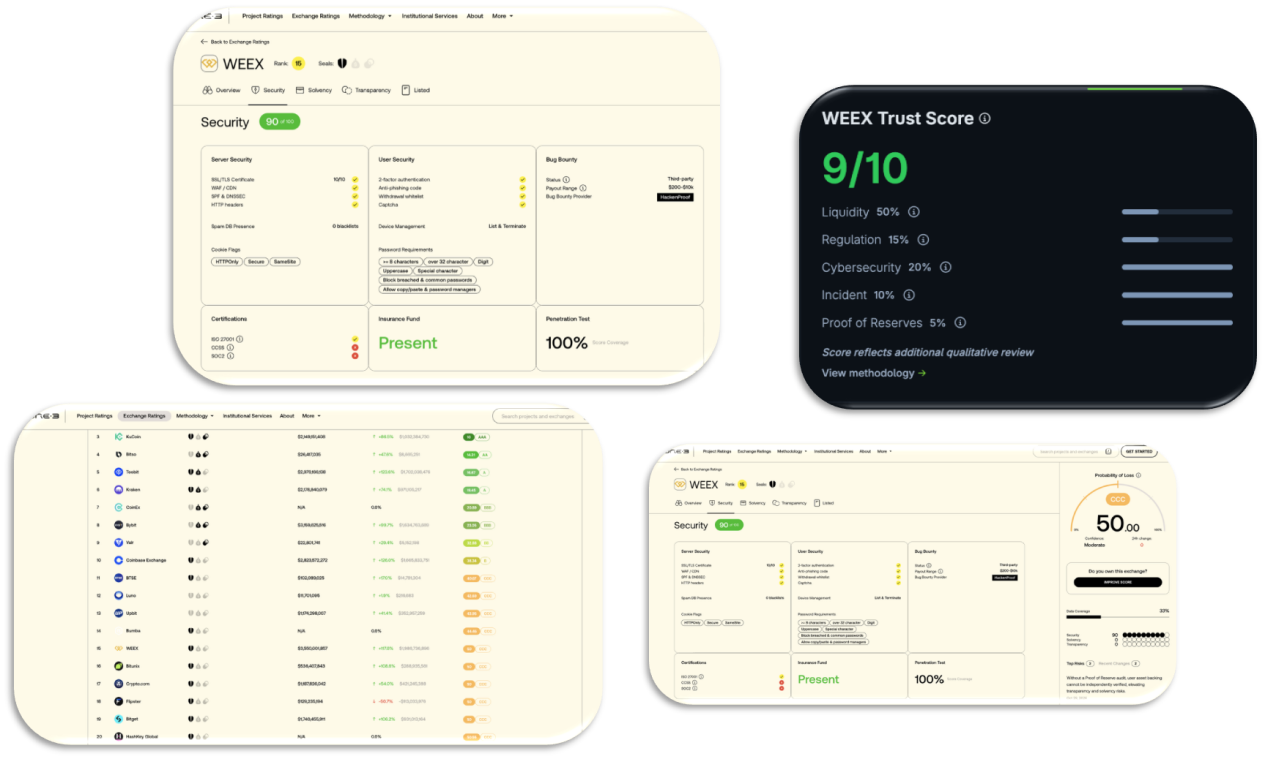
In addition to security assessments, WEEX also monitors third-party platforms' evaluations of the exchange's overall performance. For example, CoinGecko's spot exchange ranking once reached an all-time high of No. 15.
WikiBit's exchange ranking recorded No. 5.

In Coin Bureau's review materials on WEEX, the security rating was 4.8/5.
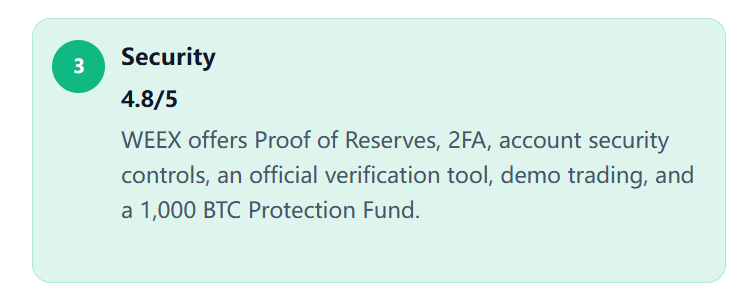
This information respectively pertains to exchange rankings, comprehensive evaluations, or third-party reviews.
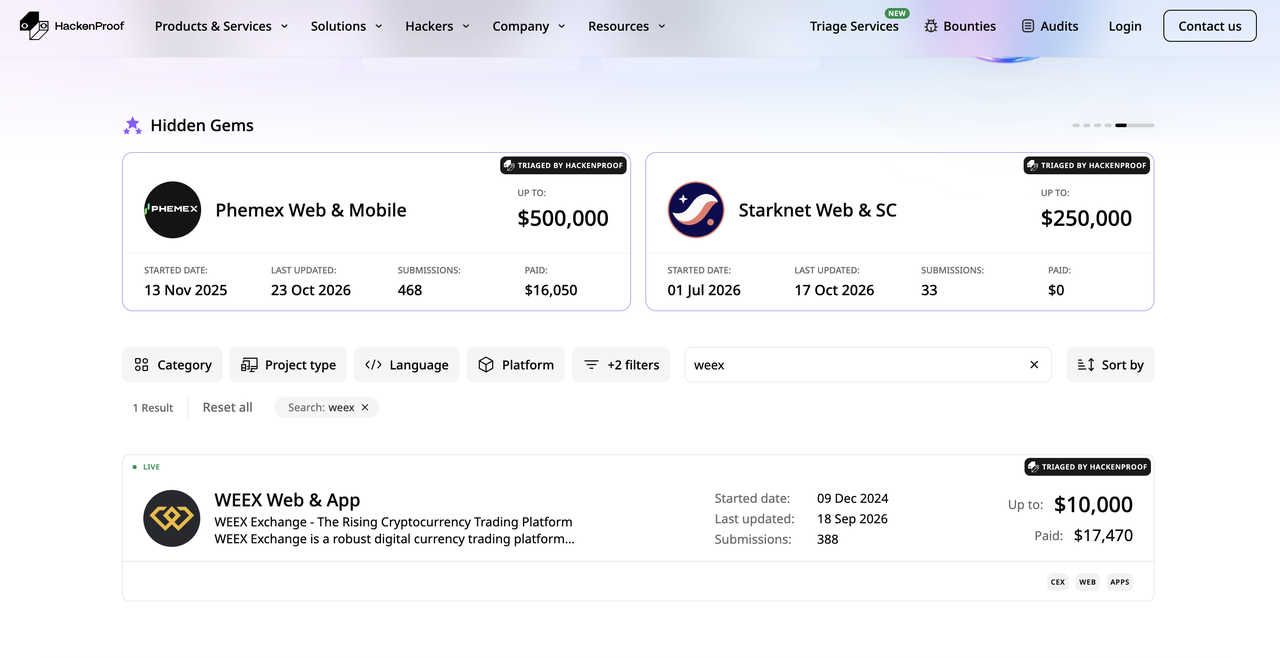
In terms of proactive vulnerability discovery, WEEX maintains a long-term partnership with HackenProof, inviting external security researchers to participate in platform security testing through a bug bounty program. Researchers can submit discovered potential vulnerabilities according to project rules, and the platform verifies, evaluates, and addresses the relevant issues. This open collaborative mechanism helps bring in external professional perspectives and expand the scope of discovering potential security issues.
At the same time, WEEX has for many consecutive years engaged external professional security firms to conduct annual security audits and assessments, examining and reviewing the platform's security construction from a third-party perspective. Such audit work is part of the platform's ongoing security management and also provides reference for subsequent security improvements.
Account Security: Multi-Layered Protection from Login Identity to Trading Permissions
Account security is the security aspect users encounter most frequently in their daily activities. Password leaks, phishing emails, abnormal device logins, and API Key misuse can all become entry points for account security risks. Therefore, account protection cannot rely on just one password verification; it needs to cover multiple aspects such as login, identity confirmation, and fund operations.
In terms of identity verification, WEEX has launched Passkey functionality with full-platform support. Passkey is based on public key cryptography mechanisms, allowing users to complete identity verification through device-supported fingerprint or facial recognition, reducing reliance on traditional passwords and thereby lowering the risks brought by password leaks, reuse, and phishing attacks.
In response to increasingly common counterfeit emails and phishing activities, WEEX provides an anti-phishing code feature. After users set a unique identification code, official emails will display the corresponding anti-phishing code, and users can verify the identification information to help determine the source of the email. Meanwhile, the platform also provides weak password detection and reminder mechanisms to help users identify passwords with lower security and promptly strengthen account protection.
In sensitive operation steps, WEEX supports two-factor authentication (2FA) to add extra verification for account-related operations; through withdrawal whitelists, users can restrict withdrawal addresses to an approved range, reducing the risk of assets being transferred to unauthorized addresses.
For users who use APIs for programmatic trading, WEEX provides API permission configuration and IP binding features. Users can configure corresponding permissions for API Keys based on actual needs and restrict call sources by binding IPs. Configuring according to the principle of least privilege helps reduce the risk of API credential misuse after a leak.
From identity verification to fund flow management, and further to API call permission control, these measures together form a multi-layered protection mechanism for account security.
Platform and Asset Security: Extending Protection to the System's Underlying Layers
The security features users can directly see are only part of the platform's security construction. For a trading platform, real security work also needs to go deep into internal aspects such as system operations, product development, fund flows, wallet management, and data protection.
• In terms of daily operations, WEEX has a professional security team conducting 7×24 security operations, continuously monitoring potential security risks during platform operations through round-the-clock monitoring, threat detection, and incident response. Security monitoring does not start only after problems arise; it runs throughout the platform's daily operations.
• In terms of product development, WEEX integrates security requirements into the Secure Development Lifecycle (SDL), covering stages such as product design, development, testing, and release. By moving security requirements earlier into the R&D process, potential issues are identified and addressed before products go live as much as possible, rather than relying entirely on post-launch remediation measures.
• In the fund flow process, WEEX has established multi-layered checking mechanisms for deposit and withdrawal processes, including identity verification, transaction risk identification, and abnormal behavior monitoring. For withdrawal operations, the platform also verifies key information such as withdrawal addresses and amounts, and suspicious withdrawals may trigger additional verification to reduce the risk of key transaction information being abnormally tampered with.
• In terms of anti-fraud, WEEX continuously monitors account and trading behavior and triggers user reminders, additional identity verification, or corresponding risk control measures based on identified risk situations. The relevant mechanisms are designed to help the platform promptly detect abnormal activities and take further risk control measures when necessary.
• Wallet security is also an important part of platform asset protection. WEEX adopts tiered management and strict permission control mechanisms, sets corresponding verification for key operations, and strengthens wallet management through continuous risk monitoring. According to publicly disclosed certification-related information from WEEX, the platform also involves technical arrangements such as MPC hot wallets and offline multi-signature cold wallets. Specific wallet architecture, hot/cold wallet ratios, key management details, and internal permission configurations are security-sensitive information of the platform and are not publicly disclosed.
• In terms of data security, WEEX extends protection measures across the entire data lifecycle, involving mechanisms such as encrypted transmission, data encryption and key management, backup and recovery, data loss prevention (DLP), isolation and least privilege, as well as monitoring and auditing. Data security is not just about encrypting information; it also needs to cover different stages such as data transmission, storage, access, backup, and use, reducing data leaks, unauthorized access, and other potential risks through multi-layered measures.
Security Construction Is a Long-Term Effort Requiring Continuous Investment
Different security mechanisms serve different purposes. Proof of Reserves focuses on the transparency of asset information; the Protection Fund provides supplementary protection under conditions that meet the rules; third-party assessments and audits help the platform examine its security construction from an external perspective; and account and system protection run throughout users' daily operations and platform operations.
For a trading platform, security is not work that can be declared complete through a single certification, a single feature, or a single number. It requires continuous investment and improvement as business develops, technology changes, and the risk environment evolves.
WEEX will continue to advance security construction around user asset protection, account security, platform infrastructure, and data protection, and through more public and verifiable information, enable users to understand the platform's actual investment in security.
About WEEX
Founded in 2018, WEEX is a comprehensive trading platform serving global users and currently serves over 10 million users. With security, liquidity, and trading experience at its core, the platform supports 2,700+ trading pairs and ranks among the global Top 2 for BTC contract liquidity. WEEX offers leverage of up to 400x and 0% Maker Fee on select contract trading pairs, providing deep liquidity, efficient execution, and flexible trading options for different types of traders. At the same time, the platform has established a 1,000 BTC user protection fund and continues to build a security system that meets mainstream international standards, providing a safe, stable, and reliable trading environment for global users.
For more information, please visit: Website | Twitter | Telegram | Linkedin