


After Marvell acquired Lumentum at a nearly 24% premium, why did both stocks plunge?


- Core Viewpoint: Marvell is acquiring Lumentum at a nearly 24% premium in an all-stock deal, aiming to integrate chip and optical communications technology to capture AI data center connectivity demand. However, the market is concerned about transaction costs and the payback period, and both companies' stocks plunged.
- Key Elements:
- The transaction implies an enterprise value of approximately $115 billion. Lumentum shareholders will receive 4.5 Marvell shares per share. Marvell fell 11.2%, and Lumentum fell 18.11%.
- The share exchange ratio is fixed but the value is not locked in. A decline in Marvell's stock price directly drags down the value Lumentum shareholders can receive. The so-called 24% premium is based on the October 28 closing price and does not guarantee returns.
- After the new shares are issued, Marvell's original shareholders' stake will drop to approximately 67%. Investors are focused on the transaction price, financing risks, and the dilution of earnings per share caused by rising AI infrastructure investment.
- The acquisition logic lies in growing bandwidth demand and the physical limitations of copper connections driving AI infrastructure toward optical connectivity. Marvell provides chips and network switching technology, while Lumentum specializes in lasers and optical communication components.
- The two sides expect the addressable market they can participate in to reach $550 billion by 2030. Marvell expects to save more than $1 billion in costs annually and to increase adjusted earnings per share in the first year.
- The transaction is expected to close in the first half of 2028 and still requires shareholder votes and regulatory approvals. The long waiting period increases uncertainty around AI demand and stock price changes.
Original | Odaily (@OdailyChina)
Author | Asher (@Asher_0210)
A hundred-billion-dollar AI acquisition, and yet both companies' stock prices plunged.
Last night, Marvell (NASDAQ: MRVL) announced a planned acquisition of Lumentum (NASDAQ: LITE) at a premium of nearly 24%, but the market didn't buy it. According to MSX.COM data, as of the U.S. market close, Marvell fell 11.2%, while the acquired Lumentum dropped even further, by 18.11%.
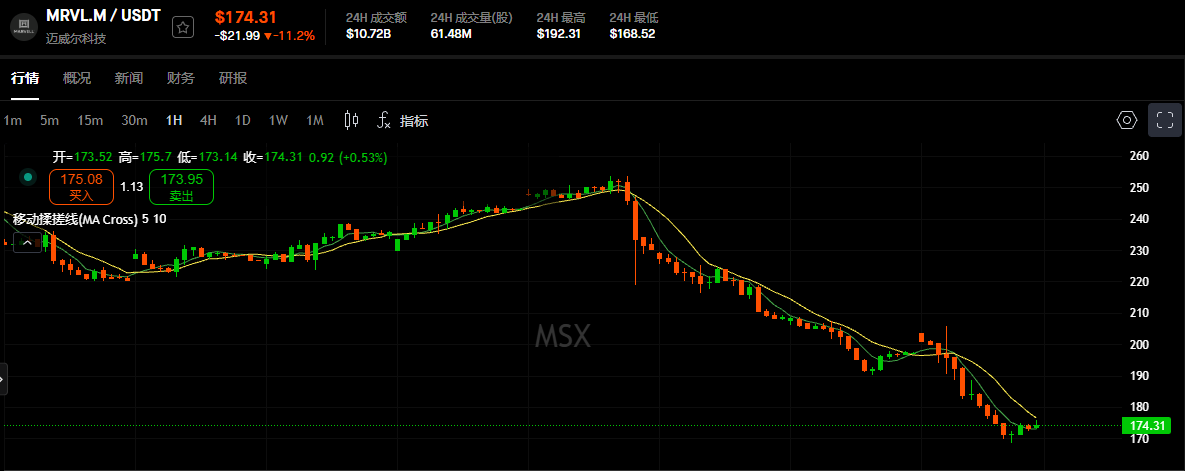
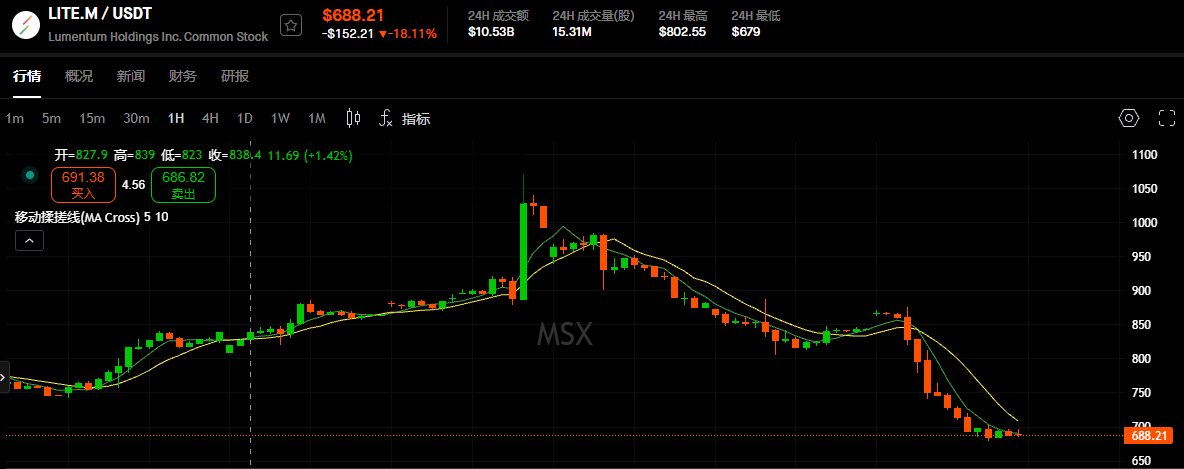
According to the joint announcement, Marvell will acquire Lumentum through an all-stock transaction, implying an enterprise value of approximately $115 billion for the latter. For each share of Lumentum stock, shareholders will receive 4.5 shares of Marvell common stock.
Marvell had hoped to combine the two companies' technologies in chips and optical communications to make data transmission within AI data centers faster and more power-efficient, capturing the business opportunities from AI infrastructure expansion. But why did both companies' stock prices plunge despite the premium acquisition?
Why Did the Acquired Company Also Plunge Despite the Premium?
Lumentum shareholders are receiving Marvell stock, so as Marvell's share price falls, the value they can exchange for shrinks accordingly. In this transaction, each Lumentum share can be exchanged for 4.5 Marvell shares — the quantity is fixed, but the value is not locked in. This means that even with the acquisition news, Lumentum's stock price will still be dragged down by Marvell's decline.
The nearly 24% premium is also not a profit margin left for investors after the announcement. The announcement used the closing prices of both companies on October 28, when the market had not yet caught wind of the acquisition. At that day's prices, 4.5 Marvell shares were worth about $1,132, roughly 23.9% more than 1 Lumentum share. As both stock prices have since changed, the actual value of this stock-swap transaction has also shifted — the so-called premium does not guarantee returns.
What Marvell shareholders worry about is whether this acquisition is worthwhile. After issuing new shares, existing shareholders' stake in the combined company will drop to about 67%. Although the company gains Lumentum's business, if the added profit cannot keep pace with the increase in share count, existing shareholders may not necessarily benefit. According to Reuters, the transaction price, financing risks, and rising AI infrastructure spending have all drawn investor attention. After the business scales up, how much profit each share can claim is what shareholders truly care about.
What Marvell Is After: The Connectivity Demand Between AI Chips
Marvell is willing to pay a premium for Lumentum because it sees the growing data transmission demand in AI data centers. As more and more chips work together, the data that needs to be exchanged between chips also increases. If transmission speeds cannot keep up, the added computing power will be difficult to fully leverage. In the joint announcement, both parties noted that growing bandwidth demand and the physical limitations of copper connections are driving AI infrastructure to adopt more optical connections. How to make data transmission faster and more power-efficient has become a shared opportunity for both companies to win orders.
Marvell and Lumentum each hold different technologies along this link. The former provides chips, high-speed data connectivity, and network switching technology, while the latter excels in lasers and optical communication components. Combining the two companies offers the opportunity for chips and optical communication components to work together from the design stage, reducing the adaptation work customers face when combining different products. Lumentum's laser manufacturing capabilities can also be combined with Marvell's chip design and packaging technology to support new product development.
Through the acquisition of Lumentum, Marvell hopes to offer more complete products to AI data center customers and participate earlier in the design of next-generation systems. If the combined solution can make data transmission faster, more power-efficient, and easier to deploy, Marvell will have the opportunity to win more orders.
Buying Growth Expectations for $100 Billion — How Long Until Returns?
Both parties expect that by 2030, the combined company will be able to compete in a market worth $550 billion. This figure covers both companies' existing businesses as well as new areas that could be opened up through technology integration. However, between how big the market is and how much the company can earn, there are still products, orders, and competition. The $550 billion figure depicts growth space but cannot directly answer whether this acquisition is worth it.
More specific commitments come from costs and profits. Marvell expects the combined company to save more than $1 billion in costs annually and to increase adjusted earnings per share in the first year after the transaction closes. If delivered, this would mean the company could still increase the profit corresponding to each share despite issuing new shares. But cost savings take time, and R&D, manufacturing, and product integration will also generate expenses — the final outcome will still depend on actual operating performance.
The transaction is expected to close in the first half of 2028, subject to shareholder votes from both parties and regulatory approvals in the interim. More than a year of waiting is enough time for AI demand, market sentiment, and Marvell's stock price to change. For Lumentum shareholders who don't want to wait and are unwilling to ultimately end up with Marvell stock, selling out as the acquisition news lands may be more appealing. Marvell is willing to pay a premium for future growth, but the market may not be willing to bear the risk of a long wait.





