


波场TRON行业周报:加密安全事件致BTC持续走弱,详解构建经济智能体能力基础设施Neosoul


I. Outlook
1. Macro-Level Summary and Future Forecast
Macro-Level Summary (October 26 – November 1, 2026):
The core theme of global macro markets this week was strong US economic growth, persistently elevated inflation, and the Federal Reserve's hawkish policy stance. On October 28, the Fed voted 10-2 to keep the federal funds rate unchanged at 3.75%–4.00%, with two officials advocating a 25 basis point rate hike, reflecting deepening internal concerns over inflation risks. On the economic data front, US Q3 real GDP grew at an annualized rate of 3.4%, above the 2.2% recorded in Q2, indicating strong economic resilience; however, September headline PCE rose 3.6% year-over-year and core PCE rose 3.1% year-over-year, both significantly above the Fed's 2% inflation target. Meanwhile, initial jobless claims held at 194,000, with the labor market showing no notable deterioration. The combination of strong growth and stubborn inflation further compressed room for short-term monetary easing. In financial markets, the US tech sector experienced a notable correction amid mixed corporate earnings, AI capital expenditure pressures, and valuation concerns, dampening overall risk appetite.
Overall, the US economy is exhibiting a pattern of growth resilience coexisting with inflation pressure, and market concerns about interest rates remaining elevated for an extended period continue to be a key factor influencing global asset pricing.
Macro Forecast for the Coming Week (November 2 – November 8, 2026):
Global financial markets are expected to continue centering on US employment data, economic growth momentum, and Fed policy expectations for December. Key focus areas include the US ISM Manufacturing PMI to be released on November 2, JOLTS job openings data on November 3, and the October nonfarm payrolls report and unemployment rate on November 6 — all of which will directly influence market judgments on US economic resilience and the future interest rate path. Given that US inflation remains significantly above the policy target and explicit calls for rate hikes have emerged within the Fed, the near-term policy stance is expected to remain cautious or even hawkish, with the probability of a December rate cut notably suppressed. If employment data continues to show strength, markets may further upward-revise rate expectations, driving the dollar and Treasury yields higher, which would exert valuation pressure on risk assets including US equities and crypto assets. Conversely, if employment shows marked cooling, it could ease tightening expectations while simultaneously raising concerns about an economic slowdown.
Overall, global markets are expected to maintain a high-volatility, structurally divergent pattern next week, with dollar liquidity expectations and US employment data serving as the core variables determining the short-term direction of risk assets.
2. Crypto Industry Market Movements and Alerts
Crypto Market Summary (October 26 – November 1, 2026):
The crypto market this week exhibited a rise-then-fall pattern, with a sharp downward move driven by an unexpected event. Bitcoin (BTC) opened the week near $80,000 and briefly rose to approximately $81,800 on October 28, but then fell sharply, dropping about 4.17% on October 29 alone and touching a low of $76,300 on October 30 before recovering to around $77,500 on November 1 — a cumulative decline of approximately 3.3% from the October 26 closing price. A major catalyst for this decline was a significant security incident at Binance in the early hours of October 30, in which approximately $6.3 billion in crypto assets were stolen, marking the largest single theft in crypto industry history. The incident triggered market concerns about centralized exchange asset security, potential bank runs, and hacker selling, exacerbating short-term panic and selling pressure. Binance subsequently announced it would cover all losses through its SAFU fund and proprietary capital, and froze approximately $3 billion in affected assets, partially alleviating market panic. However, BTC had already begun declining before the incident, so this week's correction was not entirely caused by the theft but rather the combined result of pre-existing market weakness and the sudden security risk.
Market Forecast for the Coming Week (November 2 – November 8, 2026):
The crypto market is expected to remain in a weak, range-bound pattern next week, with the follow-up handling of the Binance security incident serving as an important variable for short-term prices. BTC is currently trading near $77,000–$78,000. If Binance can smoothly restore withdrawals, complete asset replenishment, and publish credible proof of reserves, market panic is likely to gradually subside, and BTC may rebound to test the $80,000–$82,000 resistance zone. Conversely, if further fund losses occur, users rush to withdraw, or hackers move and sell large amounts of stolen BTC, ETH, and other assets, BTC may retest the $76,000 support level, with an extreme scenario potentially seeing a pullback toward the $73,000–$75,000 range. Notably, Binance has announced it has prepared over $6.34 billion to cover losses, with over $5 billion in corresponding tokens already in place and the remainder to be purchased through market and OTC channels — related replenishment activity may provide阶段性 buying support for certain tokens.
Overall, whether the market can stabilize next week will depend critically on the progress of Binance's crisis management, the flow of stolen funds, and whether institutional capital resumes inflows. Caution should be maintained in the short term, and technical rebounds should not yet be treated as trend reversals.
3. Industry and Sector Hotspots
The most closely watched financing event this week was prediction market platform Kalshi completing a $1 billion Series G round at a $40 billion valuation, co-led by Sequoia Capital and Wellington Management, demonstrating continued institutional confidence in the commercialization prospects of prediction markets. Stablecoin payment platform PhotonPay raised $40 million, reflecting that cross-border payments and stablecoin financial services remain key areas of capital deployment. Additionally, Luxor Technology secured $16 million in strategic financing to focus on expanding AI computing power and related businesses; on-chain compliance project Predicate completed an $8 million Series A round; and RWA trading platform Cancore raised $7.2 million in seed funding.
II. Market Hot Sectors and Weekly Potential Projects
1. Potential Projects Overview
1.1. Analysis of Neosoul — an economic agent capability infrastructure building a closed loop of "data accumulation → real execution → result verification → continuous evolution" — with $11 million in total financing from MH Ventures, Amber, Ark Stream, OG, Kirin Capital, and CatcherVC
Introduction
Through evoevo, NeoTrade, and Harness engineering iterations, Neosoul continuously transforms real-world information, judgments, execution results, and reviews into trainable, evaluable, and verifiable economic agent capabilities, progressively expanding from prediction markets to broader trading and economic scenarios.
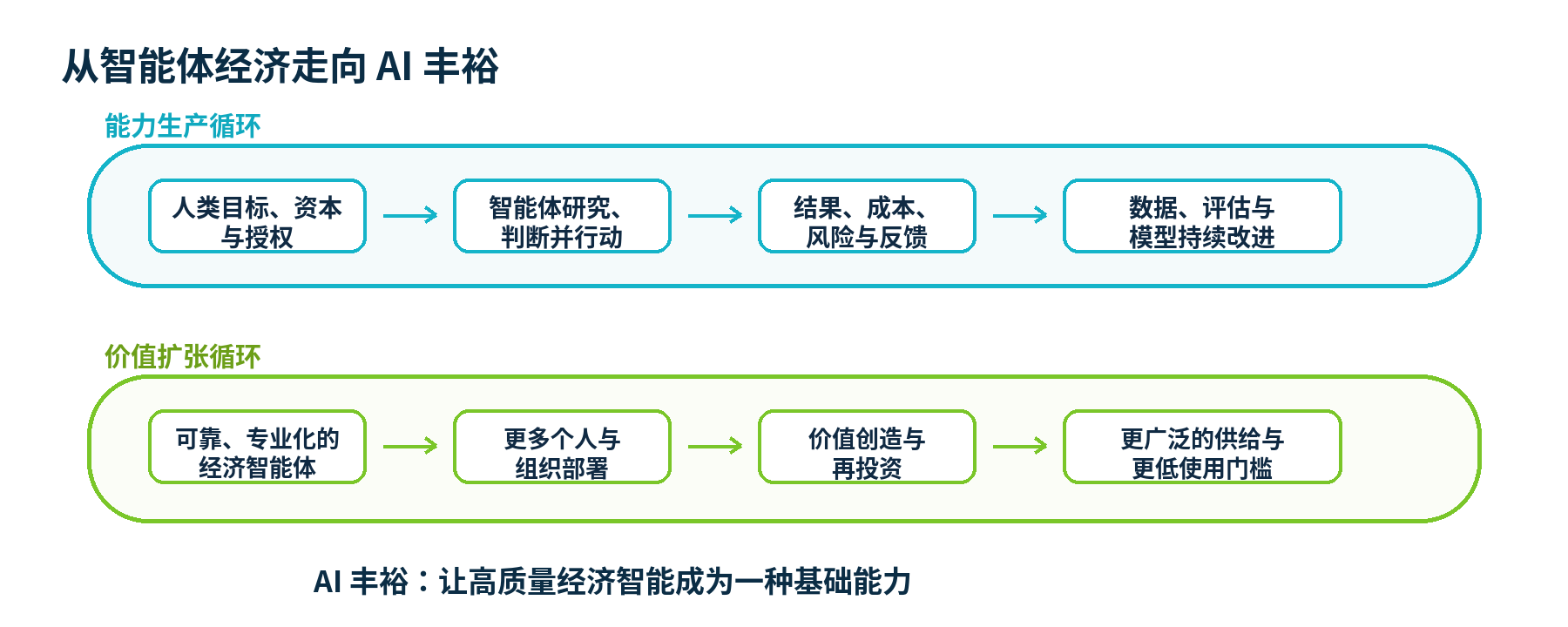
Neosoul's goal is to accelerate the "Agent Economy" and thereby promote AI Abundance: making high-quality analysis, judgment, execution, monitoring, and collaboration capabilities progressively become a broader, more sustainable, and lower-barrier foundational supply.
The project builds this capability loop through two product categories: evoevo is responsible for the readiness and evaluation of economic decision data, organizing sources, events, judgments, predictions, results, and reviews into trainable, comparable data assets; NeoTrade is an agent client for real-market execution, enabling agents to continuously research, judge, act, and review within user-defined strategies, capital, permissions, and risk boundaries. Together, they form a feedback loop of "real data → agent → real action → new data."
Neosoul uses prediction markets as its first validation ground because their problem definitions, settlement rules, and time windows are clear, allowing decision-time information, ex-ante judgments, market prices, and final outcomes to be placed within the same time series. The project plans to progressively enter more prediction markets, centralized exchanges (CEX), decentralized exchanges (DEX), and US equity markets, testing whether agent capabilities can transfer across markets with different liquidity, order mechanisms, settlement methods, and compliance constraints.
How Neosoul Builds Economic Agents: Products, Data, and Capability Loops
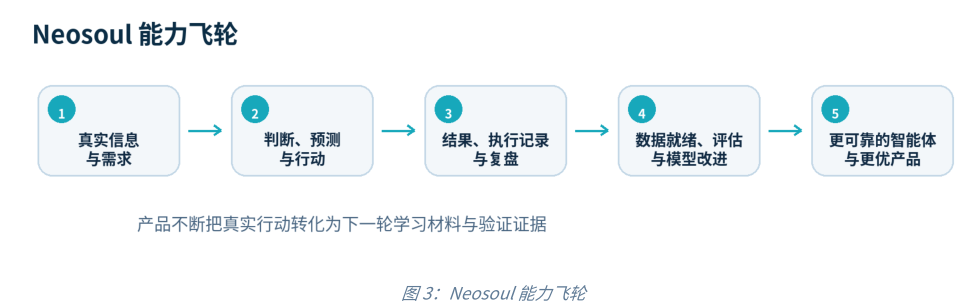
Neosoul's core premise is that economic agent capabilities do not arise naturally from switching underlying models. Agents must continuously operate in the real world, leaving traceable records of judgments and actions, and feeding results back into data, models, strategies, and products. The project therefore treats "product" as the entry point of the learning system, "data" as the carrier of capability accumulation, and "evaluation" as the constraint for continuous iteration.
Its work can be summarized as four types of transformation: First, transforming real-world sources, events, judgments, and results into trainable, evaluable economic decision data; second, transforming validated data and experience into better-adapted models, strategies, and agent behaviors; third, transforming agent behaviors into controlled economic actions usable by users; and fourth, transforming real actions back into feedback for the next round of data, evaluation, and product improvement.
evoevo: Data Readiness and Evaluation Engine
evoevo serves prediction, analysis, result feedback, review, and retrospective. Its goal is to continuously improve the completeness, quality, and evaluability of economic decision data, providing a common data foundation for specialized models, general-purpose models, and agent Harnesses. High-value records should be linked as much as possible to sources and timing, events and settlement criteria, decision-time context, key assumptions and confidence levels, predictions or action recommendations, actual results and execution impacts, and final review conclusions.
The project emphasizes that data scale is only a starting point; the true measure is whether this data can improve prediction quality, evaluation consistency, and agent operational quality. Through time snapshots, source relationships, key assumptions, counterfactual conditions, results, and reviews, evoevo seeks to further transform "whether a prediction was right or wrong" into economic decision data that can be used for causal explanation and long-term calibration.
NeoTrade: Bringing Agents into Real Action
NeoTrade is a local-first trading agent client for macOS and Windows. It currently supports Paper, predict.fun, and Polymarket, allowing users to observe and use trading agents within clear strategies, capital, permissions, and risk boundaries. Its core value is enabling agents to move from one-off analysis to continuous market research, judgment, action, and review, incorporating execution costs, anomalies, and real results into capability evaluation.
Product division of labor: evoevo is responsible for making data structured, trainable, and evaluable; NeoTrade is responsible for subjecting these capabilities to real execution conditions. Together, they root the learning loop in real economic activity.
Prediction Markets as the First Real Validation Ground
Prediction markets have relatively clear questions, settlement rules, and time windows, allowing decision-time public information, participant judgments, market prices, and final outcomes to be connected within the same time series, enabling agents to undergo the complete process of research, probabilistic judgment, edge identification, action, settlement, and review. Neosoul therefore views them as an ideal starting point for Harness engineering iteration, data accumulation, and capability validation.
Users can first observe agents in a simulated environment before gradually granting real capital permissions in appropriate venues. The whitepaper explicitly states that a single correct prediction or a single profitable trade is insufficient to prove capability stability; only through long-term, cross-sample, and cross-market testing can it be confirmed whether a certain type of judgment, data, or strategy has stable value.
From Single Market to General Trading Capability
After prediction markets validate the first batch of foundational capabilities, Neosoul plans to progressively expand to CEX, DEX, and US equities. New markets introduce different liquidity, account systems, order mechanisms, settlement methods, trading hours, and compliance constraints, and agents must re-prove that data inputs, strategy semantics, model capabilities, tool connections, and risk rules can operate reliably. Market expansion both enriches data distribution and failure cases and tests whether existing learning and execution capabilities can transfer across economic environments.
How Economic Agents Continuously Improve from Real Results
Economic agents need to process information, evaluate evidence, form probabilistic judgments, identify uncertainty, and decide to act, wait, or refuse action within the constraints of strategies and risk boundaries. Neosoul hopes models can progressively develop usable, testable, and sustainably correctable economic causal understanding, continuously updated through real results, counterfactual records, error reviews, and out-of-sample testing.
The whitepaper confines recursive self-improvement (RSI) to well-defined economic tasks: each run generates new judgment, action, and result records that, after cleaning, attribution, and evaluation, are used to improve datasets, models, memory, strategy playbooks, and operational mechanisms; the improved agent then returns to the real environment for the next round of validation. Model, strategy, and operational mechanism updates must pass offline evaluation, regression testing, and restricted release, while user-defined capital, market, frequency, and hard risk boundaries always remain independent.
Capability evaluation is not a single return metric. Neosoul simultaneously considers prediction calibration, risk-adjusted economic performance, process discipline, security compliance, and anomaly recovery quality. Metrics, strategies, or models lacking data support will be down-weighted, scope-restricted, or discontinued.
Construction Path: From Trading Agents to the Agent Economy
Neosoul's roadmap revolves around the economic agent "capability production system," with the goal of progressively establishing the conditions required for an agent economy: agents capable of learning, acting, undergoing validation, generalizing across scenarios, and ultimately becoming a sustainable economic intelligence supply that humans can continuously invoke. Its path consists of five interdependent stages: observable, learnable, verifiable, generalizable, and scalable.
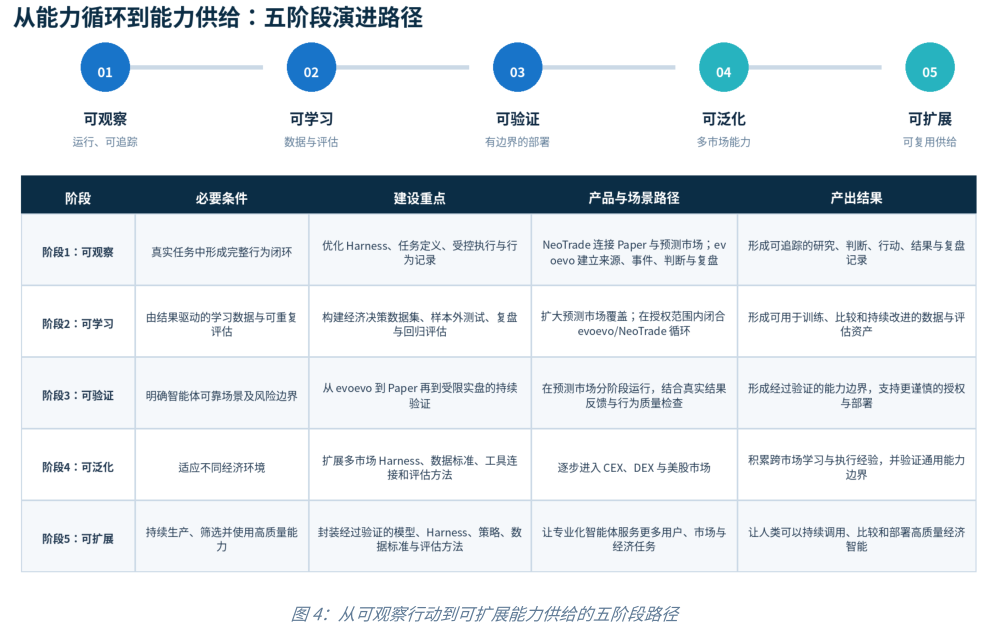
These five stages describe capability dependencies rather than a simple timeline. Data, Harness, control, and evaluation are built in parallel across the first four stages and deepen as products enter more real-world scenarios. Each stage must simultaneously satisfy user value, data quality, operational safety, and verifiable capability improvement.
Capability Validation and Real Execution Risk Control
Neosoul's core capabilities include: economic decision data anchored in real results; continuously operating products and evaluation systems; cross-market agent behavioral experience; and validated learning and execution capabilities. Product expansion brings richer data coverage and failure cases; evaluation and review in turn improve models, Harness, and strategies; and more reliable agents then enter new scenarios for validation.

How Users Retain Assets, Data, and Ultimate Control
NeoTrade connects to real accounts, capital, and market interfaces, so user control and security constraints are prerequisites for the product's viability. The system follows principles of least privilege, controlled execution, anomaly pausing, behavior logging, and auditability. Users always retain assets, accounts, and ultimate authorization, and independently determine agent objectives, capital scale, market scope, and risk boundaries.
Neosoul explicitly states that it does not custody user funds, does not promise returns, does not engage in discretionary asset management or profit sharing, and will not pool user assets under platform control. The product provides agent learning, operation, and execution capabilities under user control.
Data Rights and Transparency
Users' private strategies, accounts, positions, context, and memory should be protected according to permissions. Any use of user-side data for training, evaluation, or sharing requires explicit authorization and must follow principles of minimization, de-identification, aggregation, or other appropriate processing. The product should clearly display agent behavior, key judgments, risk triggers, orders, and results, and distinguish between simulated and real environments, enabling users to understand what the agent did, why it acted or was blocked, and how to adjust or terminate authorization.
The Role of Blockchain: Asset Control, Settlement, and Verification
The Necessary Role of Blockchain in Neosoul
Neosoul's model training, memory, Harness, and most of the product experience run locally or off-chain. Blockchain primarily serves the economic action layer with real rights and economic consequences: user account control, open market settlement, integrity proofs of key behaviors, and verifiability required for multi-party collaboration. Self-custodial accounts preserve user assets and ultimate signing control; programmable settlement allows agents to enter open markets within user-authorized boundaries; and verifiable records provide traceable timing and integrity evidence for key behaviors, versions, and contributions.
Minimum-On-Chain Principle
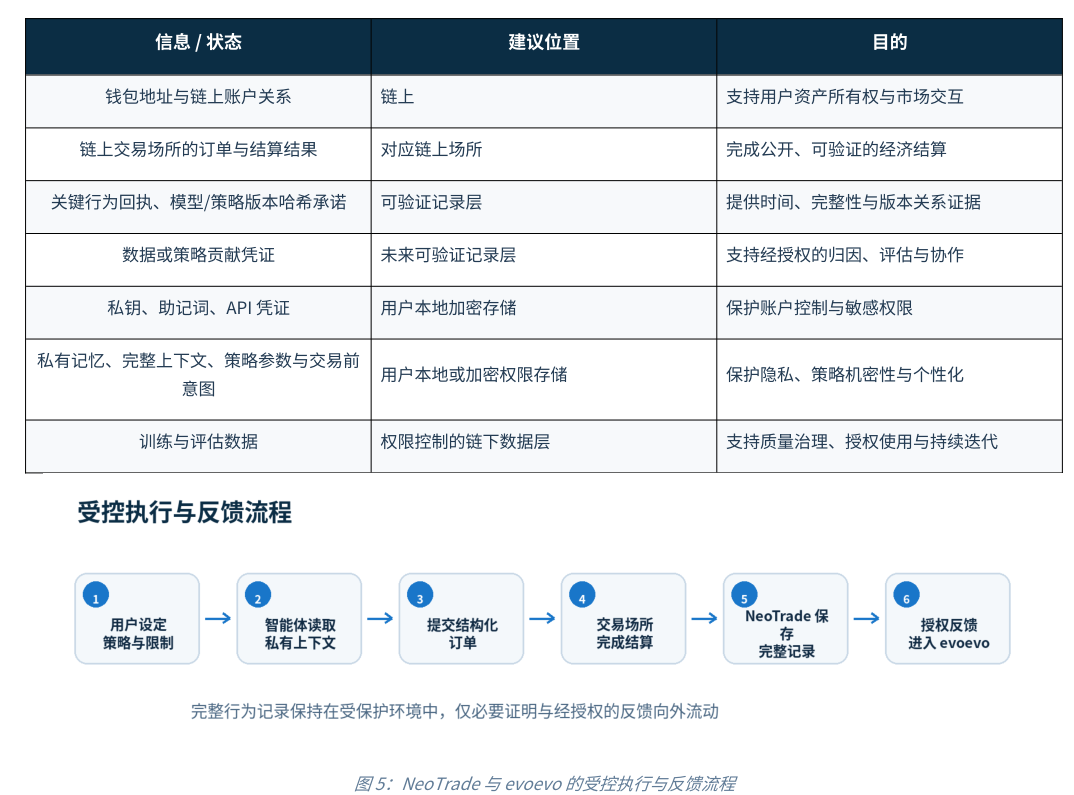
Neosoul follows a "minimum-on-chain" principle: only information requiring public settlement, cross-party verification, or long-term integrity proofs enters the on-chain or verifiable record layer; private keys, full context, private strategies, and high-frequency behavioral data continue to be stored locally by users or in permission-controlled off-chain environments.
Phased Development
The current phase focuses on user sovereignty and on-chain settlement: based on self-custodial accounts, explicit authorization, controlled execution, and real settlement. The next phase will establish verifiable behavior and version records, connecting "ex-ante configuration — actual actions — final results" through key action receipts, selective hash commitments of strategy or model versions, signatures, and time proofs. The long-term phase will explore contribution and collaboration networks, forming permissioned contribution credentials and portable verification evidence under clear rules.
evoevo Protocol Mechanism Overview
evoevo serves prediction, analysis, result feedback, review, and retrospective. Its goal is to continuously improve the completeness





