


Warsh: To Cut the Number of Policy Meetings Starting Next Year, Won't Prejudge December Decision, AI Investment Also Affected by Interest Rates (Full Text Attached)


- Core Viewpoint: The Fed kept rates unchanged at 3.75%-4% in October and announced that starting in 2027 it will add annual strategy meetings and reduce the number of rate-voting sessions to free up space for deliberation of major long-term issues; Warsh reiterated that the 2% inflation target is non-negotiable, rejected forward guidance, and said political factors have not influenced decision-making.
- Key Elements:
- Starting in 2027, one FOMC meeting will focus on macro strategy, with no vote and no statement; in 2028 this will increase to two, with policy meetings reduced to six.
- U.S. GDP growth in the first half was revised up from 1.8% to 2.4%, third-quarter consumption growth may exceed 3%, and business investment is growing at a near-double-digit pace.
- Inflation has been above target for nearly six years, energy prices have risen again in recent weeks, and the committee's discussions have centered on price stability.
- After the 25-basis-point rate hike in September, financial credit conditions have tightened, credit spreads have widened, and market capital allocation has become more prudent.
- Warsh dismissed the notion that AI investment is insensitive to interest rates, saying rates "seep into every crack," and that the capital expenditure expansion is spreading beyond AI.
- He made clear that forward guidance is not used in normal times, declined to prejudge the outcome of the December meeting, and said political factors such as midterm elections have "no effect whatsoever" on decision-making.
Original Author:
Original Link: Wallstreetcn
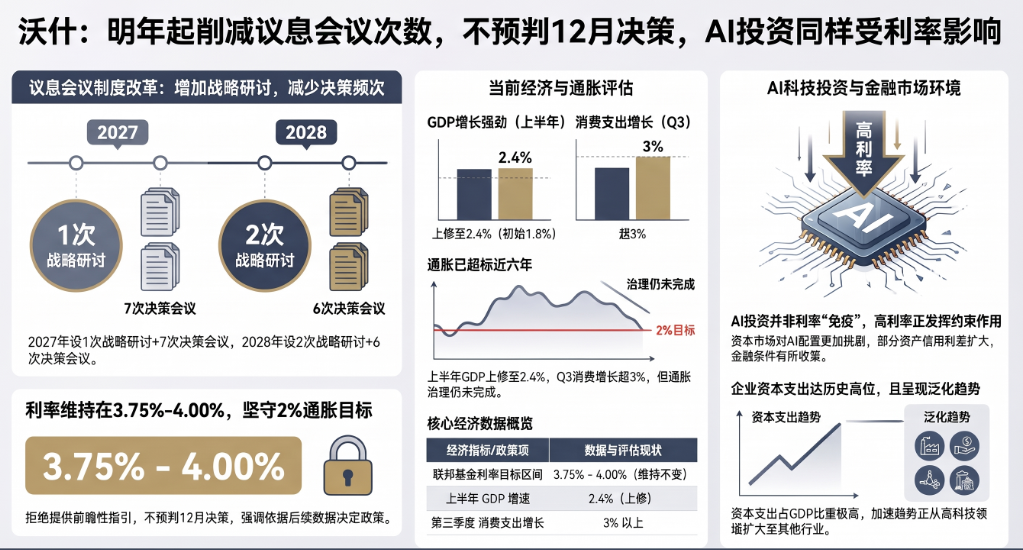
The Federal Reserve concluded its October meeting by holding interest rates steady and disclosing a major institutional reform: starting in 2027, it will gradually reduce the number of FOMC meetings at which interest rate votes are held.
On October 28, Fed Chair Warsh said at a post-meeting press conference that the Federal Reserve will begin reducing the number of rate-setting meetings starting in 2027.
He noted that while eight meetings per year is an "appropriate number" for the Federal Open Market Committee (FOMC), starting in 2027, one meeting will focus on macro monetary policy strategy, with no interest rate vote and no policy statement issued; in 2028, such strategy meetings will increase to two, with policy-setting meetings correspondingly reduced to six.
Warsh said the adjustment is intended to reserve space for the Committee to think about longer-term "big questions."
As for why rates were not raised this time, Warsh acknowledged that price stability has not yet been achieved, but said financial conditions have tightened somewhat since the September policy tightening, and that the period ahead will be information-rich and will help determine the appropriate policy stance.
He reiterated that no forward guidance is provided in normal times and that he would not prejudge the outcome of the December meeting. He said interest rates have also affected AI investment, that capital expenditure is strong and broadening. Political factors played "no role whatsoever" in this decision.
Meeting System Reform: Making Room for "Big Questions"
Warsh's most important announcement of the day concerned a systematic adjustment to the Federal Reserve's meeting system. He said:
The right way to make policy requires assessing recent developments on a timely, regular, information-rich cadence. But equally important is that we reserve time and space for strategic deliberation—rethinking the big questions, looking at longer time horizons, and focusing on the numbers to the "left of the decimal point."
He added:
I believe the setting of the meeting schedule is not merely an administrative detail, but an institutional choice that affects the nature and quality of our deliberations, and ultimately the wisdom of our decisions.
Analysts believe the change in meeting schedules appears to be the first step in the Fed's shift in its policy approach.
As for the specific content of the strategy meetings, Warsh said it is not yet clear what information will be made public at that time, saying there will be "more to come." He revealed that the Committee has had "extensive discussions" about the new meeting format.
Again Rejecting Forward Guidance, New Framework Shows Early Results
Faced with reporters pressing on why rates were not raised directly at this meeting, Warsh systematically laid out his monetary policy philosophy.
He characterized the policy actions of the past five months as "new monetary medicine," whose core elements include: reaffirming that the 2% inflation target is non-negotiable, clarifying where policy responsibility lies, publicly laying out the policy framework at the Jackson Hole conference, and acting in September to remove a degree of accommodation.
He emphasized that the key indicators for measuring policy effectiveness—inflation compensation measures and inflation expectations—are both moving in the right direction.
When pressed on whether "holding steady means the current rate level is already appropriate," Warsh did not give a direct answer, but said the Committee's "overwhelming consensus" is that policy has begun to take effect, but there is "no definitive conclusion yet."
He said the decision was intended to accumulate more information and judge whether the period ahead can provide a fuller basis for clarifying the appropriate policy direction.
Warsh also made clear he does not support the use of forward guidance in non-crisis periods, nor does he favor prejudging decision outcomes before meetings, and he declined to comment on market expectations for a December rate hike.
He specifically mentioned the 2008 financial crisis, when such tools did have value, but in the current normal period with solid economic fundamentals, he explicitly said he "does not support this approach."
On political independence, Warsh also responded. Faced with questions about whether the November 3 midterm elections influenced this decision, he said:
I was upstairs with my colleagues for two days, and I did not hear any talk about politics, no mention of elections, no discussion of what will happen in the next week or two.
He emphasized that political factors played "no role whatsoever" in this decision.
Solid Economic Fundamentals, Persistent Inflation Pressure
Warsh expressed optimism about the current economic situation.
He noted that GDP growth in the first half of this year has been revised up from the previous estimate of 1.8% to 2.4%, and third-quarter growth may accelerate further. Consumer spending is healthy, with overall growth expected above 3%, while business investment growth may reach double digits.
On the dual mandate, Warsh said recent FOMC discussions "have focused primarily on the price stability mandate." The employment picture is "quite positive", with the unemployment rate down from a year ago and the four-week average of jobless claims at "the lowest level in decades."
He specifically noted that capital expenditure as a share of GDP is at a historic high, led by high-tech investment, but other sectors are also expanding, a trend worth continued attention.
Inflation pressure remains the core focus of the Committee. Warsh noted that inflation has been above target for nearly six years, energy and related prices have risen again in recent weeks, and the Committee's discussions over the past two days focused on the price stability goal. He stated clearly:
Our job is to ensure that relative price changes do not spread throughout the economy, and that inflation expectations remain stable.
Warsh confirmed that since the Fed's 25 basis point rate hike at its September meeting, financial and credit conditions have shown some signs of tightening. He said:
We have begun to see some changes in financial and credit conditions; for some businesses and households, conditions have tightened, which is in line with our expectations. Market participants are becoming more prudent in capital allocation.
However, Warsh also emphasized that he would not characterize current financial conditions overall as "tight," but rather as helping to open a path toward price stability.
AI Investment Wave, Rates Still Have Transmission Effects
On the relationship between the AI investment boom and the effectiveness of monetary policy, Warsh made clear that the interest rate transmission mechanism has not failed.
He rejected the market narrative that "AI investment return expectations are so high that they are insensitive to interest rates," saying he is "skeptical" of this view.
He said that after the September rate hike, capital discrimination behavior emerged both inside and outside the tech sector, credit spreads on some assets widened, and financial conditions tightened somewhat, indicating that interest rates "seep into every corner," no different in essence from other parts of the economy.
He also noted that the current capital expenditure growth story is not limited to the AI sector, with data showing expansion spreading to other categories, so attributing all of the current economic strength to AI is "harder to argue than it was a few quarters ago."
According to a question from Howard Shine of Reuters, several Committee members believe that price pressures previously caused by supply chain issues had been gradually fading, but the investment frenzy in AI has brought enormous procurement and construction demand, taking over as a new driver of inflation.
In response, Warsh said stronger economic growth does not necessarily mean the economy is overheating, and he believes productivity has improved substantially in recent years, meaning inflation targets can still be achieved by tightening financial conditions without crushing the economy or causing mass unemployment.
The following is the full text of Warsh's press conference remarks:
Fed Chair's Opening Statement
Warsh:
Good afternoon. This morning, the FOMC decided to maintain the target range for the federal funds rate at 3.75% to 4% in support of the Federal Reserve's dual mandate.
Currently, economic activity is expanding at a strong pace, but uncertainty remains, partly due to evolving geopolitical conditions. Domestic spending remains resilient, productivity growth is strong, and capital investment is solid. Employment growth is keeping pace with the labor force, the unemployment rate is little changed, but inflation remains elevated.
The Committee believes that accumulating more information will help determine the appropriate policy stance to ensure inflation returns to the 2% target in a timely manner—the Committee will honor its commitment to price stability.
Warsh:
At each policy meeting, my colleagues and I assess the economic situation by "looking out the window"—what we call "interrogating reality"—to judge what is really happening. This work has not become easier over time.
Warsh:
What specifically have we observed?
On economic growth, GDP growth in the first half of this year has been revised up from the previous estimate of 1.8% to 2.4%. Third-quarter growth looks stronger: consumer spending is healthy, with growth likely exceeding 3%; business investment and related investment growth may approach double digits. Capital expenditure as a share of GDP is at a historic high. High-tech investment is leading this acceleration, but other sectors are also expanding, and these trends warrant continued attention.
On employment, the unemployment rate is lower than a year ago, and wage growth is notably higher than the same period last year. The four-week moving average of jobless claims remains at the lowest level in decades.
Warsh:
So on the employment side of the Fed's dual mandate, the current situation is quite positive.
However, the American people are still bearing the burden of inflation—inflation has been above the Committee's target for nearly six years. Bringing inflation down is our job. That is precisely why the FOMC's discussions over the past two days have focused primarily on the price stability mandate.
Warsh:
Since the policy action in September, we have begun to observe some changes in financial and credit conditions. For some businesses and households, conditions have tightened, which is broadly in line with our expectations—market participants have become more prudent in capital allocation.
Although overall financial conditions are tightening, I am neither willing nor able to characterize them as "tight." Nevertheless, on the whole, these changes are moving in the direction of achieving more durable, longer-lasting economic growth and price stability.
Warsh:
During the past two days of meetings, the Committee had in-depth discussions about changes in the economic and financial landscape during the intermeeting period, covering geopolitical developments and rapid technological change. We observed—though not surprisingly—a period of heightened volatility and shifting correlations in financial markets.
After a broad review of the overall economic and financial picture, real economic activity is clearly moving in the right direction, which is good news. But inflation remains too high. In recent weeks, energy and related prices have risen again, and our task is to ensure that relative price movements in some sectors do not spread economy-wide, and that inflation expectations remain anchored.
Warsh:
While these uncertainties are real, there is no ambiguity about the direction of the Fed's mission. Since becoming Chair five months ago, I have been deeply honored to work with a group of FOMC policymakers who are steadfast in their commitment to price stability. We have made clear that we are prepared to act when conditions require it, and we have demonstrated our willingness to act.
The information we receive in the period ahead will help us judge where policy should be adjusted. Whether conditions are good or bad, our job is to get monetary policy right—and that is exactly what we are doing now.
Warsh:
With that goal in mind, we have decided to adjust the FOMC meeting schedule: starting next fall, we believe eight FOMC meetings per year is the appropriate frequency. In 2027, one of those meetings will be devoted exclusively to macro monetary policy strategy, at which no vote on the federal funds rate is expected and no policy statement will be issued, with the remaining seven still being regular FOMC policy-setting meetings. By 2028, two meetings are expected to be devoted to strategic discussions and six to policy-setting.
Warsh:
What is the logic behind this adjustment? To me, it is very straightforward.
Doing policy well requires assessing short-term dynamics at timely, regular, and information-rich points. But equally important is that we, as an intellectually diverse group, need to reserve sufficient time and space for strategic deliberation—rethinking the big questions, looking at longer time horizons, and, as I often say, focusing on the questions to the "left of the decimal point."
I believe the meeting schedule and agenda-setting are not merely administrative details; they are an institutional choice that affects the nature and quality of deliberations and ultimately the intellectual caliber of decisions. This is another reform to put the conduct of monetary policy back on track.
Thank you for your attention. I will now take questions.
Q&A Session
Question (Colby Smith, The New York Times): Progress toward the 2% inflation target is effectively almost zero; the labor market remains stable, as you said in your opening statement; and most of your colleagues seem to support a rate hike in December. So why not raise rates today?
Warsh:
That's a good question. I read your article over the past day or two, so I somewhat anticipated this question.
What I said in my remarks is that the information over the period ahead will tell us where policy should be, but I suspect you want a more specific answer, so let me try.
Achieving price stability and controlling inflation is not about a fixed date on the calendar, nor is it about an isolated data point. If it were, this job would be much easier, and we would not have experienced nearly six years of above-target inflation.
So what is it about? It is about ensuring we have a clear objective, and about a monetary policy strategy—one that may sound different to you and others than it did in past years. Let me step back.
In the roughly five months since I arrived, we have pursued a set of measures I call the "new monetary medicine." What does this medicine contain?
First, when my colleagues and I took office, we redoubled our commitment to the 2% inflation target. We made clear that this





